100% Free Forever
AI-Powered Learning
Industry Expert Content
Certificates & Badges
Learn At Your Own Pace
Hashtag

#RAG

35 articles tagged with #RAG
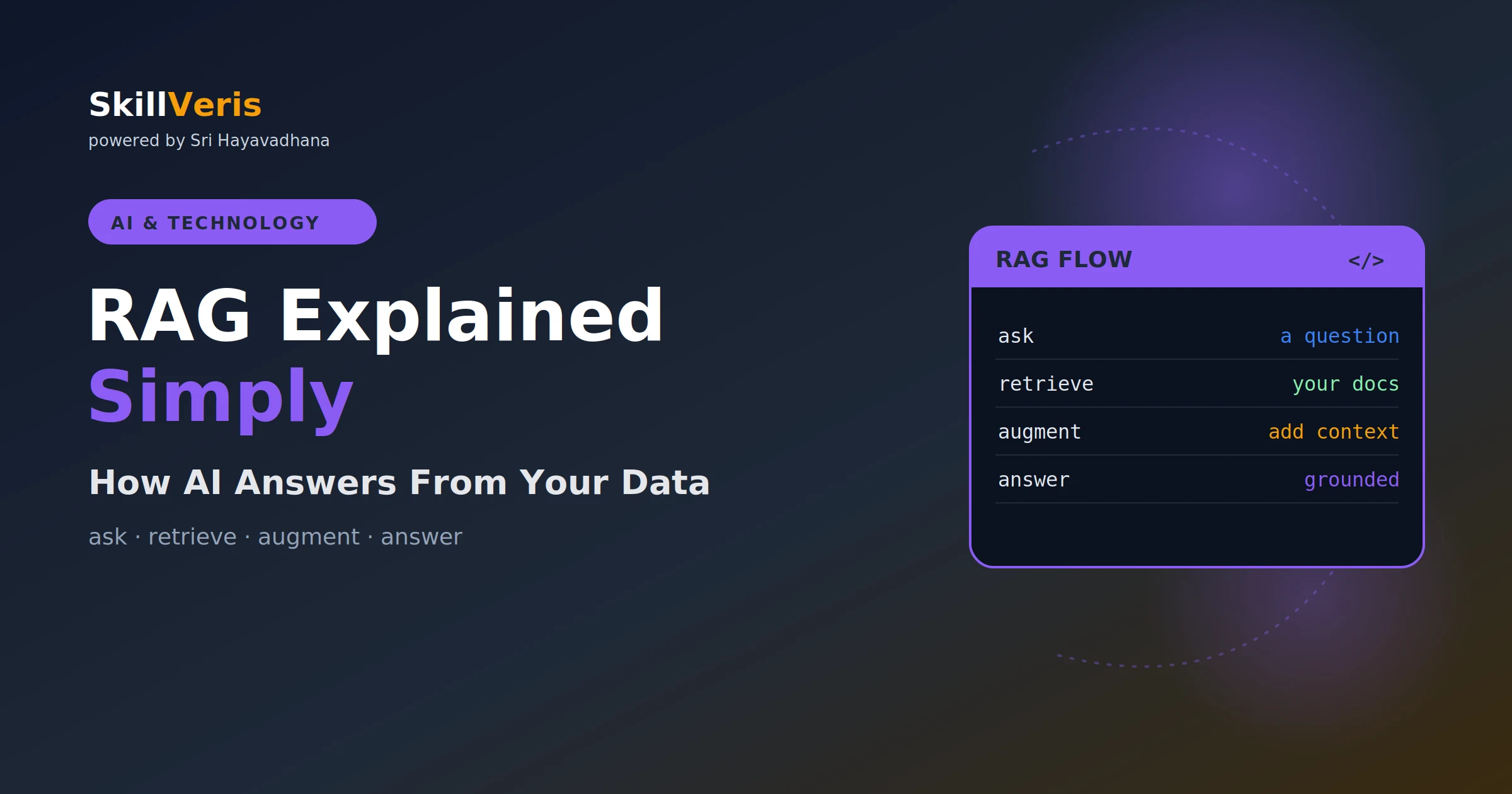
AI & Technology

RAG Explained: How AI Answers From Your Data

RAG lets AI answer from your private documents instead of just its training data — here's how it works.
Mar 29, 2026·8 min read
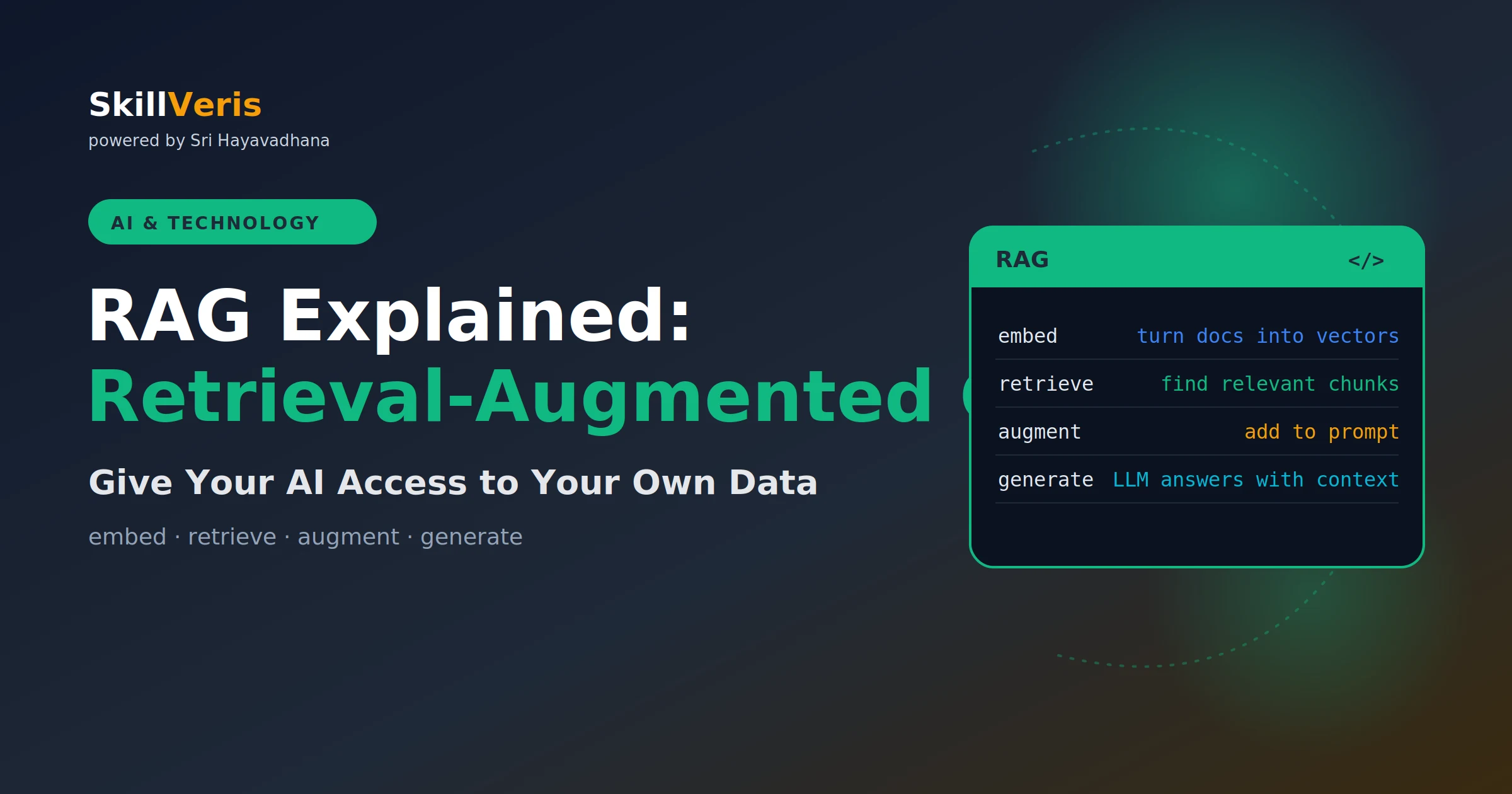
AI & Technology

RAG Explained: Retrieval-Augmented Generation

RAG is how you give an LLM access to your own private data without training a new model. This guide explains the full pipeline — chunking, embeddings, vector search, and augmented generation — with a working Python example using open-source tools.
Jun 5, 2026·11 min read
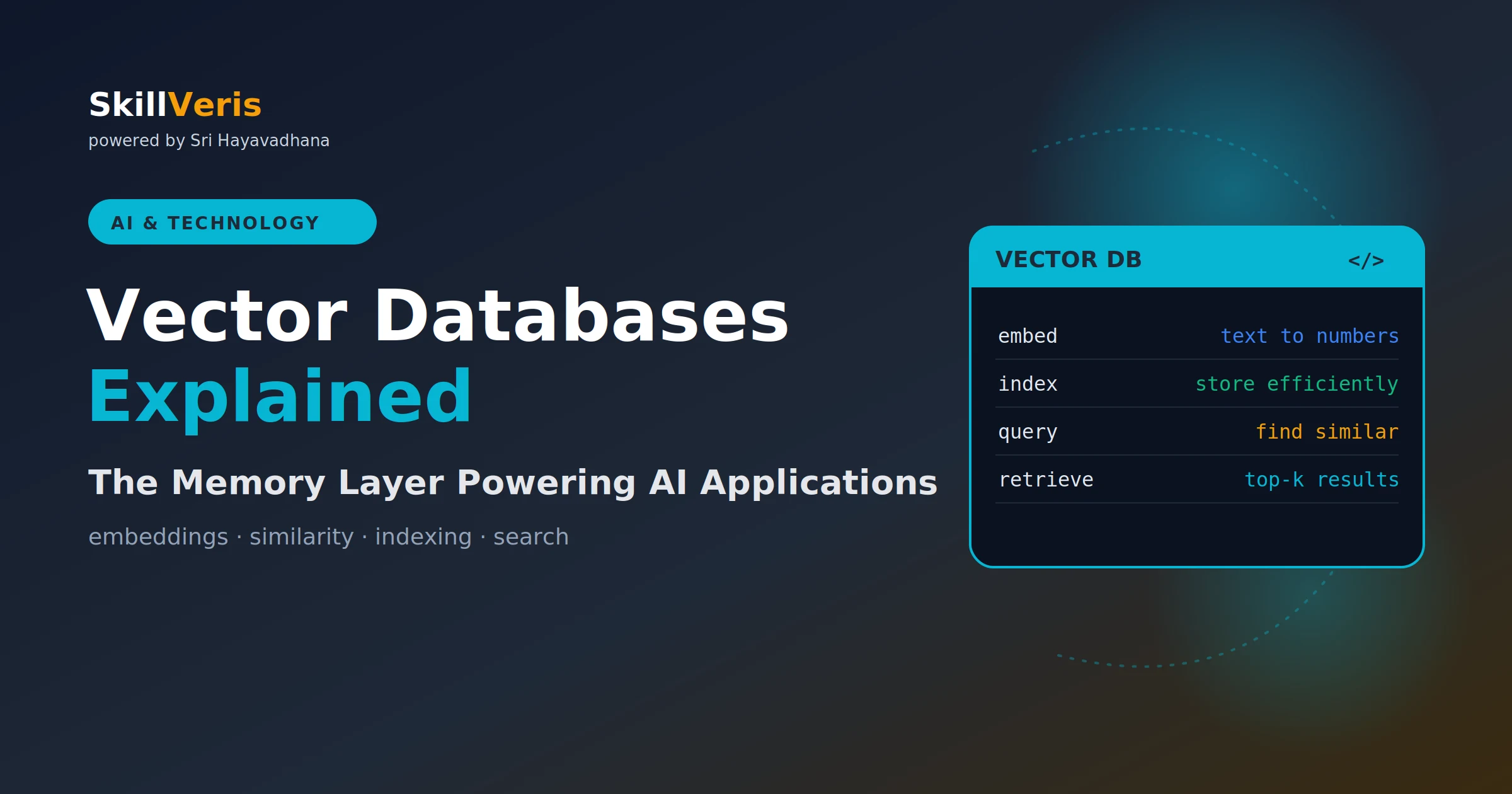
AI & Technology

Vector Databases Explained: The Memory Layer Powering AI Apps

Vector databases are the storage layer behind RAG systems, semantic search, and AI- powered recommendations. This guide explains what they are, how they differ from traditional databases, and how to choose and use one in a real application.
Jun 1, 2026·10 min read
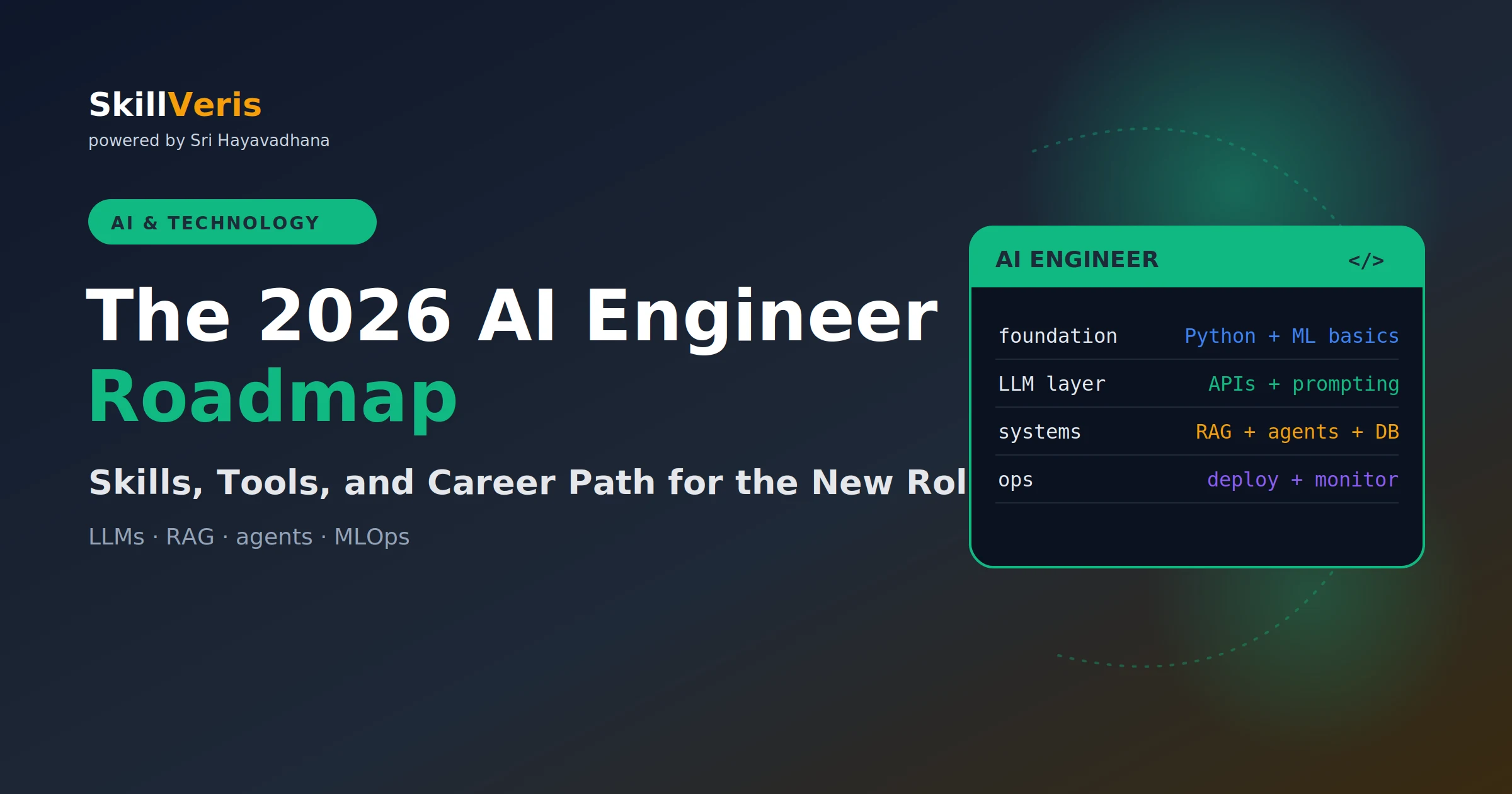
AI & Technology

The 2026 AI Engineer Roadmap: Skills, Tools, and Career Path

AI Engineer is one of the fastest-growing roles in tech — and it's more accessible than traditional ML engineering. This guide maps the exact skills, tools, and learning sequence for becoming an AI engineer in 2026, from Python basics to deploying production RAG and agent systems.
May 30, 2026·11 min read
AI & Technology

What Is Retrieval-Augmented Generation (RAG)? A Complete Guide

Learn what retrieval-augmented generation is, how RAG connects language models to your own data, and how to build reliable, source-grounded AI answers.
May 1, 2026·12 min read
AI & Technology

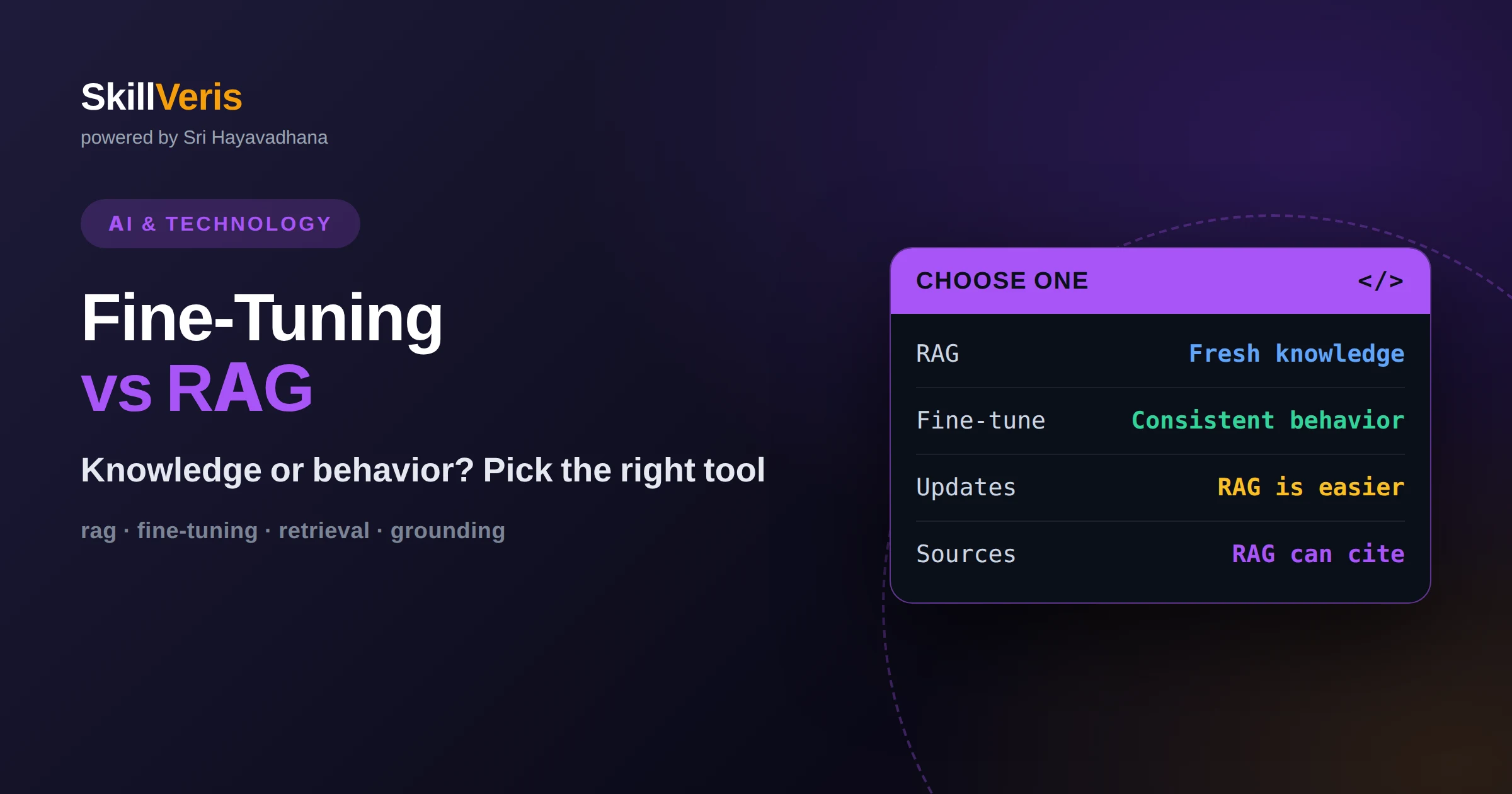
Fine-Tuning vs RAG: Which One Do You Actually Need?

Use RAG to give a model fresh, factual knowledge it can cite, and fine-tuning to teach it a consistent style or skill. Most real systems combine both.
Apr 20, 2026·12 min read
AI & Technology

Fine-Tuning vs RAG: Which Should You Use?

Use RAG to give a model fresh, factual knowledge and fine-tuning to teach it a style, format, or skill. Many systems combine both. Here is how to choose.
Jan 19, 2026·10 min read
AI & Technology

How to Reduce AI Hallucinations in Your Apps

Reduce AI hallucinations by grounding answers in real data with RAG, adding verification steps, and letting the model say 'I do not know'. Here is how.
Jan 18, 2026·7 min read
AI & Technology

What Is Retrieval-Augmented Generation in Practice

Retrieval-augmented generation grounds an LLM in your own documents, fetching relevant text at query time so answers stay accurate, current, and traceable to sources.
Oct 14, 2025·7 min read
AI & Technology

How to Build a RAG Pipeline Step by Step

Build a RAG pipeline in six steps: load documents, chunk them, embed and store the chunks, retrieve by similarity, assemble a grounded prompt, and generate a cited answer.
Oct 13, 2025·8 min read
Projects & Case Studies

Build a RAG Chatbot Over Your Own Documents

Build a RAG chatbot that answers from your own documents: chunk and embed your files, store vectors, retrieve relevant passages, and feed them to an LLM for grounded answers.
Mar 30, 2025·9 min read
AI & Technology

RAG Explained: How AI Answers From Your Own Data

RAG explained simply — learn how retrieval-augmented generation lets AI answer from your own data with grounded, cited responses instead of guesses.
Feb 10, 2025·12 min read
AI & Technology

How to Fine-Tune a Model Without Breaking the Bank

Learn how to fine-tune a model without breaking the bank — when to fine-tune vs prompt or use RAG, plus cheap techniques like LoRA and free ways to start.
Feb 8, 2025·12 min read
AI & Technology

Vector Databases: A Practical Beginner Walkthrough

A practical beginner walkthrough of vector databases: how embeddings and similarity search work, and why retrieval-augmented generation depends on them.
Feb 6, 2025·11 min read
AI & Technology

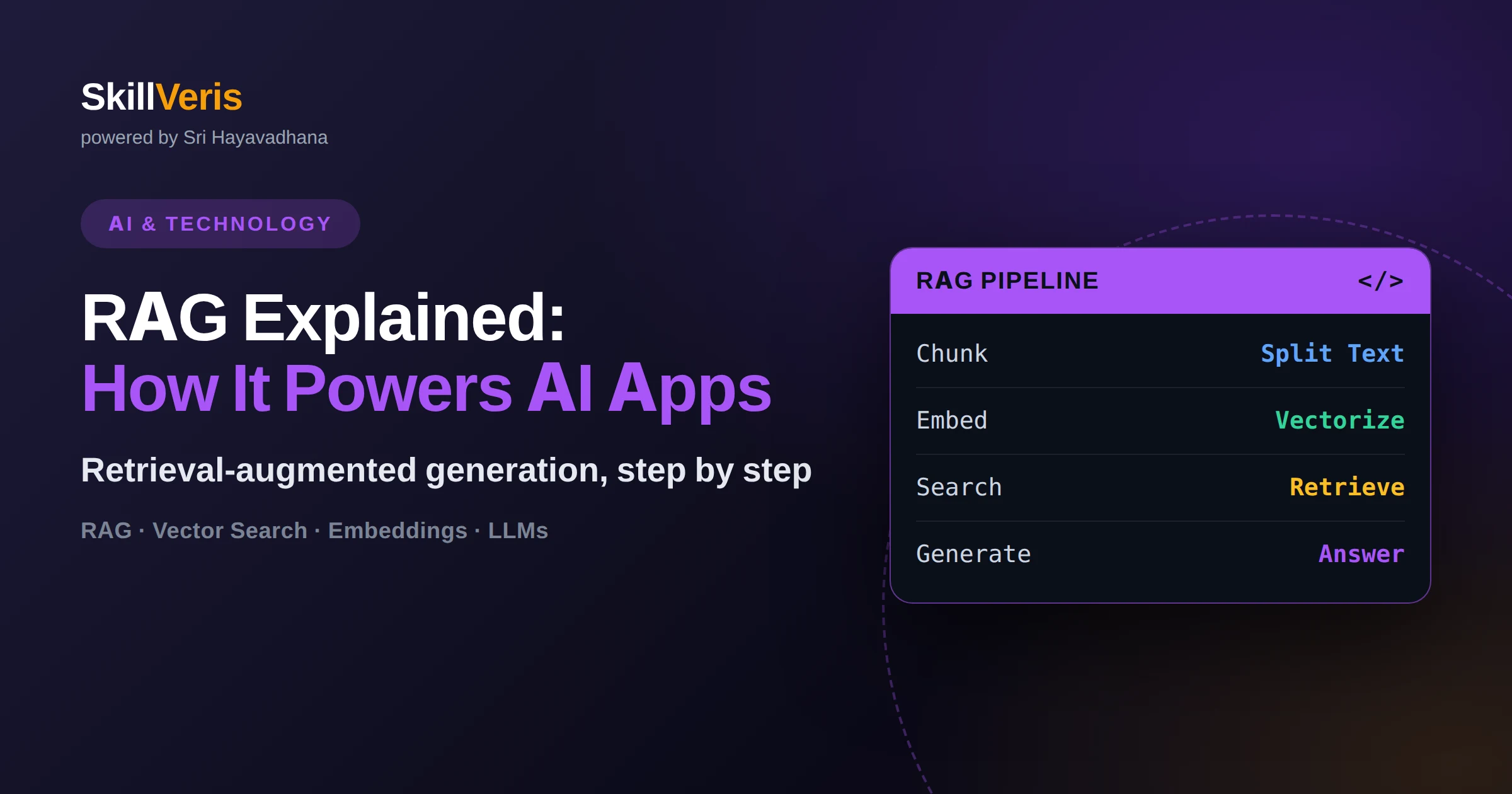
RAG Explained: How It Powers AI Apps

RAG grounds an LLM's answers in retrieved documents at query time, fixing hallucinations and stale knowledge without retraining the model.
Dec 13, 2024·10 min read
AI & Technology

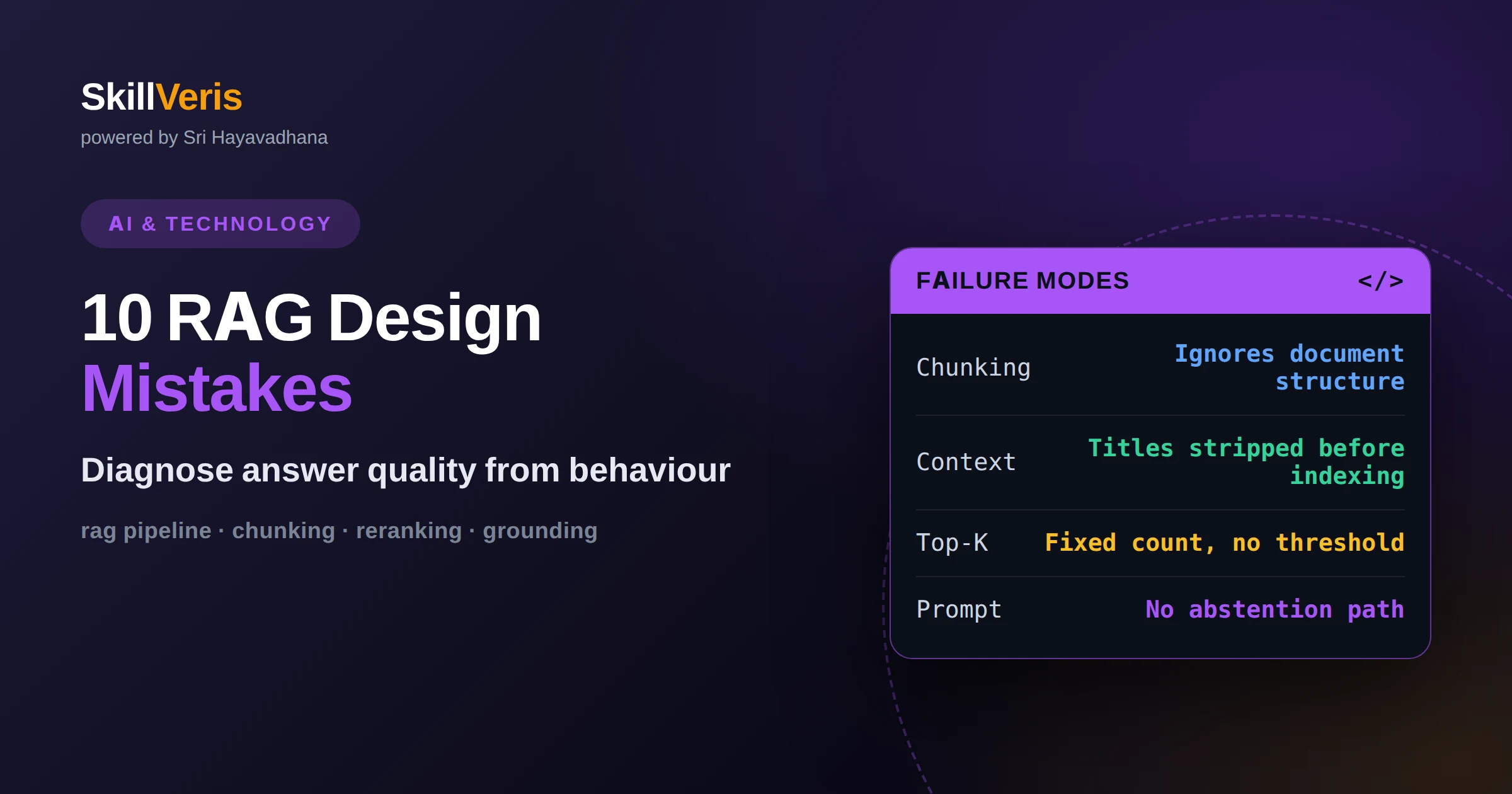
RAG Systems: A Practical Architecture Guide

A retrieval-augmented generation system is five stages — ingestion, indexing, retrieval, reranking and generation — and answer quality is set by the weakest one. This guide walks each stage, the decisions inside it, the failure it produces when it goes wrong, and how to measure the stages separately.
Jul 28, 2023·12 min read
AI & Technology

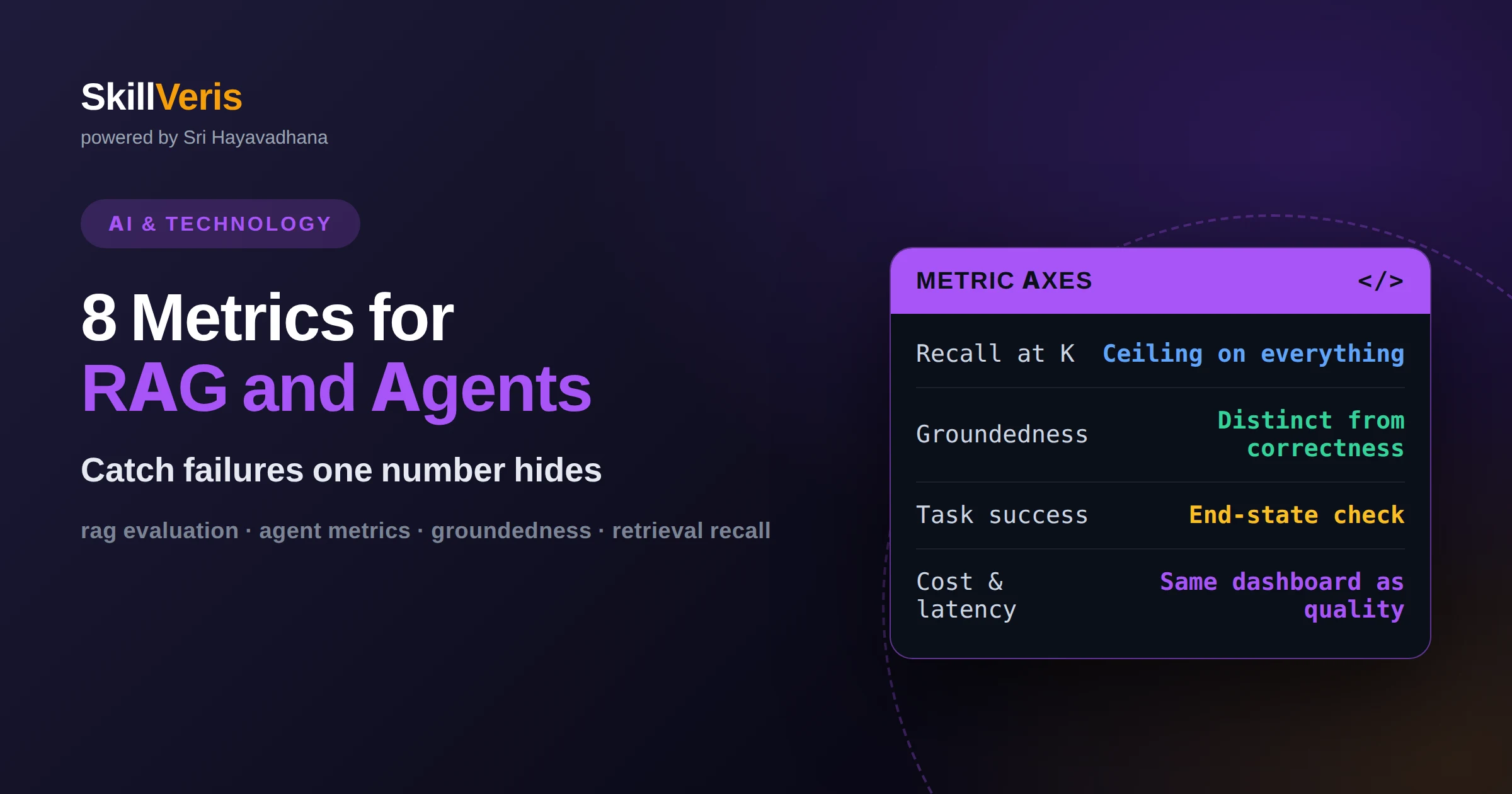
10 RAG Design Mistakes That Quietly Hurt Answer Quality

Most RAG quality problems are design errors, not model errors, and each one produces a recognisable symptom. This walks through ten recurring mistakes — from chunking that severs context to prompts that never tell the model what to do with weak evidence — and names the symptom each produces so you can diagnose from behaviour.
Jun 23, 2023·10 min read
AI & Technology

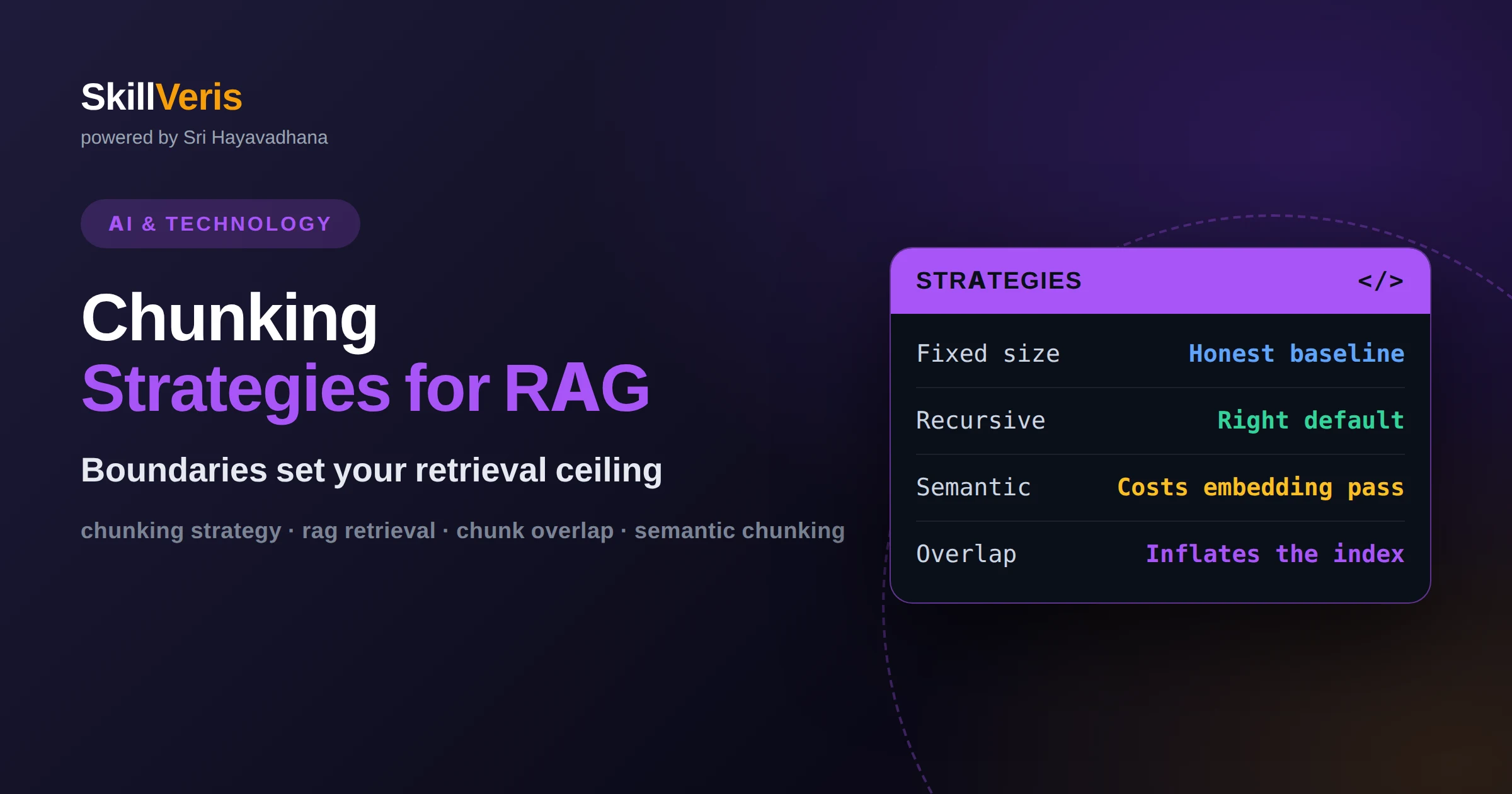
8 Metrics for Evaluating RAG and Agent Systems

No single metric tells you whether a RAG or agent system works, because retrieval, grounding, task completion and cost fail independently. These eight metrics cover the distinct failure modes, what each one catches that the others miss, and how to compute each on your own data.
Jun 19, 2023·9 min read
AI & Technology

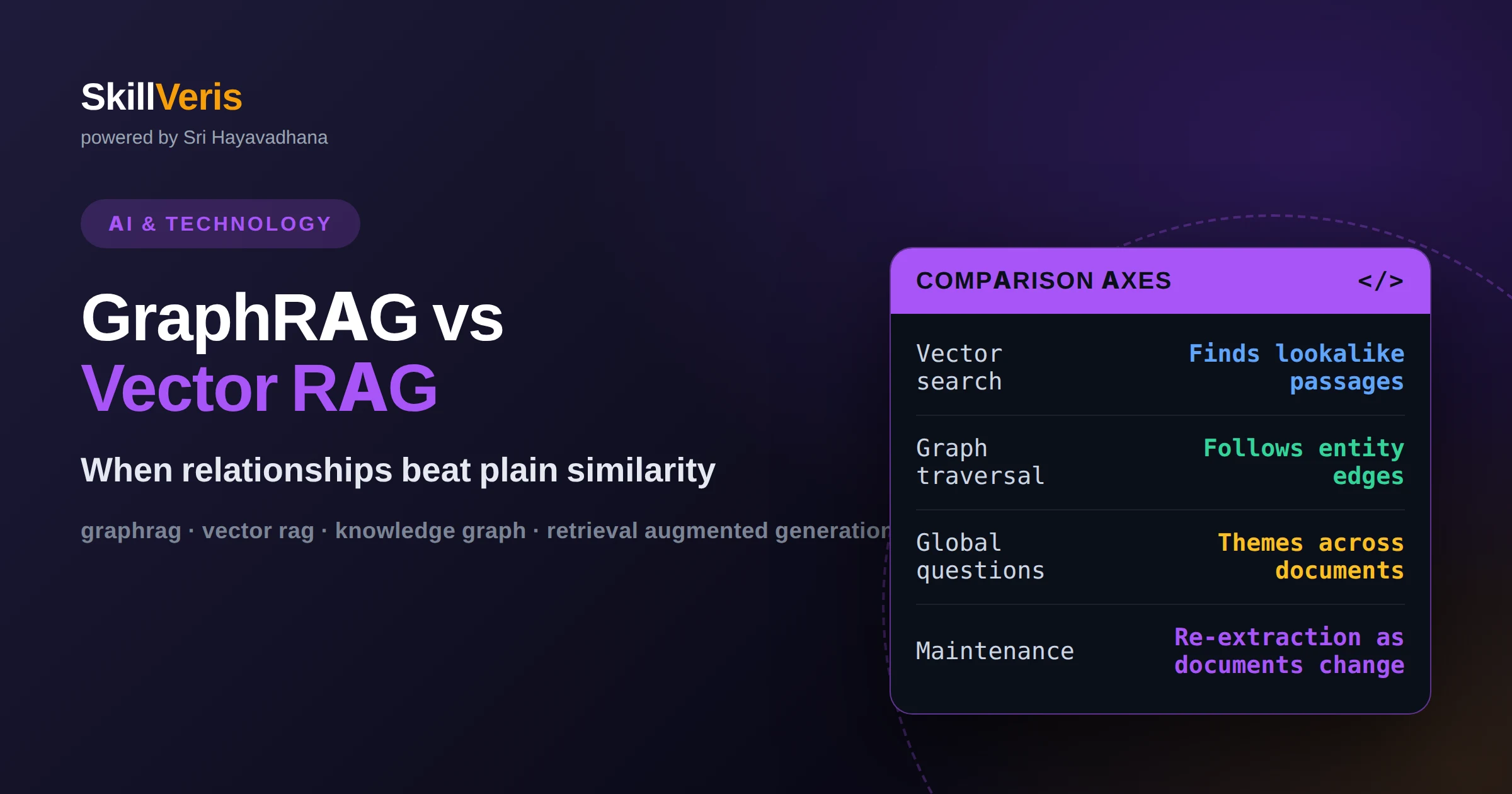
Chunking Strategies for RAG: Fixed, Recursive and Semantic

Fixed-size chunking is the fastest baseline, recursive splitting respects document structure, and semantic chunking pays off only on unstructured prose. This compares the three on retrieval quality, shows where overlap earns its cost, and gives you an evaluation loop to decide on your own corpus.
Jun 12, 2023·9 min read
AI & Technology

GraphRAG vs Vector RAG: When Relationships Beat Similarity

Vector RAG retrieves passages that look like the question; GraphRAG retrieves entities and the edges between them. This article compares the two on multi-entity and aggregation questions, on build and maintenance cost, and gives a test for deciding which your corpus actually needs.
Jun 3, 2023·10 min read
AI & Technology

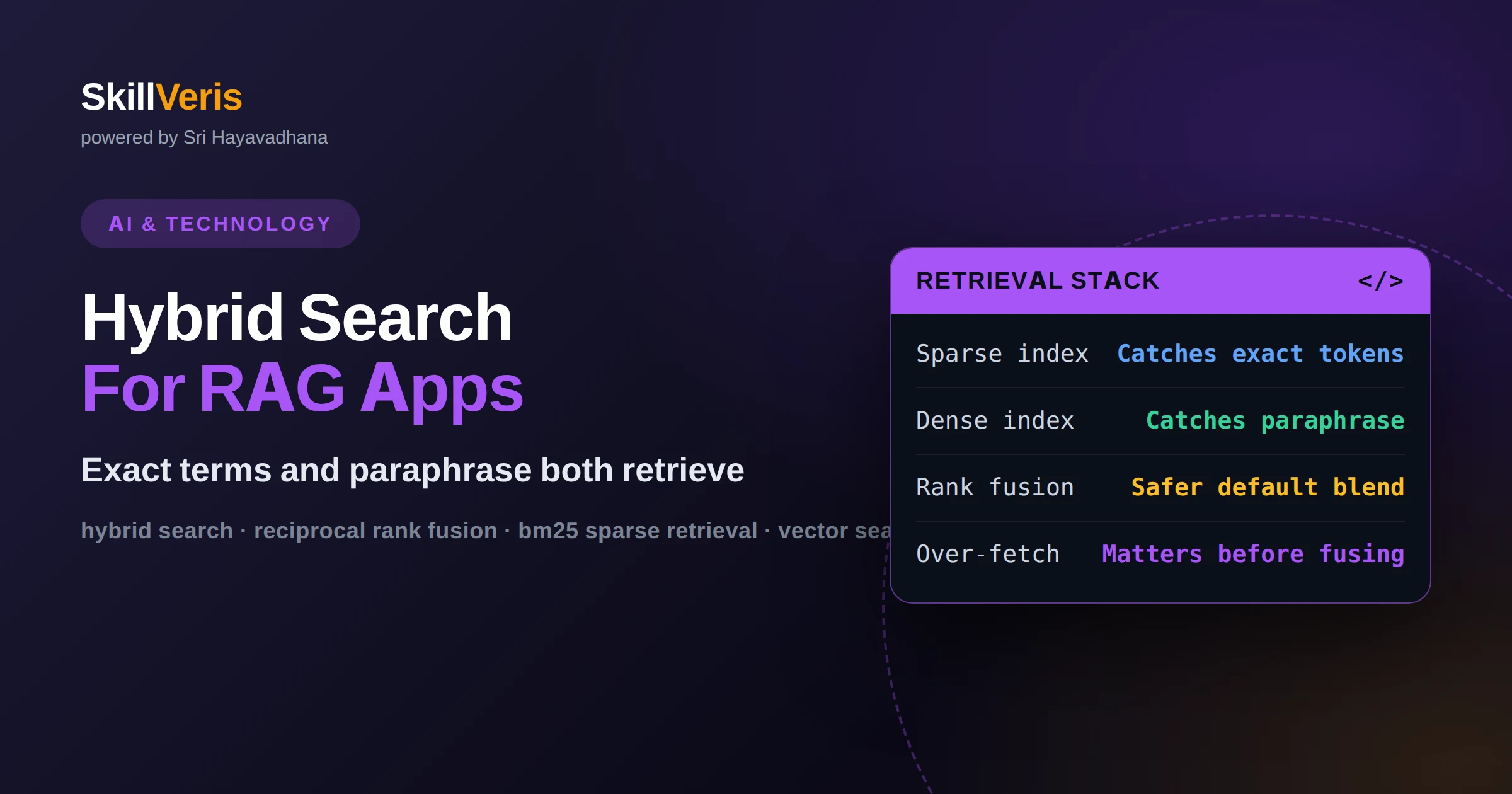
How to Add Hybrid Search to a RAG Application

Hybrid search runs a keyword index and a vector index over the same corpus and fuses their rankings, so exact identifiers and loose paraphrases both retrieve. This covers building both indexes, choosing between score fusion and rank fusion, and tuning the blend against a labelled query set.
May 26, 2023·9 min read
AI & Technology

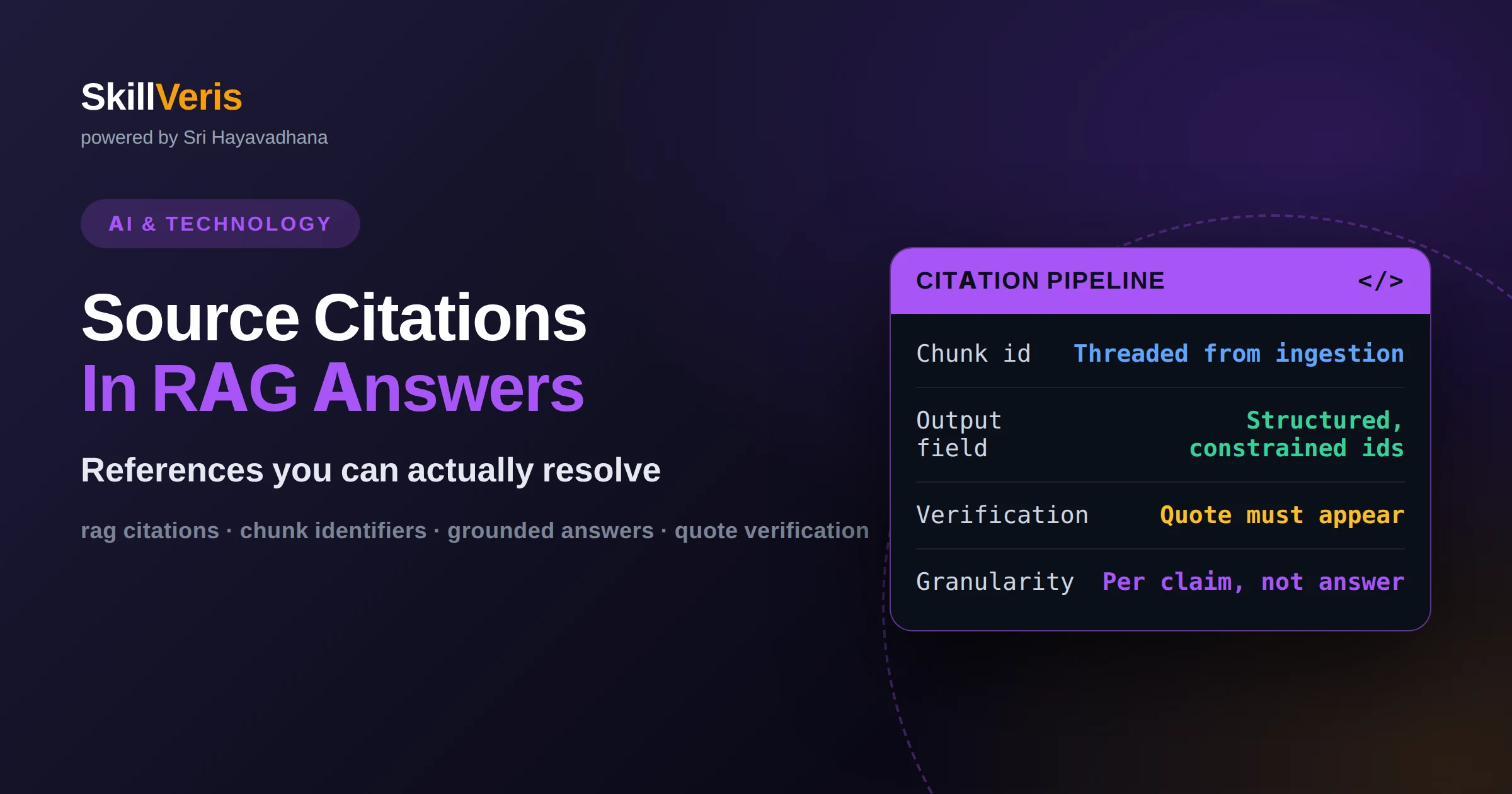
How to Add Source Citations to RAG Answers

Reliable citations come from threading a stable chunk identifier through retrieval into the prompt, asking for it back in a structured field, and then verifying the quoted span actually appears in that chunk. Anything less produces plausible references that point at the wrong document.
May 25, 2023·8 min read
AI & Technology

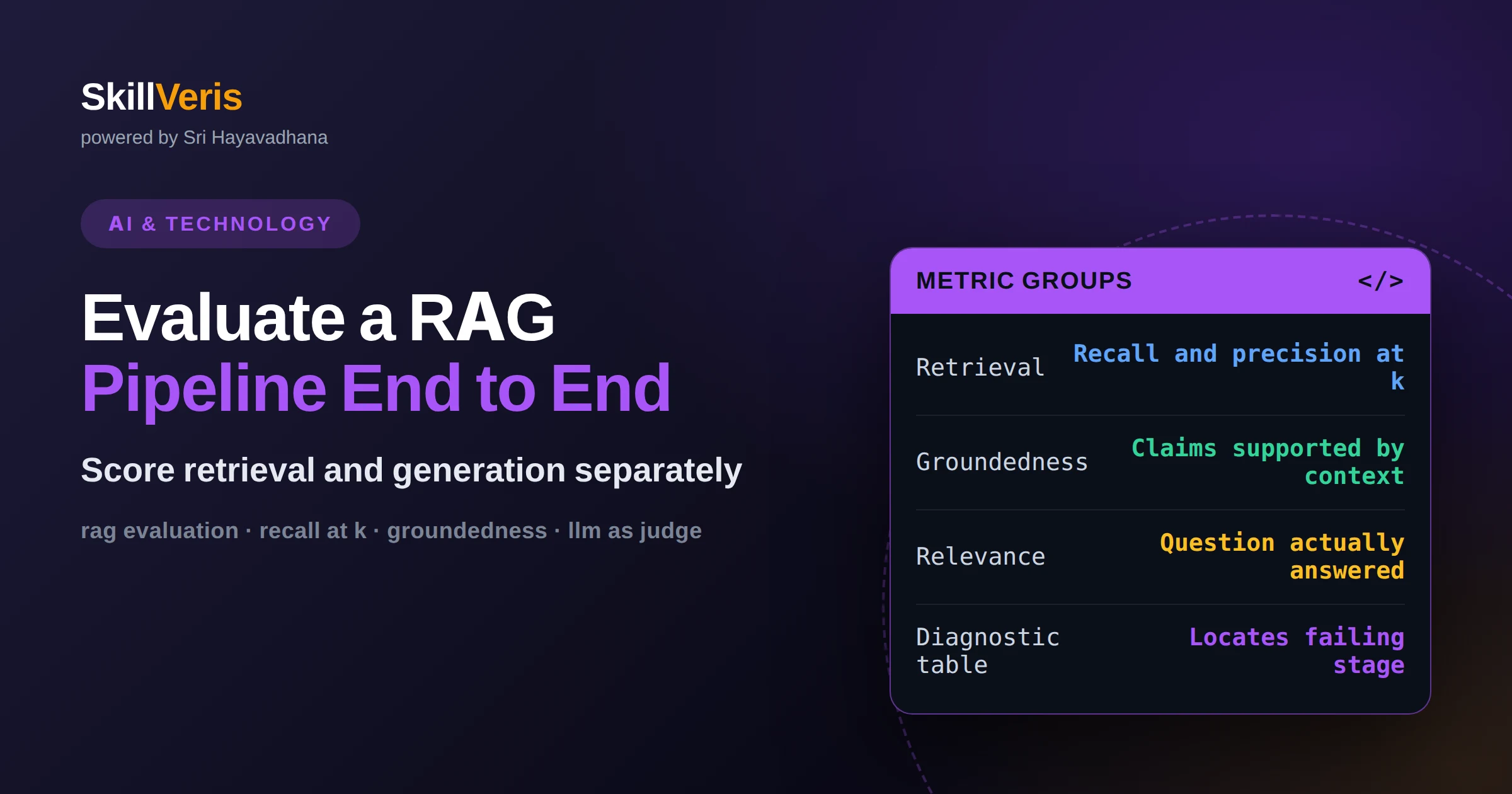
How to Evaluate a RAG Pipeline End to End

Evaluate a RAG pipeline by scoring retrieval and generation separately, because a bad answer has two possible causes and one number cannot tell them apart. This article sets out the retrieval metrics, the answer metrics, and the diagnostic table that tells you which stage to fix.
May 14, 2023·9 min read
AI & Technology

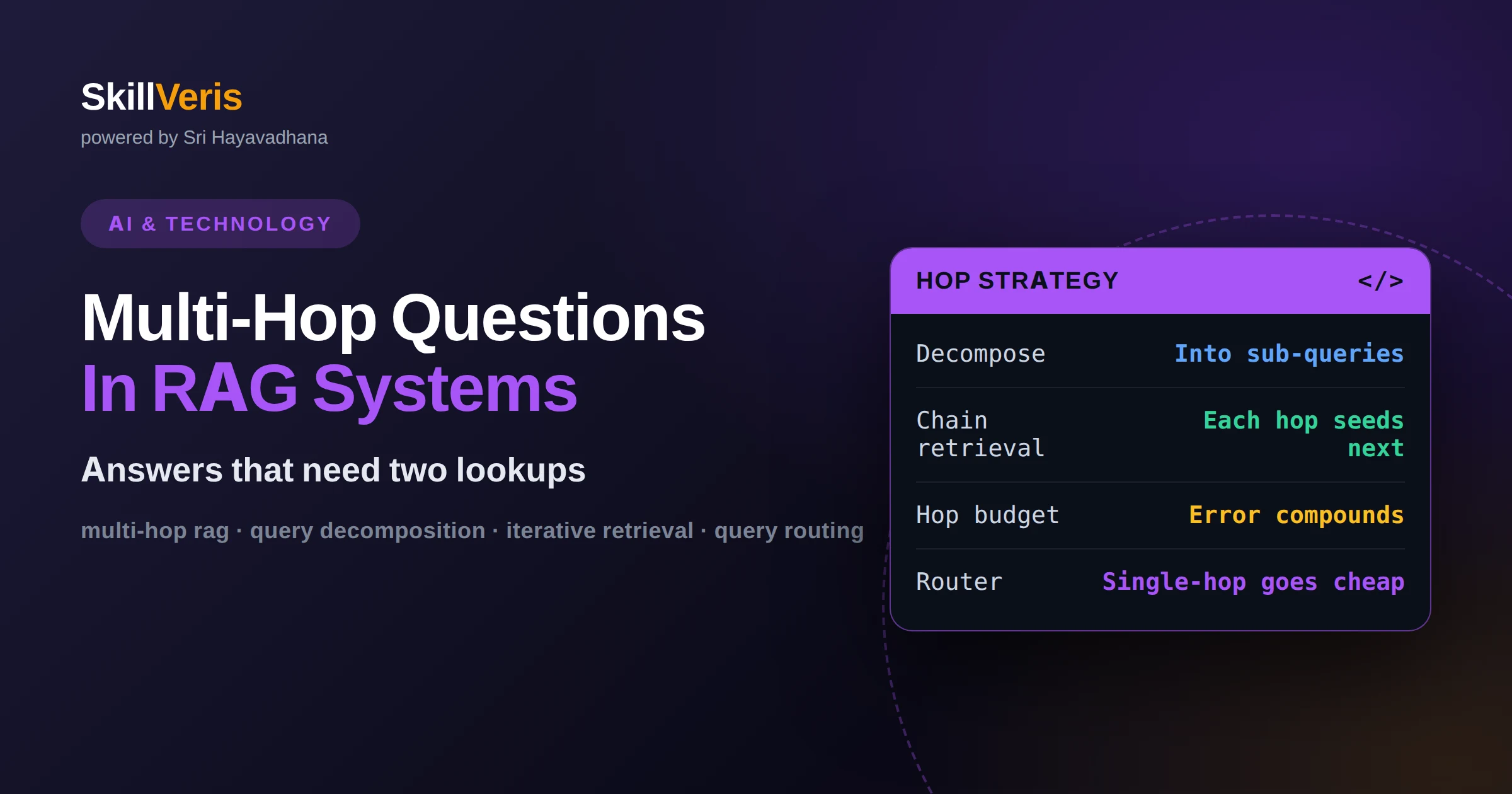
How to Handle Multi-Hop Questions in a RAG System

Multi-hop questions fail in standard RAG because the second document is only findable once you know the answer to the first hop. You fix it by decomposing the question into sub-queries, retrieving iteratively so each hop's answer seeds the next, and stopping on an explicit budget rather than when the model feels finished.
May 9, 2023·8 min read
AI & Technology

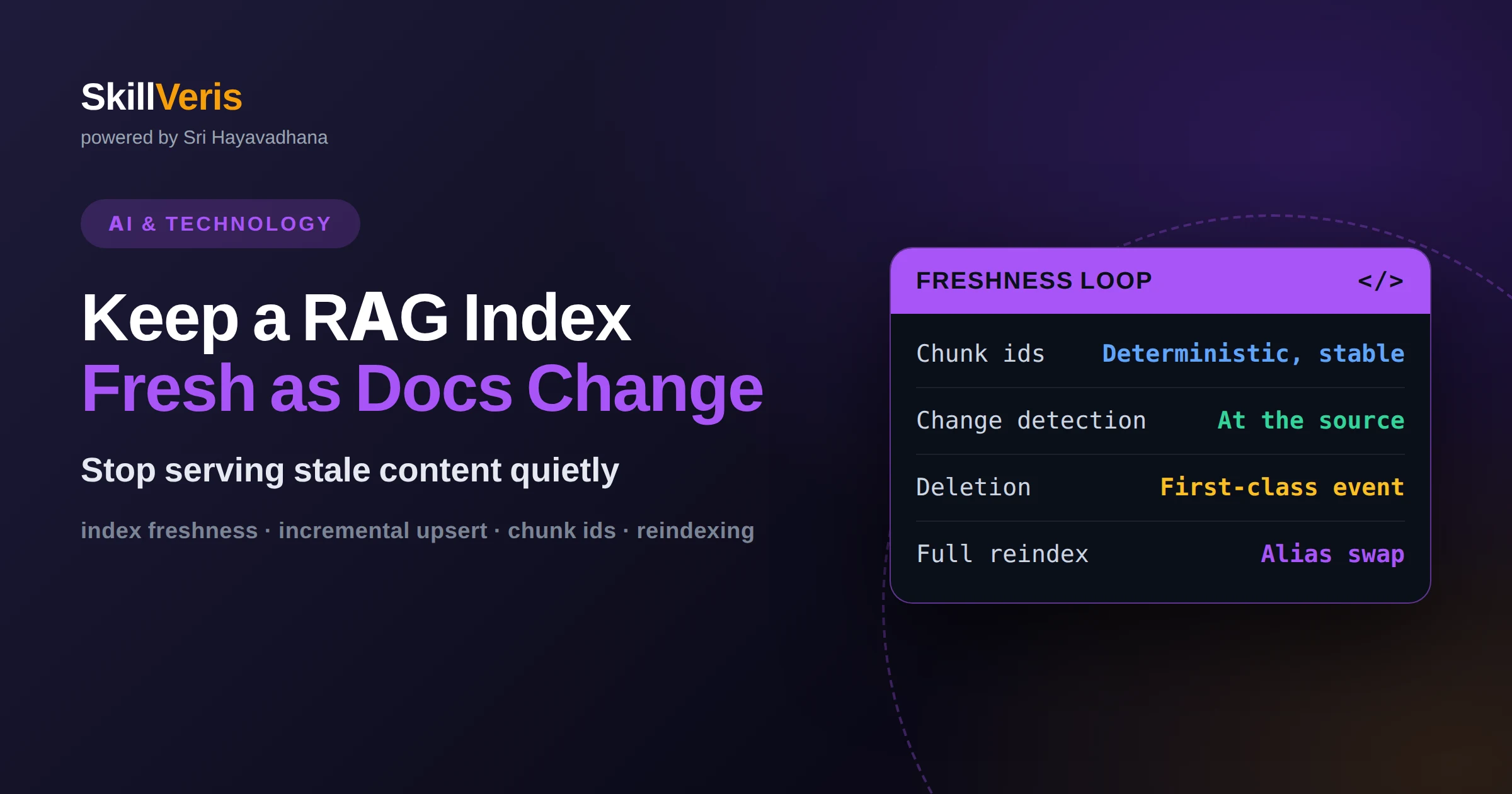
How to Keep a RAG Index Fresh as Documents Change

Keep a RAG index fresh by detecting change at the source, upserting only affected chunks with stable identifiers, and propagating deletions as first-class events. This covers change detection, deterministic chunk IDs, tombstoning, reindex triggers and the monitoring that tells you when stale content is still being served.
May 8, 2023·9 min read
AI & Technology

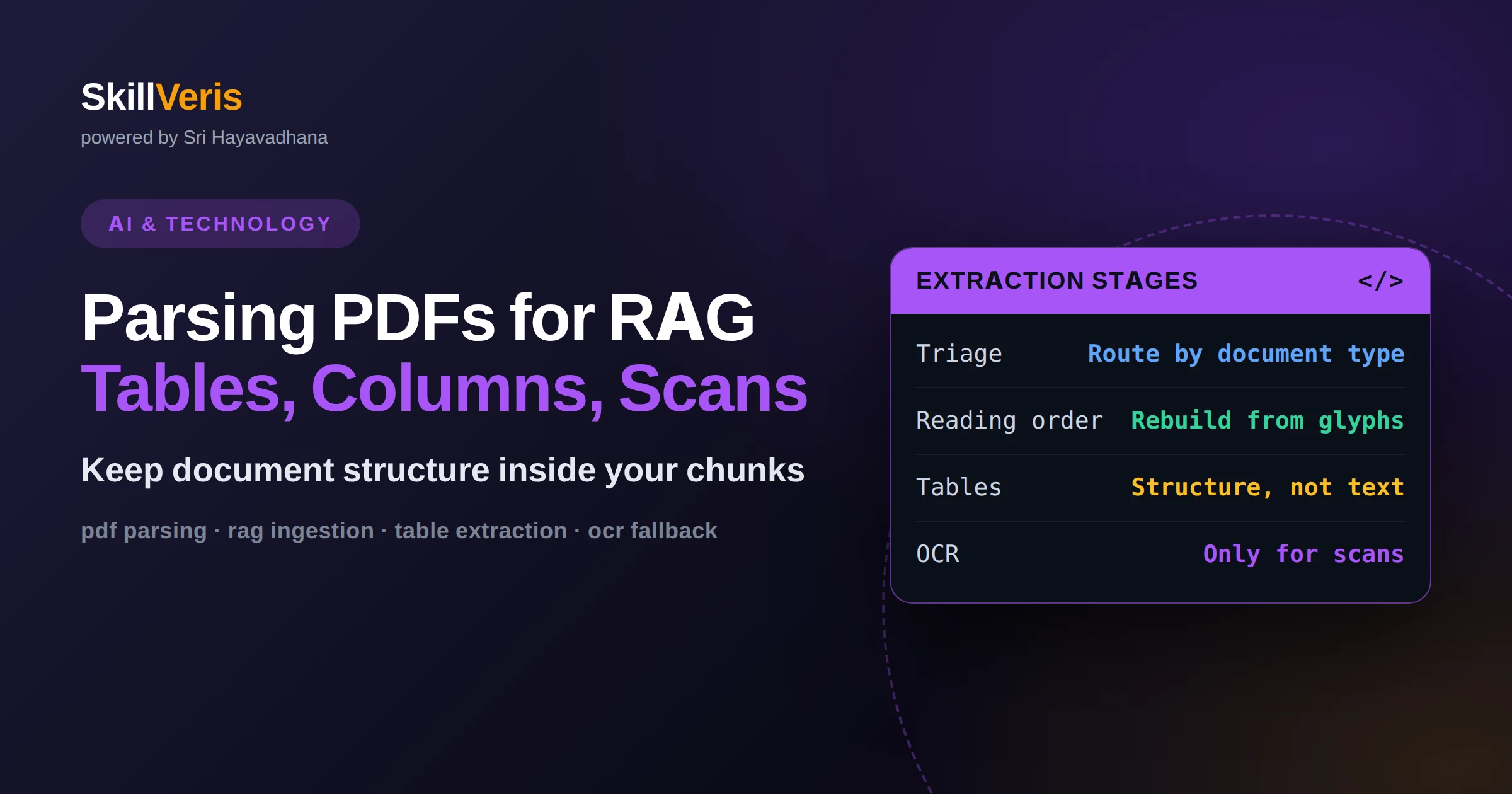
How to Parse PDFs for RAG: Tables, Columns and Scans

PDFs carry no reading order, so naive text extraction interleaves columns and flattens tables into unusable strings. This shows how to route documents by type, extract with layout awareness, keep table structure, and fall back to OCR for scans — so structure survives into your chunks.
May 3, 2023·9 min read
AI & Technology

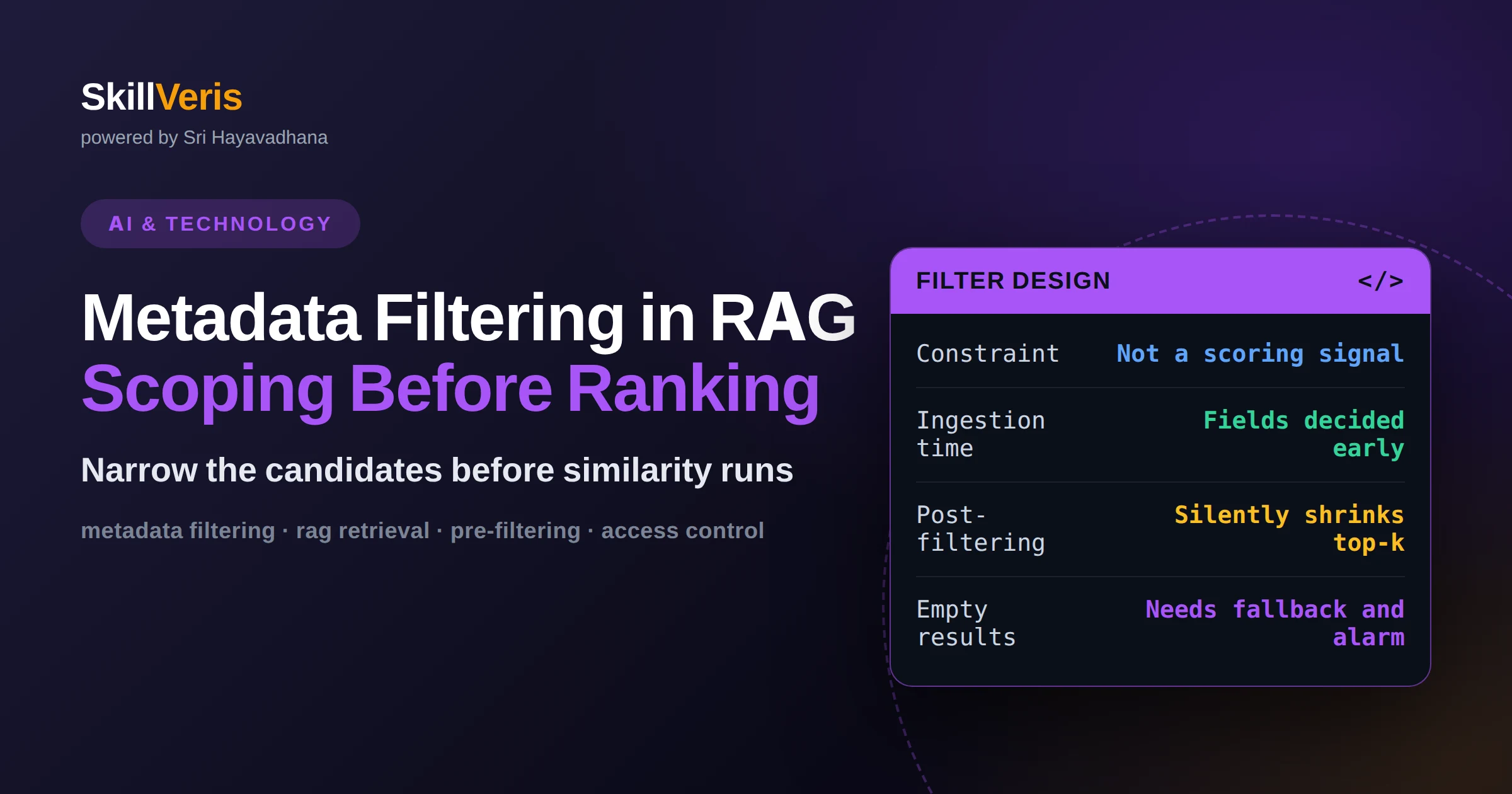
Metadata Filtering in RAG: Scoping Search Before Ranking

Metadata filtering narrows the candidate set before similarity ranking runs, so the retriever only ever sees chunks the user is allowed to read and that are current enough to trust. This guide covers which fields to capture at ingestion, how pre-filtering differs from post-filtering, and how to keep filters from silently emptying results.
Apr 18, 2023·8 min read
AI & Technology

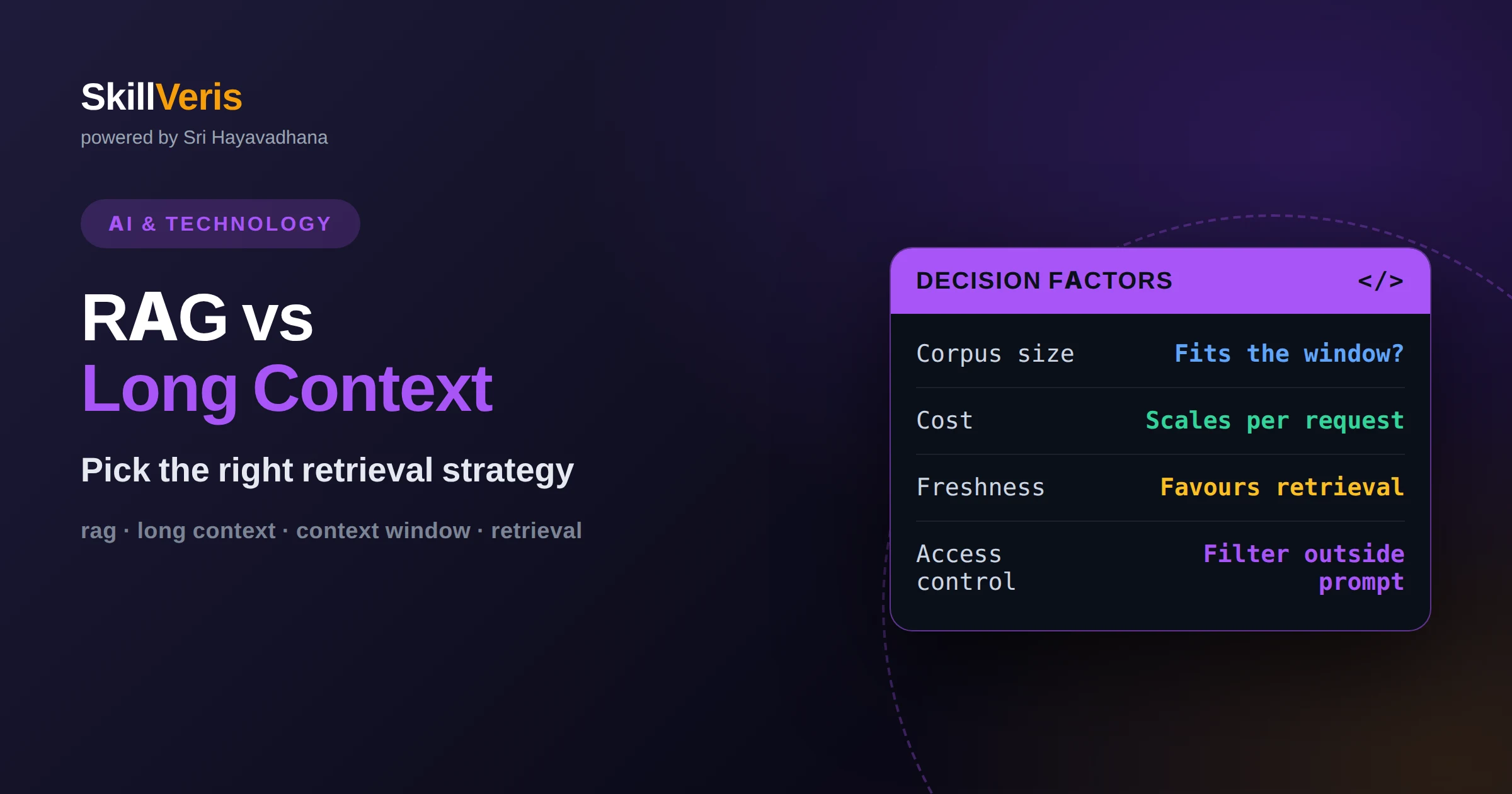
RAG vs Long-Context Prompting: Which to Reach For

Reach for long-context prompting when the relevant material is small, stable and fits comfortably in the window; reach for retrieval when the corpus is larger than the window, changes often, or must be filtered per user. The decision is driven by corpus size, update rate and cost per request, not by which approach is newer.
Apr 9, 2023·8 min read
AI & Technology

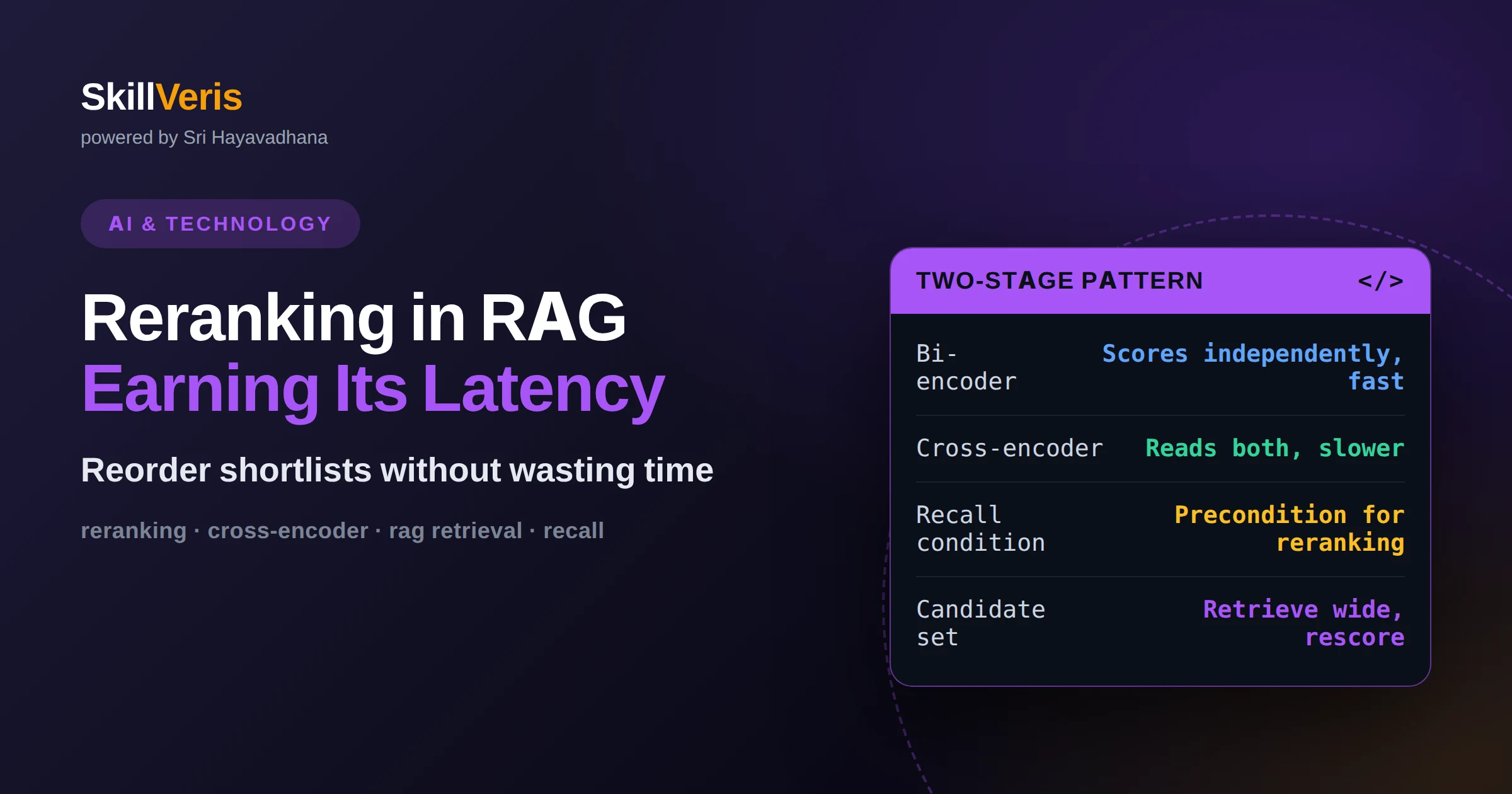
Reranking in RAG: When a Cross-Encoder Earns Its Latency

A cross-encoder reranker earns its latency when your first-stage retriever has high recall at a wide k but poor ordering in the top few. This article explains the two-stage pattern, the recall condition that makes reranking worthwhile, and how to measure whether it is paying for itself.
Apr 7, 2023·8 min read
AI & Technology

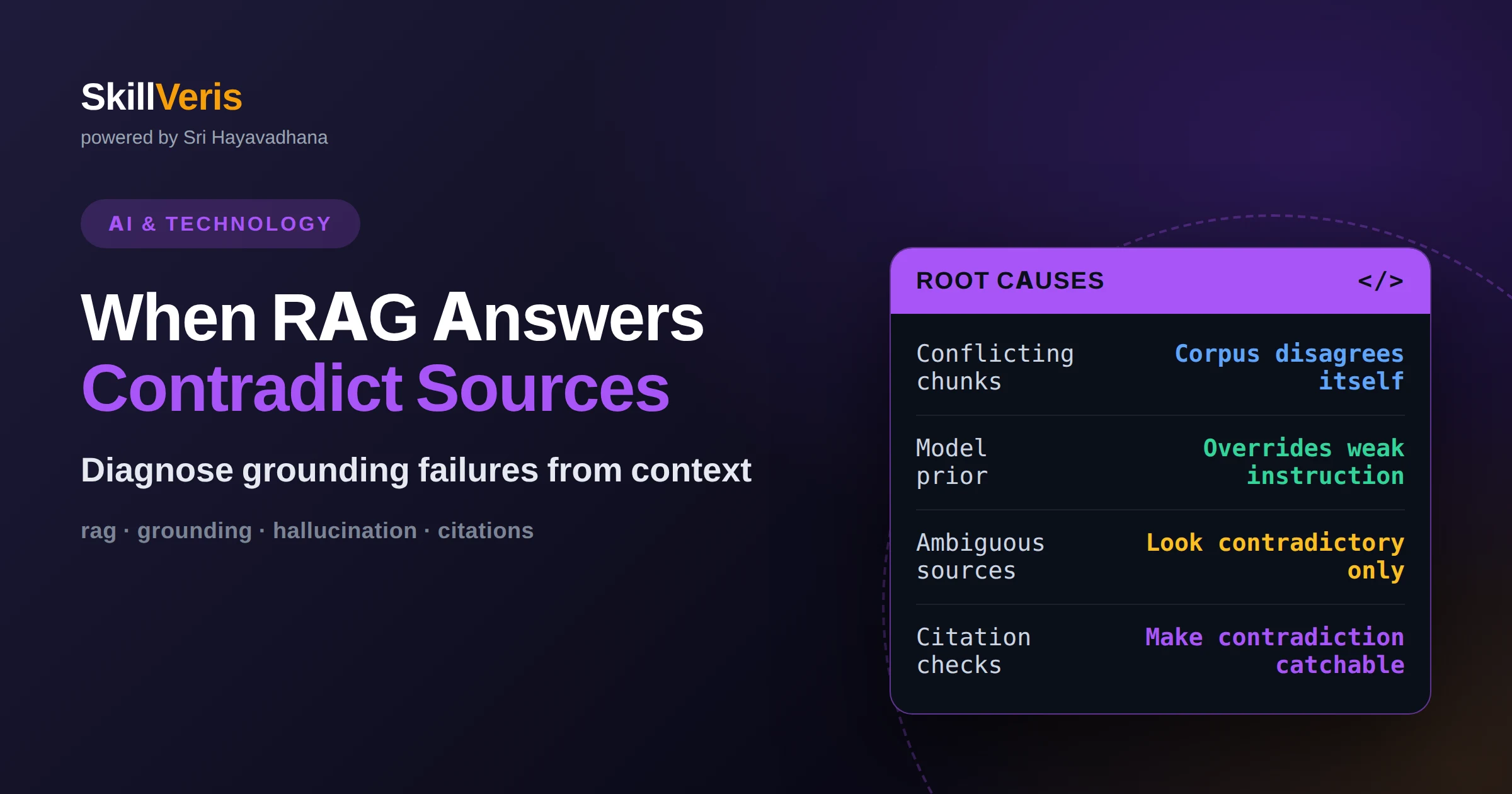
Why RAG Answers Contradict the Retrieved Sources

A RAG answer contradicts its own sources for three reasons: the retrieved chunks disagree with each other, the grounding instruction is too weak to override the model's prior, or the source itself is stale or ambiguous. Diagnosing which one is in play requires reading the actual context, not the answer.
Mar 25, 2023·8 min read
AI & Technology

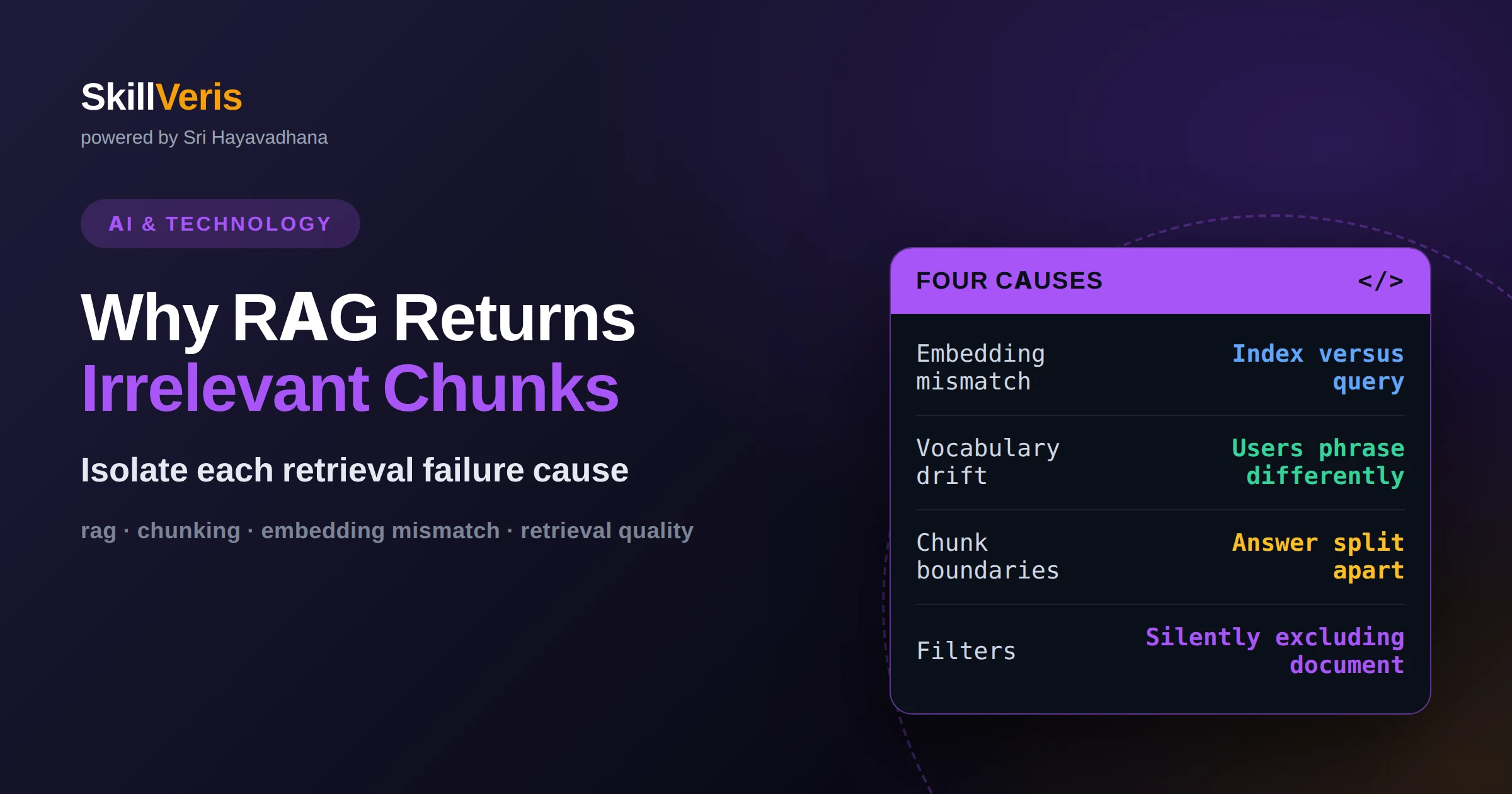
Why Your RAG Pipeline Returns Irrelevant Chunks

Irrelevant retrieval has four common causes: an embedding mismatch between query and index, chunk boundaries that split the answer, vocabulary drift between how users ask and how documents phrase, and a filter or index setting quietly excluding the right document. Here is a check that isolates each.
Mar 18, 2023·9 min read
AI & Technology

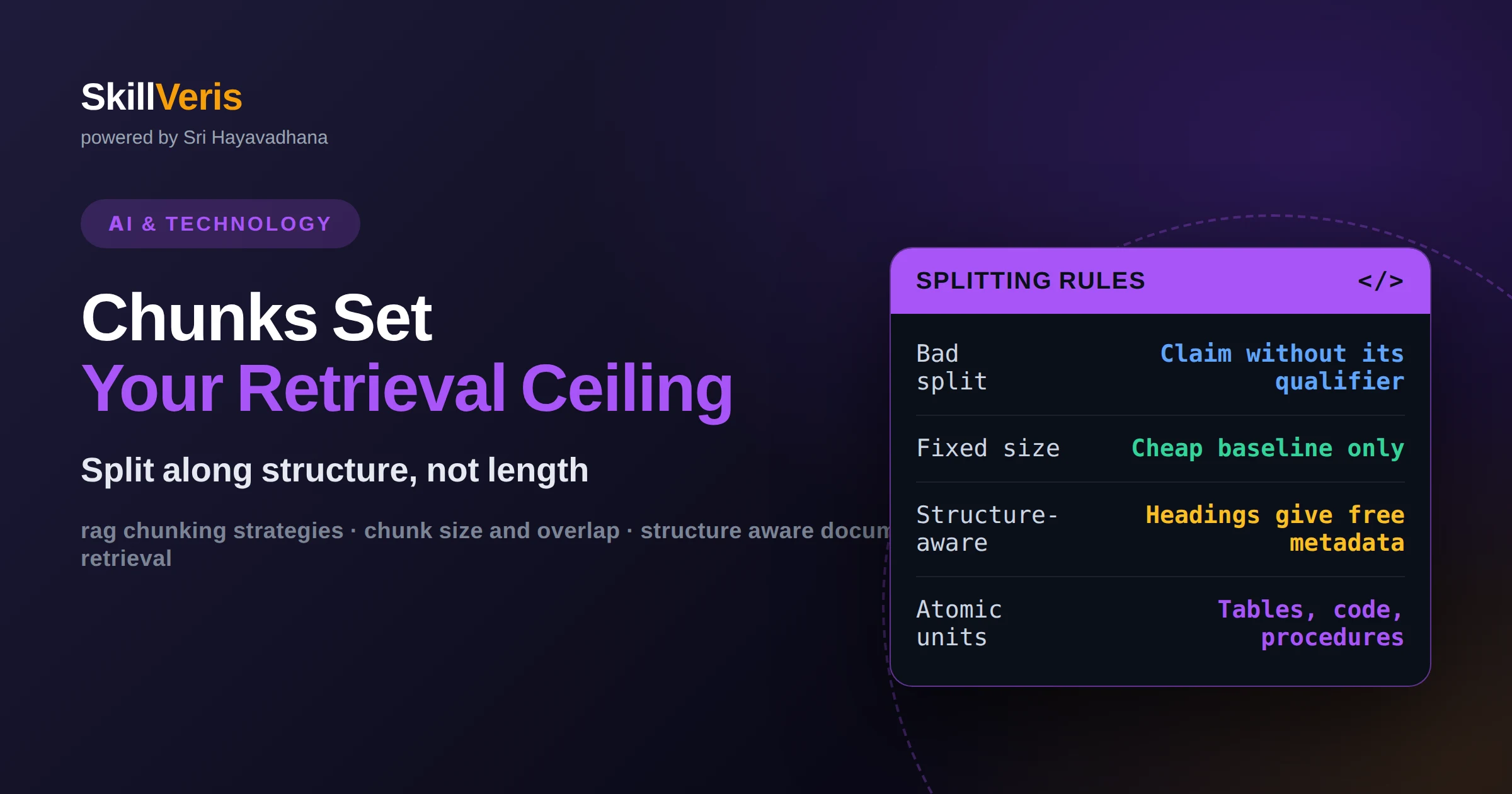
Chunking strategies for RAG: size, overlap and structure-aware splitting

Chunking sets your retrieval ceiling. Learn structure-aware splitting, overlap, metadata enrichment and how to measure whether your chunks contain whole answers.
Oct 15, 2022·9 min read
AI & Technology

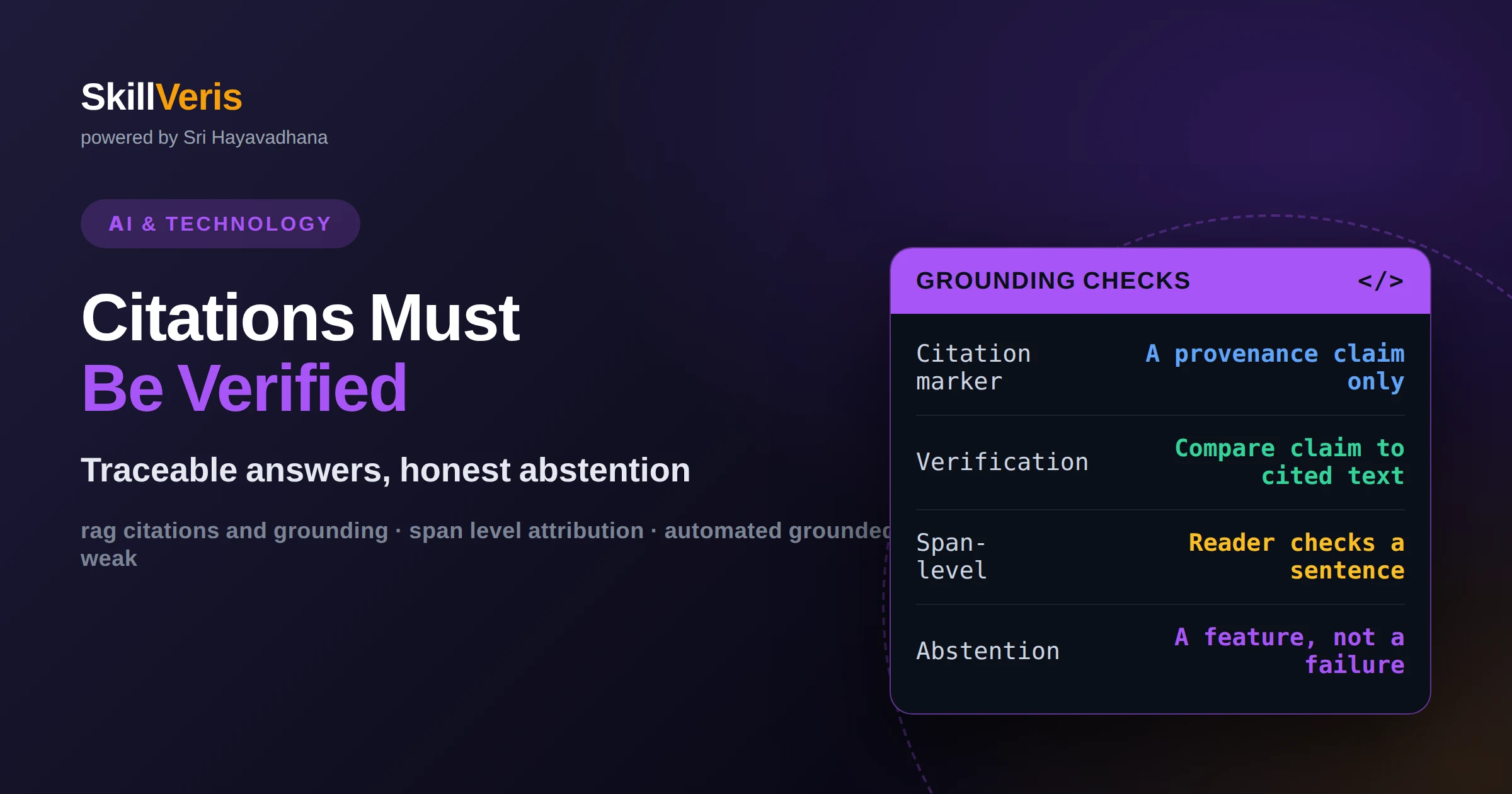
Grounding and citations in RAG: making answers traceable

Models will cite plausibly for unsupported claims. Learn citation formats, span attribution, automated groundedness checks and how to handle insufficient context.
Oct 5, 2022·9 min read
AI & Technology

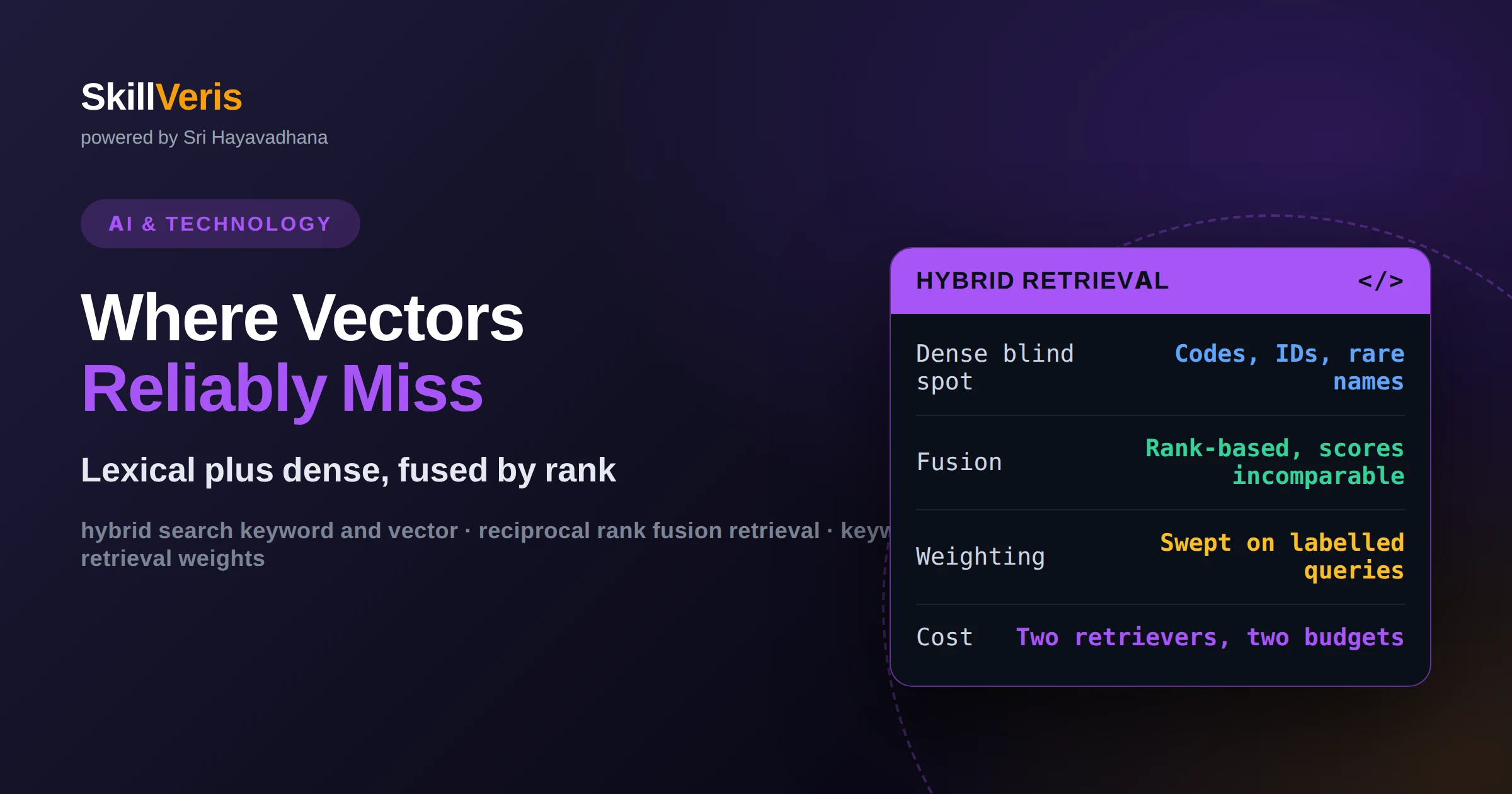
Hybrid search for RAG: combining keyword and vector retrieval

Dense retrieval misses codes, identifiers and rare names. Learn to combine lexical and vector search, fuse the rankings properly, and tune weighting with evidence.
Sep 29, 2022·9 min read
AI & Technology

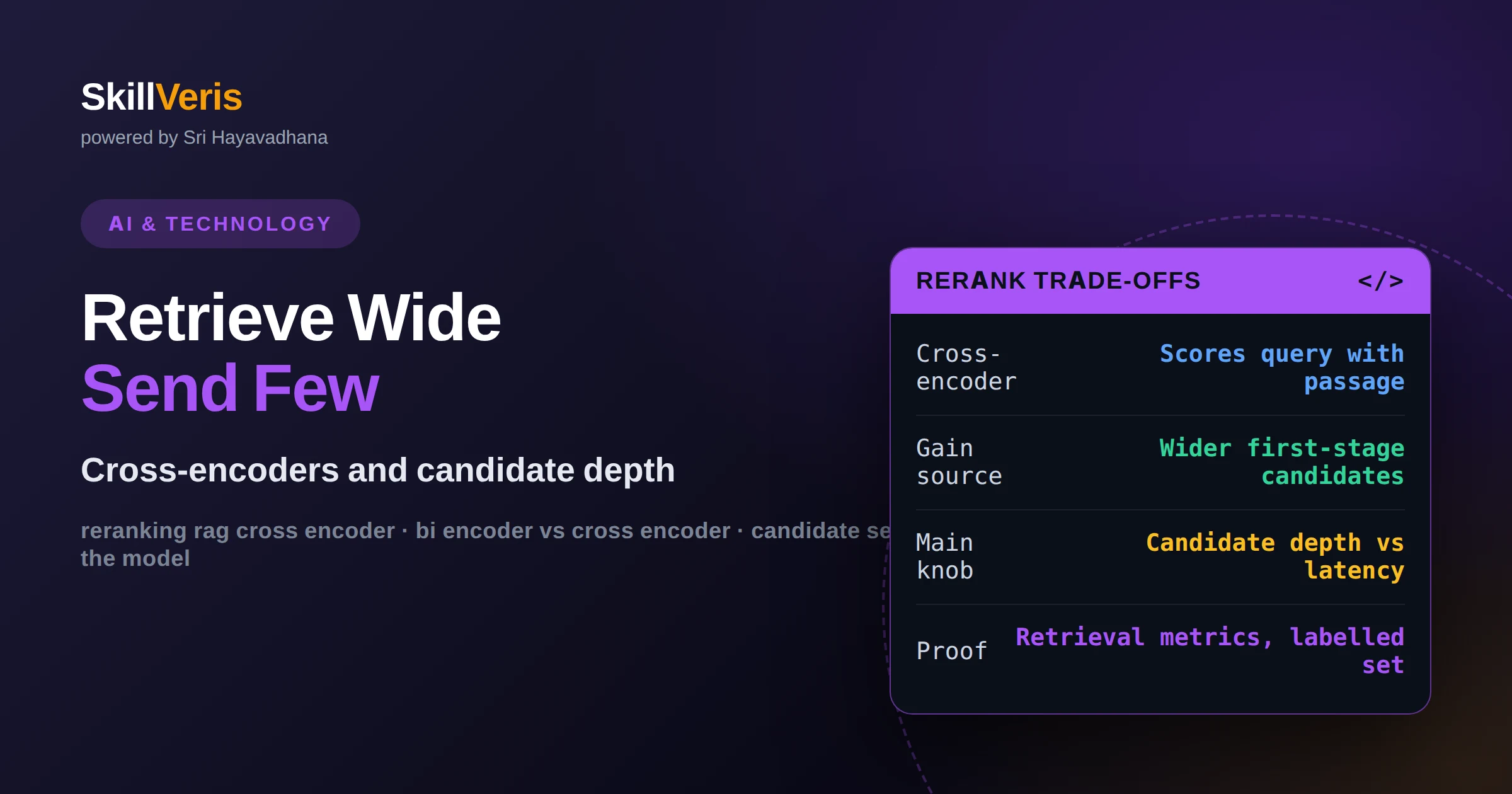
Reranking in RAG: cross-encoders, cost and how far to widen retrieval

Reranking lets you retrieve wide and send few passages. Learn candidate-set sizing, cross-encoder trade-offs, latency budgets and how to prove the gain.

Sep 18, 2022·9 min read

Frequently Asked Questions

21 categories · pick one to explore

Does SkillVeris have a tech blog, and what does it cover?
Yes, the SkillVeris blog has over 500 articles covering AI and machine learning, programming, web development, DevOps, cloud, security, databases and career guidance. Articles are practical and answer-first, and many use the Learn Through Hobbies approach, teaching technical concepts through cricket, music, gaming or cooking analogies. Everything is free to read.
What is the SkillVeris tech glossary and how big is it?
The SkillVeris glossary is a free reference of roughly 2,000-plus technology terms, each with a clear plain-language definition. It spans AI, programming, web, DevOps, cloud, security and database vocabulary, so whenever a lesson, article or job description uses jargon you do not recognise, the glossary gives you a fast, reliable answer.
Are the developer cheat sheets on SkillVeris free to download?
The cheat sheets are completely free to use, like everything else on SkillVeris. Each sheet condenses a language or tool into its essential syntax, commands and patterns for quick reference while coding. They are designed for rapid lookup during real work, complementing the deeper explanations found in study notes and courses.
Which programming references and cheat sheets are available?
Cheat sheets cover the platform's main domains, including programming languages, AI and ML tooling, web development, DevOps, cloud, security and databases, matching the topics of the 37 live courses. Each sheet lists related reading links and hashtags, so you can jump from a quick reference into fuller study notes or blog articles.
How do I find the meaning of a technical term quickly?
Search the SkillVeris glossary, which holds around 2,000-plus terms with concise, plain-language definitions. Each entry gets to the point in its first sentence, then links to related reading like blog posts or study notes for deeper context. It is faster and more consistent than sifting through scattered search results.
Is the SkillVeris blog good for beginners learning to code?
Yes, many blog articles are written specifically for beginners, and the Learn Through Hobbies style makes them unusually approachable: you might learn Python concepts through cricket or understand APIs through cooking. With 500-plus articles across skill levels, beginners can start with fundamentals and keep reading as they advance, entirely free.
Can cheat sheets replace full courses for learning a language?
No, cheat sheets are references, not teaching tools; they assume you already understand the concepts and just need syntax or commands fast. To actually learn a language, take a structured SkillVeris course with its 24–40 lessons and assessments, then keep the cheat sheet beside you while practising in Code Lab.
How often are new blog articles published on SkillVeris?
The blog grows regularly and already exceeds 500 articles, with new posts added as courses launch and technologies evolve. Topics track the platform's catalogue across AI, programming, web development, DevOps, cloud and security, so checking the Blog section periodically surfaces fresh tutorials, explainers and career-focused pieces, all free to read.
Does the glossary cover AI and machine learning terms?
Yes, AI and machine learning vocabulary is a major part of the roughly 2,000-plus term glossary, covering everything from foundational terms to modern concepts around LLMs, RAG and MLOps. Definitions are plain-language and answer-first, which helps when dense AI papers or course lessons throw unfamiliar jargon at you.
Are there cheat sheets for interview preparation?
Cheat sheets work well as interview-day refreshers because they compress syntax, commands and key concepts into scannable references. For dedicated preparation, combine them with the SkillVeris interview questions feature, which includes readiness scoring, plus study notes for depth. Reviewing a relevant cheat sheet just before an interview steadies recall under pressure.
Can I read the tech blog without signing up?
Yes, the blog is freely readable, and SkillVeris never charges for content. All 500-plus articles are open, covering tutorials, concept explainers and career advice. Creating a free account adds value elsewhere on the platform, like course progress tracking and certificates, but reading the blog requires no commitment at all.
How is the SkillVeris glossary different from Wikipedia?
The glossary is purpose-built for learners: definitions are short, plain-language and answer-first, sized for a quick lookup mid-lesson rather than a deep encyclopedic read. Entries also cross-link to related SkillVeris study notes, blog posts and courses, so a definition becomes a doorway into structured learning instead of a dead end.
Do blog articles use the Learn Through Hobbies method?
Many blog articles teach technical topics through hobby analogies, a hallmark of the SkillVeris blog, so you will find articles explaining programming through cricket, machine learning through music, or system design through cooking. The analogy is the teaching device; the article still delivers the real technical concept underneath.
Where can I find quick programming references while coding?
Open the SkillVeris cheat sheets, which are built exactly for that moment: compact, scannable references for syntax, commands and common patterns across languages and tools. Keep the relevant sheet in a browser tab while you work in Code Lab or your own editor, and dip into the glossary for terminology.
Is there a glossary entry for terms I meet in job descriptions?
Very likely yes, with roughly 2,000-plus terms across AI, programming, web, DevOps, cloud, security and databases, the glossary covers most jargon that appears in tech job descriptions. Decoding a listing this way helps you judge role fit honestly and prepares you to discuss those terms in interviews.
Are the blog articles written for the Indian tech audience?
The blog serves Indian learners plus a worldwide audience. Content stays globally relevant while acknowledging realities that matter in India, such as free access being essential for students and freshers, and career guidance that connects naturally to the SkillVeris jobs portal, which aggregates roles across India, UK, USA, Germany and Remote.
Can I suggest a topic for the blog or glossary?
SkillVeris content grows in response to what learners need, so feedback is welcome through the platform's support channels. If a term is missing from the glossary or a topic deserves an article, telling the team helps prioritise it. Meanwhile, the AI Mentor can answer the question immediately, 24/7, at any depth.
Do cheat sheets and glossary entries link to deeper learning?
Yes, every cheat sheet and glossary entry carries related reading links into study notes, blog articles and courses, plus concept hashtags for discovering similar content. This cross-linking means a thirty-second lookup can smoothly become a structured learning session whenever you decide you want more than a quick answer.
What makes SkillVeris programming references trustworthy?
The references are written to strict internal quality standards, kept consistent with the platform's 37 live courses, and never padded with invented statistics or hype. Definitions and cheat sheets are reviewed against the same content contracts that govern courses, and the answer-first style makes any inaccuracy easy to spot and correct.
How do the blog, glossary and cheat sheets fit into my learning routine?
Use them as satellites around your main course: read blog articles for context and motivation, hit the glossary the instant jargon appears, and keep cheat sheets open while coding. Together with study notes, Code Lab and the 24/7 AI Mentor, they turn passive reading into a complete, free learning system.

What Learners Say

Real journeys from the SkillVeris community — swipe for more.

SkillVeris taught me Python through Cricket. Now I’m building real projects and feeling confident!
Arjun S. · B.Tech Student
The best platform for hobby-based learning. Concepts finally stick.
Priya R. · Data Analyst
I went from zero coding to a portfolio of projects — all by learning through my love for gaming. Landed my first internship!
Kabir M. · CS Undergraduate
Trending Topics50 popular tags — tap to explore
Trending CoursesAll 37 free courses — tap to browse