Fine-Tuning vs RAG: Which One Do You Actually Need?
SkillVeris Team
AI Research Team
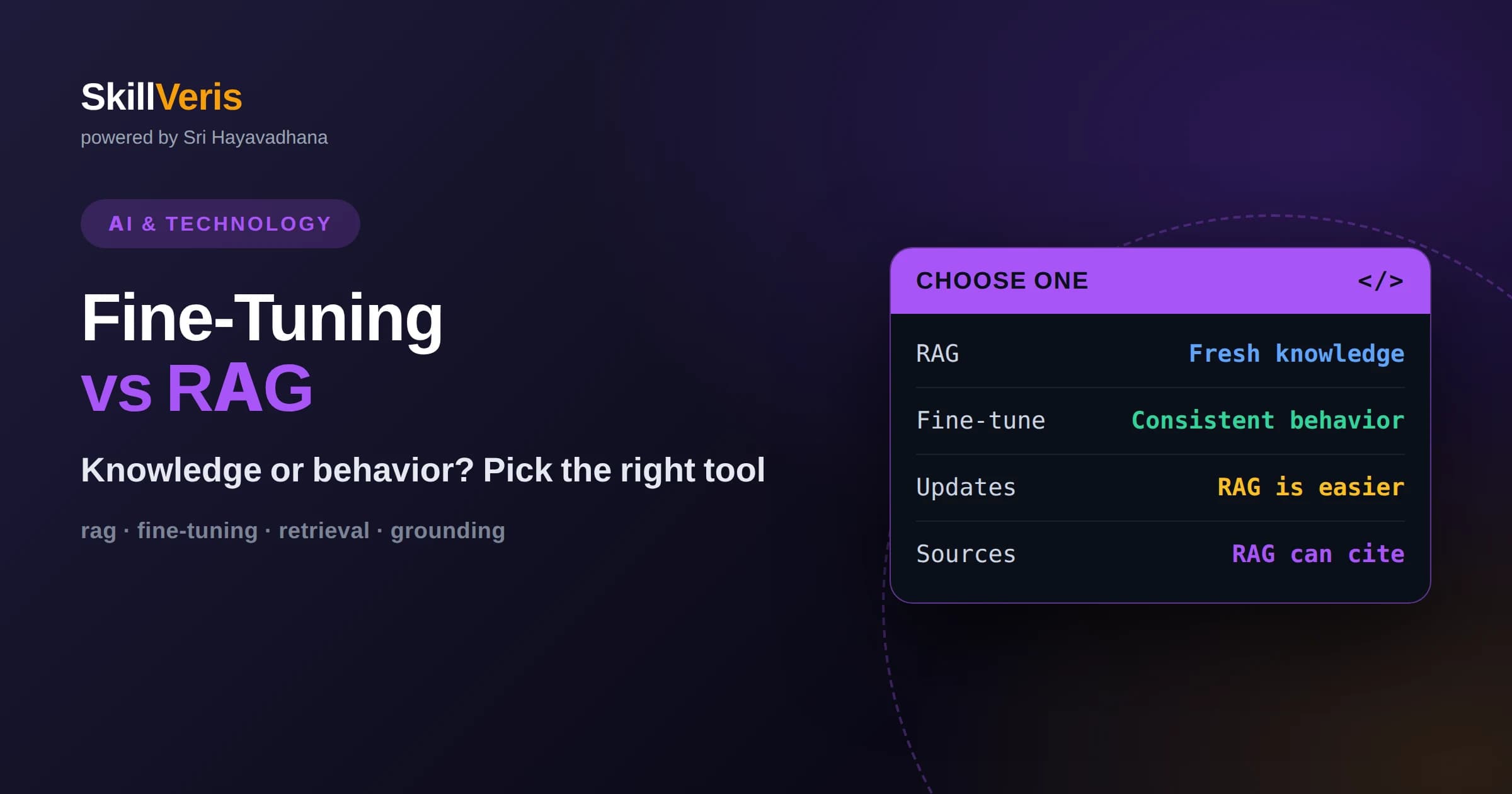
RAG supplies knowledge at query time by retrieving documents, while fine-tuning bakes behavior into the model's weights during training.
In this guide, you'll learn:
- Choose RAG when facts change often or must be cited; choose fine-tuning when you need a consistent format, tone, or specialized skill.
- RAG is usually cheaper to update and easier to keep current than retraining a model.
- Many production systems combine both: fine-tune for behavior and retrieve for up-to-date facts.
1Fine-Tuning vs RAG: Which Do You Need?
Use retrieval-augmented generation, or RAG, when your problem is about knowledge that changes or must be traceable to a source, and use fine-tuning when your problem is about behavior, such as a consistent format, tone, or specialized skill. In short, RAG changes what the model knows at the moment you ask, while fine-tuning changes how the model behaves in general. Many strong systems use both together.
The reason this distinction matters is that the two techniques solve different problems. RAG attaches an external knowledge source to a model and inserts relevant snippets into the prompt at query time. Fine-tuning continues training the model on your examples so that new patterns become part of its weights. Confusing the two leads teams to fine-tune when they should retrieve, or to retrieve when they really need behavior change.
This confusion is common because both techniques promise to make a model better at your specific task, and from the outside their goals can look similar. The difference lies in where the improvement lives: RAG improves what information reaches the model right now, while fine-tuning improves how the model responds by default. Keeping that mental separation clear prevents most of the expensive mistakes teams make when adapting models.
A simple test helps. If the answer to your problem is do not memorize this, just look it up when needed, you probably want RAG. If the answer is respond in this particular way every time, you probably want fine-tuning. Keep this framing in mind and most decisions become clear.
2What Retrieval-Augmented Generation Is
RAG is a pattern where, before the model answers, a retrieval step fetches relevant documents from a knowledge source and adds them to the prompt. The model then reads those documents and grounds its answer in them. Instead of relying only on what it learned during training, the model reasons over fresh material you supply at query time.
The typical pipeline works like this. Your documents are split into chunks and converted into embeddings, which are stored in a searchable index. When a question arrives, it is also embedded and used to find the most similar chunks. Those chunks are placed into the model's context window alongside the question, and the model composes an answer that reflects them.
The big benefit is that your knowledge base becomes something you can update independently of the model. Add a document and the system can use it immediately. Because the retrieved text is visible, you can also show sources, which builds trust and makes answers easier to verify.
3What Fine-Tuning Is
Fine-tuning takes an existing model and trains it further on a curated set of examples so that it internalizes a desired behavior. If you want the model to always answer in a specific structured format, adopt a particular voice, or perform a narrow task with high reliability, showing it many examples of the target behavior can teach it that pattern more deeply than instructions alone.
Unlike RAG, fine-tuning changes the model's parameters. The new behavior does not need to be described in every prompt because it is now part of how the model responds by default. This can make prompts shorter and outputs more consistent, which matters when you need dependable formatting across thousands of requests.
Modern fine-tuning is often done efficiently by training only a small set of additional parameters rather than the whole model. This lowers cost and hardware needs, but the core idea remains the same: you are shaping the model's ingrained behavior, not handing it new facts to read at runtime.
4Knowledge Versus Behavior
The clearest way to choose is to ask whether your problem is really about knowledge or about behavior. Knowledge is facts, documents, policies, and data that may change over time. Behavior is style, structure, tone, and task-specific skill that should stay consistent. RAG is the natural fit for knowledge, and fine-tuning is the natural fit for behavior.
Fine-tuning is a poor way to inject frequently changing facts. Retraining every time a document updates is slow and expensive, and the model may still blur or misremember specifics. RAG, by contrast, keeps facts outside the model where they are easy to edit and cite. Trying to solve a knowledge problem with fine-tuning is one of the most common and costly mistakes teams make.
5Freshness and Ease of Updates
If your information changes regularly, RAG has a decisive advantage. Updating the knowledge base is as simple as adding, editing, or removing documents in the index. The next query immediately reflects the change with no retraining. This makes RAG ideal for product documentation, support content, internal wikis, and anything that evolves.
Fine-tuning is comparatively static. Once trained, the model's behavior is fixed until you train again. That stability is a feature when you want reliable behavior, but a liability when facts move. Thinking about how often your underlying information changes is one of the fastest ways to decide which approach fits.
6Cost and Engineering Effort
The two approaches spend effort in different places. RAG shifts work toward data engineering: chunking documents well, building a good index, and retrieving the right snippets. When retrieval returns irrelevant chunks, answers suffer, so quality depends heavily on the retrieval pipeline. The upside is that no model training is required to get started.
Fine-tuning shifts work toward preparing a high-quality training set and running a training job. Gathering enough clean, representative examples is often the hardest part, and poor data leads to poor behavior. Once trained, though, inference can be simpler because behavior is built in. Weighing where your team is stronger, data pipelines or dataset curation, can guide the choice.
7Accuracy and Reducing Hallucinations
One of RAG's biggest practical wins is reducing hallucinations on factual questions. Because the model answers from retrieved text, it is far less likely to invent details, and it can point to the source it used. For any application where wrong facts are costly, grounding answers in retrieved documents is a strong safeguard.
Fine-tuning does not add a fact-checking mechanism, so a fine-tuned model can still hallucinate about knowledge it was never reliably taught. What fine-tuning improves is consistency of behavior, such as always producing valid structured output. Matching each technique to the kind of reliability you need, factual grounding versus behavioral consistency, prevents disappointment.
8When to Reach for RAG
Reach for RAG when answers must draw on a body of documents, when information changes frequently, or when you need to show sources for trust and compliance. Question answering over company documents, customer support grounded in a knowledge base, and search assistants that cite references are classic RAG use cases.
RAG is also often the right first step even when you are unsure. It is quicker to stand up, easier to keep current, and lets you validate whether better knowledge access solves your problem before you invest in training. Starting with RAG and measuring results is a pragmatic default for many knowledge-heavy applications.
Regulated and high-stakes settings add another reason to prefer RAG: the ability to point to the exact source behind an answer. When someone can ask why the system said something and you can show the retrieved passage, trust and accountability both improve. That traceability is hard to achieve with a model that answers purely from memory.
9When to Reach for Fine-Tuning
Reach for fine-tuning when you need consistent behavior that instructions and examples in the prompt cannot reliably produce. Enforcing a strict output format, adopting a distinctive brand voice, or specializing the model for a narrow, repetitive task are strong fits. If you find yourself writing ever longer prompts to force a behavior, fine-tuning may capture it more cleanly.
Fine-tuning also shines when you want shorter prompts and lower per-request overhead at scale, since the behavior no longer needs to be spelled out each time. The key is that the thing you are teaching is stable. Behavior that rarely changes is a good candidate; facts that change often are not.
A useful sign that fine-tuning is warranted is when you have accumulated many real examples of exactly the behavior you want, drawn from your own usage or curated by experts. Those examples become high-quality training data. Without such a dataset, fine-tuning is hard to do well, so the availability of good examples is often the deciding factor in practice.
10Combining Both Approaches
In practice, the two techniques are complementary, and many robust systems use them together. You might fine-tune a model so it reliably produces answers in your required format and tone, then wrap it in RAG so those well-formatted answers are always grounded in current, citable facts. Behavior comes from fine-tuning; knowledge comes from retrieval.
Thinking of them as layers rather than rivals unlocks the best designs. Decide what behavior you need baked in, then decide what knowledge must stay fresh and external. This division of labor gives you consistency and currency at the same time, which is exactly what production applications tend to require.
11A Practical Decision Checklist
Ask a short series of questions. Does the answer depend on documents or data that change over time? Lean RAG. Do you need the same tone or format every time, regardless of the facts? Lean fine-tuning. Do you need to cite sources? RAG. Are your prompts getting bloated trying to force behavior? Consider fine-tuning.
Then consider your resources. Do you have clean documents but limited training data? RAG plays to that strength. Do you have many high-quality examples of the exact behavior you want? Fine-tuning becomes viable. Running through these questions turns an intimidating architectural choice into a manageable one.
12Try Prompting Before Anything Else
Before committing to either RAG or fine-tuning, it is worth exhausting what plain prompting can do. Modern models are surprisingly capable when given clear instructions and a few examples directly in the prompt. Many problems that teams assume require training or retrieval turn out to be solvable by simply describing the task better and showing the desired output.
Prompting is the cheapest and fastest option because it changes nothing about the model or your infrastructure. Start there, measure how far it gets you, and only reach for heavier techniques when prompting clearly falls short. This disciplined progression, from prompting to RAG to fine-tuning, saves enormous time and expense.
The point at which prompting breaks down is itself informative. If it fails because the model lacks facts, that points to RAG. If it fails because you cannot force consistent behavior no matter how you phrase things, that points to fine-tuning. Letting prompting reveal the true bottleneck leads to a well-matched solution.
13Long-Term Maintenance
Whichever approach you pick, consider how it will be maintained over time. A RAG system needs its knowledge base kept current, its retrieval quality monitored, and its chunks re-indexed as content changes. This is ongoing data work, but it keeps answers fresh without touching the model.
A fine-tuned model needs re-training whenever the desired behavior shifts or the base model you built on is updated. That is a heavier, less frequent cycle. Thinking about the maintenance rhythm each approach imposes, continuous data upkeep versus periodic retraining, helps you choose something your team can actually sustain.
14Build, Measure, and Iterate
The best way to internalize this trade-off is to build a small version of each and compare. Set up a basic RAG pipeline over a handful of documents and see how grounded the answers feel. Then try shaping behavior with prompt examples before committing to a full fine-tune. Measuring real outputs beats guessing every time.
On SkillVeris you can work through hands-on lessons that walk you through building retrieval pipelines and understanding when fine-tuning earns its keep. Practicing on concrete projects is how the difference between knowledge and behavior stops being abstract and becomes a decision you can make with confidence.
Related Reading
Get The Print Version
Download a PDF of this article for offline reading.
About the Publisher
SkillVeris Team
AI Research Team
Our AI team covers the latest in machine learning, generative AI, and emerging tech — clearly and accurately.
View all postsRelated Posts
Never miss an update
Get the latest tutorials and guides delivered to your inbox.
No spam. Unsubscribe anytime.