#NLP
8 articles tagged with #NLP
Natural Language Processing (NLP) for Beginners
NLP is AI for human language — learn how machines read, understand, and generate text.
What Is Sentiment Analysis and How to Do It
Sentiment analysis uses NLP to detect whether text is positive, negative, or neutral. Learn how it works, the main approaches, and how to build one.
What Is Named Entity Recognition in NLP
Named entity recognition finds and classifies names of people, places, organizations, and more in text. Learn how NER works and where it is used.
Natural Language Processing: A Beginner Roadmap
A free beginner roadmap to natural language processing, from tokenization and embeddings to transformers and LLMs, with a practical learning order.
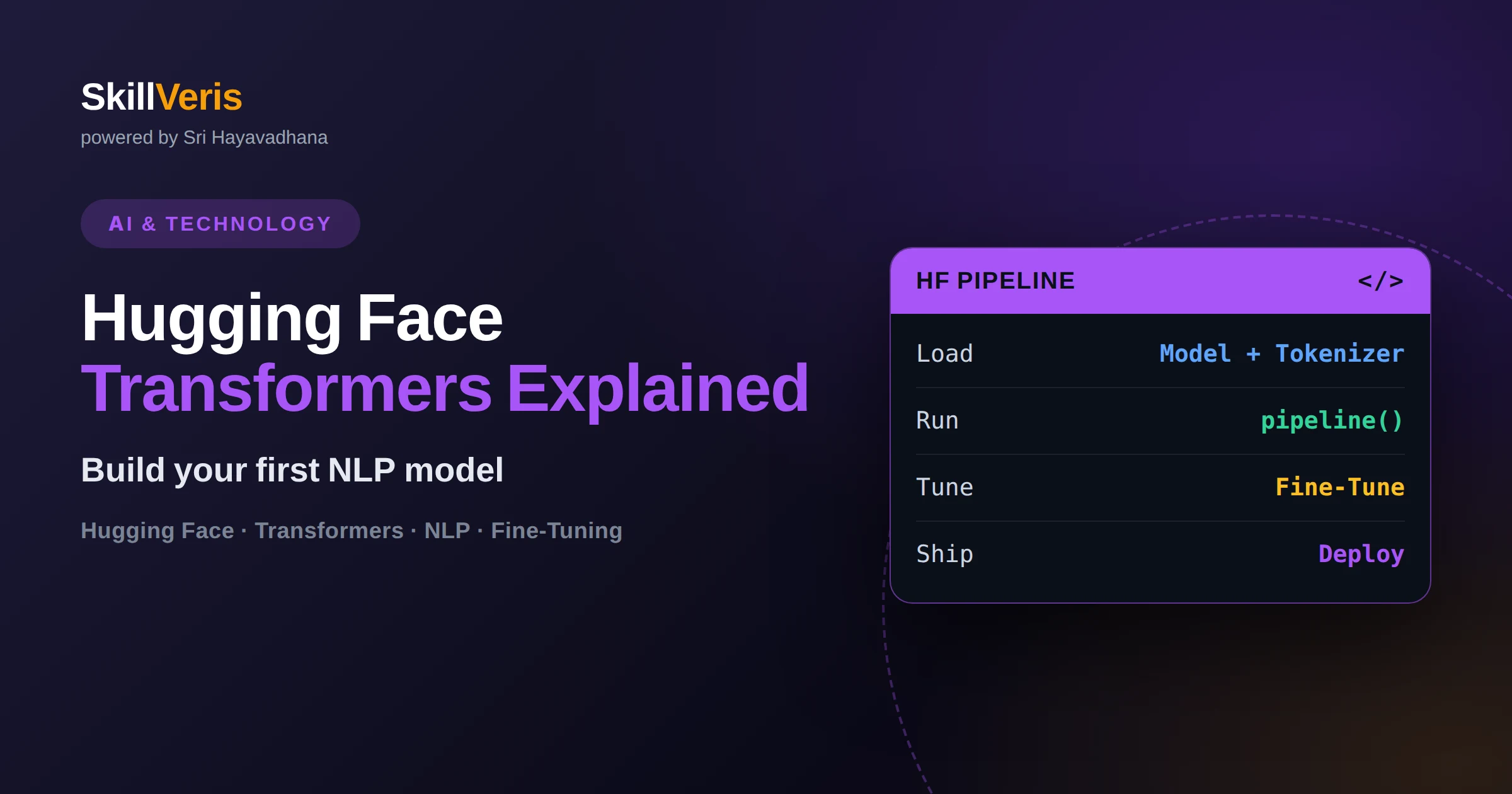
Hugging Face Transformers Explained
Hugging Face Transformers is a Python library that gives you pretrained NLP models in a few lines of code, no training from scratch required.
Semantic Analysis: How Machines Understand Meaning
Semantic analysis is the process of extracting meaning from text or data rather than just matching keywords or patterns. This guide explains how it works, where it's used, and how it connects to modern natural language processing.
What Is Stemming in NLP? A Plain-English Guide
Stemming is a text-processing technique that chops words down to a rough root form so a computer can treat running, runs, and runner as the same word. This guide explains how it works, where it is used, and how it differs from lemmatization.
Tokenization in NLP: How Machines Break Down Text
Tokenization is the process of splitting text into smaller units a model can process, and it is the first step in nearly every NLP pipeline. This guide explains how tokenization works, common strategies, and why it matters for language models.