100% Free Forever
AI-Powered Learning
Industry Expert Content
Certificates & Badges
Learn At Your Own Pace
HomeBlogBuild a RAG Chatbot Over Your Own Documents
Projects & Case Studies

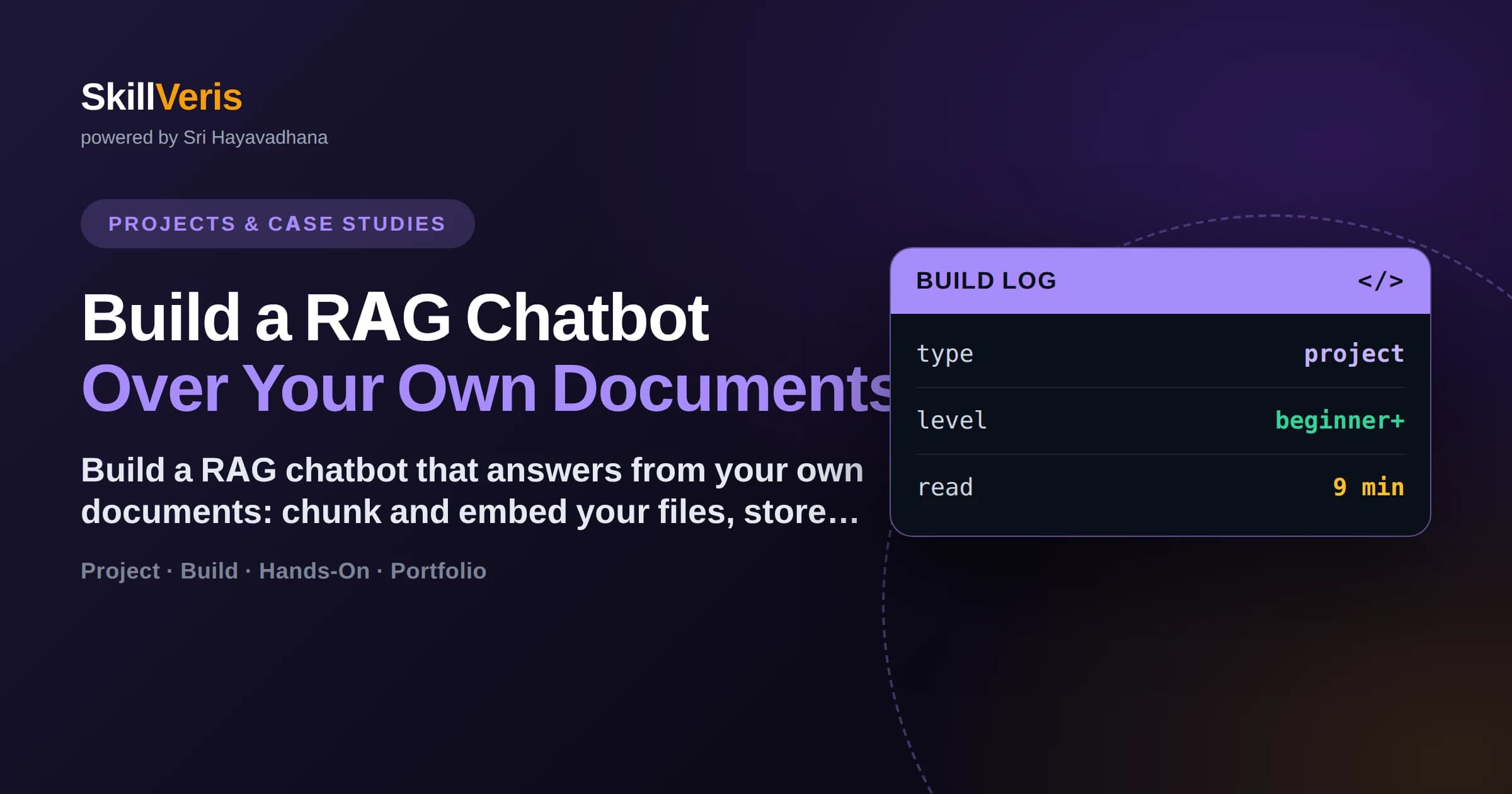
Build a RAG Chatbot Over Your Own Documents

SV

SkillVeris Team

Engineering Team

Mar 30, 2025 9 min read
Share:
Build a RAG Chatbot Over Your Own Documents
Key Takeaway

A RAG chatbot answers questions from your own documents by retrieving relevant passages and giving them to a language model as context.

In this guide, you'll learn:

  • RAG stands for Retrieval-Augmented Generation — it grounds the model in your data instead of relying only on its training.
  • The ingestion pipeline splits documents into chunks, embeds each chunk into a vector, and stores them in a vector database.
  • At query time you embed the question, find the most similar chunks, and inject them into the prompt.
  • Good chunking and retrieval quality matter more than the choice of model.

1What a RAG Chatbot Is

A RAG chatbot answers questions using your own documents by retrieving the most relevant passages and passing them to a large language model as context, so its answers are grounded in your data rather than only its training. RAG stands for Retrieval-Augmented Generation.

This pattern solves a core limitation of language models: they do not know about your private files, and they can confidently make things up. By retrieving real passages and instructing the model to answer from them, you get responses tied to actual source material — and you can show which documents an answer came from.

2How RAG Works

RAG has two phases: an offline ingestion phase that prepares your documents, and an online query phase that answers questions. Understanding this split makes the whole system click.

  • Ingest: split documents into chunks and convert each to an embedding vector.
  • Store: save those vectors in a vector database for fast similarity search.
  • Embed query: turn the user's question into a vector the same way.
  • Retrieve: find the chunks whose vectors are most similar to the question.
  • Generate: put those chunks in the prompt and ask the model to answer from them.

🔑Key Idea

RAG does not fine-tune the model. It changes what you put in the prompt at query time — retrieved context — so the same base model answers accurately about data it was never trained on.

3Chunking Your Documents

Before anything else, you split documents into chunks — passages small enough to embed meaningfully but large enough to carry context. Chunk size is a real trade-off: too small and passages lose meaning, too large and retrieval returns irrelevant filler alongside the answer.

A common starting point is a few hundred tokens per chunk with some overlap between consecutive chunks, so an idea that straddles a boundary is not cut in half. Splitting on natural boundaries like paragraphs or headings usually beats splitting on a fixed character count.

  • Aim for a few hundred tokens per chunk as a starting point.
  • Add overlap (for example, 10-20%) so context spans boundaries.
  • Prefer splitting on paragraphs or sections over raw character counts.
  • Keep metadata (source file, page) with each chunk for citations.
  • Tune chunk size by testing retrieval quality on real questions.

4Embeddings and the Vector Store

An embedding is a numeric vector that captures the meaning of text, so passages about similar topics sit close together in vector space. You run each chunk through an embedding model to get its vector, then store all the vectors in a vector database such as FAISS, Chroma, Pinecone, or pgvector.

The vector store's job is fast similarity search: given a query vector, return the nearest chunk vectors. This is what lets retrieval find semantically relevant passages even when the question uses different words than the document.

Ingestion Sketch

Embed each chunk and add it to the store with its metadata.

code
for chunk in chunks:
    vector = embed(chunk.text)
    store.add(vector, metadata={'text': chunk.text, 'source': chunk.source})
# later, at query time:
results = store.search(embed(question), top_k=4)

5Retrieval and Prompt Construction

At query time you embed the user's question and ask the vector store for the top-k most similar chunks. Then you build a prompt that includes those chunks as context and instructs the model to answer using only that context, saying so when the answer is not present.

This instruction matters. Explicitly telling the model to rely on the provided passages — and to admit when they do not contain the answer — is what curbs hallucination and keeps responses honest.

💡Pro Tip

Return the source metadata alongside the answer so your bot can cite which document each fact came from. Citations build trust and make wrong answers easy to spot.

A Grounding Prompt

Give the model the retrieved passages and a clear instruction to stay within them.

code
prompt = f'''Answer the question using only the context below.
If the answer is not in the context, say you do not know.

Context:
{retrieved_chunks}

Question: {question}'''

6Getting Quality Answers

The most common surprise is that a RAG bot's quality is limited by retrieval, not by the model. If the right passage never makes it into the context, no model can answer correctly. Spend your effort on chunking, embedding quality, and how many chunks you retrieve.

Evaluate with real questions you know the answers to. When answers are wrong, check whether the correct chunk was retrieved at all — that tells you whether to fix retrieval or the prompt. Iterate on chunk size and top-k before blaming the model.

  • Test with questions whose answers you can verify.
  • When wrong, check if the right chunk was even retrieved.
  • Tune chunk size, overlap, and how many chunks you pass.
  • Consider re-ranking retrieved chunks for relevance.
  • Only after retrieval is solid, experiment with the generation model.

7Common Mistakes to Avoid

Most RAG problems trace back to a few predictable issues.

  • Chunks too large or too small, wrecking retrieval relevance.
  • No overlap, so answers that span a boundary get split and lost.
  • Passing too many low-relevance chunks and drowning the real answer.
  • Not instructing the model to answer only from context, inviting hallucination.
  • Blaming the model when the real problem is that retrieval missed the passage.

⚠️Watch Out

RAG reduces hallucination but does not eliminate it. If retrieval returns irrelevant chunks, the model may still guess. Always ground answers in retrieved text and let the bot say 'I don't know.'

8Key Takeaways

RAG is the standard way to make a model answer from your own data.

  • RAG retrieves relevant passages and feeds them to the model as context.
  • Ingestion chunks documents, embeds them, and stores the vectors.
  • At query time you embed the question, retrieve top-k chunks, and build the prompt.
  • Retrieval quality, not the model, usually decides answer quality.
  • Instruct the model to answer only from context and to cite its sources.

9Frequently Asked Questions

Q: What does RAG stand for? A: Retrieval-Augmented Generation. It augments a language model's generation with information retrieved from your own documents at query time, so answers are grounded in your data rather than only the model's training.

Q: Does RAG require fine-tuning the model? A: No. RAG changes what you put in the prompt — retrieved context — rather than the model's weights. That makes it far cheaper and faster to set up than fine-tuning, and easy to update by just changing the documents.

Q: Why are my RAG answers wrong even with a good model? A: Usually because retrieval failed to surface the right passage. Check whether the correct chunk was retrieved at all. Tune chunk size, overlap, and top-k before changing the model, since the model can only answer from what it is given.

Q: Does RAG stop hallucination completely? A: It reduces hallucination by grounding answers in real text, but it does not eliminate it. If retrieval returns irrelevant chunks, the model may still guess. Instruct it to answer only from context and to admit when it does not know.

📄

Get The Print Version

Download a PDF of this article for offline reading.

About the Publisher

SV

SkillVeris Team

Engineering Team

Our engineering team documents real build journeys so you can learn by doing, not just reading.

View all posts

Never miss an update

Get the latest tutorials and guides delivered to your inbox.

No spam. Unsubscribe anytime.

Frequently Asked Questions

21 categories · pick one to explore

Does SkillVeris have a tech blog, and what does it cover?
Yes, the SkillVeris blog has over 500 articles covering AI and machine learning, programming, web development, DevOps, cloud, security, databases and career guidance. Articles are practical and answer-first, and many use the Learn Through Hobbies approach, teaching technical concepts through cricket, music, gaming or cooking analogies. Everything is free to read.
What is the SkillVeris tech glossary and how big is it?
The SkillVeris glossary is a free reference of roughly 2,000-plus technology terms, each with a clear plain-language definition. It spans AI, programming, web, DevOps, cloud, security and database vocabulary, so whenever a lesson, article or job description uses jargon you do not recognise, the glossary gives you a fast, reliable answer.
Are the developer cheat sheets on SkillVeris free to download?
The cheat sheets are completely free to use, like everything else on SkillVeris. Each sheet condenses a language or tool into its essential syntax, commands and patterns for quick reference while coding. They are designed for rapid lookup during real work, complementing the deeper explanations found in study notes and courses.
Which programming references and cheat sheets are available?
Cheat sheets cover the platform's main domains, including programming languages, AI and ML tooling, web development, DevOps, cloud, security and databases, matching the topics of the 37 live courses. Each sheet lists related reading links and hashtags, so you can jump from a quick reference into fuller study notes or blog articles.
How do I find the meaning of a technical term quickly?
Search the SkillVeris glossary, which holds around 2,000-plus terms with concise, plain-language definitions. Each entry gets to the point in its first sentence, then links to related reading like blog posts or study notes for deeper context. It is faster and more consistent than sifting through scattered search results.
Is the SkillVeris blog good for beginners learning to code?
Yes, many blog articles are written specifically for beginners, and the Learn Through Hobbies style makes them unusually approachable: you might learn Python concepts through cricket or understand APIs through cooking. With 500-plus articles across skill levels, beginners can start with fundamentals and keep reading as they advance, entirely free.
Can cheat sheets replace full courses for learning a language?
No, cheat sheets are references, not teaching tools; they assume you already understand the concepts and just need syntax or commands fast. To actually learn a language, take a structured SkillVeris course with its 24–40 lessons and assessments, then keep the cheat sheet beside you while practising in Code Lab.
How often are new blog articles published on SkillVeris?
The blog grows regularly and already exceeds 500 articles, with new posts added as courses launch and technologies evolve. Topics track the platform's catalogue across AI, programming, web development, DevOps, cloud and security, so checking the Blog section periodically surfaces fresh tutorials, explainers and career-focused pieces, all free to read.
Does the glossary cover AI and machine learning terms?
Yes, AI and machine learning vocabulary is a major part of the roughly 2,000-plus term glossary, covering everything from foundational terms to modern concepts around LLMs, RAG and MLOps. Definitions are plain-language and answer-first, which helps when dense AI papers or course lessons throw unfamiliar jargon at you.
Are there cheat sheets for interview preparation?
Cheat sheets work well as interview-day refreshers because they compress syntax, commands and key concepts into scannable references. For dedicated preparation, combine them with the SkillVeris interview questions feature, which includes readiness scoring, plus study notes for depth. Reviewing a relevant cheat sheet just before an interview steadies recall under pressure.
Can I read the tech blog without signing up?
Yes, the blog is freely readable, and SkillVeris never charges for content. All 500-plus articles are open, covering tutorials, concept explainers and career advice. Creating a free account adds value elsewhere on the platform, like course progress tracking and certificates, but reading the blog requires no commitment at all.
How is the SkillVeris glossary different from Wikipedia?
The glossary is purpose-built for learners: definitions are short, plain-language and answer-first, sized for a quick lookup mid-lesson rather than a deep encyclopedic read. Entries also cross-link to related SkillVeris study notes, blog posts and courses, so a definition becomes a doorway into structured learning instead of a dead end.
Do blog articles use the Learn Through Hobbies method?
Many blog articles teach technical topics through hobby analogies, a hallmark of the SkillVeris blog, so you will find articles explaining programming through cricket, machine learning through music, or system design through cooking. The analogy is the teaching device; the article still delivers the real technical concept underneath.
Where can I find quick programming references while coding?
Open the SkillVeris cheat sheets, which are built exactly for that moment: compact, scannable references for syntax, commands and common patterns across languages and tools. Keep the relevant sheet in a browser tab while you work in Code Lab or your own editor, and dip into the glossary for terminology.
Is there a glossary entry for terms I meet in job descriptions?
Very likely yes, with roughly 2,000-plus terms across AI, programming, web, DevOps, cloud, security and databases, the glossary covers most jargon that appears in tech job descriptions. Decoding a listing this way helps you judge role fit honestly and prepares you to discuss those terms in interviews.
Are the blog articles written for the Indian tech audience?
The blog serves Indian learners plus a worldwide audience. Content stays globally relevant while acknowledging realities that matter in India, such as free access being essential for students and freshers, and career guidance that connects naturally to the SkillVeris jobs portal, which aggregates roles across India, UK, USA, Germany and Remote.
Can I suggest a topic for the blog or glossary?
SkillVeris content grows in response to what learners need, so feedback is welcome through the platform's support channels. If a term is missing from the glossary or a topic deserves an article, telling the team helps prioritise it. Meanwhile, the AI Mentor can answer the question immediately, 24/7, at any depth.
Do cheat sheets and glossary entries link to deeper learning?
Yes, every cheat sheet and glossary entry carries related reading links into study notes, blog articles and courses, plus concept hashtags for discovering similar content. This cross-linking means a thirty-second lookup can smoothly become a structured learning session whenever you decide you want more than a quick answer.
What makes SkillVeris programming references trustworthy?
The references are written to strict internal quality standards, kept consistent with the platform's 37 live courses, and never padded with invented statistics or hype. Definitions and cheat sheets are reviewed against the same content contracts that govern courses, and the answer-first style makes any inaccuracy easy to spot and correct.
How do the blog, glossary and cheat sheets fit into my learning routine?
Use them as satellites around your main course: read blog articles for context and motivation, hit the glossary the instant jargon appears, and keep cheat sheets open while coding. Together with study notes, Code Lab and the 24/7 AI Mentor, they turn passive reading into a complete, free learning system.

What Learners Say

Real journeys from the SkillVeris community — swipe for more.

SkillVeris taught me Python through Cricket. Now I’m building real projects and feeling confident!
Arjun S. · B.Tech Student
The best platform for hobby-based learning. Concepts finally stick.
Priya R. · Data Analyst
I went from zero coding to a portfolio of projects — all by learning through my love for gaming. Landed my first internship!
Kabir M. · CS Undergraduate
Trending Topics50 popular tags — tap to explore
Trending CoursesAll 37 free courses — tap to browse