What Is Retrieval-Augmented Generation (RAG)? A Complete Guide
SkillVeris Team
AI Research Team
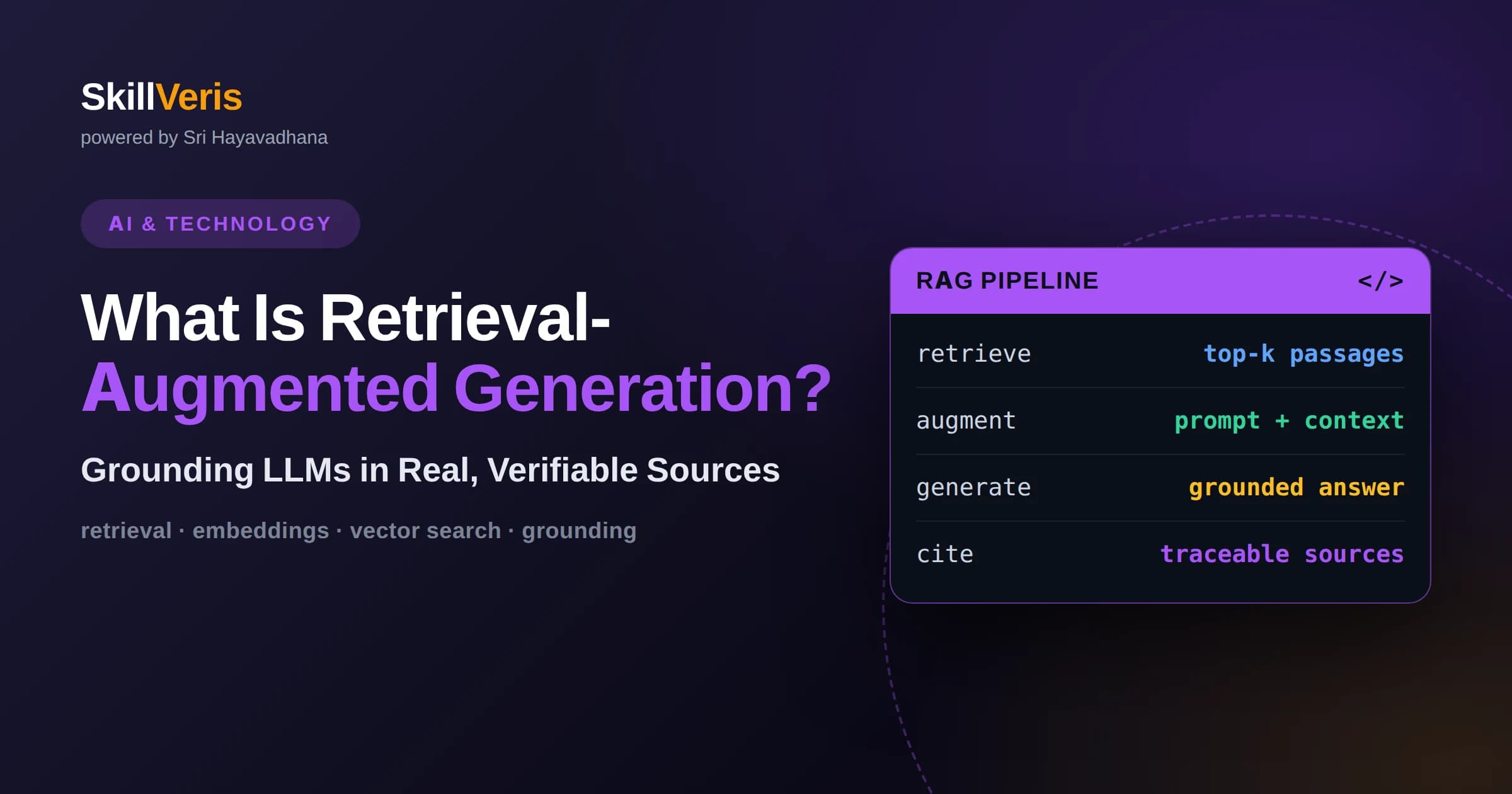
Retrieval-augmented generation is a technique that lets a language model fetch relevant documents from an external knowledge source and use them as context before it writes an answer.
In this guide, you'll learn:
- RAG reduces hallucination and lets a model answer questions about private, recent, or domain-specific data it was never trained on, without retraining the model itself.
- A working RAG system has two phases: an offline indexing pipeline that turns documents into searchable vectors, and an online query pipeline that retrieves and generates.
- RAG is usually cheaper, faster to update, and more transparent than fine-tuning, which makes it the default starting point for most enterprise AI question-answering projects.
1What Is Retrieval-Augmented Generation?
Retrieval-augmented generation, or RAG, is a technique that connects a large language model to an external body of knowledge so that the model can look up relevant information before it answers. Instead of relying only on what it memorized during training, the model first retrieves the most relevant passages from a knowledge source you control, then generates its response using those passages as grounding. In one sentence: RAG lets a language model answer questions using your data rather than only its training data.
This matters because a standalone language model has two well-known weaknesses. Its knowledge is frozen at the point its training ended, and it will sometimes state false information with complete confidence, a behavior called hallucination. RAG addresses both problems at once. By supplying fresh, relevant, and verifiable source text at question time, it keeps answers current and anchors them to material you can trace back to a document.
The idea has become the default architecture for building AI assistants over private or specialized content. Customer support bots that answer from a company help center, internal tools that search policy documents, and research assistants that cite papers are almost all built on some version of RAG. It has become popular precisely because it is practical: you get grounded answers without the cost and complexity of retraining a model.
2Why RAG Matters
The core value of RAG is trust. When an answer is generated from retrieved passages, you can show the user exactly which sources were used, which turns an opaque model into something closer to a well-read assistant that shows its work. For any application where a wrong answer has real consequences, such as legal, medical, or financial contexts, this traceability is often the difference between a demo and a deployable product.
RAG also solves the freshness problem cheaply. Language models are expensive and slow to retrain, so their built-in knowledge lags behind the real world. With RAG, updating what the system knows is as simple as adding, editing, or removing documents in the knowledge source. The next question automatically benefits from the change, with no model training involved.
Finally, RAG lets a general-purpose model become a specialist. The same base model can serve a hospital, a law firm, and a software company simply by pointing it at different document collections. This separation between the reasoning engine and the knowledge it draws on is what makes RAG so flexible and so widely adopted.
3How RAG Works, Step by Step
A RAG system runs in two phases. The first is an offline indexing phase that happens before any user asks a question. Documents are collected, split into manageable chunks, converted into numerical representations called embeddings, and stored in a database optimized for similarity search. This is the preparation that makes fast retrieval possible.
The second phase happens live, every time a user asks something. The question itself is converted into an embedding, the system searches the database for the chunks whose embeddings are most similar to the question, and those top chunks are pulled out as context. The question and the retrieved context are then combined into a single prompt and sent to the language model, which writes an answer grounded in that supplied material.
The elegance of this design is that the two phases are independent. You can improve retrieval quality without touching the model, and you can swap the model without rebuilding your index. Understanding this split is the key to reasoning about where a RAG system is succeeding or failing.
4Embeddings and Vector Search
Embeddings are the technical heart of retrieval. An embedding model reads a piece of text and outputs a long list of numbers, a vector, that captures the meaning of that text. Passages about similar topics end up with vectors that sit close together in this high-dimensional space, even when they use completely different words. This is what allows a search for account cancellation to find a document titled how to close your subscription.
A vector database stores these embeddings and can find the nearest neighbors to a query vector very quickly, even across millions of chunks. This is called semantic search, and it is fundamentally different from traditional keyword search, which only matches exact terms. Semantic search finds relevant material by meaning, which is what makes RAG feel intelligent rather than mechanical.
Choosing a good embedding model matters more than beginners expect. If the embeddings do not represent your domain well, retrieval will surface the wrong passages and the model will generate confident answers from irrelevant context. Many teams evaluate several embedding models on their own data before committing, because retrieval quality places a hard ceiling on the quality of the whole system.
5Chunking: Splitting Documents Well
Documents are rarely retrieved whole. Instead they are split into chunks, typically a few hundred words each, so that retrieval can return just the passages relevant to a question rather than an entire manual. How you chunk has a large and often underestimated effect on quality. Chunks that are too large dilute relevance and waste the model's context window, while chunks that are too small can lose the surrounding meaning a passage needs to make sense.
Good chunking respects the structure of the content. Splitting on natural boundaries such as headings, paragraphs, or sections keeps related ideas together. Many teams also use overlapping chunks, where each chunk shares a little text with its neighbors, so that a sentence sitting on a boundary is not cut off from its context. There is no single correct chunk size; it depends on the documents and the questions users ask.
Metadata is the other half of good chunking. Attaching information such as the source title, section, date, or author to each chunk lets you filter retrieval and, just as importantly, cite sources accurately in the final answer. Well-structured chunks with clean metadata are one of the highest-leverage investments you can make in a RAG pipeline.
6A Concrete Worked Example
Imagine a software company that wants an assistant to answer questions from its product documentation. During indexing, every documentation page is split into sections, each section becomes a chunk tagged with its page title and last-updated date, and every chunk is embedded and stored in a vector database. This runs once and then updates whenever the docs change.
Now a user asks, how do I reset my API key. The system embeds that question, searches the vector database, and retrieves the three most relevant chunks, perhaps a section on key management, a security note, and a step-by-step guide. These chunks are inserted into a prompt that instructs the model to answer using only the provided context and to cite the source pages.
The model then produces a clear, step-by-step answer that matches the company's actual documentation, followed by references to the exact pages it drew from. If the documentation changes next week, the answer updates automatically once the new content is re-indexed. Nothing about the model was retrained, yet the assistant behaves like a domain expert.
7RAG Versus Fine-Tuning
People often ask whether they should use RAG or fine-tune a model, but the two solve different problems. RAG gives a model access to knowledge, while fine-tuning changes a model's behavior, tone, or output format. If your goal is to answer questions about a body of facts that changes over time, RAG is almost always the better fit because you can update the knowledge instantly by editing documents.
Fine-tuning shines when you need the model to consistently follow a particular style, structure its output in a specific way, or handle a specialized task that prompting alone cannot reliably produce. It bakes patterns into the model itself, which is powerful but slow to change and harder to audit, since the knowledge is no longer sitting in a document you can point to.
In practice these approaches are complementary rather than competing. A mature system might fine-tune a model for consistent formatting and domain vocabulary while using RAG to supply the up-to-date facts. For most teams starting out, though, RAG is the sensible first move because it delivers grounded answers faster and at lower cost.
8When to Use RAG, and When Not To
RAG is an excellent choice whenever answers must come from a specific, verifiable body of knowledge that a general model would not know or would get wrong. Private company data, frequently changing information, regulated content that requires citations, and large document collections too big to fit in a single prompt are all classic RAG scenarios. If users will ask, where did that answer come from, RAG is likely the right architecture.
RAG is less useful when the task does not depend on external facts at all. Creative writing, general reasoning, code transformation, or brainstorming rarely benefit from retrieval, because there is no authoritative document to ground against. Adding retrieval in these cases only introduces complexity and latency without improving the result.
It is also worth being honest about RAG's limits. If your knowledge source is disorganized, contradictory, or poorly maintained, RAG will faithfully surface that mess. Retrieval cannot invent quality that does not exist in your documents, so the effort you put into curating and structuring your content directly determines how good the answers can be.
9Common Mistakes to Avoid
The most frequent mistake is treating RAG as a purely generation problem when it is really a retrieval problem. Teams pour energy into prompt wording while ignoring whether the right chunks are being retrieved in the first place. If retrieval returns irrelevant passages, even a perfect prompt cannot produce a correct answer. Measuring retrieval quality separately from answer quality is essential.
Another common error is poor chunking and missing metadata, which quietly degrades everything downstream. Chunks that split ideas awkwardly, lack source information, or contain boilerplate noise all make retrieval less precise. Similarly, failing to instruct the model to answer only from the provided context lets it fall back on its training memory, which reintroduces the hallucinations RAG was meant to prevent.
Finally, many teams never build an evaluation set. Without a collection of realistic questions and expected sources to test against, you are guessing whether changes help or hurt. A small, honest test set is the single most valuable tool for improving a RAG system over time, and skipping it is the difference between engineering and hoping.
10Tools and Technologies
The RAG ecosystem has matured into a recognizable stack. Embedding models turn text into vectors, vector databases store and search those vectors at scale, and orchestration frameworks tie retrieval and generation together into a pipeline. On top of these sit the language models themselves, which do the final generation from retrieved context.
Popular building blocks include dedicated vector databases and search engines for storage and retrieval, along with frameworks that handle document loading, chunking, embedding, and prompt assembly so you do not have to wire everything by hand. Many general databases have also added vector search, which lets some teams keep retrieval close to data they already store.
You do not need every tool to start. A simple RAG prototype can run with one embedding model, one lightweight vector store, and one language model. The sophisticated components, such as re-ranking models, hybrid keyword-plus-vector search, and query rewriting, are refinements you add once a basic pipeline is working and you have measured where it falls short.
11Advanced RAG Techniques
Once a basic pipeline is running, several techniques can raise quality substantially. Re-ranking uses a second, more precise model to reorder the retrieved chunks so the most relevant passages land at the top of the prompt. Hybrid search combines semantic vector search with traditional keyword matching, which helps with exact terms like product codes or names that embeddings sometimes handle poorly.
Query transformation is another powerful idea. Instead of searching with the user's raw question, the system rewrites or expands it, sometimes generating several search variations, to retrieve a broader and more relevant set of passages. This is especially helpful for vague or conversational questions that do not map cleanly onto how the documents are written.
More advanced systems add self-checking steps, where the model assesses whether the retrieved context actually answers the question and retrieves again if it does not. These agentic patterns blur the line between RAG and AI agents, and they represent the direction the field is heading: retrieval that is iterative, adaptive, and aware of its own gaps.
12Evaluating a RAG System
Evaluating RAG means measuring two things separately: did retrieval find the right material, and did generation use it correctly. For retrieval, you check whether the relevant chunks appear among the results for a set of test questions. For generation, you check whether the final answer is faithful to the retrieved context and actually addresses the question. A system can fail at either stage, and lumping them together hides where the real problem is.
Faithfulness is a particularly important metric. An answer that sounds right but contradicts or invents beyond the retrieved sources is a failure even if it reads well, because it undermines the trust that RAG exists to provide. Many teams review a sample of answers by hand and increasingly use a capable language model as an automated judge to scale this checking, while still validating that judge against human opinion.
The discipline that makes all of this work is treating evaluation as continuous rather than one-time. Documents change, user questions drift, and models get swapped, so a RAG system that was accurate at launch can quietly degrade. Regular evaluation against a maintained test set keeps quality honest and catches regressions before users do.
13How to Learn RAG and Build Real Systems
The fastest way to understand RAG is to build a small one end to end. Take a handful of documents you know well, chunk them, embed them, store them in a lightweight vector database, and wire up a simple retrieve-then-generate loop. Seeing your own questions answered from your own content makes every abstract concept concrete, and the failures you hit will teach you more than any diagram.
From there, deepen your foundations deliberately. A solid grasp of how large language models work explains why grounding matters, and comfort with embeddings and vector search explains why retrieval succeeds or fails. Understanding agentic workflows shows you where RAG is heading as systems become more iterative and self-correcting. These topics reinforce one another, and studying them together produces a much clearer mental model than learning any one in isolation.
SkillVeris offers structured, hobby-personalized courses that cover exactly this path, including a dedicated Retrieval-Augmented Generation course alongside courses on Large Language Models and AI Agents and Agentic Workflows. Working through them in sequence gives you both the intuition and the hands-on practice to design, build, and evaluate RAG systems that people can actually trust, which is the real goal behind the technique.
Related Reading
Get The Print Version
Download a PDF of this article for offline reading.
About the Publisher
SkillVeris Team
AI Research Team
Our AI team covers the latest in machine learning, generative AI, and emerging tech — clearly and accurately.
View all postsRelated Posts
Never miss an update
Get the latest tutorials and guides delivered to your inbox.
No spam. Unsubscribe anytime.