RAG Explained: How It Powers AI Apps
SkillVeris Team
AI Research Team
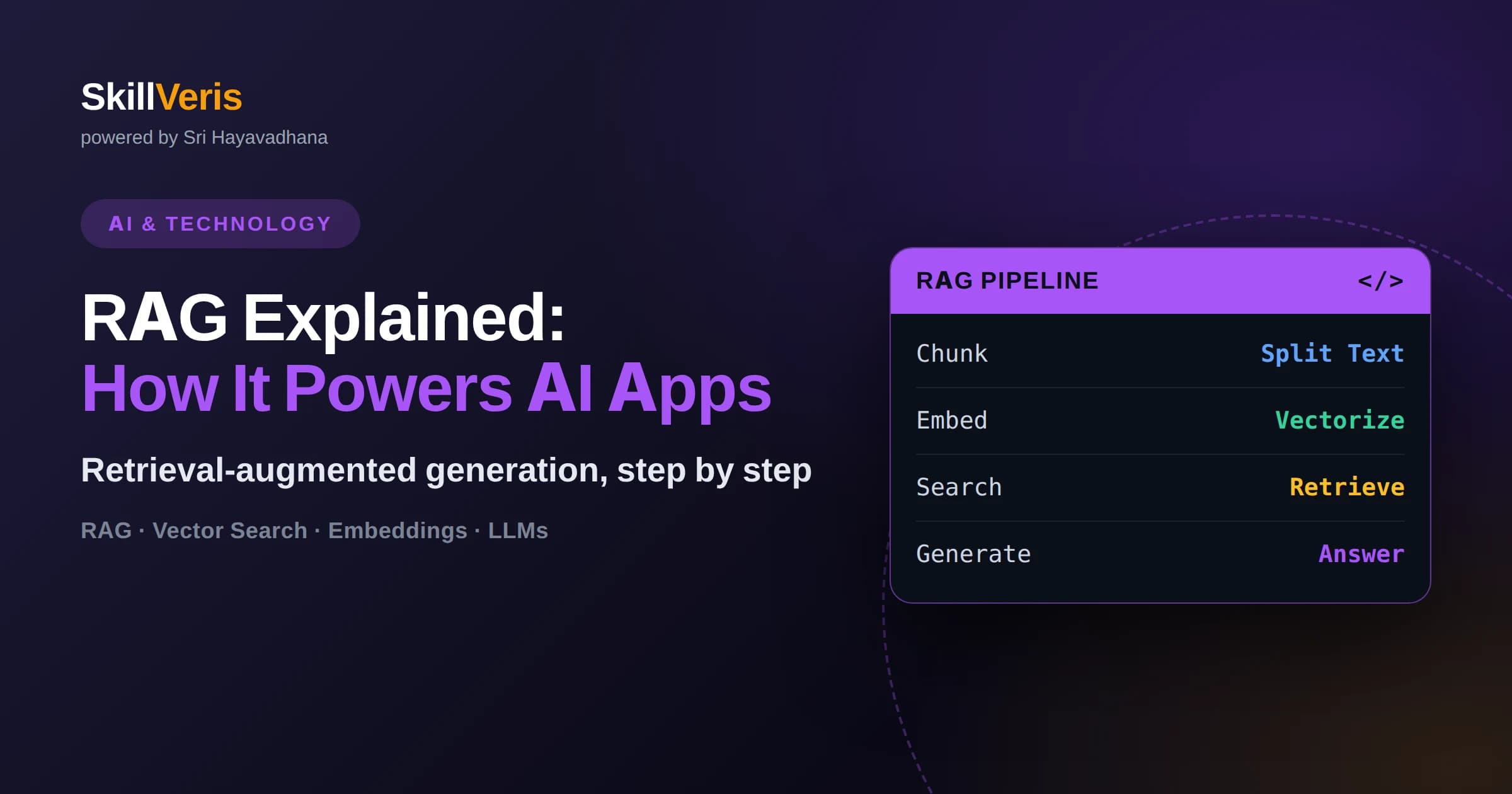
Retrieval-augmented generation pairs a language model with a live search step so answers are grounded in real documents instead of memorized parameters.
In this guide, you'll learn:
- A standard RAG pipeline has five stages: chunking, embedding, vector search, re-ranking, and generation.
- Vector databases find semantically similar text by comparing numerical embeddings, not by matching exact keywords.
- RAG quality has two separate axes: retrieval precision, which measures whether the right chunks were found, and answer faithfulness, which measures whether the model actually used them.
- Naive RAG runs retrieval once per query, while agentic RAG lets the model decide when, whether, and how many times to search.
1What Is RAG in AI? A Working Definition
Retrieval-augmented generation (RAG) is a technique that gives a language model access to an external knowledge source at the moment it answers a question, so its response is grounded in retrieved facts rather than only in what it memorized during training.
Instead of relying purely on the patterns baked into a model's weights, a RAG system searches a document collection, pulls back the most relevant passages, and feeds them to the model alongside the user's question. The model then generates its answer using that retrieved context, much like a person writing an essay with reference material open beside them rather than from memory alone.
This is the architecture behind most production chatbots and assistants that need to answer questions about private documents, recent events, or company-specific data: the retrieval step supplies current, verifiable information, and the generation step turns it into a fluent, natural-language answer.
2Why LLMs Alone Hallucinate and Go Stale
A language model's knowledge is frozen at the point its training data was collected, and it has no built-in mechanism to distinguish confident recall from confident guessing — which is exactly why hallucination and staleness happen.
Every fact an LLM produces is reconstructed from statistical patterns across billions of parameters, not looked up from a stored record. When a question falls outside its training distribution, or when the true answer requires very specific, low-frequency details, the model can still generate a fluent, plausible-sounding response that happens to be wrong. It has no notion of 'I don't know' unless it has been explicitly trained to express uncertainty.
On top of that, anything that happened, changed, or was published after the model's training cutoff simply doesn't exist in its parameters. A model can't tell you about a product released last week, a policy that changed yesterday, or the contents of an internal company wiki it never saw. RAG directly addresses both problems: it supplies fresh, external, checkable text at answer time, so the model is reasoning over evidence instead of guessing from memory.
3The Core RAG Pipeline: Chunking, Embeddings, Search, and Generation
A typical RAG pipeline breaks the problem into five sequential stages, each of which directly affects the quality of the final answer.
It starts long before a user ever asks a question: documents are split into chunks and converted into embeddings ahead of time, then indexed for fast lookup. Only the search, re-ranking, and generation steps happen live, in response to a query.
- Chunking: source documents (PDFs, articles, wikis, support tickets) are split into smaller passages, since feeding an entire document to the model would be slow, expensive, and dilute the relevant details.
- Embedding: each chunk is converted into a dense numerical vector by an embedding model, capturing its meaning in a form that can be compared mathematically.
- Vector search: the user's query is embedded the same way, and the system finds the chunks whose vectors are closest to the query vector — this is the actual 'retrieval' in retrieval-augmented generation.
- Re-ranking: an optional second pass, often using a more precise (and slower) model, reorders the retrieved candidates so the truly most relevant chunks rise to the top before being sent to the LLM.
- Generation: the top chunks are inserted into the model's prompt alongside the original question, and the LLM composes a final answer grounded in that retrieved text.
4How Vector Databases Make Retrieval Fast
A vector database finds relevant text by measuring the mathematical distance between embeddings, so that passages with similar meaning end up near each other in vector space even if they don't share any exact words.
This is the key advantage over traditional keyword search: a query about 'reducing employee turnover' can retrieve a passage about 'improving staff retention' because their embeddings land close together, even though the two phrases share almost no vocabulary. Vector databases use specialized indexing structures to make this similarity search fast across millions or billions of vectors, rather than comparing the query to every stored chunk one by one.
In practice, many production systems combine vector similarity with traditional keyword filters — narrowing by date, source, or category metadata before or after the vector search — because pure semantic similarity alone can occasionally surface passages that are topically related but not actually useful for the specific question asked.
5How to Evaluate RAG Quality: Retrieval vs. Faithfulness
Evaluating a RAG system requires checking two distinct things: whether the retrieval step found the right information, and whether the generation step actually used that information correctly.
Retrieval precision asks a narrow question: out of the chunks the system pulled back, how many were actually relevant to the query? Poor retrieval precision means the model is being handed noise, irrelevant tangents, or outdated passages, and no amount of prompting can fix an answer built on the wrong evidence.
Answer faithfulness is a separate concern: even when retrieval surfaces the correct passages, the model can still ignore them, misread them, or blend them with its own memorized (and possibly wrong) assumptions. A faithful answer sticks strictly to what the retrieved context actually supports; an unfaithful one drifts into unsupported claims even though the right source material was right there. Strong RAG systems are tested on both dimensions separately, because a system can score well on one and poorly on the other.
6Naive RAG vs. Agentic RAG: Common Architectures
Naive RAG performs one retrieval step per query and generates a single answer, while agentic RAG lets the model actively decide when to search, what to search for, and whether the first attempt was good enough.
In the naive pattern, every question triggers exactly one retrieval call, and whatever comes back is what the model works with — simple to build, but it can struggle with multi-part questions or queries where the first search doesn't return enough context.
Agentic RAG treats retrieval as a tool the model can call repeatedly and strategically: it might break a complex question into sub-questions, search for each one separately, decide a result set is insufficient and reformulate the query, or cross-check a draft answer against additional retrieved evidence before responding. This is more expensive and slower per query, but it materially improves accuracy on multi-step or ambiguous questions, and it's increasingly the default pattern in production assistants built on modern agent frameworks.
7Practical Pitfalls When Building a RAG Pipeline
Most real-world RAG failures trace back to a handful of recurring mistakes in how the pipeline is configured rather than a fundamental flaw in the approach itself.
Chunks that are too large dilute relevance and waste context budget; chunks that are too small strip away the surrounding context a passage needs to make sense on its own. Skipping re-ranking often means the model receives technically-similar-but-not-actually-useful passages ranked above the genuinely best answer. Ignoring metadata (dates, source authority, document type) lets outdated or lower-quality content compete equally with authoritative, current sources. And treating retrieval as a one-shot process — rather than testing whether the system should re-search, expand the query, or ask a clarifying question — caps accuracy on anything beyond simple, single-fact lookups.
Because these are engineering and evaluation problems as much as conceptual ones, teams that want hands-on practice with chunking strategies, embedding choices, and evaluation techniques can go deeper with SkillVeris's Retrieval-Augmented Generation course, which walks through building a full pipeline end to end.
8Frequently Asked Questions
Q: What is RAG in simple terms? A: RAG is a way of giving an AI model outside information to read before it answers, so its response is based on retrieved facts instead of only what it memorized during training.
Q: Is RAG the same as fine-tuning? A: No. Fine-tuning changes a model's internal weights through additional training, while RAG leaves the model unchanged and instead supplies fresh, relevant text at query time — the two techniques are often complementary, not competing.
Q: Why does RAG reduce hallucinations? A: Because the model is generating its answer from specific retrieved passages rather than reconstructing facts from memorized patterns, there's real source text to ground the response in and, in many implementations, to cite.
Q: What is a RAG pipeline made of? A: The core stages are chunking documents, embedding them into vectors, searching a vector database for the most relevant chunks, optionally re-ranking those results, and generating a final answer using the retrieved text as context.
Q: Can RAG use data that changes daily? A: Yes — this is one of RAG's main advantages, since updating the pipeline just means re-indexing the changed documents, rather than retraining or fine-tuning the underlying model.
Q: What's the difference between naive and agentic RAG? A: Naive RAG retrieves once per query and generates a single answer, while agentic RAG lets the model decide to search multiple times, reformulate queries, or verify its own draft answer against additional retrieved evidence.
Related Reading
Get The Print Version
Download a PDF of this article for offline reading.
About the Publisher
SkillVeris Team
AI Research Team
Our AI team covers the latest in machine learning, generative AI, and emerging tech — clearly and accurately.
View all postsRelated Posts
Never miss an update
Get the latest tutorials and guides delivered to your inbox.
No spam. Unsubscribe anytime.