Fine-Tuning vs RAG: Which Should You Use?
SkillVeris Team
AI Research Team
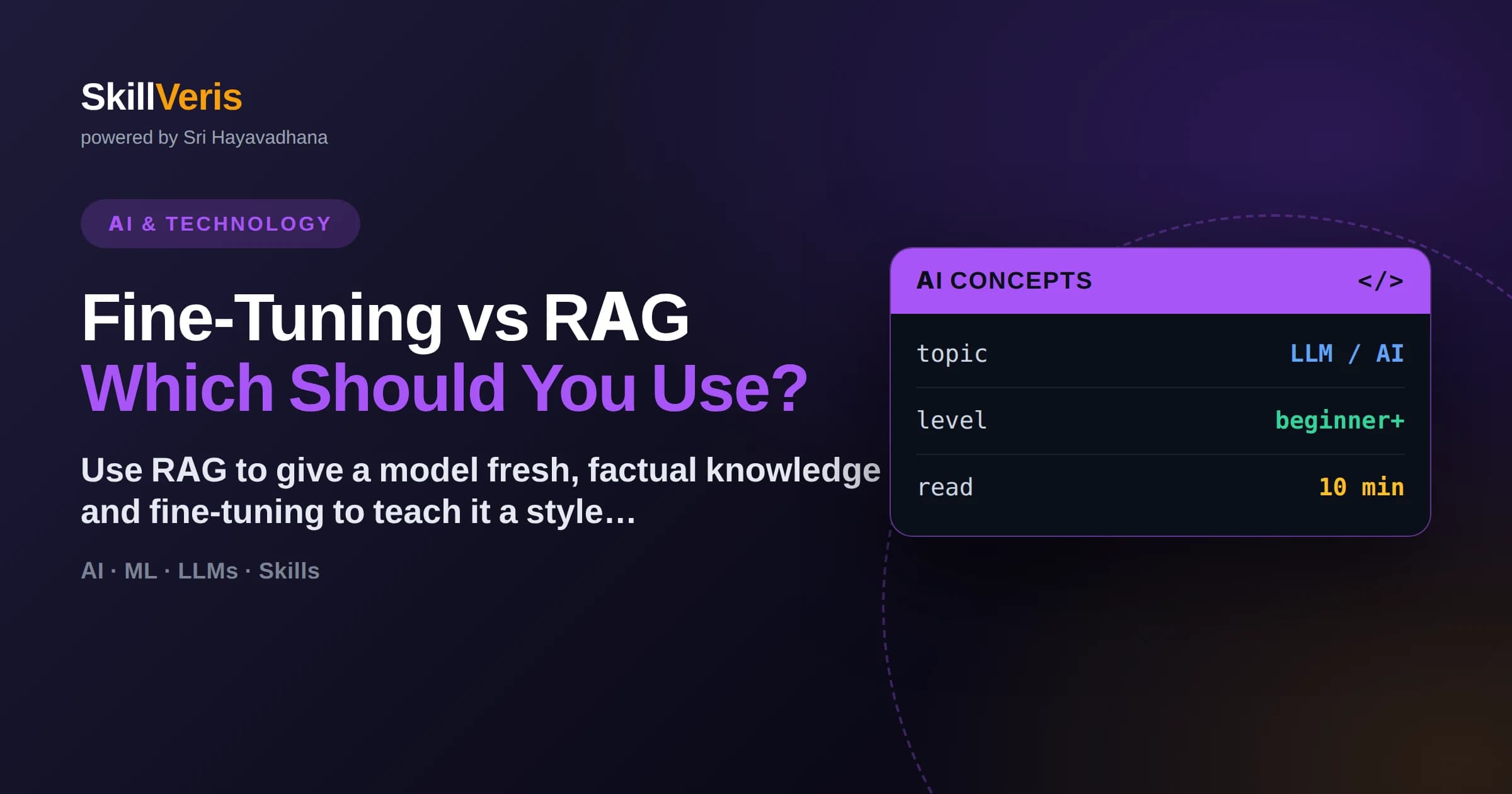
Use RAG when you need current, factual, or private knowledge; use fine-tuning when you need to change how the model behaves, formats, or sounds.
In this guide, you'll learn:
- RAG retrieves relevant documents at query time and injects them into the prompt, keeping knowledge fresh without retraining.
- Fine-tuning updates the model's weights on your examples to bake in a consistent style, tone, or specialized skill.
- RAG is easier to update and audit; fine-tuning is better for shaping behavior and reducing prompt length.
- The two are complementary, and many production systems fine-tune for format while using RAG for facts.
1Fine-Tuning vs RAG: The Quick Answer
Use RAG when you need the model to know facts it was not trained on, especially data that changes or is private. Use fine-tuning when you need to change how the model behaves, such as its tone, output format, or a specialized skill. In short: RAG adds knowledge, fine-tuning adds behavior.
They are not rivals so much as tools for different jobs. Retrieval-augmented generation feeds relevant documents into the prompt at query time, while fine-tuning adjusts the model's internal weights using your own examples. Understanding that split makes the choice straightforward in most cases.
2What RAG Does
RAG keeps your knowledge outside the model and pulls in only what is relevant for each question. When a user asks something, the system searches a knowledge base, retrieves the most relevant chunks, and adds them to the prompt so the model answers from that context.
Because the knowledge lives in a database rather than the weights, you can update it instantly. Add a new document and the model can use it on the very next query, with no retraining. You also get traceability, since you can show which sources produced an answer.
🔑RAG in One Line
RAG is open-book: the model answers using documents you hand it at query time, so knowledge stays fresh, private, and auditable.
3What Fine-Tuning Does
Fine-tuning continues training a base model on your own examples so it internalizes a pattern. If you feed it hundreds of examples of the exact JSON structure you want, or the precise tone your brand uses, it learns to produce that consistently without lengthy instructions in every prompt.
The knowledge and behavior become part of the weights, which means shorter prompts and often lower per-request cost. The downside is that updating what the model 'knows' requires preparing new data and running another training job, so it is poorly suited to facts that change frequently.
💡Fine-Tuning in One Line
Fine-tuning is closed-book: it teaches the model a durable skill, style, or format so you do not have to re-explain it every time.
4Side-by-Side Comparison
Laying the two approaches next to each other makes the trade-offs concrete.
- Knowledge freshness: RAG updates instantly; fine-tuning needs a new training run.
- Behavior and format: fine-tuning excels; RAG only nudges via instructions.
- Setup effort: RAG needs a retrieval pipeline; fine-tuning needs curated training data.
- Traceability: RAG can cite sources; fine-tuned knowledge is opaque.
- Prompt length: fine-tuning shortens prompts; RAG adds retrieved context to them.
- Cost pattern: RAG pays per query in tokens; fine-tuning pays upfront to train.
When Facts Change Often
If your data updates weekly or is user-specific, such as support docs, product catalogs, or account details, RAG is almost always the right call. Baking that into weights would mean retraining constantly and still risking stale answers.
When Behavior Must Be Consistent
If you need the model to always respond in a specific structured format, adopt a niche writing style, or handle a narrow task the base model struggles with, fine-tuning delivers reliability that prompting alone often cannot match at scale.
5Using Both Together
The most capable production systems frequently combine the two. Fine-tune the model to reliably produce your desired format and tone, then use RAG to supply the up-to-date facts it should reason over. Behavior comes from the weights; knowledge comes from retrieval.
A customer support assistant is a classic example: fine-tune it to follow your brand voice and escalation rules, and wire up RAG so it answers using the latest help-center articles. Neither technique alone would give you both the consistency and the freshness the product needs.
6How to Decide
Work through a short checklist before committing engineering time, because the cheapest solution that meets your needs is usually the best starting point.
- Does the model need facts it lacks? Lean RAG.
- Does it need a consistent format, tone, or skill? Lean fine-tuning.
- Does the knowledge change often or vary per user? Strongly favor RAG.
- Are prompts getting huge and repetitive? Fine-tuning can compress them.
- Have you tried strong prompting first? If not, do that before either.
- Do you need both fresh facts and strict formatting? Combine them.
⚠️Do Not Skip This
Fine-tuning cannot make a model 'know' facts reliably the way people expect. It shapes behavior. For factual recall, use RAG. Confusing the two is the most common mistake teams make.
7Common Mistakes to Avoid
Most regret in this area traces back to reaching for the heavier tool too early or using it for the wrong purpose.
- Fine-tuning to inject facts, then being surprised the model still hallucinates or goes stale.
- Jumping to fine-tuning before trying better prompts or RAG, which are cheaper and faster.
- Building RAG but skipping retrieval quality work, so the model gets irrelevant context.
- Under-investing in training data for fine-tuning; a few noisy examples teach the wrong pattern.
- Treating the choice as permanent instead of revisiting it as your needs and data evolve.
8Key Takeaways
Here is the decision distilled into its essentials.
- RAG adds knowledge; fine-tuning adds behavior, style, and format.
- RAG keeps facts fresh and auditable; fine-tuning shortens prompts and enforces consistency.
- For data that changes often or is private, prefer RAG.
- For strict formatting or a specialized skill, prefer fine-tuning.
- Try strong prompting first, and combine both when you need fresh facts and consistent behavior.
9Frequently Asked Questions
Q: Is RAG cheaper than fine-tuning? A: It depends on your traffic. RAG has low upfront cost but pays per query in retrieval and extra prompt tokens. Fine-tuning has upfront training cost but can shorten prompts, which may lower per-request cost at high volume. Compare based on your expected usage.
Q: Can fine-tuning teach a model new facts? A: Not reliably. Fine-tuning is best for behavior, tone, and format. It can nudge factual tendencies, but for accurate, updatable knowledge you should use RAG, which supplies facts at query time.
Q: Do I need machine learning expertise to use RAG? A: Less than you might think. RAG is mostly software engineering: embedding content, storing it in a vector database, retrieving relevant chunks, and adding them to a prompt. Fine-tuning generally requires more care around data curation and evaluation.
Q: Should I always start with fine-tuning? A: No. Start with strong prompting, then RAG if you need external knowledge. Reach for fine-tuning only when prompting and RAG hit a clear ceiling on format, tone, or a specialized skill.
Related Reading
Get The Print Version
Download a PDF of this article for offline reading.
About the Publisher
SkillVeris Team
AI Research Team
Our AI team covers the latest in machine learning, generative AI, and emerging tech — clearly and accurately.
View all postsRelated Posts
Never miss an update
Get the latest tutorials and guides delivered to your inbox.
No spam. Unsubscribe anytime.