#Pandas
38 articles tagged with #Pandas
Learn Pandas by Analyzing Virat Kohli's Career Stats
A comprehensive guide to learn pandas by analyzing virat kohli's career stats — written for learners at every level.
Pandas for Beginners: A Complete Tutorial
A comprehensive guide to pandas for beginners: a complete tutorial — written for learners at every level.
Learn Python Through Cricket Statistics
Cricket generates rich data — runs, wickets, overs, strike rates, economy rates. This project uses real IPL-style match data to teach you pandas, matplotlib, and data analysis in a context that actually interests you. No dry tutorials — just cricket and code.
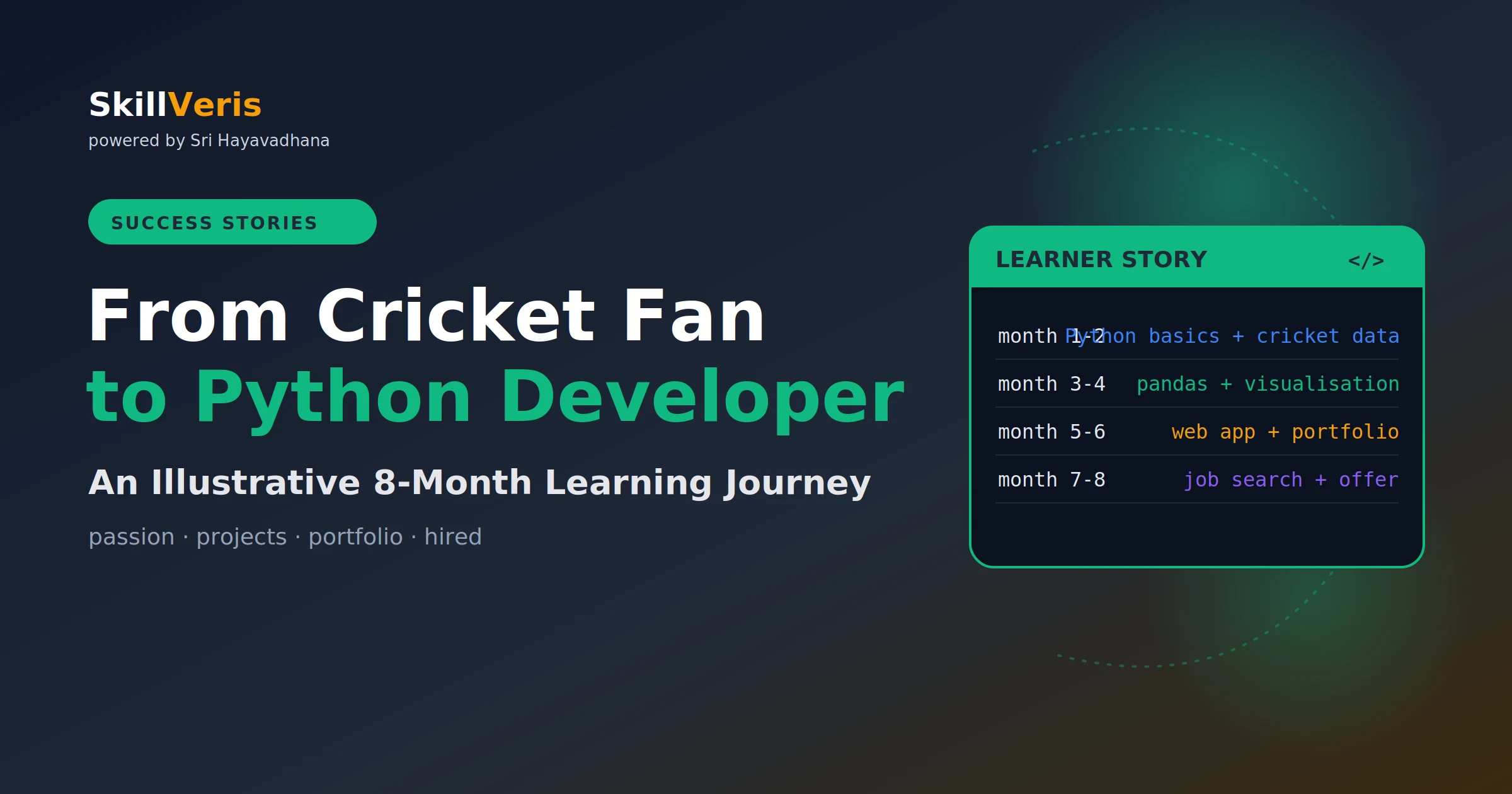
From Cricket Fan to Python Developer: An Illustrative Learning Journey
This is a composite illustrative journey — based on the real paths taken by many self- taught developers — showing how a passionate cricket fan used IPL data to learn Python, pandas, and data visualisation, and landed a data analyst role in 8 months.
NumPy for Data Science: Arrays and Vectorisation
NumPy is the foundation of Python's scientific computing stack. This guide covers ndarrays, vectorised operations, broadcasting, linear algebra, and why NumPy is 10-100x faster than equivalent Python loops — with practical examples for data science work.
Learn Data Science Through Bollywood Box Office Analytics
Bollywood produces hundreds of films a year and generates rich box office data. This project uses real film data to teach pandas groupby, matplotlib charting, correlation analysis, and time-series trends in a context that film fans genuinely find interesting.
Pandas for Data Analysis: A Complete Guide
Pandas is the Python library for working with tabular data. Learn DataFrames, selection, cleaning, grouping, and joins to analyze real datasets with confidence.
NumPy for Beginners: The Foundation of Data Science
NumPy powers Python's entire data science stack with fast numerical arrays. Learn arrays, vectorization, broadcasting, and indexing to compute at scale with clean code.
NumPy for Beginners: A Complete Tutorial
NumPy is Python's core library for fast numerical computing, built around the ndarray. Learn arrays, indexing, broadcasting, and vectorization in this beginner tutorial.
Data Cleaning in Python: A Practical Guide
Data cleaning fixes missing values, duplicates, wrong types, and outliers so analysis is trustworthy. This practical guide walks through the process with pandas.
How to Perform Exploratory Data Analysis in Python
Exploratory data analysis (EDA) summarizes and visualizes a dataset to understand its structure before modeling. Learn a repeatable EDA workflow with pandas.
How to Handle Missing Data in a Dataset
Handle missing data by first understanding why it is missing, then choosing to delete or impute. This guide covers the methods and the pitfalls with pandas.
Pandas GroupBy Explained With Examples
Pandas GroupBy splits a DataFrame into groups, applies an aggregation, and combines the results. Learn the split-apply-combine pattern with clear examples.
Merging and Joining DataFrames in Pandas
Combine Pandas DataFrames with merge, join, and concat. Learn inner, left, right, and outer joins, how keys work, and how to avoid duplicated rows.
Pandas Apply, Map and Applymap Explained
apply, map, and applymap all transform Pandas data but at different scopes. Learn when to use each, and why vectorised operations usually beat them all.
How to Read CSV and Excel Files With Pandas
Load CSV and Excel files into Pandas with read_csv and read_excel. Learn to handle encodings, delimiters, dtypes, dates, and messy real-world files.
How to Clean Messy Data with Pandas
Learn how to clean messy data with Pandas step by step: fix missing values, correct dtypes, drop duplicates, tidy strings, and reshape frames for analysis.
Excel to Python: Level Up Your Data Analysis
Move from Excel to Python for data analysis and map your spreadsheet habits to pandas, so you gain power and repeatability without losing everyday productivity.
Pandas GroupBy: The Analyst's Most Useful Tool
Master pandas GroupBy, the analyst's most useful tool, with the split-apply-combine pattern, real business questions, and clear examples you can reuse immediately.
COVID Data Analysis: A Guided Pandas Project
Learn pandas by analyzing real COVID data: load daily case counts, compute rolling averages, spot trends, and build honest visualizations that avoid misleading readers.
Web Scraping to Dataset: Your First End-to-End Project
Build your first end-to-end web scraping project: scrape a site responsibly, structure the results into a clean dataset, and analyze it with pandas from start to finish.
NumPy Basics Every Data Analyst Should Know
Master the NumPy basics every data analyst needs: arrays, vectorization, broadcasting, and why they crush plain Python loops for speed and clarity.
Working With CSV and Excel Files in Python
A practical guide to working with CSV and Excel files in Python: read, write, clean, and automate tabular data with pandas, no more manual spreadsheet drudgery.
How to Connect Python to a SQL Database
Learn how to connect Python to a SQL database, run queries safely, load results into pandas, and automate reports — a core skill for every data analyst.
Learn Pandas by Analyzing Your Fitness Data
Learn pandas by analyzing your fitness data — turn steps, heart rate, and workouts into a practice dataset that teaches real data-wrangling skills.
What Is Pandas in Python? A Beginner's Guide to Data Analysis
Pandas is a Python library that gives developers fast, flexible data structures for cleaning, analyzing, and transforming tabular data. This guide covers its core objects, common operations, and where it fits in a data workflow.
What Is NumPy and Why Does Python Need It?
NumPy is the foundational Python library for fast numerical computing, giving Python array operations that run at compiled-language speed. This guide explains what NumPy does, its core array object, and why so much of the Python data stack depends on it.
The Scientific Python Stack: NumPy, SciPy and Friends
The scientific Python stack is built on one data structure: NumPy's ndarray, a typed block of contiguous memory with shape and stride metadata. SciPy, pandas, scikit-learn and the deep learning frameworks all sit on that foundation, and understanding it explains their performance, their errors and their interoperability.
Data Wrangling With Pandas: A Practical Field Guide
Wrangling in pandas follows a repeatable arc: load with explicit types, inspect, clean, reshape, join, aggregate, then export in a format that preserves what you fixed. This guide walks that arc, names the failure at each stage, and shows the habits that keep a pipeline reproducible.
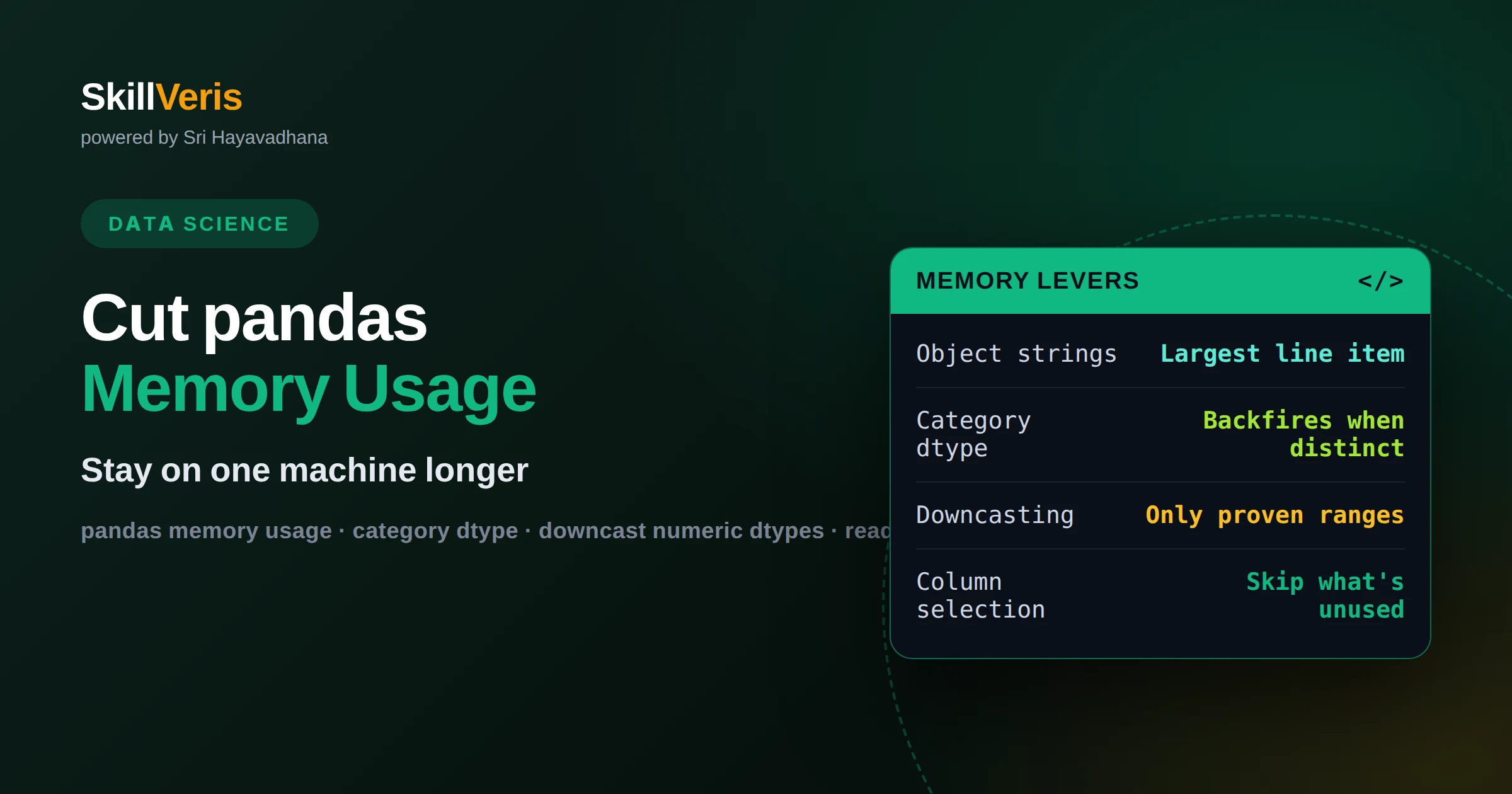
How to cut a pandas DataFrame's memory use before you reach for Spark
Most oversized DataFrames are oversized for three fixable reasons: strings stored as Python objects, 64-bit numerics that never needed the range, and columns you loaded but never used. Declaring dtypes at read time, converting low-cardinality text to category and selecting columns usually recovers enough room to stay on one machine.
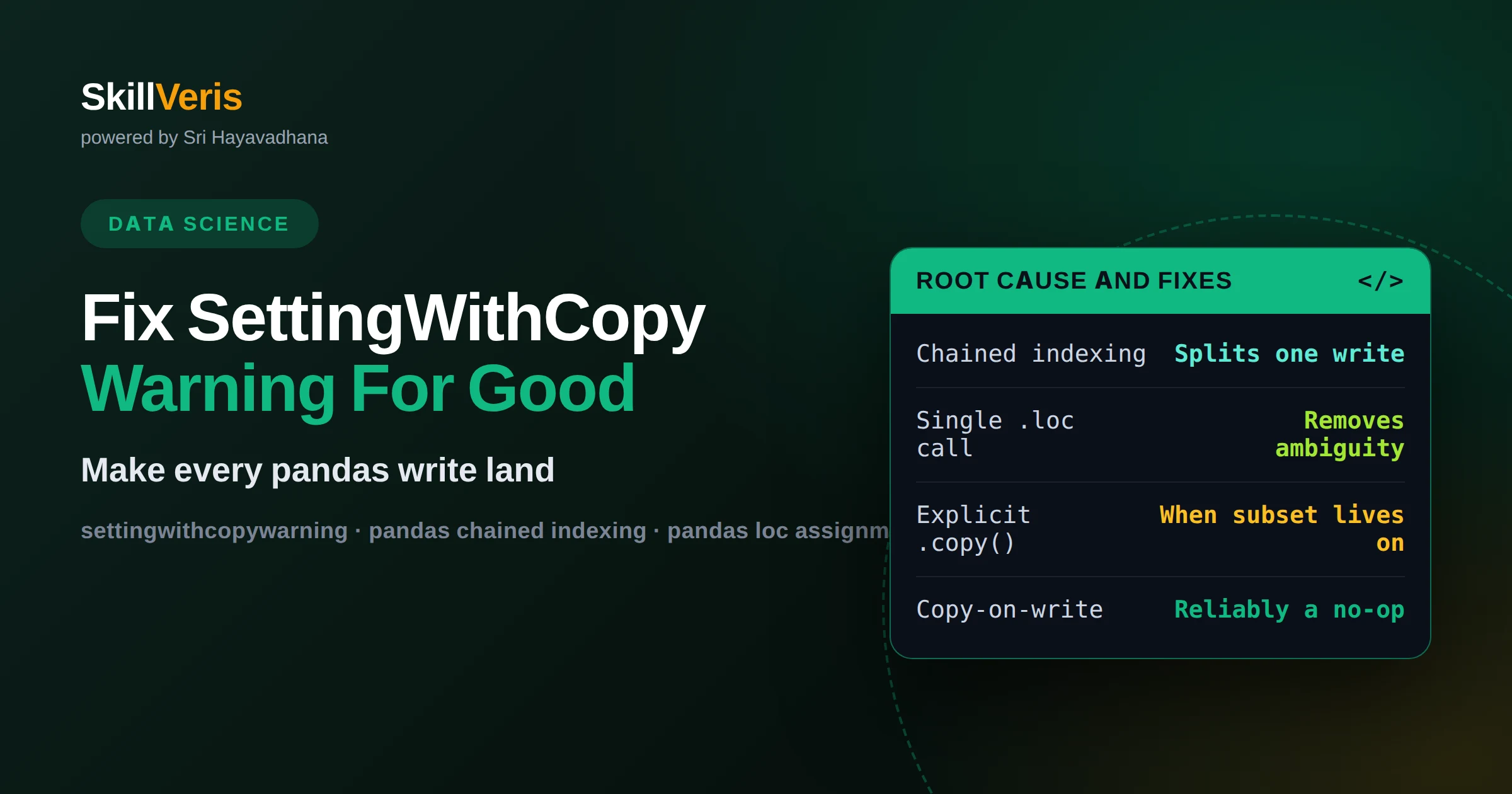
How to fix SettingWithCopyWarning in pandas for good
SettingWithCopyWarning means pandas cannot tell whether the object you are assigning into is a view of another frame or a fresh copy, so your write may silently go nowhere. The durable fix is structural: select and assign in one .loc step, or take an explicit .copy() when you mean to branch.
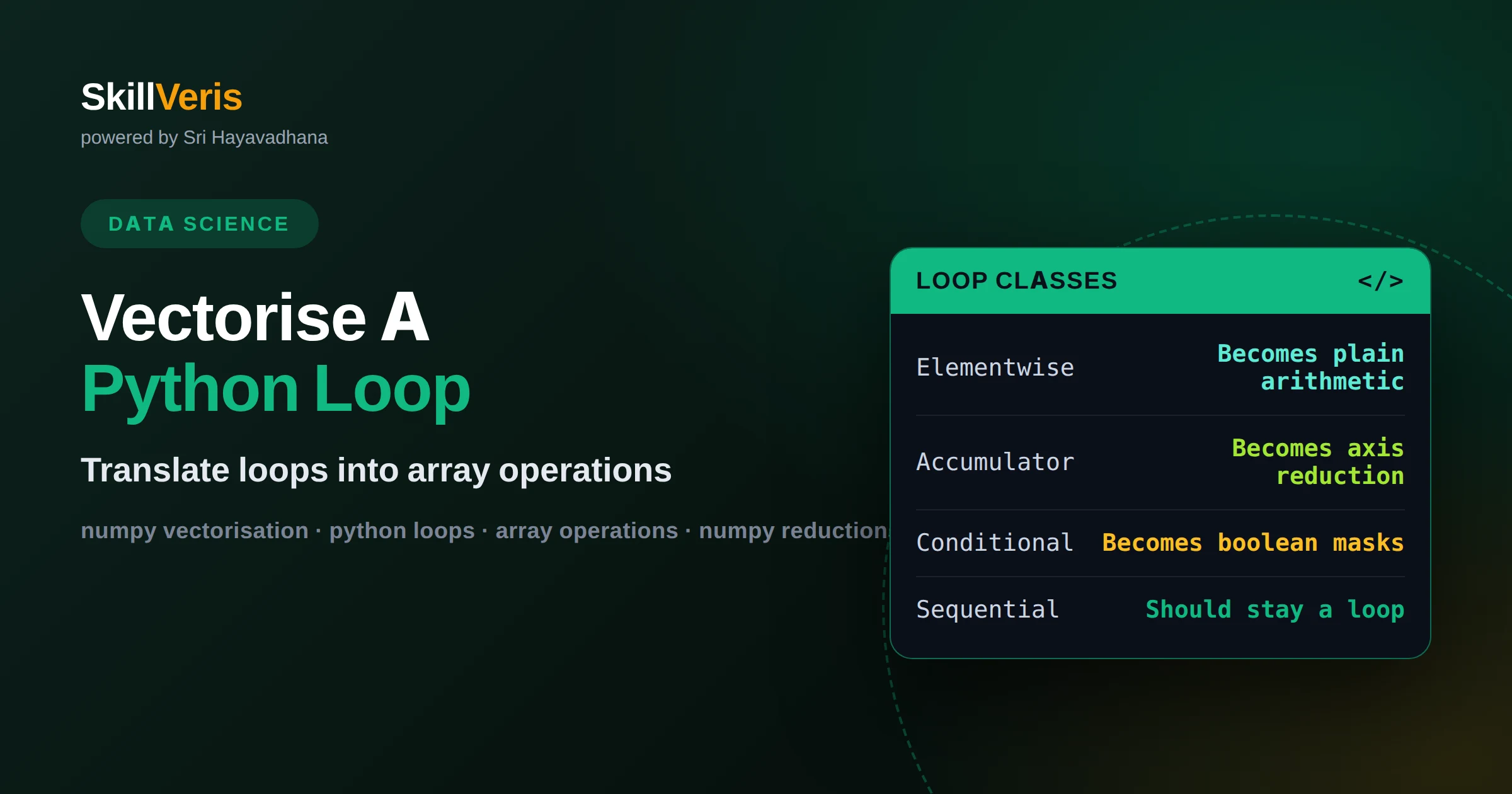
How to vectorise a Python loop with NumPy, step by step
Vectorising is a translation procedure, not a bag of tricks. Classify the loop first — elementwise, reduction, sliding window or conditional — then map it to its array form: arithmetic, a reduction with an axis, a windowed view or cumulative operation, and boolean masks or where.
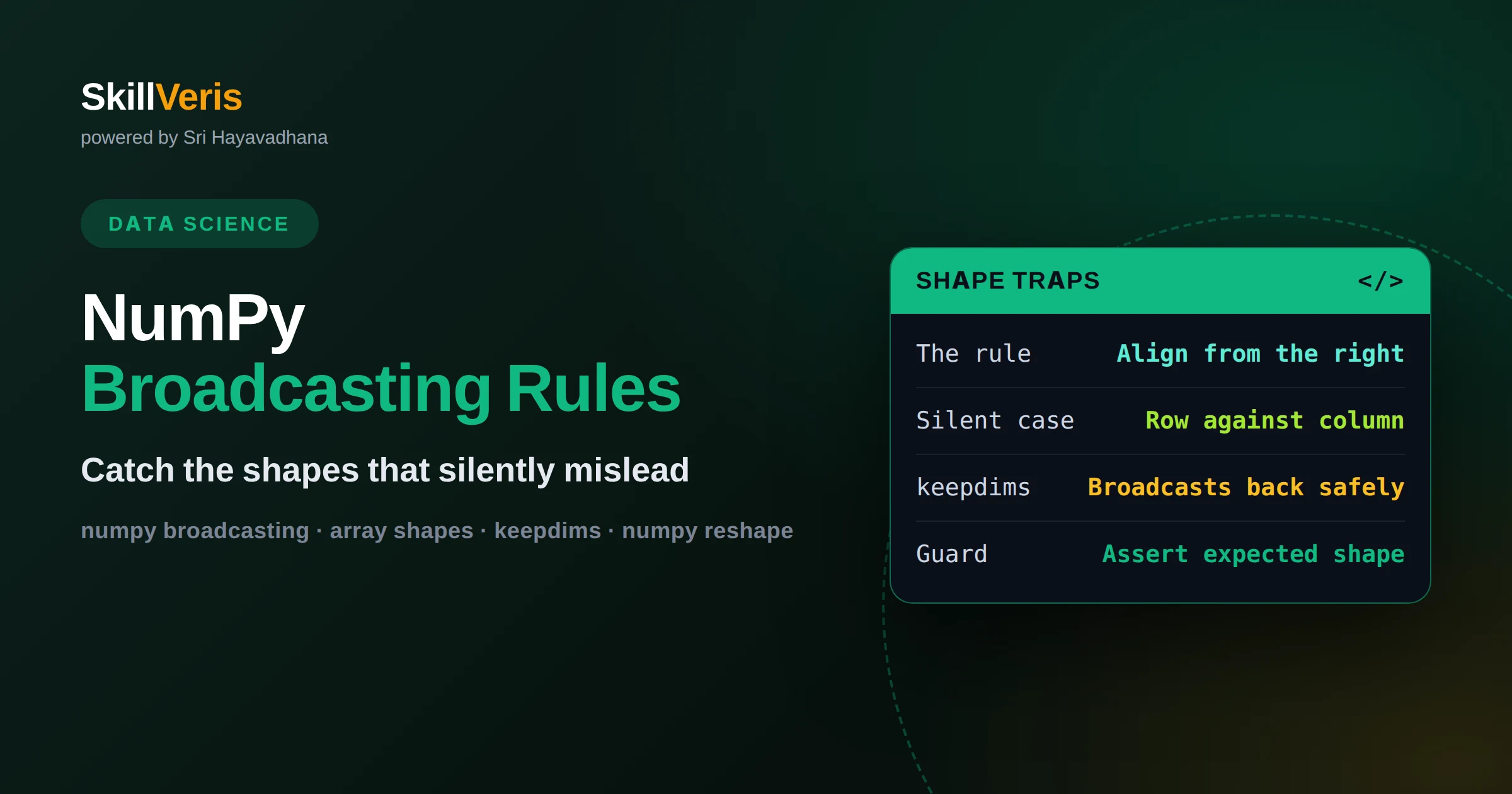
NumPy broadcasting: the rules, and the shapes that silently do the wrong thing
Broadcasting aligns array shapes from the trailing axis, stretching any axis of length one. The rule is short; the danger is the case it does not reject — a row vector against a column vector produces a full matrix where you wanted elementwise arithmetic, and every downstream number is wrong without an error.
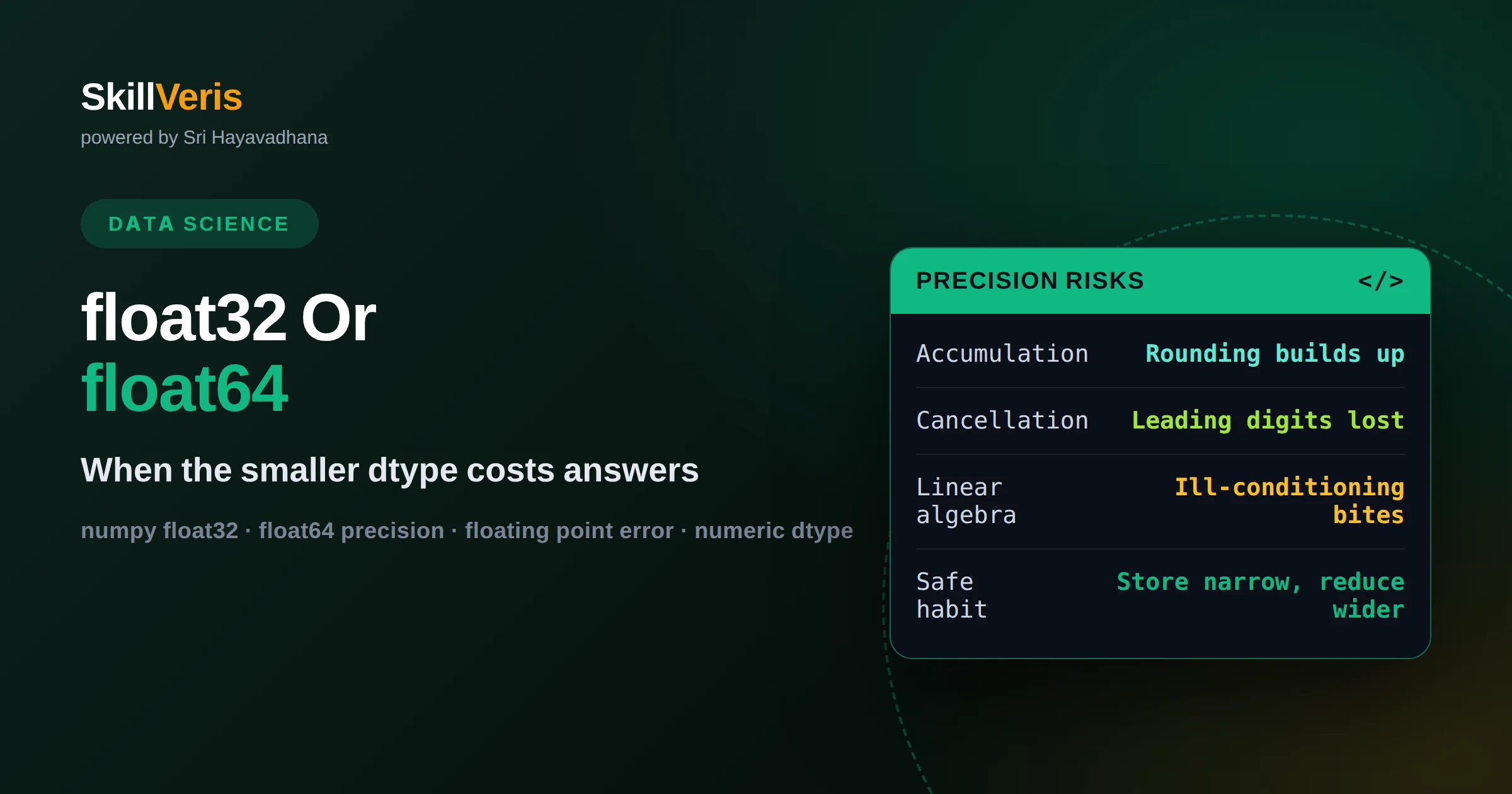
float32 vs float64 in NumPy: when the smaller dtype costs you an answer
The choice is about the operation, not the storage. Long accumulations, differences of large near-equal numbers and matrix inversion lose meaningful precision at the narrower width, while storage, image data and model inputs generally do not. The safe habit is to store narrow and reduce wider.
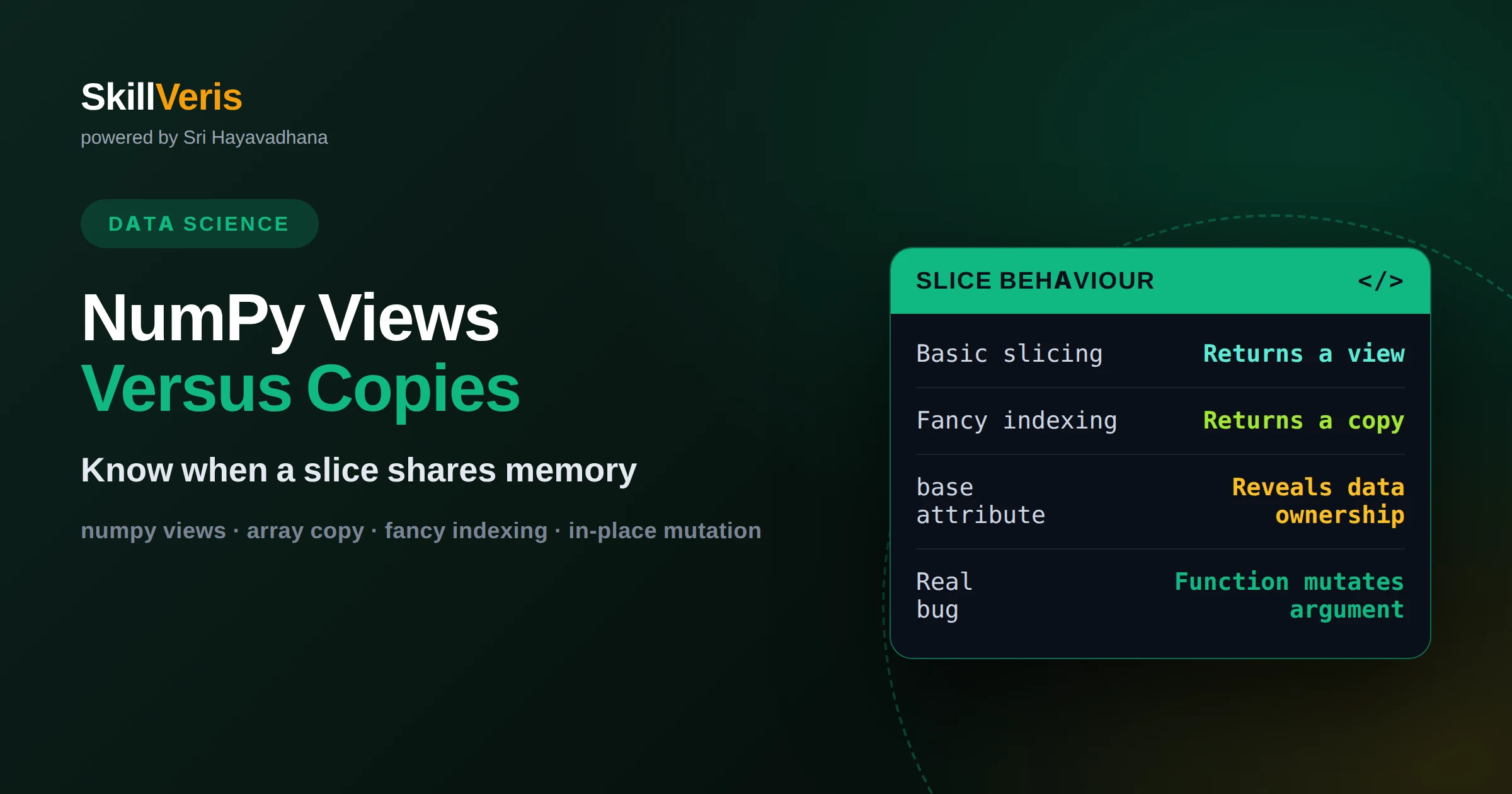
NumPy views vs copies: when a slice shares memory and when it does not
Basic slicing returns a view that shares memory with the original array; fancy indexing and boolean masks return copies. Rather than trusting recall, verify with the base attribute or a shared-memory check. The bug worth preventing is a function that mutates the array it was handed.
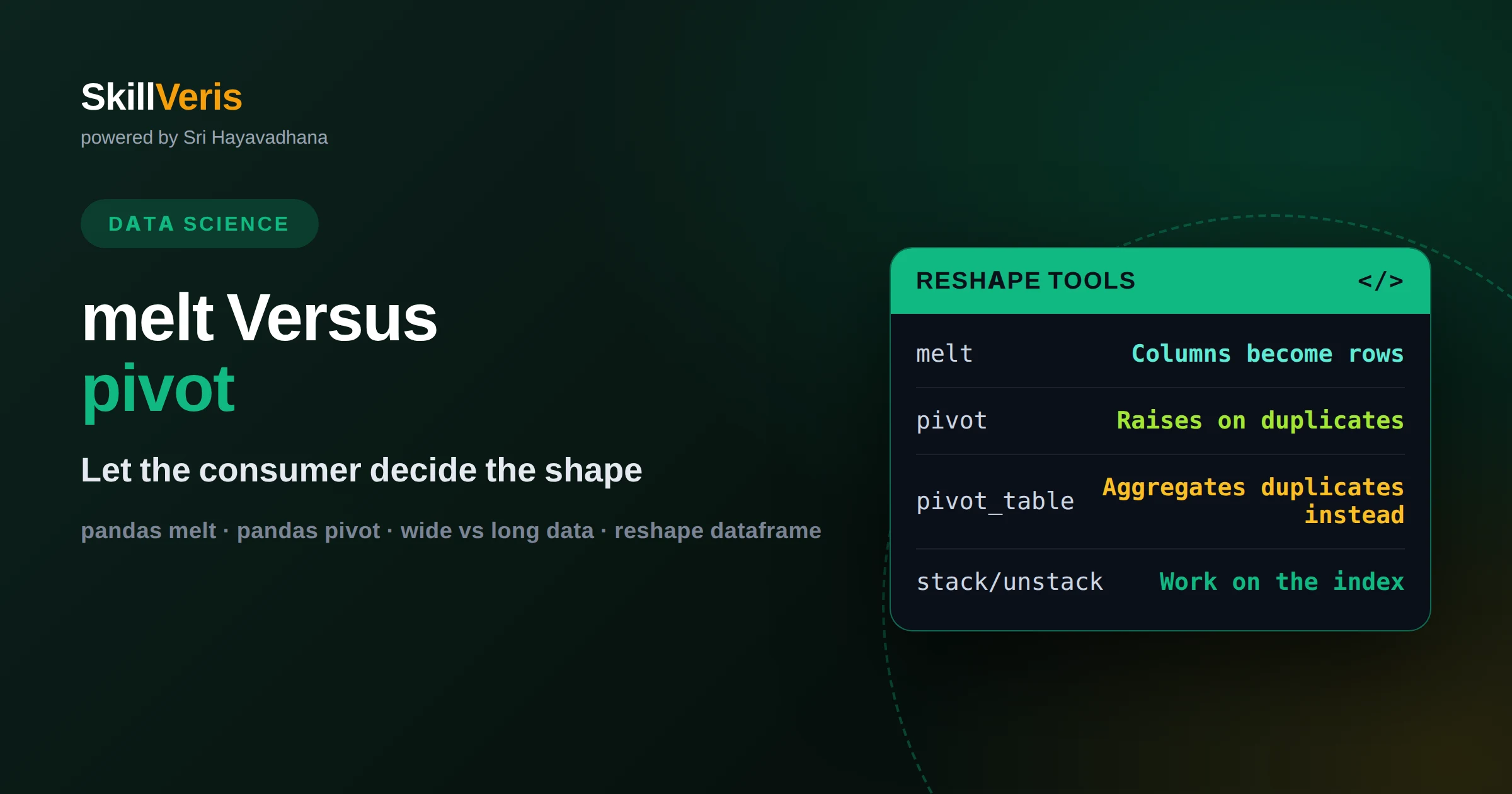
melt vs pivot in pandas: choosing wide or long for the job ahead
Choose the shape by what consumes the table, not by what looks tidier. Long form suits grouping, plotting and storage; wide form suits human reading and matrix-style model inputs. melt and stack go long, pivot and pivot_table go wide, and they differ mainly in what they do with duplicate pairs.
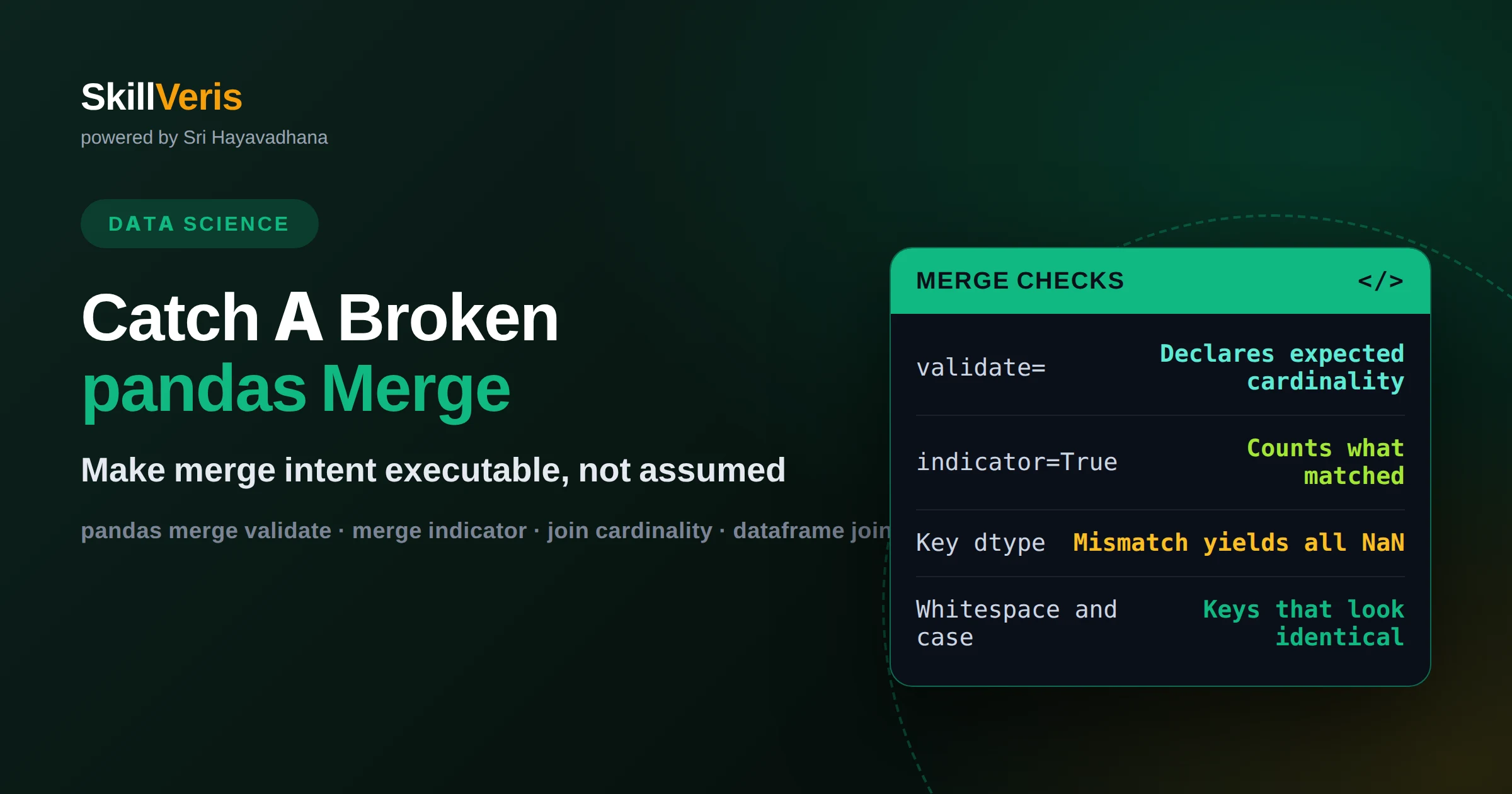
How to catch a broken pandas merge with validate and indicator
A pandas merge will not warn you when it multiplies rows or matches nothing at all. Passing validate= to declare the expected cardinality turns a silent many-to-many explosion into an exception, and indicator=True lets you count unmatched rows on each side before you trust the result.
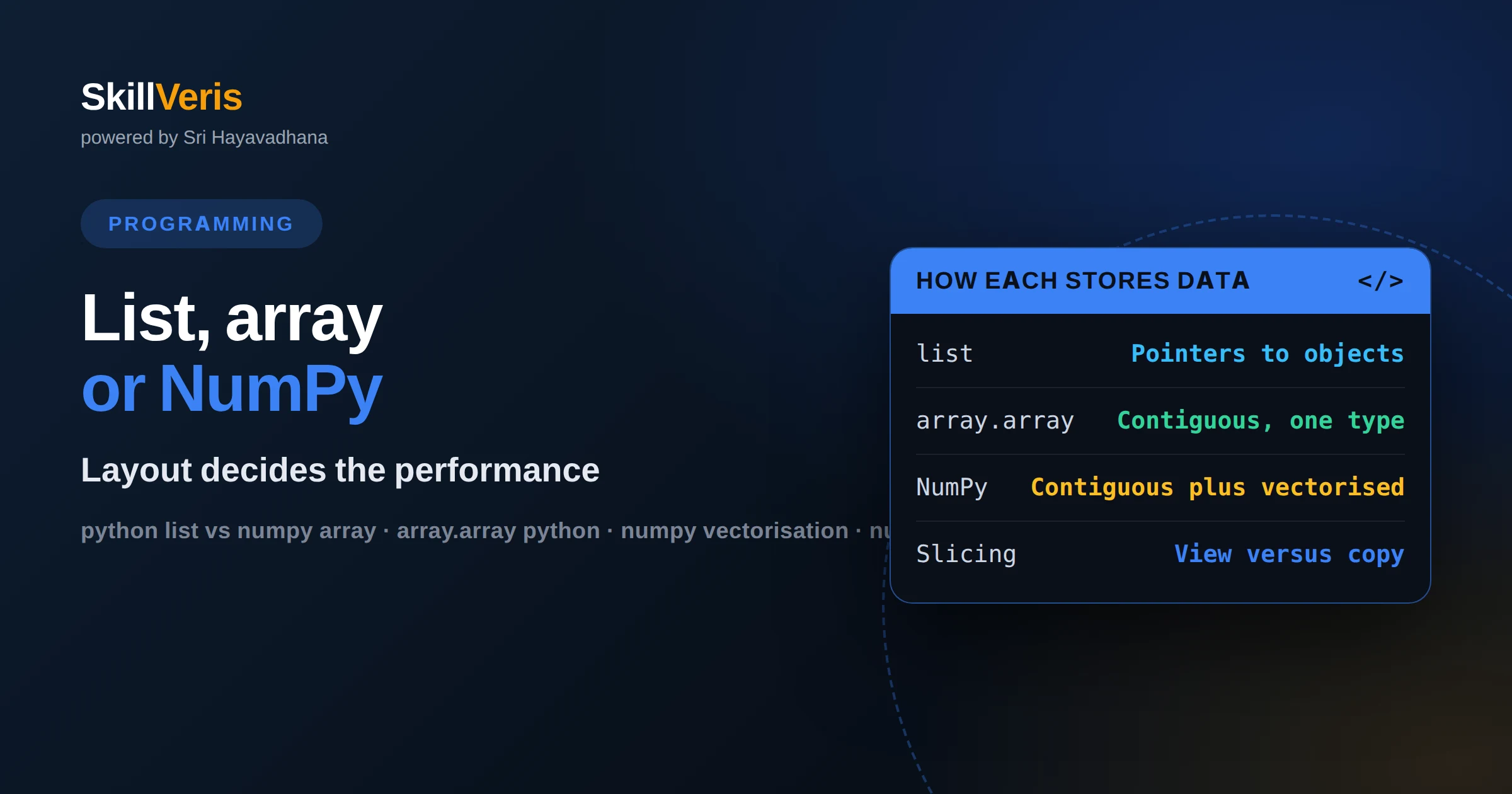
Python list vs array.array vs NumPy array
A list stores pointers to objects, array.array stores raw values of one type, and a NumPy array adds vectorised operations over that same contiguous buffer. The choice comes down to whether your data is homogeneous and whether you operate on it element-wise — and mixing Python loops with NumPy throws away the reason to use it.