The 2026 AI Engineer Roadmap: Skills, Tools, and Career Path
SkillVeris Team
AI Research Team
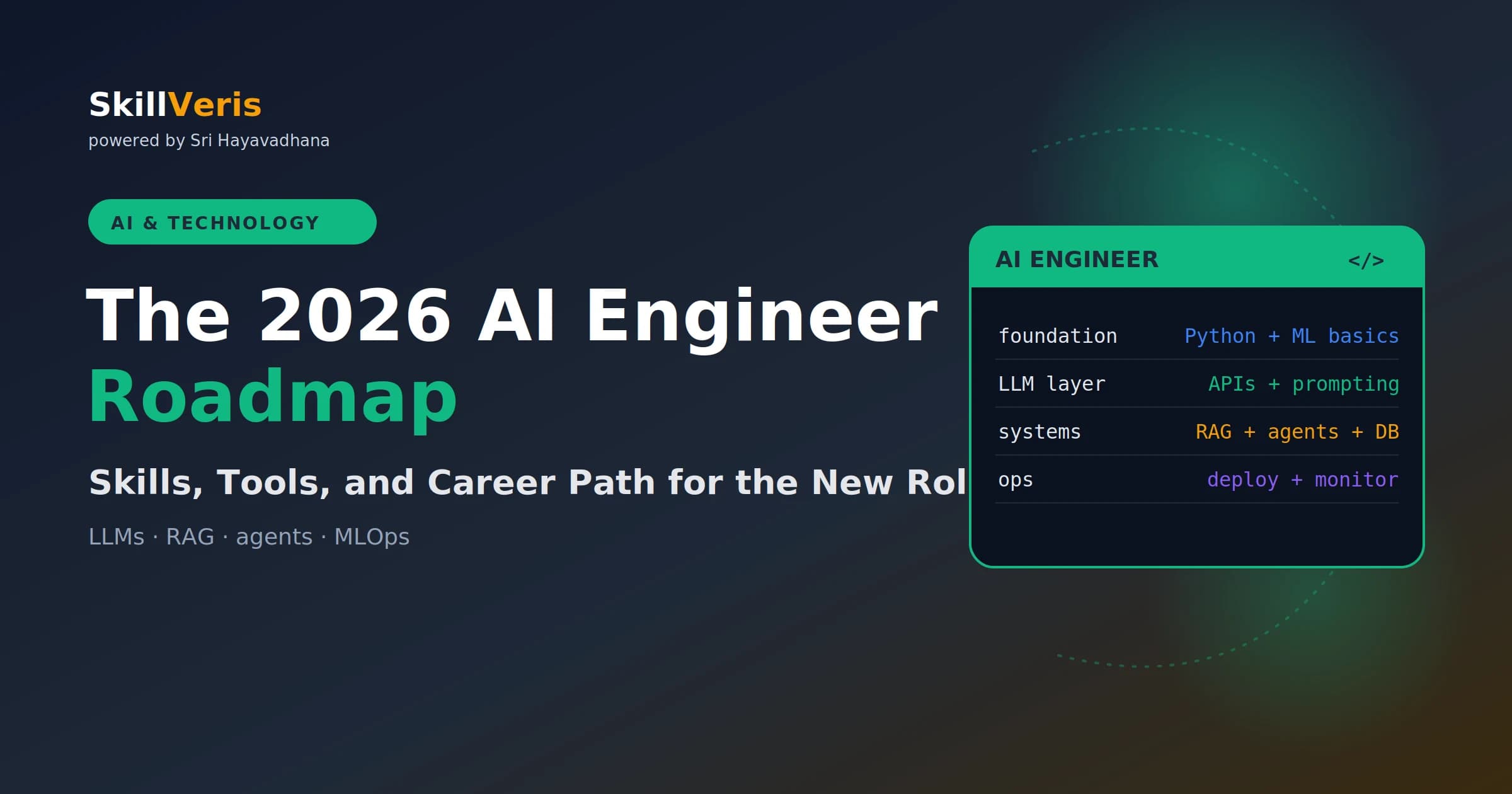
An AI engineer builds products with LLM APIs rather than training models from scratch — and it's achievable in 12–18 months with no ML PhD.
In this guide, you'll learn:
- The skill stack builds in order: Python, then LLM APIs and prompting, then RAG, then agents, then evaluation and deployment.
- AI engineering is more accessible than ML engineering, with a lower entry barrier and a software-first skill set.
- Evaluation is the most underrated layer — without it you can't know whether your system actually works.
- Deployment skills like Docker, FastAPI, caching, and observability turn prototypes into production systems.
1What Is an AI Engineer?
An AI engineer is a software engineer who specialises in building products and systems that use large language models and other AI capabilities. Unlike a machine learning engineer (who trains and deploys models) or a data scientist (who analyses data to generate insights), an AI engineer is primarily a builder — using pre-trained models via APIs to create applications: chatbots, RAG systems, AI agents, intelligent search, document processing pipelines, and voice interfaces.
The role emerged clearly in 2023–2024 as LLM APIs became the primary way most companies interacted with AI, and has grown rapidly into one of the most in-demand positions in tech. In 2026, AI engineer roles outnumber traditional ML engineer openings at most companies outside pure research organisations.
2AI Engineer vs ML Engineer vs Data Scientist
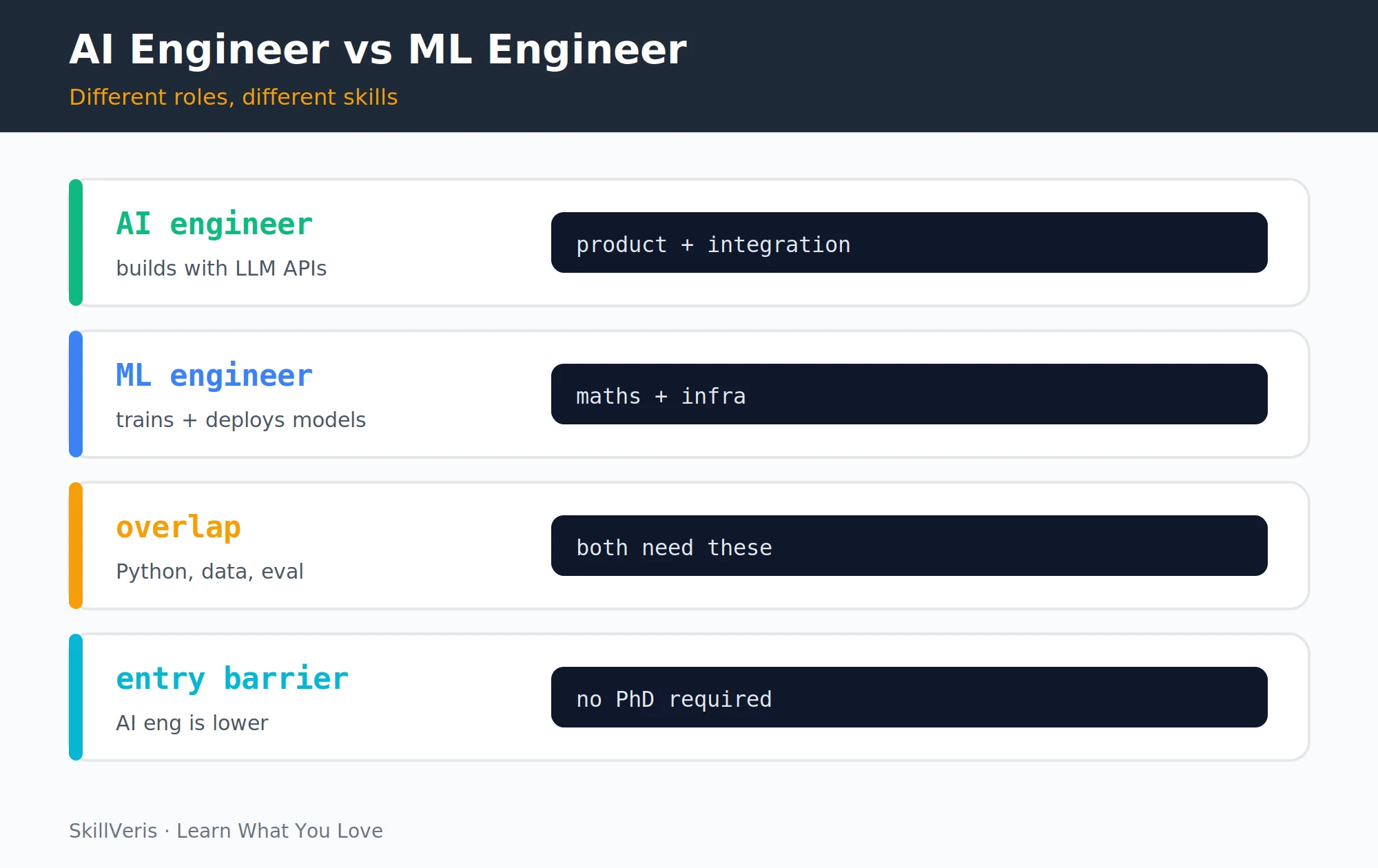
These three roles are related but distinct, and AI engineering is the most accessible entry point. The table below contrasts their primary work, core skills, maths requirement, tools, and entry barrier.
- Primary work — AI Engineer: build LLM-powered apps · ML Engineer: train and serve models · Data Scientist: analyse data, build models
- Core skills — AI Engineer: software eng + LLM APIs · ML Engineer: ML theory + MLOps · Data Scientist: statistics + Python/R
- Maths requirement — AI Engineer: low-medium · ML Engineer: high · Data Scientist: high
- Tools — AI Engineer: LangChain, vector DBs, APIs · ML Engineer: PyTorch, Kubernetes, CUDA · Data Scientist: Pandas, scikit-learn, SQL
- Entry barrier — AI Engineer: lower (no PhD typical) · ML Engineer: higher · Data Scientist: medium
3The 2026 AI Engineer Skill Stack
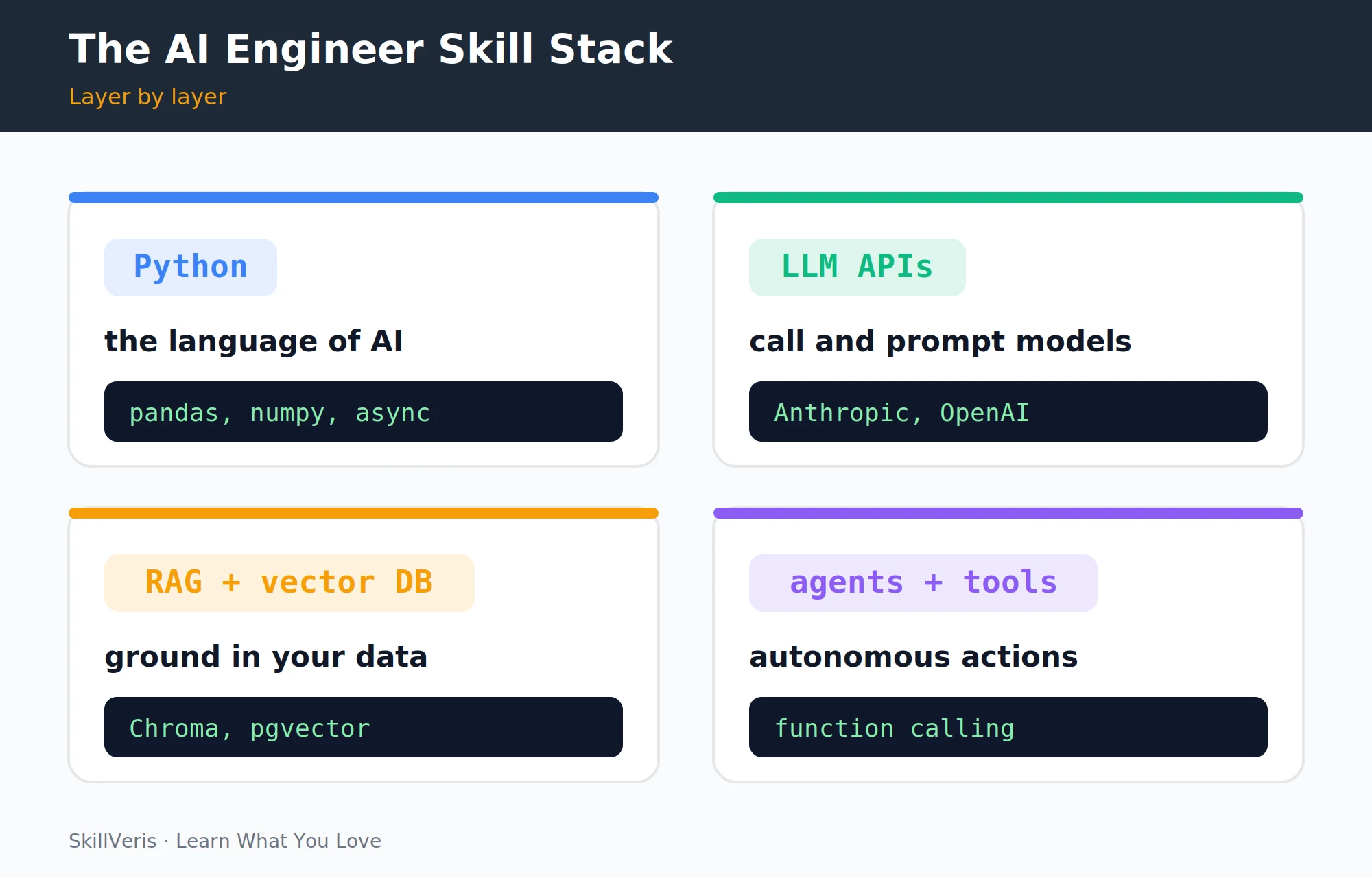
The AI engineer skill stack is layered: each layer builds on the previous. Don't jump to agents before you understand prompting; don't tackle RAG before you're comfortable with async Python and API calls.
- Layer 1: Python + software engineering fundamentals.
- Layer 2: LLM APIs, prompt engineering, and output parsing.
- Layer 3: RAG, embeddings, and vector databases.
- Layer 4: AI agents, tool use, and multi-agent orchestration.
- Layer 5: Evaluation, testing, and quality assurance for AI systems.
- Layer 6: Deployment, monitoring, and MLOps for LLM applications.
4Layer 1: Python and Software Fundamentals
AI engineering is software engineering first. Before any AI-specific content, build a solid base in Python and the surrounding tooling.
Estimated time: 2–4 months for someone new to programming; 2–4 weeks for an experienced developer coming from another language.
- Python fluency: functions, classes, async/await, type hints, virtual environments.
- REST APIs: making HTTP requests with httpx or requests, handling JSON, authentication.
- Git and GitHub: version control, pull requests, CI/CD.
- Linux basics: file system, SSH, running Python scripts on a server.
- Databases: SQL basics (SELECT, JOIN, GROUP BY), PostgreSQL, basic ORM usage.
5Layer 2: LLM APIs and Prompt Engineering
This layer is about reliably calling LLMs and shaping their output. Learn the messages format, prompting techniques, structured output, streaming, and cost estimation.
- Call the Anthropic, OpenAI, or Gemini API from Python.
- Understand the messages format: system, user, and assistant roles.
- Prompt engineering: zero-shot, few-shot, chain-of-thought, output formatting.
- Structured output: extract JSON reliably from LLM responses.
- Streaming: handle streamed responses for better UX.
- Token counting, context window management, and cost estimation (tokens in + tokens out × price per token).
Your First Meaningful LLM Call
A structured-extraction call that returns valid JSON from a single user message.
import anthropic, json
client = anthropic.Anthropic()
response = client.messages.create(
    model="claude-sonnet-4-6", max_tokens=512,
    system="Extract structured data. Respond only with valid JSON.",
    messages=[{"role": "user",
        "content": "Extract: name, company, role from: 'Hi I am Sathya from Sri Hayavadhana Info-Tech, I build Android apps'"}]
)
data = json.loads(response.content[0].text)
print(data) # {"name": "Sathya", "company": "Sri Hayavadhana Info-Tech", "role": "Android app developer"}6Layer 3: RAG and Vector Databases
Retrieval-augmented generation grounds the model in your own data. Learn embeddings, vector databases, chunking, the full pipeline, and how to evaluate retrieval quality.
Build project: a document Q&A system over your own notes or a public PDF corpus. Deploy it and evaluate retrieval quality with real queries.
- Embedding models: sentence-transformers, OpenAI embeddings, Voyage AI.
- Vector databases: Chroma (prototyping), pgvector (production with Postgres), Pinecone (managed scale).
- Document chunking strategies: fixed size, sentence, semantic, hierarchical.
- Full RAG pipeline: index → retrieve → augment → generate.
- Evaluation: retrieval recall, answer faithfulness, answer relevance (RAGAs framework).
- Advanced RAG: hybrid search, re-ranking, query rewriting.
7Layer 4: AI Agents and Tool Use
Agents let the model take actions through tools and loop until a task is done. Learn tool calling, the agent loop, memory management, multi-agent coordination, and safety.
Build project: a research agent that takes a question, searches the web, reads relevant pages, and writes a structured summary with citations.
- Function/tool calling: define tools in JSON schema, handle tool use responses, return results.
- The agent loop: perceive → plan → act → observe → repeat.
- ReAct pattern: interleaved reasoning and acting.
- Memory management: conversation history, summarisation, long-term storage in vector DB.
- Multi-agent coordination: orchestrator pattern with specialist sub-agents.
- Safety: iteration limits, human-in-the-loop for irreversible actions, prompt injection defence.
8Layer 5: Evaluation and Monitoring
This is the most underrated layer. Without evaluation, you don't know if your AI system is working.
- Automated eval: LLM-as-judge (use a model to score another model's outputs), RAGAS for RAG quality, task-specific metrics.
- Human eval: blind A/B comparisons, preference ratings, error labelling.
- Regression testing: a suite of test cases that must pass before any change goes to production.
- Production monitoring: log inputs, outputs, and latency; track error rates and user feedback.
- Evals-driven development: define what "good" looks like before writing any prompt, then iterate until evals pass.
9Layer 6: Deployment and MLOps
The final layer turns a working prototype into a reliable, observable production service. Containerise, serve, cache, control cost, manage secrets, and trace every call.
- Containerisation: Docker for packaging AI services.
- API serving: FastAPI + uvicorn for exposing AI capabilities as HTTP endpoints.
- Caching: cache LLM responses for identical inputs to reduce cost and latency (Redis, exact-match cache).
- Rate limiting and cost controls: prevent runaway API spend.
- Secrets management: never hardcode API keys; use environment variables and secret managers.
- Observability: LangSmith, Langfuse, or custom logging for LLM call traces.
1012-Month Learning Roadmap
A month-by-month plan turns the skill stack into a concrete schedule, each phase ending in a tangible milestone.
- Months 1–2 — Python + APIs + Git — Call an LLM API and parse the response
- Month 3 — Prompt engineering — Build a reliable structured extractor
- Months 4–5 — RAG fundamentals — Deploy a document Q&A app
- Month 6 — Vector databases — Semantic search over 10,000+ documents
- Months 7–8 — AI agents — Research agent with web search + citations
- Month 9 — Evaluation — Eval suite with 50+ test cases, automated scoring
- Months 10–11 — Deployment — FastAPI + Docker + cloud deployment of a full AI app
- Month 12 — Portfolio + job search — 3 deployed projects, active applications
11Portfolio Projects That Signal AI Engineering Skills
Three projects demonstrate the full AI engineer stack. Deploy all three publicly and document each with a README that includes an architecture diagram, tech stack, evaluation results, and known limitations.
- Document Q&A system: RAG over a public corpus (legal texts, research papers, product manuals). Shows: embeddings, vector DB, retrieval, augmented generation, evaluation.
- Research agent: given a question, searches the web, reads pages, synthesises an answer with citations. Shows: tool use, agent loop, multi-step reasoning, output formatting.
- Voice assistant: STT → LLM → TTS pipeline with domain-specific knowledge. Shows: multimodal, API integration, streaming, deployment.
12Key Takeaways
AI engineering rewards builders who combine software skills with disciplined evaluation and a strong portfolio.
- AI engineering is software engineering + LLM APIs + systems thinking. No ML PhD required.
- The stack builds in order: Python → prompting → RAG → agents → eval → deployment.
- Evaluation is the most underrated skill: without it you can't know if your system works or measure improvement.
- Three well-documented, deployed portfolio projects are more valuable than any certification for landing an AI engineering role.
13What to Learn Next
Start your AI engineering journey with these SkillVeris guides.
- Prompt Engineering Guide — master Layer 2 first.
- RAG Explained — the most impactful Layer 3 skill.
- AI Agents Explained — Layer 4 in depth.
14Frequently Asked Questions
Do I need a computer science degree to become an AI engineer? No. Many practising AI engineers come from software development, data analysis, or even non-technical backgrounds with a strong learning track. What matters: the ability to write clean Python, understand systems design, and reason about the behaviour of probabilistic systems. The roadmap above is achievable without formal CS education.
What salary can an AI engineer expect in 2026? Salaries vary significantly by location and experience. In India: ₹12–30 LPA for junior-mid roles; ₹30–70 LPA+ for senior AI engineers at product companies. In the US: $150k–$250k+ for experienced AI engineers at top companies. Verify current market rates on LinkedIn Salary, Glassdoor, or levels.fyi before negotiating.
Is Python the only language for AI engineering? Python dominates for LLM integration, data processing, and ML tooling. TypeScript/Node.js is increasingly common for AI-powered web applications (LangChain.js, Vercel AI SDK). Rust is used in performance-critical inference infrastructure. Start with Python; add TypeScript once you're building web-facing AI features.
How is AI engineering different from working with AI as a non-engineer? Non-engineers use AI tools (ChatGPT, Claude, Copilot) to improve their own work. AI engineers build the systems that others use — they write the code that calls the APIs, manages the context, processes the outputs, and handles the edge cases. The distinction is builder vs user, and it requires software engineering skills on top of AI knowledge.
Related Reading
Get The Print Version
Download a PDF of this article for offline reading.
About the Publisher
SkillVeris Team
AI Research Team
Our AI team covers the latest in machine learning, generative AI, and emerging tech — clearly and accurately.
View all postsRelated Posts
Never miss an update
Get the latest tutorials and guides delivered to your inbox.
No spam. Unsubscribe anytime.