100% Free Forever
AI-Powered Learning
Industry Expert Content
Certificates & Badges
Learn At Your Own Pace
HomeBlogTime Management Tips for Self-Taught Coders
Career Growth

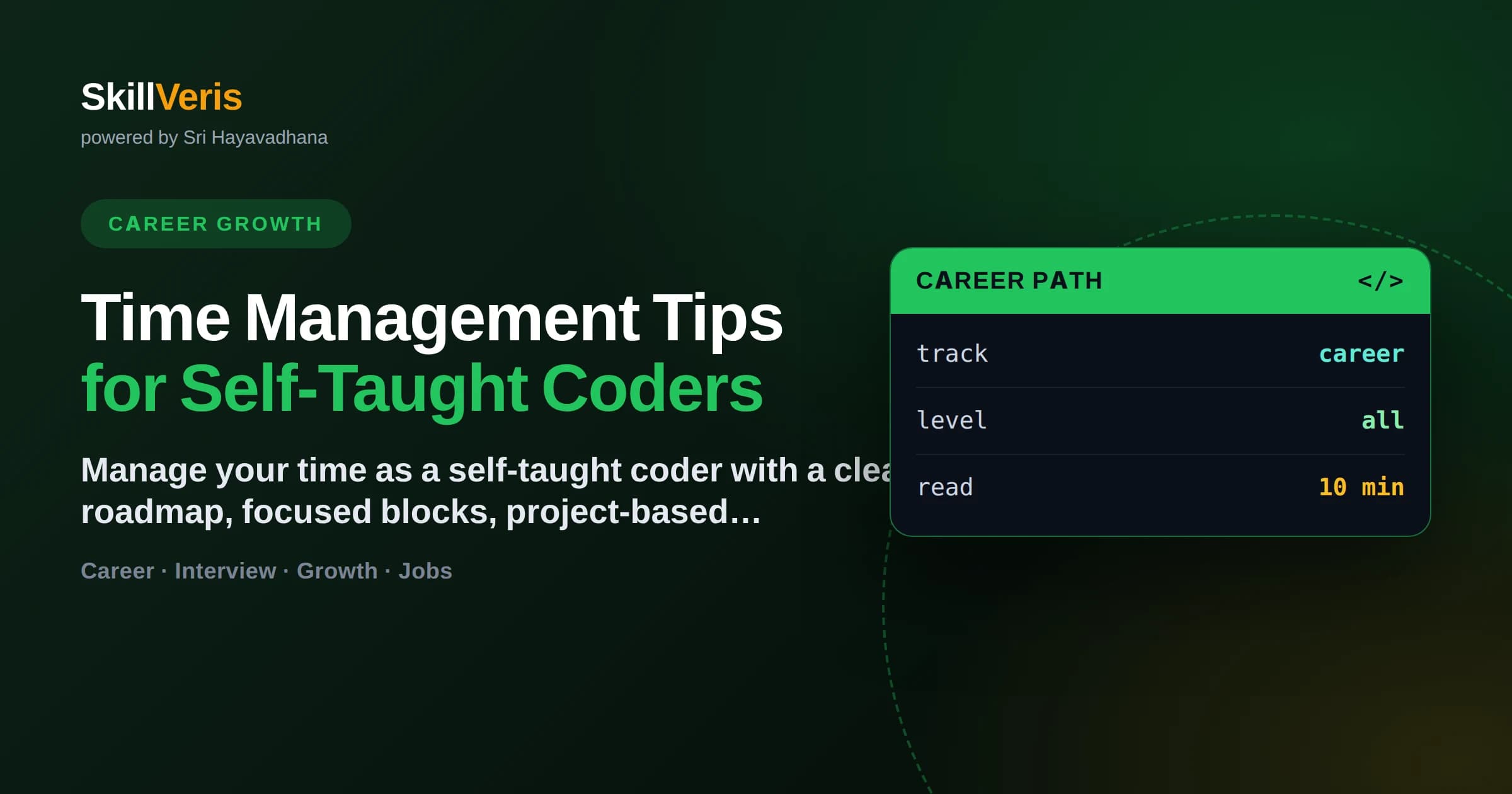
Time Management Tips for Self-Taught Coders

SV

SkillVeris Team

Careers Team

Apr 30, 2025 10 min read
Share:
Time Management Tips for Self-Taught Coders
Key Takeaway

Manage your learning time by following a clear roadmap, working in focused blocks, and choosing consistency over occasional marathons.

In this guide, you'll learn:

  • Without a set curriculum, a written roadmap keeps you from wandering between random tutorials and losing momentum.
  • Short, regular sessions build skill more reliably than rare all-day binges that lead to burnout.
  • Project-based learning turns study time into real progress and fights the trap of endless passive tutorials.
  • Protect focus by removing distractions and batching learning into deliberate, uninterrupted blocks.

1Time Management for Self-Taught Coders

The most effective time management for self-taught coders combines a clear roadmap, focused learning blocks, and consistency over intensity. Without the structure a school or bootcamp provides, you have to build your own — deciding what to learn, in what order, and protecting the time to do it. A written plan plus short, regular, distraction-free sessions beats sporadic marathon days almost every time.

This matters because self-taught learners face two silent time-killers: aimless wandering between tutorials, and inconsistent effort that never compounds. Solving both is less about finding more hours and more about spending the hours you have deliberately.

2Start With a Roadmap

The biggest time drain for self-taught coders is not knowing what to learn next, which leads to jumping between random tutorials without ever going deep. A roadmap fixes this by giving you a clear sequence, so every session has an obvious next step and you stop wasting energy deciding where to start.

  • Pick one clear goal — a job, a project, or a specific skill.
  • Work backward into the topics that goal actually requires.
  • Sequence them from fundamentals to advanced, one at a time.
  • Use an established curriculum or roadmap instead of inventing your own.
  • Revisit the plan monthly and adjust as your goal sharpens.

💡Pro Tip

You do not have to design your curriculum from scratch. Follow a well-regarded roadmap or structured course, and spend your energy learning rather than planning.

3Consistency Beats Intensity

A little every day outperforms a lot once in a while. Studying for a focused hour most days builds skill and habit far more reliably than a single exhausting weekend session that leaves you drained and skipping the next two weeks. Regular exposure also helps material move into long-term memory, so you spend less time relearning what you forgot.

Consistency is especially powerful for people learning around a job or other commitments. You may not have large blocks of time, but small, dependable sessions compound. The goal is a sustainable rhythm you can hold for months, not a heroic burst you cannot repeat.

🔑Key Insight

Learning to code is a compounding process. Frequent small deposits of focused time grow far more than rare large ones separated by long gaps.

4Work in Focused Blocks

Deep learning requires uninterrupted attention, so batch your study into deliberate blocks free of distraction. Techniques like working in timed intervals with short breaks help sustain focus, but the core idea is simple: protect a defined window, remove interruptions, and give the material your full attention rather than studying with a phone buzzing beside you.

Setting Up a Focus Block

A few small setup steps dramatically improve the quality of your learning time.

code
Silence notifications and put your phone out of reach.
Pick one topic or task for the block, not several.
Use a timer to work in focused intervals with short breaks.
Keep a notepad for stray thoughts so you do not chase them.
End with a note on where to resume next time.

5Learn by Building, Not Just Watching

Project-based learning is one of the best uses of limited time because it turns study into visible progress and forces active recall. Passive tutorial-watching can consume hours while producing little durable skill. Building something real — even small — makes every session count and keeps motivation high because you can see what you have made.

  • Apply new concepts in a project within a day of learning them.
  • Prefer building a small tool over watching one more tutorial.
  • Let real problems, not a syllabus, drive what you look up.
  • Keep a portfolio of finished projects as proof of progress.

6Escape the Tutorial Trap

Endless tutorials feel productive but often are not. Because everything works when you follow along, you can spend weeks 'learning' without ever writing independent code. The fix is a firm rule: for every tutorial you complete, build something on your own that uses what it taught, so knowledge converts into ability.

7Track Progress and Review

Because no one else is grading you, self-tracking keeps your limited time honest and aimed at your goal. Regularly reviewing what you have learned, what you have built, and what is next prevents drift and keeps motivation up. Seeing tangible progress is also one of the strongest defences against giving up during the inevitable hard stretches.

  • Keep a simple log of sessions, topics, and projects.
  • Review weekly: what stuck, what did not, what is next.
  • Set small milestones so progress stays visible.
  • Adjust your roadmap when your goals or interests shift.

8Common Mistakes to Avoid

Self-taught learners tend to lose time in a few predictable ways.

  • Jumping between random tutorials with no roadmap.
  • Relying on rare marathon sessions instead of steady practice.
  • Watching content passively without building anything.
  • Studying with constant distractions and no focused blocks.
  • Never reviewing progress, so effort quietly drifts off course.

⚠️Watch Out

Feeling busy is not the same as making progress. Hours of passive tutorials with no project to show for them is time spent, not skill gained.

9Key Takeaways

Make your self-taught time count with these principles.

  • Follow a clear roadmap so every session has a purpose.
  • Choose consistent short sessions over rare marathons.
  • Protect focus with distraction-free, timed blocks.
  • Learn by building real projects, not just watching tutorials.
  • Track progress and review regularly to stay on course.

10Frequently Asked Questions

Q: How many hours a day should a self-taught coder study? A: There is no magic number, and consistency matters more than volume. A focused hour most days often beats sporadic long sessions, and even less is fine if it is regular. Choose a sustainable amount you can maintain for months around your other commitments rather than an intense schedule you will abandon.

Q: How do I stay disciplined without a teacher or deadlines? A: Build external structure yourself: a roadmap, a schedule, milestones, and a progress log. Project deadlines you set, public commitments, or study communities add accountability. Making your plan concrete and visible replaces much of the structure a formal program would otherwise provide.

Q: Is it better to finish one tutorial or build a project? A: Building a project almost always teaches more, because it forces active problem-solving and recall. Use tutorials to learn a concept, then immediately apply it in something of your own. The combination of guided input and independent building is what turns watching into real skill.

Q: How do I avoid wasting time deciding what to learn next? A: Adopt an established roadmap or structured course so the sequence is already decided for you. This removes daily decision fatigue and stops the aimless tutorial-hopping that drains so much time. Spend your energy learning the material, not endlessly researching how to learn it.

📄

Get The Print Version

Download a PDF of this article for offline reading.

About the Publisher

SV

SkillVeris Team

Careers Team

Our careers team helps you navigate tech job markets, build portfolios, and land the roles you want.

View all posts

Never miss an update

Get the latest tutorials and guides delivered to your inbox.

No spam. Unsubscribe anytime.

Frequently Asked Questions

21 categories · pick one to explore

Does SkillVeris have a tech blog, and what does it cover?
Yes, the SkillVeris blog has over 500 articles covering AI and machine learning, programming, web development, DevOps, cloud, security, databases and career guidance. Articles are practical and answer-first, and many use the Learn Through Hobbies approach, teaching technical concepts through cricket, music, gaming or cooking analogies. Everything is free to read.
What is the SkillVeris tech glossary and how big is it?
The SkillVeris glossary is a free reference of roughly 2,000-plus technology terms, each with a clear plain-language definition. It spans AI, programming, web, DevOps, cloud, security and database vocabulary, so whenever a lesson, article or job description uses jargon you do not recognise, the glossary gives you a fast, reliable answer.
Are the developer cheat sheets on SkillVeris free to download?
The cheat sheets are completely free to use, like everything else on SkillVeris. Each sheet condenses a language or tool into its essential syntax, commands and patterns for quick reference while coding. They are designed for rapid lookup during real work, complementing the deeper explanations found in study notes and courses.
Which programming references and cheat sheets are available?
Cheat sheets cover the platform's main domains, including programming languages, AI and ML tooling, web development, DevOps, cloud, security and databases, matching the topics of the 37 live courses. Each sheet lists related reading links and hashtags, so you can jump from a quick reference into fuller study notes or blog articles.
How do I find the meaning of a technical term quickly?
Search the SkillVeris glossary, which holds around 2,000-plus terms with concise, plain-language definitions. Each entry gets to the point in its first sentence, then links to related reading like blog posts or study notes for deeper context. It is faster and more consistent than sifting through scattered search results.
Is the SkillVeris blog good for beginners learning to code?
Yes, many blog articles are written specifically for beginners, and the Learn Through Hobbies style makes them unusually approachable: you might learn Python concepts through cricket or understand APIs through cooking. With 500-plus articles across skill levels, beginners can start with fundamentals and keep reading as they advance, entirely free.
Can cheat sheets replace full courses for learning a language?
No, cheat sheets are references, not teaching tools; they assume you already understand the concepts and just need syntax or commands fast. To actually learn a language, take a structured SkillVeris course with its 24–40 lessons and assessments, then keep the cheat sheet beside you while practising in Code Lab.
How often are new blog articles published on SkillVeris?
The blog grows regularly and already exceeds 500 articles, with new posts added as courses launch and technologies evolve. Topics track the platform's catalogue across AI, programming, web development, DevOps, cloud and security, so checking the Blog section periodically surfaces fresh tutorials, explainers and career-focused pieces, all free to read.
Does the glossary cover AI and machine learning terms?
Yes, AI and machine learning vocabulary is a major part of the roughly 2,000-plus term glossary, covering everything from foundational terms to modern concepts around LLMs, RAG and MLOps. Definitions are plain-language and answer-first, which helps when dense AI papers or course lessons throw unfamiliar jargon at you.
Are there cheat sheets for interview preparation?
Cheat sheets work well as interview-day refreshers because they compress syntax, commands and key concepts into scannable references. For dedicated preparation, combine them with the SkillVeris interview questions feature, which includes readiness scoring, plus study notes for depth. Reviewing a relevant cheat sheet just before an interview steadies recall under pressure.
Can I read the tech blog without signing up?
Yes, the blog is freely readable, and SkillVeris never charges for content. All 500-plus articles are open, covering tutorials, concept explainers and career advice. Creating a free account adds value elsewhere on the platform, like course progress tracking and certificates, but reading the blog requires no commitment at all.
How is the SkillVeris glossary different from Wikipedia?
The glossary is purpose-built for learners: definitions are short, plain-language and answer-first, sized for a quick lookup mid-lesson rather than a deep encyclopedic read. Entries also cross-link to related SkillVeris study notes, blog posts and courses, so a definition becomes a doorway into structured learning instead of a dead end.
Do blog articles use the Learn Through Hobbies method?
Many blog articles teach technical topics through hobby analogies, a hallmark of the SkillVeris blog, so you will find articles explaining programming through cricket, machine learning through music, or system design through cooking. The analogy is the teaching device; the article still delivers the real technical concept underneath.
Where can I find quick programming references while coding?
Open the SkillVeris cheat sheets, which are built exactly for that moment: compact, scannable references for syntax, commands and common patterns across languages and tools. Keep the relevant sheet in a browser tab while you work in Code Lab or your own editor, and dip into the glossary for terminology.
Is there a glossary entry for terms I meet in job descriptions?
Very likely yes, with roughly 2,000-plus terms across AI, programming, web, DevOps, cloud, security and databases, the glossary covers most jargon that appears in tech job descriptions. Decoding a listing this way helps you judge role fit honestly and prepares you to discuss those terms in interviews.
Are the blog articles written for the Indian tech audience?
The blog serves Indian learners plus a worldwide audience. Content stays globally relevant while acknowledging realities that matter in India, such as free access being essential for students and freshers, and career guidance that connects naturally to the SkillVeris jobs portal, which aggregates roles across India, UK, USA, Germany and Remote.
Can I suggest a topic for the blog or glossary?
SkillVeris content grows in response to what learners need, so feedback is welcome through the platform's support channels. If a term is missing from the glossary or a topic deserves an article, telling the team helps prioritise it. Meanwhile, the AI Mentor can answer the question immediately, 24/7, at any depth.
Do cheat sheets and glossary entries link to deeper learning?
Yes, every cheat sheet and glossary entry carries related reading links into study notes, blog articles and courses, plus concept hashtags for discovering similar content. This cross-linking means a thirty-second lookup can smoothly become a structured learning session whenever you decide you want more than a quick answer.
What makes SkillVeris programming references trustworthy?
The references are written to strict internal quality standards, kept consistent with the platform's 37 live courses, and never padded with invented statistics or hype. Definitions and cheat sheets are reviewed against the same content contracts that govern courses, and the answer-first style makes any inaccuracy easy to spot and correct.
How do the blog, glossary and cheat sheets fit into my learning routine?
Use them as satellites around your main course: read blog articles for context and motivation, hit the glossary the instant jargon appears, and keep cheat sheets open while coding. Together with study notes, Code Lab and the 24/7 AI Mentor, they turn passive reading into a complete, free learning system.

What Learners Say

Real journeys from the SkillVeris community — swipe for more.

SkillVeris taught me Python through Cricket. Now I’m building real projects and feeling confident!
Arjun S. · B.Tech Student
The best platform for hobby-based learning. Concepts finally stick.
Priya R. · Data Analyst
I went from zero coding to a portfolio of projects — all by learning through my love for gaming. Landed my first internship!
Kabir M. · CS Undergraduate
Trending Topics50 popular tags — tap to explore
Trending CoursesAll 37 free courses — tap to browse