100% Free Forever
AI-Powered Learning
Industry Expert Content
Certificates & Badges
Learn At Your Own Pace
HomeBlogHow to Build a Standout Tech Resume in 2026
Career Growth

How to Build a Standout Tech Resume in 2026

SV

SkillVeris Team

Careers Team

Apr 28, 2026 8 min read
Share:
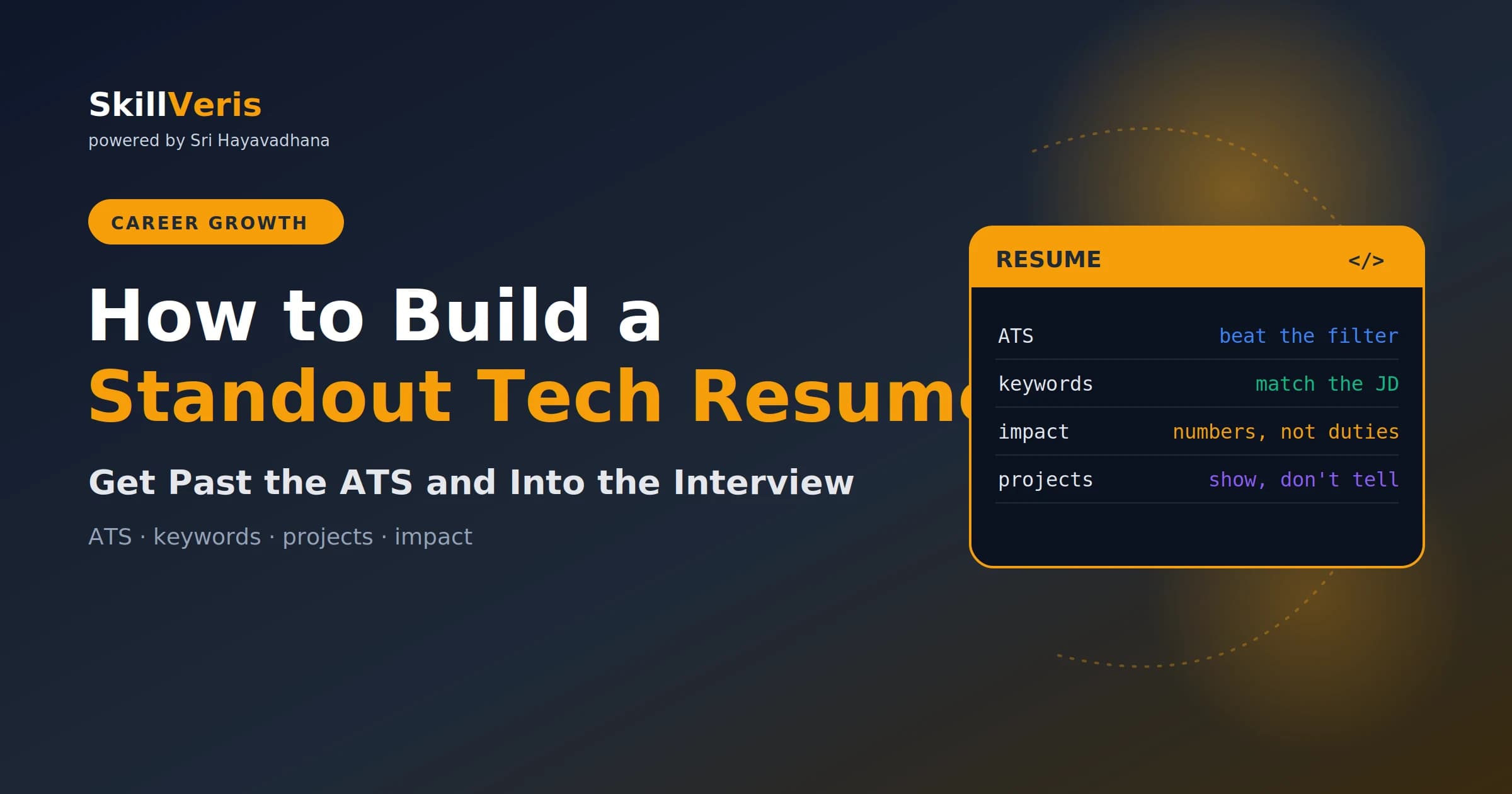
How to Build a Standout Tech Resume in 2026
Key Takeaway

A strong tech resume passes the ATS, proves impact with numbers, and shows your work through project and GitHub links.

In this guide, you'll learn:

  • Most resumes are rejected by an Applicant Tracking System before a human ever reads them.
  • Keep it to one page under 5 years of experience and two pages maximum after that.
  • Write experience bullets as action + result + scale, not lists of job duties.
  • Mirror the job description's exact keywords and capitalisation in your Skills and Experience sections.

1Why Most Resumes Fail

The average tech job listing receives hundreds of applications. Most companies use an Applicant Tracking System (ATS) to filter them before a human ever reads them. The majority of resumes are rejected at this stage — not because the candidate is unqualified, but because the resume wasn't written for how the ATS parses it.

The other common failure is listing job duties instead of achievements. Recruiters who do read your resume want to know what you accomplished — not what your job description said.

2How ATS Works

An ATS parses your resume into a structured database and scores it against the job description — primarily by keyword matching. There are several things it simply cannot read reliably.

The safest format is a single-column layout with standard section headings (Experience, Education, Skills), clean fonts, and the file exported as PDF.

  • Text inside tables or multiple columns — it often scrambles the order.
  • Text placed in headers and footers.
  • Graphics, icons, or images.
  • Fancy fonts or non-standard characters.

3The Right Format

Recruiters skim rather than read in full, so length and formatting choices matter as much as content. A few simple rules keep your resume both human-readable and ATS-parseable.

  • Length: one page for under 5 years of experience; two pages maximum after that. Recruiters skim — they don't reward length.
  • Font: Calibri, Helvetica, or Georgia at 10–11pt. No novelty fonts.
  • Margins: 0.75–1 inch. Narrower looks cramped; wider wastes space.
  • File type: PDF preserves formatting. Use .docx only when the job posting specifically requests it.
  • File name: FirstName_LastName_Resume.pdf — not resume_final_v3.pdf.

4The Summary Section

A 2–3 line summary at the top tells the recruiter immediately who you are and what you bring. It's optional for experienced candidates but valuable for career changers and fresh graduates.

A bad summary reads: "Passionate developer with excellent communication skills looking for a challenging role." A good one reads: "Full-stack developer with 2 years building Python/React applications. Shipped three production features serving 10,000+ users. Seeking a backend engineering role in a product-led company."

The good version mentions a stack, quantifies experience, and states a goal. The bad version says nothing specific.
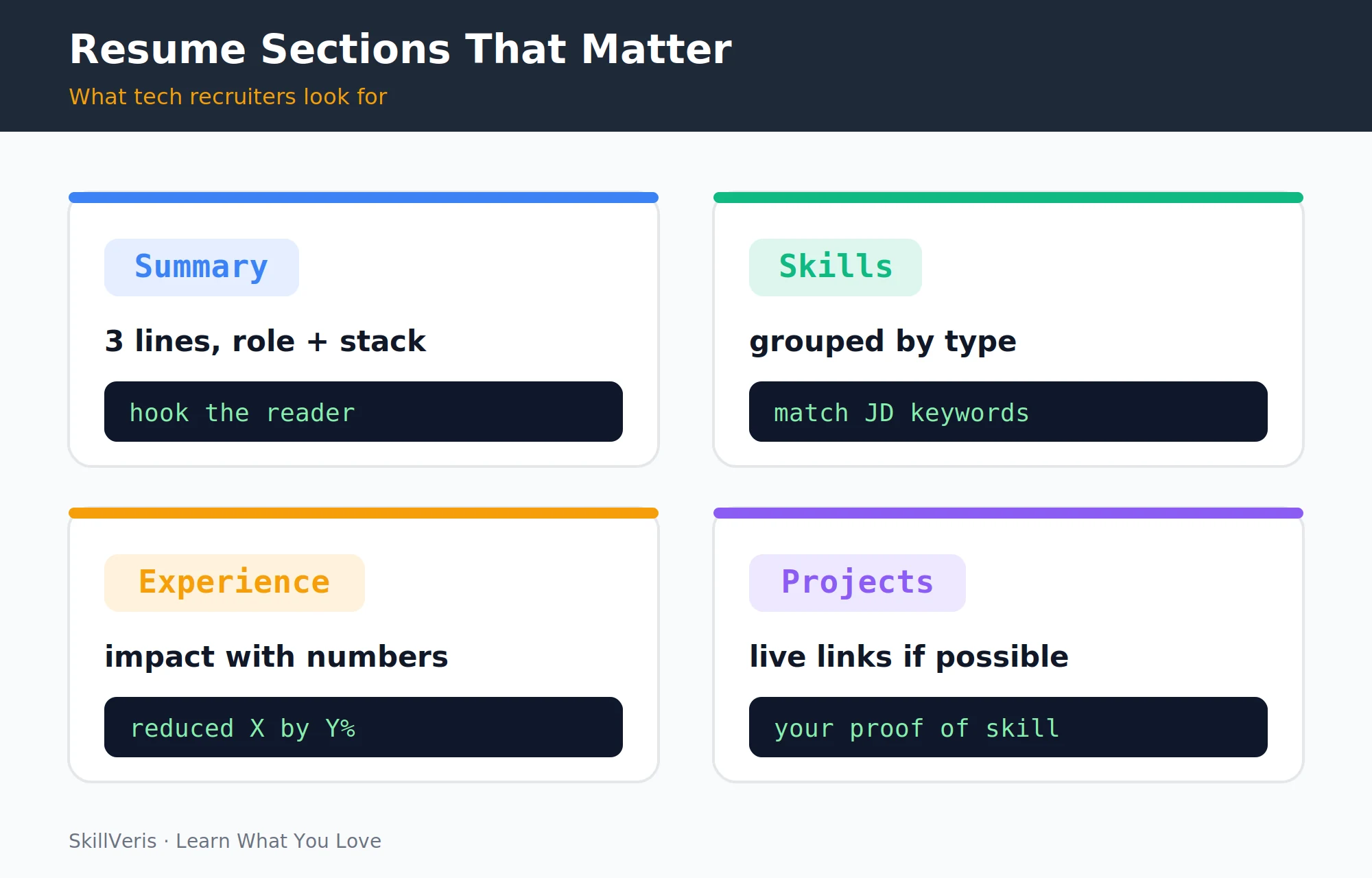
The four sections that carry most weight in a tech resume.

5The Skills Section

Group skills by type for scannability so a recruiter can find what they need at a glance. Only list skills you can discuss in an interview — claiming "Machine Learning" because you finished one tutorial will backfire when an interviewer asks about it.

  • Languages: Python, JavaScript, SQL, Bash
  • Frameworks: React, FastAPI, Django, Node.js
  • Cloud & DevOps: AWS, Docker, Kubernetes, Terraform, GitHub Actions
  • Tools: Git, PostgreSQL, Redis, Jira

💡Pro Tip

Copy the exact phrasing from the job description for your core skills. If the JD says "React.js" and your resume says "ReactJS," the ATS may not match them. Use the employer's exact capitalisation and spelling.

6Writing Experience Bullets

Each bullet should follow the action + result + scale formula. Swapping vague duties for concrete outcomes is the single biggest improvement most resumes can make.

If you don't have exact numbers, estimate conservatively: "improved performance by approximately 30%", or "supported a team of 5 developers."

  • Responsible for backend APIs → Built REST APIs in FastAPI that reduced page load time by 40% for 25k daily active users
  • Worked on CI/CD pipelines → Migrated manual deployments to GitHub Actions, reducing release time from 2 hours to 12 minutes
  • Helped with database optimisation → Rewrote 3 slow SQL queries, cutting average report generation from 45s to 3s

7The Projects Section

For junior developers, projects often matter more than experience. For each project, include a one-line description of what it does, the stack used, a live or GitHub link (if public), and one notable technical detail or scale metric.

Example: "RailVeris AI — Android railway companion app with 8,697-station dataset, fare calculator, and on-device AI journey planner. Built in Kotlin/Jetpack Compose. 500+ installs." Then a GitHub or Play Store link.

⚠️Watch Out

A private GitHub repository linked on a resume looks worse than no link at all. Make portfolio projects public, add a README, and ensure the code is clean before sharing the link.

8Education and Certifications

List your degree, institution, and graduation year. Keep this section short and relevant rather than exhaustive.

  • List degree, institution, and graduation year. GPA only if 3.5+ and recently graduated.
  • Relevant certifications (AWS, Google, CompTIA) go here or in a separate Certifications section.
  • Online courses (Coursera, Udemy) are fine to list if they're substantial and relevant, but don't pad with dozens of completions.

9Tailoring for Each Job

A generic resume performs worse than a tailored one in ATS scoring. For each application, follow a short, repeatable process.

This takes 10–15 minutes per application and significantly improves pass-through rates.
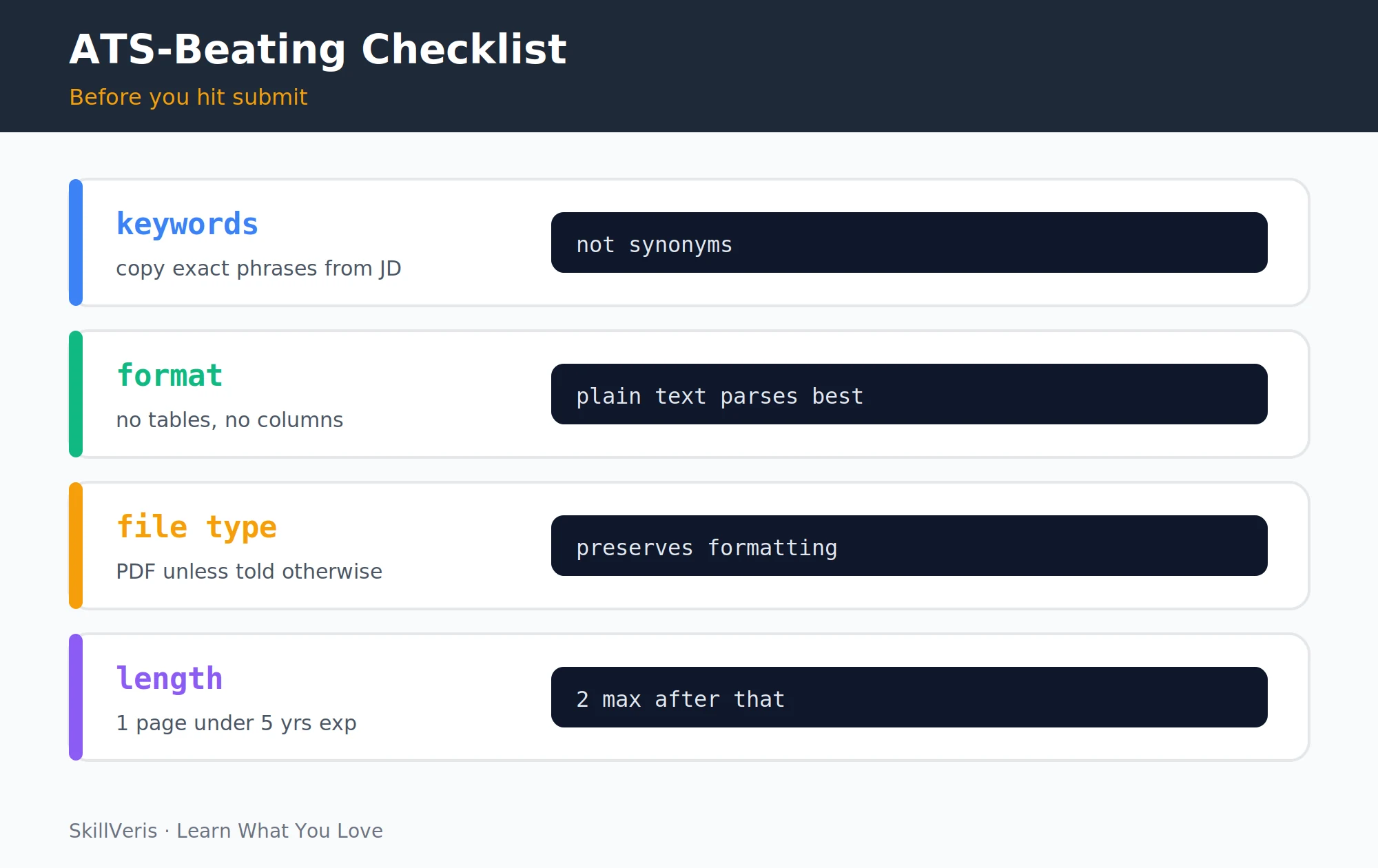
Tailoring each application meaningfully improves ATS pass-through rates.
  • Read the job description and highlight the required and preferred skills.
  • Ensure those exact terms appear in your Skills and Experience sections.
  • Reorder bullet points so the most relevant experience comes first.
  • Adjust the summary to mirror the role's title and primary requirement.

10What NOT to Include

Some resume conventions are outdated and actively hurt you. Cutting them frees up space for the content that actually wins interviews.

  • Photo: not expected in most tech markets (US, UK, India) and can introduce bias.
  • Date of birth, marital status, religion: irrelevant and can introduce bias.
  • Objective statement: replaced by the Summary; objectives focus on what you want, not what you offer.
  • "References available on request": wastes space; it's assumed.
  • Unrelated experience from 10+ years ago: unless it demonstrates a transferable skill directly relevant to the role.

11Free Tools That Help

A handful of free tools can sharpen your resume before you submit it, from ATS scoring to clean templates and grammar checks.

  • Jobscan.co — scores your resume against a job description for ATS match
  • Resume.io / Canva — clean, ATS-friendly templates
  • Grammarly — catches typos and grammar errors
  • LinkedIn Resume Builder — auto-generates from your LinkedIn profile

12Key Takeaways

Pulling it together, a standout tech resume is engineered for both the ATS and the recruiter who reads it next.

  • Format for the ATS: single column, standard headings, PDF, no tables or graphics.
  • Use the job description's exact keywords in your Skills and Experience sections.
  • Write bullets as action + result + scale — not duty lists.
  • Link to public projects; keep GitHub repos clean and documented.
  • Tailor for every application — 15 minutes per job, not a generic blast.

13What to Learn Next

Complete your job-search toolkit with these companion guides.

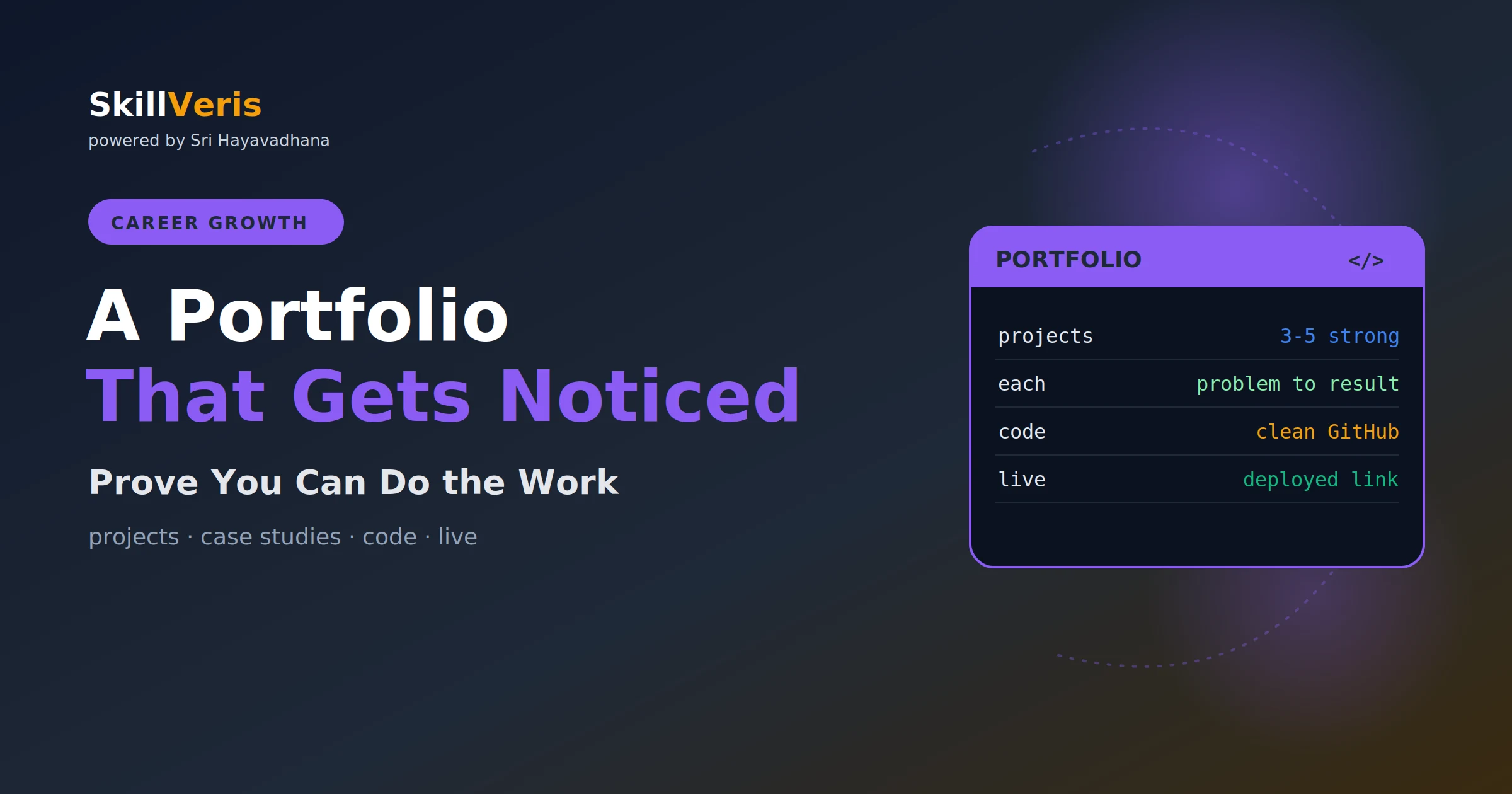
  • How to Build a Developer Portfolio — projects to put on the resume.
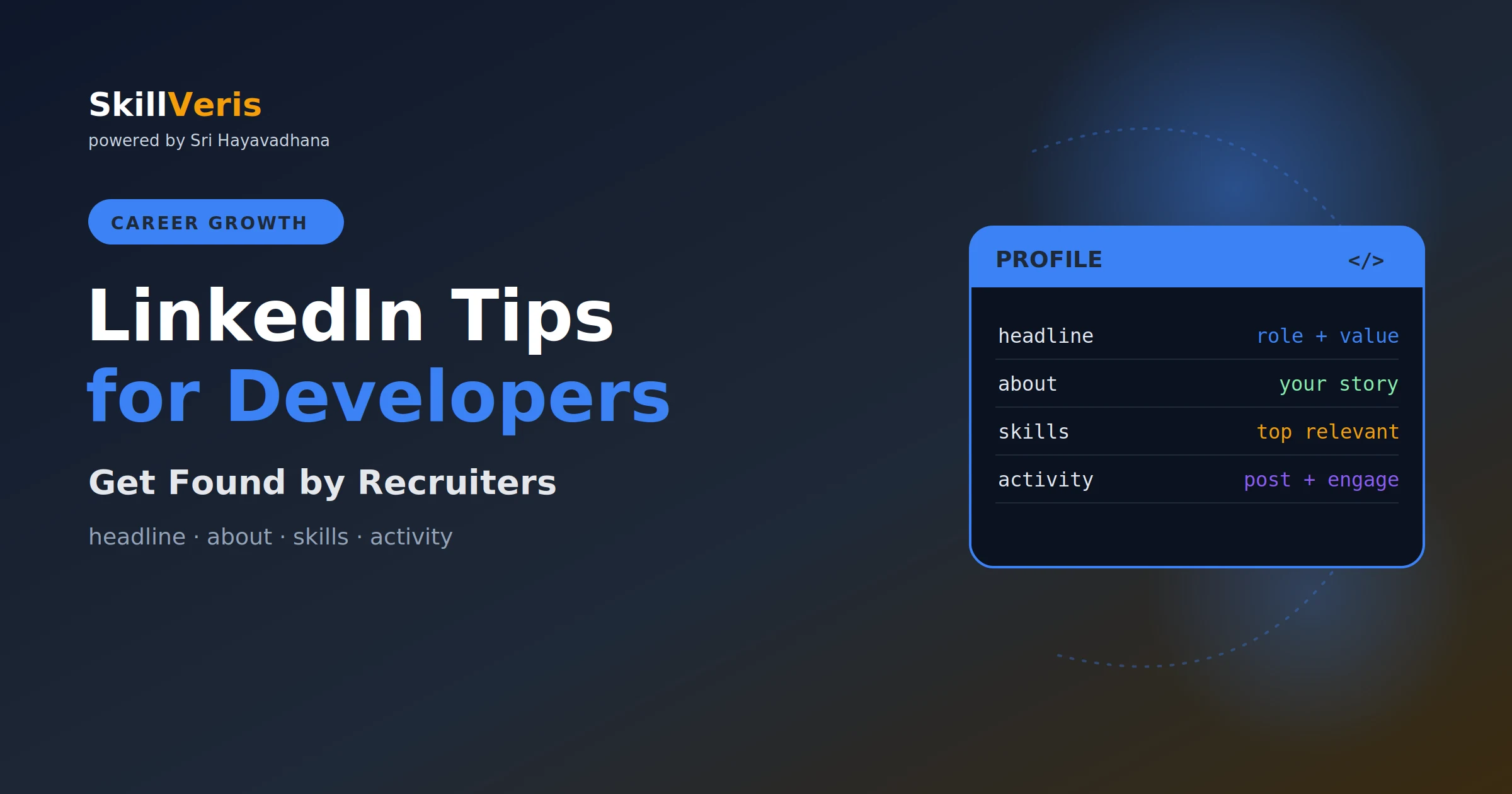
  • LinkedIn Tips for Developers — make recruiters come to you.
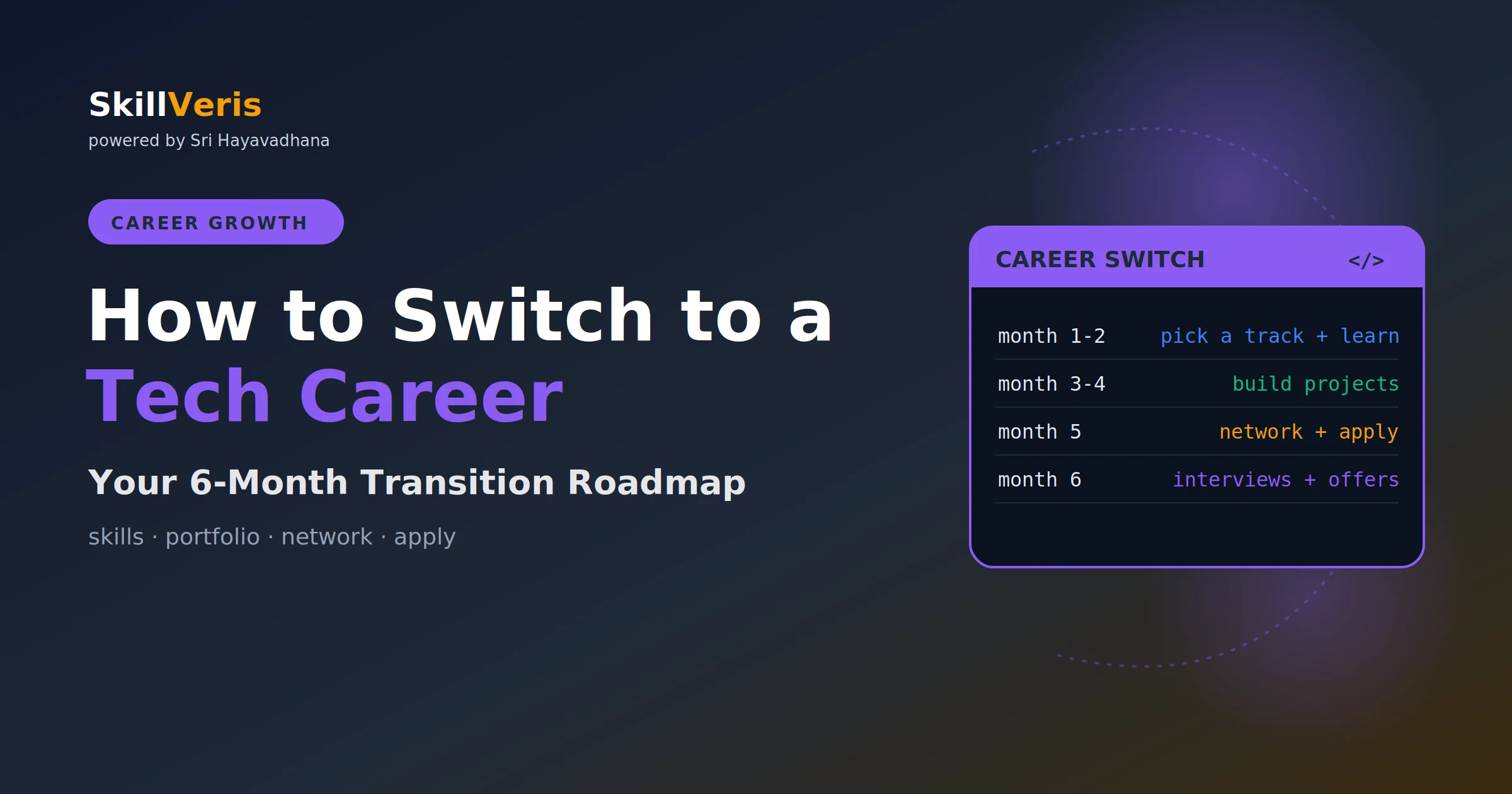
  • How to Switch to a Tech Career in 6 Months — the full transition plan.

14Frequently Asked Questions

Should my tech resume be one page or two? One page for under 5 years of experience; two pages maximum for more. Recruiters prefer concise over comprehensive — if in doubt, cut it down.

Do I need a cover letter? Not always, but a well-written cover letter can differentiate you when the role is competitive or when you're making a career change. If a cover letter is optional, write one — most candidates don't.

Can I use a creative or designed resume template? Only if you're applying to design roles where visual presentation is part of the evaluation. For most tech roles, clean and ATS-parseable beats visually impressive — the ATS doesn't appreciate your typography choices.

How important is a GitHub profile on a resume? Very. For developer roles especially, a GitHub with active, well-documented projects is often weighted as heavily as formal experience. Pin your best 6 repositories and add READMEs to each.

📄

Get The Print Version

Download a PDF of this article for offline reading.

About the Publisher

SV

SkillVeris Team

Careers Team

Our careers team helps you navigate tech job markets, build portfolios, and land the roles you want.

View all posts

Never miss an update

Get the latest tutorials and guides delivered to your inbox.

No spam. Unsubscribe anytime.

Frequently Asked Questions

21 categories · pick one to explore

Does SkillVeris have a tech blog, and what does it cover?
Yes, the SkillVeris blog has over 500 articles covering AI and machine learning, programming, web development, DevOps, cloud, security, databases and career guidance. Articles are practical and answer-first, and many use the Learn Through Hobbies approach, teaching technical concepts through cricket, music, gaming or cooking analogies. Everything is free to read.
What is the SkillVeris tech glossary and how big is it?
The SkillVeris glossary is a free reference of roughly 2,000-plus technology terms, each with a clear plain-language definition. It spans AI, programming, web, DevOps, cloud, security and database vocabulary, so whenever a lesson, article or job description uses jargon you do not recognise, the glossary gives you a fast, reliable answer.
Are the developer cheat sheets on SkillVeris free to download?
The cheat sheets are completely free to use, like everything else on SkillVeris. Each sheet condenses a language or tool into its essential syntax, commands and patterns for quick reference while coding. They are designed for rapid lookup during real work, complementing the deeper explanations found in study notes and courses.
Which programming references and cheat sheets are available?
Cheat sheets cover the platform's main domains, including programming languages, AI and ML tooling, web development, DevOps, cloud, security and databases, matching the topics of the 37 live courses. Each sheet lists related reading links and hashtags, so you can jump from a quick reference into fuller study notes or blog articles.
How do I find the meaning of a technical term quickly?
Search the SkillVeris glossary, which holds around 2,000-plus terms with concise, plain-language definitions. Each entry gets to the point in its first sentence, then links to related reading like blog posts or study notes for deeper context. It is faster and more consistent than sifting through scattered search results.
Is the SkillVeris blog good for beginners learning to code?
Yes, many blog articles are written specifically for beginners, and the Learn Through Hobbies style makes them unusually approachable: you might learn Python concepts through cricket or understand APIs through cooking. With 500-plus articles across skill levels, beginners can start with fundamentals and keep reading as they advance, entirely free.
Can cheat sheets replace full courses for learning a language?
No, cheat sheets are references, not teaching tools; they assume you already understand the concepts and just need syntax or commands fast. To actually learn a language, take a structured SkillVeris course with its 24–40 lessons and assessments, then keep the cheat sheet beside you while practising in Code Lab.
How often are new blog articles published on SkillVeris?
The blog grows regularly and already exceeds 500 articles, with new posts added as courses launch and technologies evolve. Topics track the platform's catalogue across AI, programming, web development, DevOps, cloud and security, so checking the Blog section periodically surfaces fresh tutorials, explainers and career-focused pieces, all free to read.
Does the glossary cover AI and machine learning terms?
Yes, AI and machine learning vocabulary is a major part of the roughly 2,000-plus term glossary, covering everything from foundational terms to modern concepts around LLMs, RAG and MLOps. Definitions are plain-language and answer-first, which helps when dense AI papers or course lessons throw unfamiliar jargon at you.
Are there cheat sheets for interview preparation?
Cheat sheets work well as interview-day refreshers because they compress syntax, commands and key concepts into scannable references. For dedicated preparation, combine them with the SkillVeris interview questions feature, which includes readiness scoring, plus study notes for depth. Reviewing a relevant cheat sheet just before an interview steadies recall under pressure.
Can I read the tech blog without signing up?
Yes, the blog is freely readable, and SkillVeris never charges for content. All 500-plus articles are open, covering tutorials, concept explainers and career advice. Creating a free account adds value elsewhere on the platform, like course progress tracking and certificates, but reading the blog requires no commitment at all.
How is the SkillVeris glossary different from Wikipedia?
The glossary is purpose-built for learners: definitions are short, plain-language and answer-first, sized for a quick lookup mid-lesson rather than a deep encyclopedic read. Entries also cross-link to related SkillVeris study notes, blog posts and courses, so a definition becomes a doorway into structured learning instead of a dead end.
Do blog articles use the Learn Through Hobbies method?
Many blog articles teach technical topics through hobby analogies, a hallmark of the SkillVeris blog, so you will find articles explaining programming through cricket, machine learning through music, or system design through cooking. The analogy is the teaching device; the article still delivers the real technical concept underneath.
Where can I find quick programming references while coding?
Open the SkillVeris cheat sheets, which are built exactly for that moment: compact, scannable references for syntax, commands and common patterns across languages and tools. Keep the relevant sheet in a browser tab while you work in Code Lab or your own editor, and dip into the glossary for terminology.
Is there a glossary entry for terms I meet in job descriptions?
Very likely yes, with roughly 2,000-plus terms across AI, programming, web, DevOps, cloud, security and databases, the glossary covers most jargon that appears in tech job descriptions. Decoding a listing this way helps you judge role fit honestly and prepares you to discuss those terms in interviews.
Are the blog articles written for the Indian tech audience?
The blog serves Indian learners plus a worldwide audience. Content stays globally relevant while acknowledging realities that matter in India, such as free access being essential for students and freshers, and career guidance that connects naturally to the SkillVeris jobs portal, which aggregates roles across India, UK, USA, Germany and Remote.
Can I suggest a topic for the blog or glossary?
SkillVeris content grows in response to what learners need, so feedback is welcome through the platform's support channels. If a term is missing from the glossary or a topic deserves an article, telling the team helps prioritise it. Meanwhile, the AI Mentor can answer the question immediately, 24/7, at any depth.
Do cheat sheets and glossary entries link to deeper learning?
Yes, every cheat sheet and glossary entry carries related reading links into study notes, blog articles and courses, plus concept hashtags for discovering similar content. This cross-linking means a thirty-second lookup can smoothly become a structured learning session whenever you decide you want more than a quick answer.
What makes SkillVeris programming references trustworthy?
The references are written to strict internal quality standards, kept consistent with the platform's 37 live courses, and never padded with invented statistics or hype. Definitions and cheat sheets are reviewed against the same content contracts that govern courses, and the answer-first style makes any inaccuracy easy to spot and correct.
How do the blog, glossary and cheat sheets fit into my learning routine?
Use them as satellites around your main course: read blog articles for context and motivation, hit the glossary the instant jargon appears, and keep cheat sheets open while coding. Together with study notes, Code Lab and the 24/7 AI Mentor, they turn passive reading into a complete, free learning system.

What Learners Say

Real journeys from the SkillVeris community — swipe for more.

SkillVeris taught me Python through Cricket. Now I’m building real projects and feeling confident!
Arjun S. · B.Tech Student
The best platform for hobby-based learning. Concepts finally stick.
Priya R. · Data Analyst
I went from zero coding to a portfolio of projects — all by learning through my love for gaming. Landed my first internship!
Kabir M. · CS Undergraduate
Trending Topics50 popular tags — tap to explore
Trending CoursesAll 37 free courses — tap to browse