Tech Resume Guide: How to Land Interviews in 2026
SkillVeris Team
Careers Team
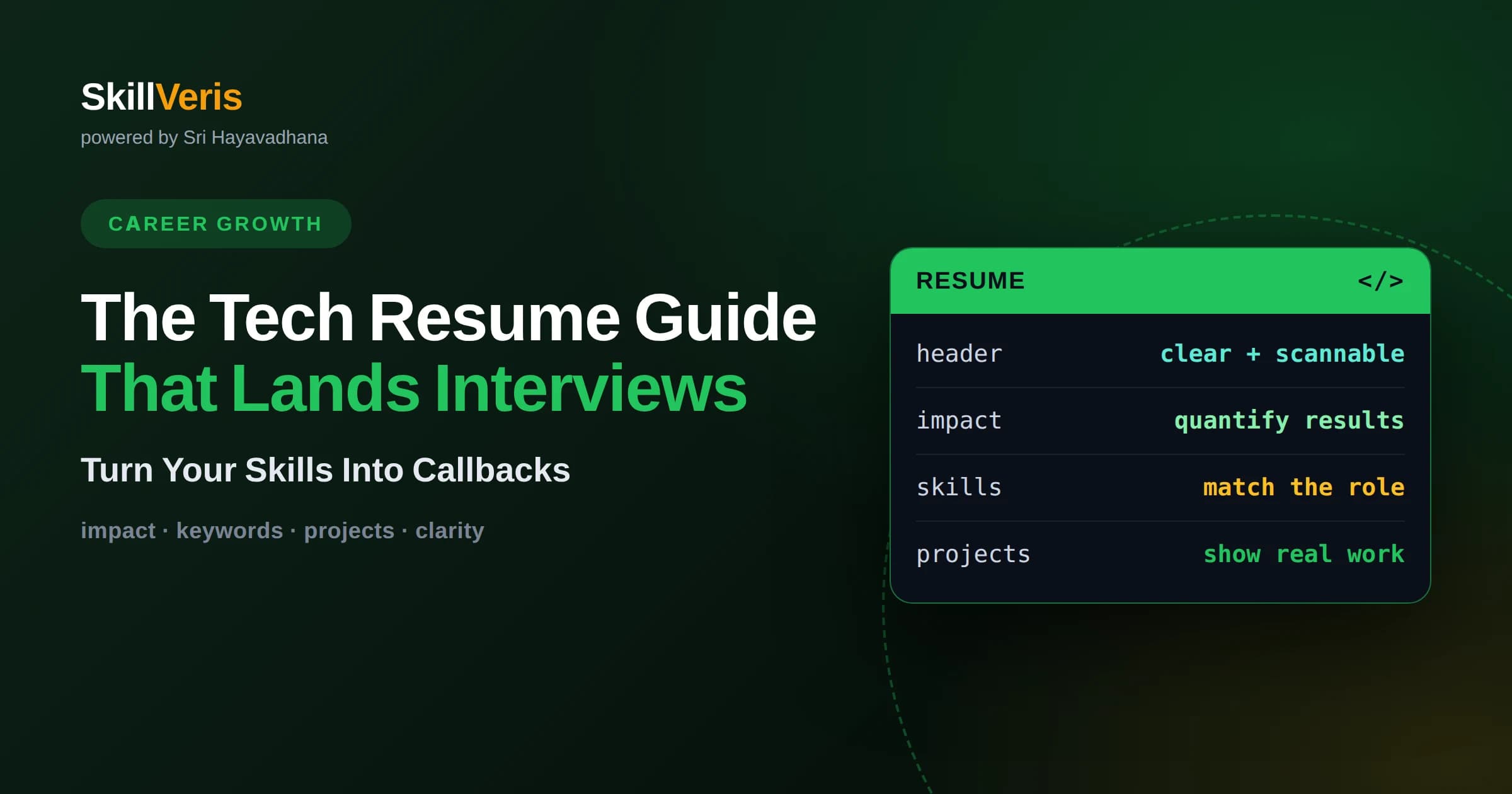
A tech resume that lands interviews is clear, tailored to the specific role, machine-readable for applicant tracking systems, and built around quantified accomplishments rather than lists of responsibilities.
In this guide, you'll learn:
- The single highest-impact habit is tailoring each resume to the job description by mirroring its real language and priorities, which helps you pass automated filters and speaks directly to the hiring manager.
- For early-career candidates, well-documented portfolio projects can carry as much weight as formal experience when they demonstrate real, deployed work and clear thinking.
- Most rejected resumes fail on fixable basics: vague bullet points, no measurable impact, poor formatting, and no tailoring — all of which you control.
1What Actually Gets You an Interview
A resume gets you an interview when it quickly convinces a busy reader that you can do the job and are worth a conversation. That is the entire purpose — not to tell your life story, not to list every technology you have touched, but to make a fast, credible case for one specific role. Everything in this guide serves that single goal. If a line on your resume does not help a reader reach that conclusion, it is taking up space that a better line could use.
In 2026, your resume usually faces two audiences before a human decides to talk to you. First an applicant tracking system, or ATS, parses and often filters it based on how well it matches the job. Then a recruiter or hiring manager skims it for a few seconds to decide whether to read more closely. A resume that lands interviews is built to satisfy both: machine-readable and keyword-aligned for the first, clear and compelling for the second.
The good news is that almost everything determining this is within your control. You cannot change your years of experience overnight, but you can control clarity, tailoring, formatting, and how you frame the work you have done. Most candidates who struggle are not unqualified; they are presenting themselves poorly. Fixing the presentation is often the difference between silence and a full inbox.
2The Structure That Works
A strong tech resume follows a predictable, scannable structure, because reinventing the format only makes a reader work harder. At the top, put your name and contact details plus links to your portfolio, GitHub, and LinkedIn. Follow with a short summary only if it adds real signal, then your skills, experience, projects, and education. For most technical roles, one page is right early in your career, and two pages is acceptable once you have substantial relevant experience.
Order the sections by what makes your strongest case. If your experience is your best asset, lead with it. If you are early-career or switching fields, a projects section near the top can do more work than a thin employment history. The reader should see your most convincing evidence in the top third of the page, because that is often all a first skim covers.
Keep the visual design clean and conventional. Use a standard single-column layout, clear headings, consistent formatting, and plenty of white space. Fancy multi-column templates and heavy graphics look impressive to humans but frequently confuse the software that parses your resume first. Boring and readable beats creative and unparseable every time in this context.
3Understanding ATS Without the Myths
There is a lot of fear and misinformation about applicant tracking systems, so it helps to be clear about what they actually do. An ATS stores and organizes applications and helps recruiters search and filter them. It is not a mysterious robot that arbitrarily rejects good candidates; it is a database with search on top. Recruiters often search it for the skills and terms that matter for a role, and a resume that lacks those terms simply does not surface.
The practical implication is straightforward: use the real language of the job description. If a posting asks for experience with a specific tool or concept and you have it, name it explicitly using the same words rather than a clever synonym. Do not make the reader or the search engine guess that your unnamed experience counts. This is not gaming the system; it is describing your qualifications in terms that match how they will be searched for.
Avoid the tricks that circulate online, like stuffing invisible keywords or copying the whole job description into white text. Modern systems and human reviewers catch these, and they damage your credibility. The honest version of ATS optimization is simply writing clearly, using standard section headings, and making sure the genuine skills you have appear in the words the role uses.
4Tailoring to Each Role
The most effective habit you can build is tailoring your resume to each job rather than sending one generic version everywhere. This does not mean rewriting from scratch every time; it means adjusting the summary, reordering skills, and emphasizing the bullets that match what a specific posting cares about. A tailored resume tells both the software and the human that you read the job and are a genuine fit, which is far more persuasive than a broad one-size-fits-all document.
Start by reading the job description closely and identifying its true priorities — the skills mentioned first and most often, the responsibilities that recur, the problems the team clearly wants solved. Then make sure your resume surfaces your relevant experience against those priorities near the top. If a role emphasizes building data pipelines, your pipeline work should be prominent, not buried under unrelated bullets.
Tailoring takes a little extra time per application, and that is precisely why it works: most people do not do it. Sending ten carefully tailored applications almost always beats blasting a hundred generic ones. Quality of match, not quantity of submissions, is what fills your calendar with interviews.
5Quantifying Your Impact
The difference between a forgettable resume and a compelling one usually comes down to whether the bullets describe responsibilities or results. Responsibilities tell a reader what you were supposed to do; results tell them what actually happened because you were there. Wherever possible, quantify the outcome: how much faster, how much cheaper, how much larger, how many users, how much less error. Numbers give a claim weight and make it memorable.
A useful pattern is to describe what you did, how you did it, and what changed as a result. Instead of writing that you were responsible for improving a service, write that you redesigned a specific process using a specific approach and that it reduced processing time by a meaningful amount. Even approximate, honestly estimated figures are far stronger than vague adjectives like fast or scalable, which every resume overuses.
Be truthful with your numbers. You will likely be asked about them in an interview, and a figure you cannot explain does more harm than good. If you do not have precise metrics, describe scale and outcome in honest terms — the size of the system, the number of people affected, the problem that stopped happening. The goal is credible evidence of impact, never invented statistics.
6Writing Strong Bullet Points
Each bullet point is a small argument for your competence, so treat it with care. Start with a strong action verb, focus on one accomplishment, and lead with the most impressive part. Avoid the passive, committee-style language that drains energy from a claim. A reader skimming quickly should be able to grasp what you achieved from the first few words of each line.
Cut filler ruthlessly. Phrases like responsible for, helped with, and worked on add words without adding signal. Compare a weak line that says you helped with the migration of a system to a strong one that says you migrated a service to a new architecture and cut its response time. The second is shorter, more specific, and more convincing. Every word should either add credibility or come out.
Aim for a handful of high-quality bullets per role rather than an exhaustive list. Three sharp, quantified accomplishments make a stronger impression than eight vague ones, and they respect the reader's time. Your resume is an argument, not an archive, and the best arguments are focused.
7Projects Versus Experience
A common worry, especially for career changers and early-career candidates, is having little formal experience. The reassuring reality is that well-executed projects can carry real weight, particularly for technical roles where the work speaks for itself. A hiring manager wants evidence that you can build things that work; a deployed, documented project provides that evidence directly, sometimes more convincingly than a line on an employment history.
That said, projects and experience are not equivalent in every reader's eyes, so present projects to close the gap deliberately. Describe them the way you would describe a job: the problem you solved, the technologies you used, the decisions you made, and the outcome. A project bullet that reads like a professional accomplishment lands far better than one that reads like a homework assignment. Treat your best projects with the same rigor as real work.
If you have relevant experience, lead with it and use projects to reinforce specific skills. If you do not, make projects a prominent, well-crafted section and let them do the heavy lifting. Either way, the underlying message is the same: here is evidence that I can do the work you need done.
8Building Portfolio Projects Worth Listing
The projects that impress are the ones that resemble real work rather than tutorials. Aim for a small number of end-to-end projects that solve a recognizable problem, are deployed somewhere a stranger can actually reach, and are documented clearly. One polished, deployed, well-explained project outweighs a long list of half-finished experiments that never left your laptop. Depth and completeness are what signal readiness.
Choose projects that mirror the roles you want. If you are targeting AI engineering positions, a working retrieval-augmented system over a real document set or a small agent that automates a genuine task demonstrates exactly the skills those teams hire for. This is where structured learning pays off: following a path like the ones on SkillVeris, which move from Python foundations through deep learning and into LLMs, RAG, agents, and deployment, gives each phase of study a concrete project to leave behind.
Document each project as if the reader will never speak to you, because often they will not before deciding. A clear README that states the problem, your approach, the tradeoffs, and what you would improve tells a hiring manager how you think, which is what they are really evaluating. A great portfolio is not just proof that you can code; it is proof that you can reason, finish, and communicate.
9Getting the Skills Section Right
The skills section is easy to get wrong in both directions. List too little and you fail to surface for relevant searches; list too much and you dilute your real strengths into an indiscriminate word cloud that reads as padding. The goal is an honest, well-organized inventory of the technologies and concepts you can actually discuss under questioning, grouped in a way that is easy to scan.
Organize skills into sensible categories — languages, frameworks, tools, platforms — and order them so your strongest and most role-relevant appear first. Only list things you would be comfortable being asked about, because interviewers do treat this section as fair game. A skill you padded to look impressive becomes a liability the moment someone probes it and finds nothing behind it.
Keep the section aligned with the specific role. When you tailor a resume, revisit this section and promote the skills the posting emphasizes. This small act of curation helps both the automated search and the human reviewer see the match immediately, without having to hunt through your experience to confirm you have what they asked for.
10The Common Mistakes to Avoid
Most rejected resumes fail on a handful of avoidable mistakes. The most frequent is describing responsibilities instead of results, leaving the reader with no sense of impact. Close behind are vague, jargon-heavy bullets that could describe anyone, a generic version sent to every job with no tailoring, and formatting so elaborate that the parsing software mangles it. None of these require talent to fix; they require attention.
Other frequent errors include typos and inconsistent formatting, which quietly signal carelessness in a field where precision matters, and dumping every technology you have ever encountered into an unfocused skills list. A resume cluttered with weak signal buries the strong signal that would actually get you called. Editing out the mediocre is as important as adding the impressive.
There is also the opposite failure of undersell: strong candidates who describe genuine accomplishments in flat, modest language that hides how much they achieved. Be accurate, never inflate, but do give yourself full credit for real results. Honest confidence reads very differently from vague humility, and the interview goes to the resume that made its case clearly.
11Beyond the Resume Itself
A resume rarely travels alone, so make sure the rest of your presence reinforces it. Your GitHub should show real, readable code and completed projects rather than empty repositories. Your LinkedIn should tell a consistent story. If a role invites a short cover note, a few genuine sentences about why this specific team interests you can tip a borderline decision in your favor, because so few candidates bother to write anything specific.
Referrals and networking still matter enormously, and they work alongside a strong resume rather than replacing it. A resume that reaches a hiring manager through a colleague gets read with more attention than one that arrives cold. Building genuine relationships in the field, contributing to communities, and staying visible all increase the odds that your well-crafted resume actually lands in front of a human who cares.
None of this excuses a weak resume; it amplifies a strong one. Think of your resume as the centerpiece of a small, consistent system — resume, portfolio, profiles, and relationships — all pointing at the same clear message about what you can do. When those elements agree and reinforce each other, the interviews follow.
12Putting It All Together
Landing interviews in 2026 is less about secret tricks and more about disciplined execution of the fundamentals. Build a clean, machine-readable resume. Tailor it to each role using the job's real language. Replace responsibilities with quantified results. Let strong, documented projects fill any gaps in formal experience. Cut the vague filler, fix the careless errors, and give your genuine accomplishments the full, honest credit they deserve.
Treat your resume as a living document rather than a one-time task. Update it after every meaningful project, keep a running log of accomplishments and numbers while they are fresh, and revise your framing as you learn what resonates. The candidates who get interviews are usually not the only ones qualified; they are the ones who presented their qualifications most clearly and matched them most deliberately to the role.
Finally, remember that the resume exists to start a conversation, not to win the job by itself. Its job is done the moment it earns you an interview. Focus on making that case cleanly and honestly, keep building real skills and real projects to write about, and the interviews will come — not because you gamed a system, but because you made it easy for the right people to see what you can do.
Get The Print Version
Download a PDF of this article for offline reading.
About the Publisher
SkillVeris Team
Careers Team
Our careers team helps you navigate tech job markets, build portfolios, and land the roles you want.
View all postsRelated Posts
Never miss an update
Get the latest tutorials and guides delivered to your inbox.
No spam. Unsubscribe anytime.