100% Free Forever
AI-Powered Learning
Industry Expert Content
Certificates & Badges
Learn At Your Own Pace
HomeBlogSystem Design Interview Basics for Beginners
Career Growth

System Design Interview Basics for Beginners

SV

SkillVeris Team

Careers Team

Nov 2, 2025 8 min read
Share:
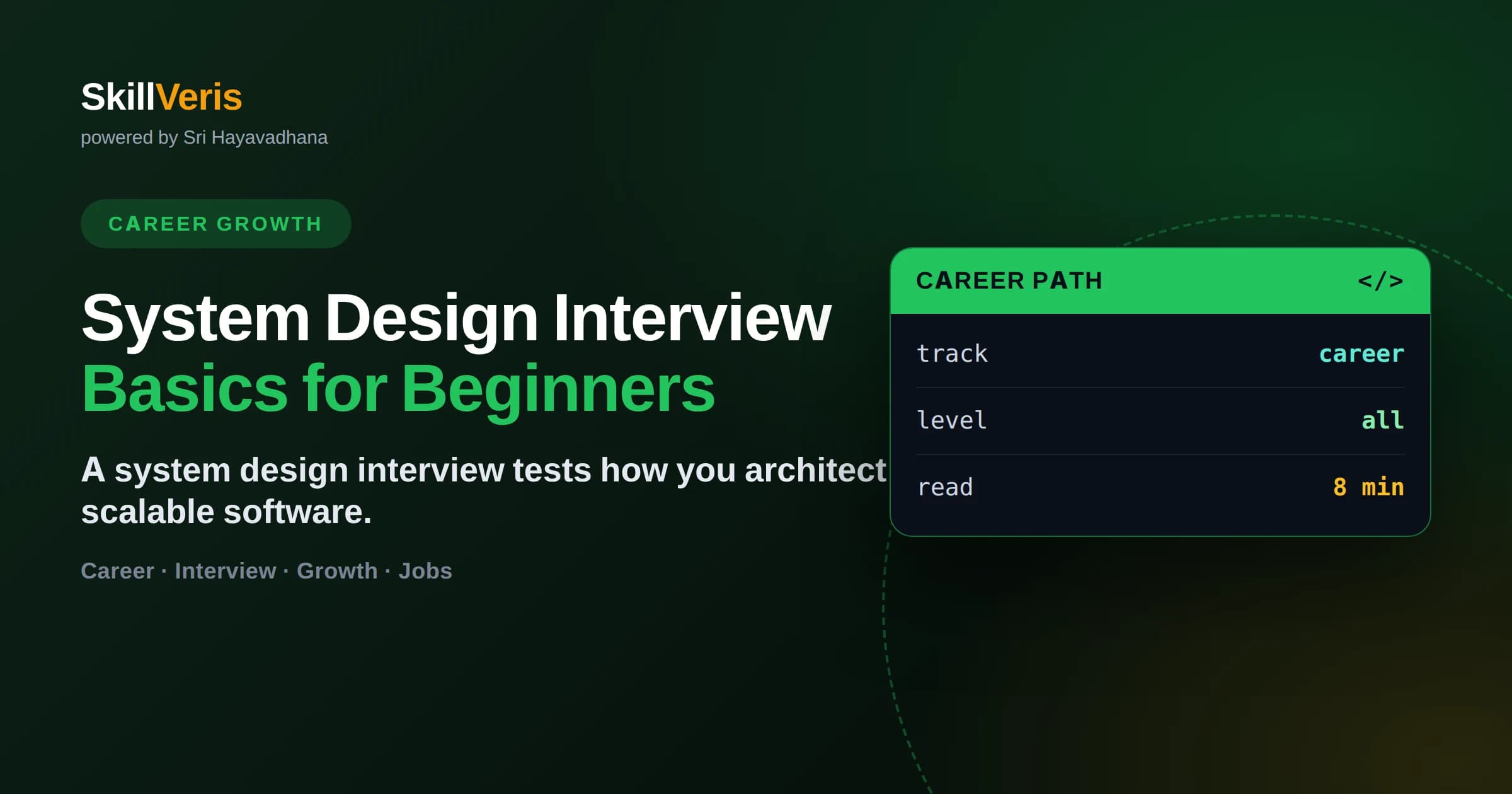
System Design Interview Basics for Beginners
Key Takeaway

A system design interview evaluates how you architect a scalable, reliable system from vague requirements — interviewers want your reasoning and trade-offs, not a single perfect answer.

In this guide, you'll learn:

  • Start every design by clarifying requirements and estimating scale before drawing a single box.
  • Master a small vocabulary — load balancers, caches, databases, queues, and CDNs — and you can assemble most designs.
  • There is no correct architecture, only trade-offs; naming them explicitly is what scores points.
  • A four-step framework — requirements, high-level design, deep dive, wrap-up — keeps you structured under pressure.

1What Is a System Design Interview?

A system design interview is an open-ended round where you architect a large software system — such as a URL shortener, a chat app, or a news feed — from vague requirements. Unlike coding rounds with a right answer, it measures how you reason about scale, reliability, and trade-offs. Interviewers care far more about your thought process than about arriving at one blessed diagram.

For beginners this feels intimidating because there is no single solution to memorize. The good news: the round rewards structure. If you clarify requirements, estimate scale, sketch a clean high-level design, and discuss trade-offs out loud, you demonstrate exactly the judgment interviewers are hiring for.

2Why Companies Ask These Questions

System design rounds reveal how you handle ambiguity and scale — skills that coding puzzles cannot surface. Real engineering work is rarely a self-contained function; it is deciding where data lives, how services talk, and what happens when traffic spikes tenfold.

  • It shows whether you can turn fuzzy requirements into a concrete plan.
  • It tests your grasp of trade-offs between cost, speed, and reliability.
  • It reveals how you communicate technical decisions to teammates.
  • It signals seniority — how deep you can go when the interviewer pushes.

3The Core Building Blocks

Most designs are assembled from a small vocabulary of components. Learn what each does and when to reach for it, and you can compose an answer to almost any prompt without memorizing specific systems.

  • Load balancer — spreads incoming traffic across multiple servers so no single one is overwhelmed.
  • Application servers — run your business logic, usually stateless so they scale horizontally.
  • Database — stores persistent data; choose SQL for structure and relations, NoSQL for flexible high-volume data.
  • Cache — keeps hot data in memory (Redis, Memcached) to cut database load and latency.
  • Message queue — decouples services and smooths spikes (Kafka, RabbitMQ, SQS).
  • CDN — serves static assets from locations near the user to reduce latency.

🔑Key Insight

You do not need dozens of technologies. Six or seven building blocks cover the majority of interview prompts — depth of understanding beats a long tool list.

4A Repeatable Framework

The best way to avoid freezing is to follow the same process every time. A clear structure signals maturity and keeps you from jumping straight to boxes and arrows before you understand the problem.

Four Steps to Follow

Walk the interviewer through each stage out loud so they can follow and steer you.

code
Requirements: clarify functional needs and non-functional goals like scale and latency.
High-level design: sketch major components and how requests flow between them.
Deep dive: pick one or two areas the interviewer cares about and go deeper.
Wrap-up: discuss bottlenecks, failure modes, and how you would improve the design.

5Estimating Scale

Back-of-the-envelope estimation grounds your design in reality. Before choosing components, work out roughly how much traffic and data the system handles, because a design for a thousand users looks nothing like one for a hundred million.

You are not expected to be precise. Round aggressively and state your assumptions. Estimating reads and writes per second, and total storage over time, tells you whether you need caching, sharding, or a queue — and shows the interviewer you think about scale rather than assuming it away.

💡Pro Tip

Keep a few round numbers handy: a day has roughly 86,400 seconds, and one million requests a day is about 12 per second. Simple anchors like these make estimation fast and credible.

6Talking About Trade-offs

The heart of system design is trade-offs, and naming them explicitly is what earns strong scores. Every meaningful decision buys one property at the cost of another, and there is no free choice that is best in all situations.

  • SQL vs NoSQL — strong consistency and relations versus flexible scale.
  • Consistency vs availability — during a partition you often must favor one.
  • Caching — faster reads at the cost of possible stale data.
  • Vertical vs horizontal scaling — a bigger machine versus more machines and added complexity.

Say It Out Loud

When you pick an option, state what you gain and what you give up. Even if the interviewer would have chosen differently, showing you understand the tension is the point.

7Common Mistakes to Avoid

Beginners tend to stumble in predictable ways. Avoiding these puts you ahead of many candidates immediately.

  • Diving into details before clarifying requirements and scale.
  • Presenting one design as the only answer instead of discussing alternatives.
  • Adding trendy technologies you cannot justify — every box needs a reason.
  • Going silent while thinking, leaving the interviewer unable to guide you.
  • Ignoring failure cases like a server crashing or a database going down.

⚠️Watch Out

Over-engineering is a red flag. Sprinkling in Kafka, sharding, and microservices for a simple app suggests you cannot match complexity to the problem. Start simple and scale only when the requirements demand it.

8How to Prepare as a Beginner

You do not need years of experience to do well; you need familiarity with the components and practice explaining designs aloud. Pick a handful of classic prompts and work through each one repeatedly until the flow feels natural.

Draw your designs on paper or a whiteboard rather than describing them in your head. Seeing the boxes and arrows helps you spot missing pieces, and it mirrors how the real interview unfolds.

  • Design a URL shortener to practice hashing, storage, and read-heavy scaling.
  • Design a chat application to practice real-time messaging and delivery.
  • Design a news feed to practice fan-out, caching, and ranking.
  • Design a rate limiter to practice counters, windows, and distributed state.

9Key Takeaways

Strong system design answers share the same foundations.

  • The round tests reasoning and trade-offs, not a single correct architecture.
  • Always clarify requirements and estimate scale before designing.
  • Master a small set of building blocks: load balancers, caches, databases, queues, CDNs.
  • Follow a fixed framework so you stay structured under pressure.
  • Name your trade-offs out loud — that is what interviewers score.

10Frequently Asked Questions

Q: Do junior developers get system design interviews? A: Increasingly, yes, though at a lighter depth than for senior roles. For juniors, interviewers mainly check whether you understand basic components and can reason about a simple system. You are not expected to design planet-scale infrastructure.

Q: How do I answer if I have never built a large system? A: Focus on fundamentals and reasoning rather than production war stories. Clarify requirements, use the building blocks you know, and explain your trade-offs. Interviewers understand a junior's experience is limited and score your thinking, not your resume.

Q: What is the most important part of a system design interview? A: Communication and structure. A clear, well-organized walkthrough of a simple design beats a sophisticated one you cannot explain. Talk through every step so the interviewer can follow and guide you.

Q: Should I memorize designs for common systems? A: Understand the patterns rather than memorizing diagrams. Interviewers often twist a familiar prompt, and rote answers collapse under follow-up questions. Practice the reasoning so you can adapt to whatever variation you are given.

📄

Get The Print Version

Download a PDF of this article for offline reading.

About the Publisher

SV

SkillVeris Team

Careers Team

Our careers team helps you navigate tech job markets, build portfolios, and land the roles you want.

View all posts

Never miss an update

Get the latest tutorials and guides delivered to your inbox.

No spam. Unsubscribe anytime.

Frequently Asked Questions

21 categories · pick one to explore

Does SkillVeris have a tech blog, and what does it cover?
Yes, the SkillVeris blog has over 500 articles covering AI and machine learning, programming, web development, DevOps, cloud, security, databases and career guidance. Articles are practical and answer-first, and many use the Learn Through Hobbies approach, teaching technical concepts through cricket, music, gaming or cooking analogies. Everything is free to read.
What is the SkillVeris tech glossary and how big is it?
The SkillVeris glossary is a free reference of roughly 2,000-plus technology terms, each with a clear plain-language definition. It spans AI, programming, web, DevOps, cloud, security and database vocabulary, so whenever a lesson, article or job description uses jargon you do not recognise, the glossary gives you a fast, reliable answer.
Are the developer cheat sheets on SkillVeris free to download?
The cheat sheets are completely free to use, like everything else on SkillVeris. Each sheet condenses a language or tool into its essential syntax, commands and patterns for quick reference while coding. They are designed for rapid lookup during real work, complementing the deeper explanations found in study notes and courses.
Which programming references and cheat sheets are available?
Cheat sheets cover the platform's main domains, including programming languages, AI and ML tooling, web development, DevOps, cloud, security and databases, matching the topics of the 37 live courses. Each sheet lists related reading links and hashtags, so you can jump from a quick reference into fuller study notes or blog articles.
How do I find the meaning of a technical term quickly?
Search the SkillVeris glossary, which holds around 2,000-plus terms with concise, plain-language definitions. Each entry gets to the point in its first sentence, then links to related reading like blog posts or study notes for deeper context. It is faster and more consistent than sifting through scattered search results.
Is the SkillVeris blog good for beginners learning to code?
Yes, many blog articles are written specifically for beginners, and the Learn Through Hobbies style makes them unusually approachable: you might learn Python concepts through cricket or understand APIs through cooking. With 500-plus articles across skill levels, beginners can start with fundamentals and keep reading as they advance, entirely free.
Can cheat sheets replace full courses for learning a language?
No, cheat sheets are references, not teaching tools; they assume you already understand the concepts and just need syntax or commands fast. To actually learn a language, take a structured SkillVeris course with its 24–40 lessons and assessments, then keep the cheat sheet beside you while practising in Code Lab.
How often are new blog articles published on SkillVeris?
The blog grows regularly and already exceeds 500 articles, with new posts added as courses launch and technologies evolve. Topics track the platform's catalogue across AI, programming, web development, DevOps, cloud and security, so checking the Blog section periodically surfaces fresh tutorials, explainers and career-focused pieces, all free to read.
Does the glossary cover AI and machine learning terms?
Yes, AI and machine learning vocabulary is a major part of the roughly 2,000-plus term glossary, covering everything from foundational terms to modern concepts around LLMs, RAG and MLOps. Definitions are plain-language and answer-first, which helps when dense AI papers or course lessons throw unfamiliar jargon at you.
Are there cheat sheets for interview preparation?
Cheat sheets work well as interview-day refreshers because they compress syntax, commands and key concepts into scannable references. For dedicated preparation, combine them with the SkillVeris interview questions feature, which includes readiness scoring, plus study notes for depth. Reviewing a relevant cheat sheet just before an interview steadies recall under pressure.
Can I read the tech blog without signing up?
Yes, the blog is freely readable, and SkillVeris never charges for content. All 500-plus articles are open, covering tutorials, concept explainers and career advice. Creating a free account adds value elsewhere on the platform, like course progress tracking and certificates, but reading the blog requires no commitment at all.
How is the SkillVeris glossary different from Wikipedia?
The glossary is purpose-built for learners: definitions are short, plain-language and answer-first, sized for a quick lookup mid-lesson rather than a deep encyclopedic read. Entries also cross-link to related SkillVeris study notes, blog posts and courses, so a definition becomes a doorway into structured learning instead of a dead end.
Do blog articles use the Learn Through Hobbies method?
Many blog articles teach technical topics through hobby analogies, a hallmark of the SkillVeris blog, so you will find articles explaining programming through cricket, machine learning through music, or system design through cooking. The analogy is the teaching device; the article still delivers the real technical concept underneath.
Where can I find quick programming references while coding?
Open the SkillVeris cheat sheets, which are built exactly for that moment: compact, scannable references for syntax, commands and common patterns across languages and tools. Keep the relevant sheet in a browser tab while you work in Code Lab or your own editor, and dip into the glossary for terminology.
Is there a glossary entry for terms I meet in job descriptions?
Very likely yes, with roughly 2,000-plus terms across AI, programming, web, DevOps, cloud, security and databases, the glossary covers most jargon that appears in tech job descriptions. Decoding a listing this way helps you judge role fit honestly and prepares you to discuss those terms in interviews.
Are the blog articles written for the Indian tech audience?
The blog serves Indian learners plus a worldwide audience. Content stays globally relevant while acknowledging realities that matter in India, such as free access being essential for students and freshers, and career guidance that connects naturally to the SkillVeris jobs portal, which aggregates roles across India, UK, USA, Germany and Remote.
Can I suggest a topic for the blog or glossary?
SkillVeris content grows in response to what learners need, so feedback is welcome through the platform's support channels. If a term is missing from the glossary or a topic deserves an article, telling the team helps prioritise it. Meanwhile, the AI Mentor can answer the question immediately, 24/7, at any depth.
Do cheat sheets and glossary entries link to deeper learning?
Yes, every cheat sheet and glossary entry carries related reading links into study notes, blog articles and courses, plus concept hashtags for discovering similar content. This cross-linking means a thirty-second lookup can smoothly become a structured learning session whenever you decide you want more than a quick answer.
What makes SkillVeris programming references trustworthy?
The references are written to strict internal quality standards, kept consistent with the platform's 37 live courses, and never padded with invented statistics or hype. Definitions and cheat sheets are reviewed against the same content contracts that govern courses, and the answer-first style makes any inaccuracy easy to spot and correct.
How do the blog, glossary and cheat sheets fit into my learning routine?
Use them as satellites around your main course: read blog articles for context and motivation, hit the glossary the instant jargon appears, and keep cheat sheets open while coding. Together with study notes, Code Lab and the 24/7 AI Mentor, they turn passive reading into a complete, free learning system.

What Learners Say

Real journeys from the SkillVeris community — swipe for more.

SkillVeris taught me Python through Cricket. Now I’m building real projects and feeling confident!
Arjun S. · B.Tech Student
The best platform for hobby-based learning. Concepts finally stick.
Priya R. · Data Analyst
I went from zero coding to a portfolio of projects — all by learning through my love for gaming. Landed my first internship!
Kabir M. · CS Undergraduate
Trending Topics50 popular tags — tap to explore
Trending CoursesAll 37 free courses — tap to browse