SAP for Beginners: Modules & Career Paths
SkillVeris Team
Careers Team
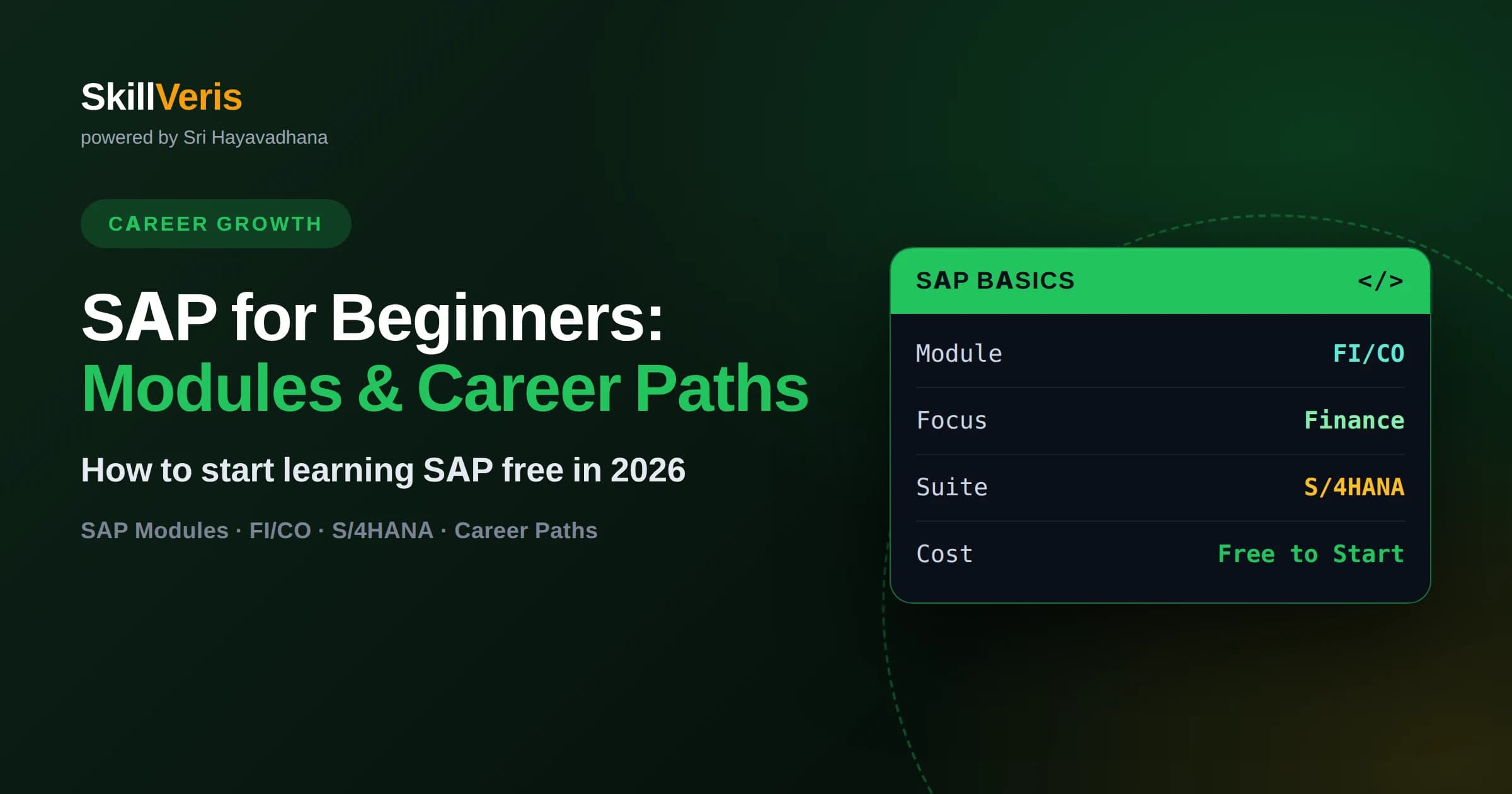
SAP is an enterprise resource planning (ERP) system that unifies finance, logistics, HR, and manufacturing data into one platform.
In this guide, you'll learn:
- The most in-demand SAP modules for beginners are FI/CO (finance), MM (materials management), SD (sales and distribution), and HR/HCM.
- S/4HANA is SAP's modern in-memory ERP suite and the version most new implementations and job postings now require.
- You can start learning real SAP systems for free through SAP Learning Hub's free tier, community edition trials, and the openSAP platform.
- ABAP is SAP's proprietary programming language and a common technical entry point for developers moving into the SAP ecosystem.
1What Is SAP and Why Does Every Beginner Keep Hearing About It?
SAP is a German-made enterprise resource planning (ERP) software system that large and mid-sized organizations use to manage core business processes—finance, procurement, inventory, sales, manufacturing, and human resources—inside one connected platform instead of dozens of disconnected spreadsheets and tools.
The reason beginners keep encountering SAP in career research is structural: once a company of meaningful size adopts an ERP system, that system becomes the backbone every finance, supply chain, HR, and IT decision routes through. That creates ongoing, durable demand for people who understand how to configure, use, support, and extend it—demand that doesn't disappear when a single product trend fades, because ripping out an ERP system is one of the most expensive and disruptive things a company can do.
For a newcomer, the practical takeaway is this: SAP is not one app but a family of integrated modules, each mapped to a specific business function. Understanding SAP for beginners starts with learning that modular structure, not memorizing menus—once you know which module owns which business process, the rest of the system becomes far easier to navigate.
2How SAP Actually Works Behind the Scenes
SAP works by storing every business transaction—an invoice, a purchase order, a payroll run, a shipped order—as structured data in a shared central database, so that when one department records an event, every other module that depends on it updates automatically without manual re-entry.
This is the core value proposition of ERP software in general: a sale recorded in the Sales and Distribution module can automatically reduce inventory in Materials Management, trigger a production order in Manufacturing, and post revenue in Financial Accounting—all from a single transaction. That integration is also why SAP has a reputation for complexity; the same interconnectedness that eliminates duplicate data entry also means changes in one area ripple into others, which is why configuration and consulting roles exist around the platform.
Modern SAP runs on HANA, an in-memory database engine that processes data in RAM rather than on disk, making real-time reporting and analytics dramatically faster than in older SAP versions. This underpins S/4HANA, the current generation of SAP's ERP suite, which is steadily replacing the older ECC (ERP Central Component) systems still running in many companies today.
3The Major SAP Modules Explained Plainly
SAP modules are the distinct functional areas of the system, and understanding a handful of the most common ones gives you a working map of the entire platform without needing to study all of them at once.
Modules are generally split into two families: functional modules (aligned to a business department, requiring domain knowledge more than programming) and technical modules (aligned to system development and customization, requiring coding and infrastructure skills). Most beginners start in a functional module because it requires less upfront technical training and maps directly onto business knowledge many people already have from a degree or prior job.
- FI/CO (Financial Accounting & Controlling) — manages general ledger, accounts payable/receivable, asset accounting, cost centers, and internal management reporting; a natural starting point for people with an accounting or finance background.
- MM (Materials Management) — handles procurement, purchasing, vendor management, and inventory; relevant to supply chain and operations professionals.
- SD (Sales and Distribution) — manages the order-to-cash cycle: sales orders, pricing, billing, and delivery; a fit for people coming from sales operations or customer service.
- HR/HCM (Human Capital Management) — covers payroll, employee records, time management, recruitment, and organizational structure; suited to HR professionals moving into HR systems work.
- PP (Production Planning) — manages manufacturing schedules, bills of materials, and shop floor execution; common in manufacturing-heavy industries.
- S/4HANA — not a single module but the modern ERP suite itself, simplifying and merging older module logic with a redesigned interface (Fiori) and real-time analytics; increasingly the default target for new SAP learning.
4What Real SAP Career Paths Look Like
A realistic SAP career path usually begins in a functional or technical support role, moves into module-specific consulting or configuration work, and can eventually lead to solution architecture, project management, or specialization in a niche like SAP security or S/4HANA migration.
Unlike many software careers that require a computer science background, SAP functional consulting is unusually open to career-changers: an accountant can become an SAP FI/CO consultant, a warehouse manager can become an SAP MM consultant, and an HR generalist can become an SAP HCM consultant, because the module knowledge they already have is the harder half of the job—the system navigation is the learnable half.
Entry points vary by background, but they generally fall into a few recognizable tracks that combine domain expertise with SAP-specific configuration and support skills.
- SAP end user / power user — using the system day-to-day inside a specific department, often the first exposure people get before pursuing SAP work formally.
- SAP functional consultant — configuring a specific module (FI/CO, MM, SD, HR) to match a company's business processes; typically the most common entry-level consulting title.
- SAP technical consultant / ABAP developer — writing custom code, reports, and interfaces within the SAP environment; requires programming aptitude.
- SAP Basis administrator — manages the technical infrastructure the system runs on, including installation, performance tuning, and security patches.
- SAP project manager / solution architect — senior roles overseeing implementations across multiple modules, usually reached after several years of functional or technical experience.
- SAP security / GRC specialist — a growing niche focused on access control, segregation of duties, and compliance within SAP systems.
5How to Start Learning SAP for Free
You can start learning SAP for free through SAP's own free training resources and trial systems, without paying for a bootcamp or buying system access up front.
The most efficient free path is to pair conceptual learning (what each module does and why) with hands-on practice in an actual SAP interface, since recruiters and hiring managers consistently value candidates who can demonstrate they've navigated the system, not just describe it from a slide deck.
Free options have expanded significantly in recent years as SAP has invested in lowering the barrier to entry for new talent, partly to address its own long-term talent pipeline needs.
- openSAP — SAP's free MOOC-style learning platform offering self-paced courses on S/4HANA, ABAP, analytics, and more, taught by SAP's own product experts.
- SAP Learning Hub, free tier — SAP has periodically offered free or discounted access tiers to its learning content library; check current availability directly on SAP's learning site since offerings change.
- SAP Community — a free forum and knowledge base where beginners can read real implementation questions, module-specific discussions, and troubleshooting threads from working consultants.
- Community/trial cloud systems — SAP periodically offers free trial access to cloud-based S/4HANA or Business Technology Platform environments for hands-on practice; availability and duration vary, so check current terms before relying on one.
- ABAP basics — if you're technically inclined, start with ABAP fundamentals (data types, internal tables, basic reports) through openSAP or SAP's developer tutorials before attempting custom development.
- YouTube and documentation walkthroughs — free video walkthroughs of Fiori navigation and common transaction codes (t-codes) help beginners get comfortable with the interface before touching a live system.
6What Actually Makes You Job-Ready in SAP
Being job-ready in SAP means you can demonstrate practical configuration or navigation skill in one module, explain the business process it supports, and speak credibly about how that module connects to the rest of the system—credential-collecting alone does not substitute for this.
Employers hiring entry-level SAP talent are typically looking for a combination of business process understanding, basic system navigation confidence, and evidence of self-directed learning, since most companies expect to provide deeper on-the-job training once someone is hired into a functional or technical support role.
The most effective preparation strategy is to pick one module aligned with your existing background or strongest interest, learn it in real depth using free resources, and be ready to walk an interviewer through a concrete business scenario—like how a purchase requisition flows through MM into FI—rather than trying to superficially cover every module at once.
7Frequently Asked Questions
Q: What is SAP in simple terms? A: SAP is enterprise software that helps organizations manage core business functions—finance, inventory, sales, HR, and manufacturing—inside one connected system instead of separate disconnected tools.
Q: Which SAP module should a complete beginner start with? A: Most beginners start with FI/CO if they have a finance or accounting background, MM if they come from supply chain or operations, or HR/HCM if they come from human resources—choose the module closest to your existing domain knowledge.
Q: Can I really learn SAP for free, or do I eventually need to pay? A: You can learn a substantial amount for free through openSAP courses, SAP Community discussions, and periodic free trial or learning-hub access; some official certifications and extended hands-on system access may eventually require payment, but foundational learning does not.
Q: Do I need to know how to code to work with SAP? A: No—functional consulting roles in modules like FI/CO, MM, SD, and HR/HCM focus on business process configuration rather than programming; coding is mainly required for technical tracks like ABAP development.
Q: Is SAP experience still valuable given newer cloud software trends? A: Yes—large organizations rarely replace their core ERP system quickly due to cost and disruption, and SAP continues to modernize through S/4HANA and cloud offerings, keeping demand for SAP skills steady.
Q: How long does it typically take to become job-ready in one SAP module? A: It varies by background and study intensity, but someone studying consistently can typically reach a solid working understanding of one module's core processes and navigation within a few months of focused, hands-on learning.
Get The Print Version
Download a PDF of this article for offline reading.
About the Publisher
SkillVeris Team
Careers Team
Our careers team helps you navigate tech job markets, build portfolios, and land the roles you want.
View all postsRelated Posts
Never miss an update
Get the latest tutorials and guides delivered to your inbox.
No spam. Unsubscribe anytime.