Portfolio Projects That Get You Hired
SkillVeris Team
Careers Team
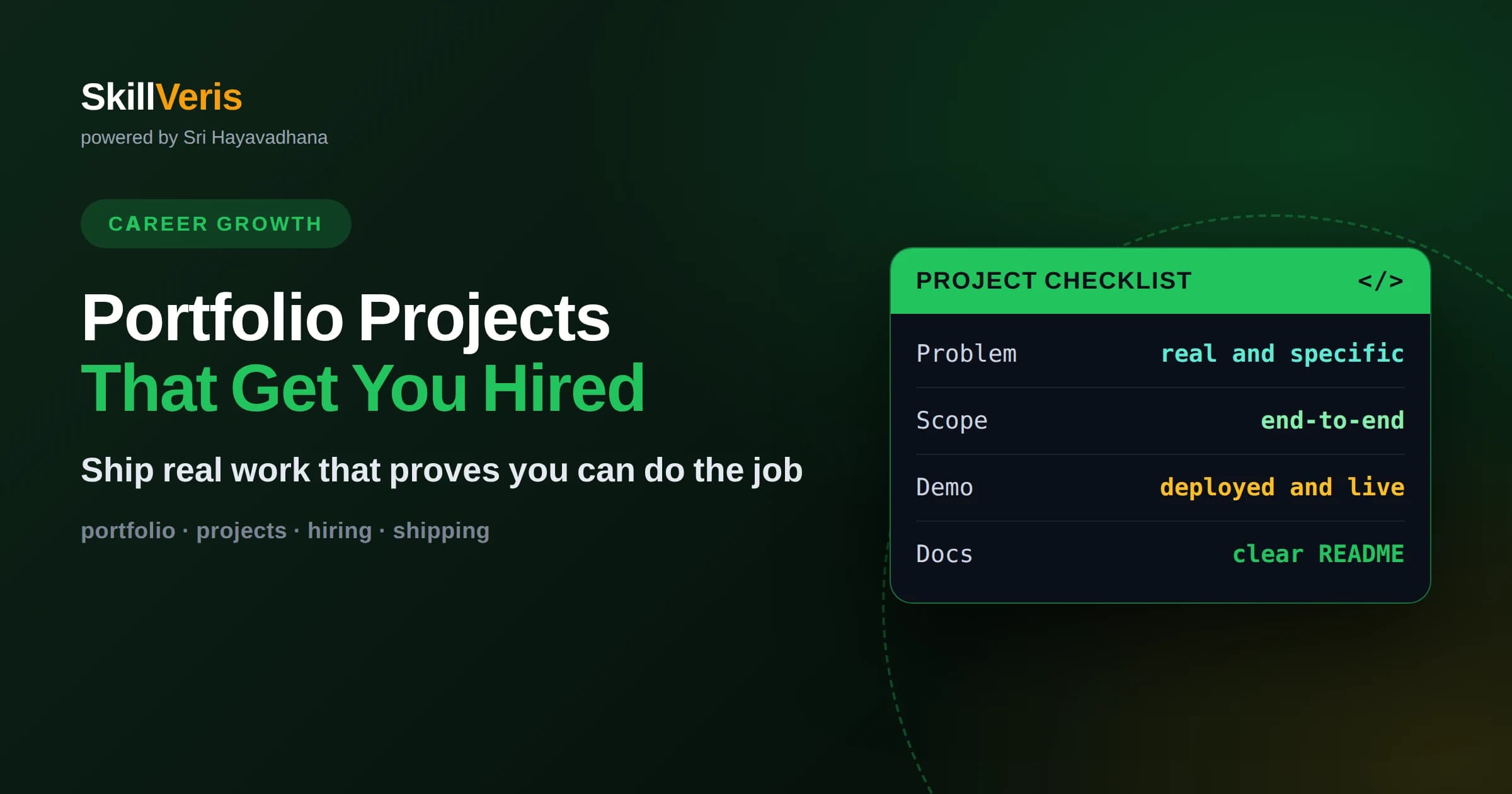
A hiring-grade project solves a genuine problem end-to-end rather than cloning a tutorial you followed step by step.
In this guide, you'll learn:
- Depth beats breadth: two or three polished, deployed projects outperform ten half-finished repositories.
- Documentation, a live demo, and a clear README often decide whether a reviewer even runs your code.
- Framing each project around the decisions you made turns a code dump into evidence of engineering judgment.
1What Makes a Portfolio Project Hire-Worthy
A portfolio project gets you hired when it proves you can take a real problem and ship a working solution end-to-end, not when it simply repeats a tutorial. Reviewers are looking for signal that you can scope work, make trade-offs, handle edge cases, and deliver something that runs. A to-do app copied line by line from a video sends the opposite signal, because thousands of candidates submit the same one and none of them demonstrate independent thinking.
The strongest projects share a few traits. They address a problem the author actually cared about, they are complete enough to use, and they are honest about their limits. When a hiring manager can open your live demo, understand the problem in thirty seconds, and see clean commits behind it, you have already separated yourself from most applicants.
Think of your portfolio as an argument. Every project is a piece of evidence for the claim that you can do the job. Weak evidence dilutes strong evidence, so a small collection of convincing work is far more persuasive than a long list of abandoned experiments.
2Start With a Real Problem, Not a Tech Stack
Many developers begin by choosing a framework they want to show off and then hunt for something to build with it. Reverse that order. Start with a problem you or someone you know genuinely faces, and let the problem dictate the tools. This produces projects that feel authentic and gives you real motivation to finish, which is usually the hardest part.
Good problems are specific and personal. Maybe you want to track the books you lend to friends, summarize the newsletters clogging your inbox, or compare grocery prices across the shops near you. These are small, but they are real, and a small real thing is more impressive than a large fake thing.
When you frame a project around a problem, you also gain a story to tell in interviews. You can explain who the user is, what pain they had, and how your choices addressed it. That narrative is exactly the kind of product thinking teams want, and it is impossible to fake if you only cloned someone else's idea.
3Choose Depth Over Breadth
Two or three deep projects will serve you better than ten shallow ones. Depth means the project handles the messy parts most tutorials skip: validation, error states, empty states, authentication where relevant, and sensible behavior when the network or database misbehaves. These details are where real engineering lives, and reviewers notice them immediately.
A deep project also invites follow-up questions you can answer well. If an interviewer asks why you chose a particular data model or how you handled a race condition, a project you truly built will let you respond with confidence. A shallow clone leaves you guessing, and that gap is obvious in conversation.
Prune ruthlessly. If a repository is half-finished, either finish it or leave it off your portfolio. An abandoned project on your profile suggests you abandon things, which is not the impression you want a future employer to form.
4Ship It End-to-End
A project that only runs on your laptop is incomplete from a hiring perspective. Shipping end-to-end means the application is deployed somewhere a stranger can click it, the data persists, and the whole flow works from first load to final action. This demonstrates that you understand more than just writing functions; you understand delivery.
Deployment forces you to confront environment configuration, secrets management, build steps, and the difference between development and production. These are exactly the skills teams pay for, and encountering them in a personal project is a low-stakes way to learn. When you can say you deployed and maintained something live, you are speaking the language of working engineers.
You do not need expensive infrastructure. Free and low-cost hosting tiers are plenty for a portfolio piece. The point is that the project exists in the world, not that it scales to millions. A modest live demo beats an ambitious repository that no one can run.
5Write a README That Sells the Work
The README is often the first and sometimes the only thing a reviewer reads, so treat it as the front door to your project. Open with one or two sentences explaining what the project does and who it is for. Follow with a screenshot or short clip, a link to the live demo, and clear instructions for running it locally.
Then go beyond setup. Describe the problem you solved, the key decisions you made, and the trade-offs you accepted. If you chose one database over another or skipped a feature deliberately, say so and explain why. This turns your README into evidence of judgment rather than a dry list of commands.
Keep it honest and readable. Note known limitations and what you would do next if you had more time. Reviewers respect self-awareness far more than false claims of completeness, and a candid roadmap signals that you think like someone who ships and iterates.
6Keep the Code and Commit History Clean
Reviewers frequently skim your source and your commit history to gauge how you work. Consistent formatting, sensible names, and small focused functions make a strong impression before anyone reads a single algorithm. Automated formatting and linting cost you almost nothing and remove a whole category of easy criticism.
Your commit history tells a story of how you build. A series of small, well-described commits suggests you work incrementally and think about each change. One giant commit labeled final version suggests the opposite. You do not need to be perfect, but a tidy history is a cheap way to look professional.
Avoid leaving commented-out code, unused files, and debugging leftovers in the repository. These clutter the project and imply carelessness. A clean tree tells the reviewer that you finish things and take pride in the details.
7Include Meaningful Tests
Tests are a strong hiring signal because most tutorial projects skip them entirely. You do not need exhaustive coverage; a focused set of tests around the core logic shows that you understand why testing matters and how to structure code so it can be tested. That alone puts you ahead of many candidates.
Prioritize tests that would catch a real regression, such as the main calculation, an important validation rule, or a critical user flow. Explain in your README what you tested and why. A small, thoughtful test suite communicates maturity far better than a large one full of trivial assertions.
Testing also improves your own confidence when extending the project. As you add features, tests catch mistakes early, which makes your live demo more reliable when a reviewer clicks through it. Reliability in a demo is itself a quiet form of persuasion.
8Make Your Reasoning Visible
The most valuable thing a portfolio can convey is how you think, yet code alone rarely captures reasoning. Add a short design note, either in the README or a separate document, that walks through the problem, the options you considered, and why you chose the path you did. This is the difference between showing what you built and showing why you built it that way.
Reasoning notes also prepare you for interviews. When you have already articulated your trade-offs in writing, discussing them out loud becomes natural. You can speak to alternatives you rejected, which demonstrates breadth, and to constraints you respected, which demonstrates pragmatism.
Do not overdo it. A page of clear thinking beats ten pages of jargon. The goal is to let a busy reviewer understand your judgment quickly and come away convinced that you would make sound decisions on their team.
9Tailor Projects to the Roles You Want
Your portfolio should point toward the job you are seeking. If you want a frontend role, invest in interface polish, accessibility, and responsive design. If you want a backend or data role, emphasize the data model, the API design, and how you handle scale and failure. Aligning your work with the target role helps reviewers imagine you in the seat.
Read the job descriptions you are excited about and note the recurring skills. If several roles mention a particular capability, a project that demonstrates it becomes disproportionately valuable. You are essentially building evidence for the specific claims those employers care about.
This does not mean chasing every trend. It means being intentional. A focused portfolio that speaks directly to a role reads as deliberate, while a scattered one reads as unsure of its own direction.
10Avoid the Common Portfolio Mistakes
The most common mistake is submitting well-known tutorial clones with no personal contribution. Reviewers have seen the same weather app and clone dashboards countless times, and these projects prove only that you can follow instructions. If you must start from a tutorial, extend it substantially until it becomes genuinely yours.
Another frequent error is neglecting presentation. A brilliant project with no live demo, a broken build, or a one-line README will be passed over in favor of a simpler project that is easy to evaluate. Reviewers are busy, and friction kills interest quickly.
Finally, avoid overclaiming. Do not describe a weekend prototype as a production system. Experienced engineers can tell, and inflated claims erode trust. Present your work accurately and let its genuine quality speak for itself.
11Treat Your Portfolio as Living Work
A portfolio is never finished; it grows as you do. Revisit your projects periodically, fix bugs users report, refine the README, and retire pieces that no longer represent your best work. This ongoing care signals that you treat your work as a craft rather than a checkbox.
As you learn new skills, fold them into existing projects or build focused new ones. Incremental improvement is easier to sustain than sporadic bursts, and a steadily improving profile tells a compelling story of growth over time.
Ask peers or mentors to review your portfolio with fresh eyes. Outside feedback catches confusing explanations and rough edges you have stopped noticing. A quick review before a job search can meaningfully raise the quality of the impression you make.
12Present Your Portfolio Where It Counts
Building great projects is only half the job; the other half is making sure the right people see them in the right way. Host your portfolio somewhere clean and fast, link directly to live demos and source code, and lead with the two or three projects you are proudest of rather than burying them in a long list. First impressions form in seconds, so put your strongest evidence up front.
Tailor how you present your work to each application. Reorder or highlight the projects most relevant to the specific role, and reference them in your cover note and interviews so reviewers connect your portfolio to their needs. A little curation makes your work feel purpose-built for the job rather than generic.
Keep your links working and your demos alive. A broken demo link at the moment a hiring manager clicks it can undo weeks of effort. Periodically test every link and deployment so that whenever someone reviews your portfolio, everything just works and reinforces the impression of someone who ships reliably.
13Give Yourself a Realistic Timeline
A strong portfolio is built over weeks and months, not a single frantic weekend, so plan accordingly. Set a modest, sustainable pace, perhaps dedicating a few focused hours each week, and let projects accumulate steadily. Consistency beats intensity, and steady progress prevents the burnout that abandoned portfolios are often born from.
Break each project into small milestones you can finish and feel good about. Shipping a minimal version quickly, then improving it, keeps your motivation high and ensures you always have something demonstrable. A finished simple version is infinitely more valuable than an unfinished ambitious one.
Start before you feel ready. Waiting until you have mastered everything means never starting, and much of the learning happens through the act of building. Begin your first real project this week, however small, and let momentum carry you toward a portfolio that genuinely represents your abilities.
14Build Your Next Project With SkillVeris
The fastest way to build a hiring-grade portfolio is to build steadily with structured guidance, and SkillVeris is designed for exactly that kind of hands-on progress. Working through practical, project-oriented lessons gives you the reps you need to turn ideas into shipped, documented, deployed work.
Pick one real problem this week, scope it small, and take it all the way to a live demo with a clear README. Then do it again. Each finished project compounds into a portfolio that argues, convincingly, that you are ready for the job you want.
Get The Print Version
Download a PDF of this article for offline reading.
About the Publisher
SkillVeris Team
Careers Team
Our careers team helps you navigate tech job markets, build portfolios, and land the roles you want.
View all postsRelated Posts
Never miss an update
Get the latest tutorials and guides delivered to your inbox.
No spam. Unsubscribe anytime.