Networking for Developers Who Hate Networking
SkillVeris Team
Careers Team
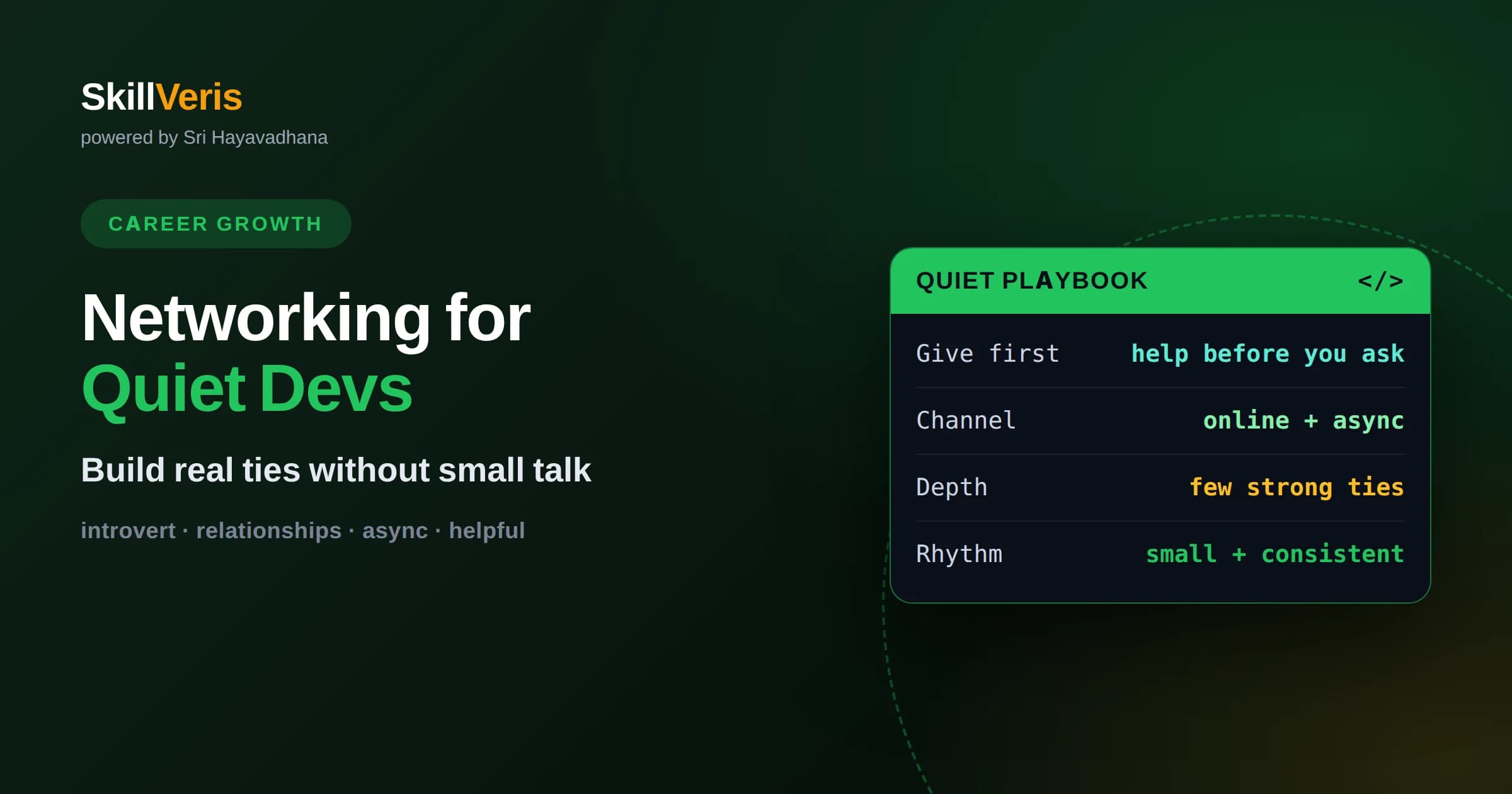
Networking is really relationship building, and the version that works for developers is based on being useful rather than being outgoing.
In this guide, you'll learn:
- Online and asynchronous channels let you build a strong network without the crowded rooms and forced small talk you dread.
- Helping people, sharing what you learn, and staying loosely in touch beat collecting business cards every time.
- A small, genuine network you actually maintain is more valuable than a huge list of contacts you never speak to.
1Reframe What Networking Really Is
Networking for developers who hate networking starts with a reframe: networking is not schmoozing at loud events, it is building genuine professional relationships over time by being helpful and staying in touch. Once you drop the mental image of forced small talk and business cards, the whole activity becomes something an introverted engineer can do comfortably and even enjoy.
The version of networking that actually advances careers has almost nothing to do with charisma. It is the accumulation of people who know what you do, trust that you are competent, and think of you when an opportunity appears. You build that trust through work and small, consistent interactions, not through performance.
This matters because most good opportunities travel through people, not job boards. A referral, an introduction, or a tip about a team hiring quietly outperforms cold applications. You do not have to become an extrovert to benefit from this; you have to become known to a few of the right people.
2Why So Many Developers Resist Networking
Many developers dislike networking because the mainstream advice is built for extroverts: work the room, follow up aggressively, sell yourself. That style feels transactional and exhausting to people who would rather be judged by their code than their charm. The resistance is reasonable.
There is also a fairness instinct at play. Developers often want to believe that skill alone should be enough, and that needing relationships is somehow a flaw in the system. But relationships are not a substitute for skill; they are how your skill becomes visible to people who can act on it.
Recognizing that your discomfort comes from a mismatch of style, not a personal deficiency, is freeing. You can discard the extrovert playbook entirely and build a networking practice that fits how you actually operate.
3Lead by Being Useful, Not by Asking
The most comfortable and effective networking strategy for a reluctant developer is to give before you ask. Answer a question in a community forum, review someone's code, write up a solution to a problem you just solved, or share a resource that helped you. Each of these is a small gift that builds goodwill without any social performance.
This works because helpfulness is memorable and low-pressure. You are not asking anyone for anything, so there is no awkward power dynamic. Over time, the people you have helped form a network of quiet reciprocity, and many will be glad to help you when you eventually need it.
Being useful also plays directly to a developer's strengths. You already solve problems all day; redirecting a fraction of that toward answering others' questions turns your existing skills into relationship capital with almost no extra emotional cost.
Keep the giving genuine and unconditional. The moment help comes with an implied invoice, people sense it and pull away. Offer what you can with no expectation of return, and the returns tend to arrive anyway, larger and more freely than any transactional approach would ever produce.
4Network Online and Asynchronously
You do not have to attend a single in-person event to build a strong network. Online communities, technical forums, open-source projects, and professional platforms let you connect on your own schedule, in writing, with time to think before you respond. For many developers this asynchronous mode is not a compromise; it is far better than live conversation.
Written interaction removes the pressures that make networking feel awful. There is no eye contact to manage, no pause to fill, and no need to think on your feet. You can craft a thoughtful reply, edit it, and post when you are ready, which lets your competence and personality come through cleanly.
Choose one or two communities aligned with your interests and show up in them regularly. Depth in a small number of places beats a thin presence spread across every platform, and it lets people actually get to know you.
5Let Your Work Do the Talking
Sharing what you build and learn is networking that requires no direct social interaction at all. A blog post about a problem you solved, a public project, or a short note about a concept that finally clicked puts your work in front of others and invites them to come to you. This is sometimes called building in public, and it is ideal for people who would rather create than converse.
The audience filters itself. People who engage with your work share your interests, which means the connections that form are already relevant. You skip the awkward stage of explaining who you are because your work has already done it.
Consistency matters more than polish. A steady trickle of small, honest updates about your work builds a reputation over months. You are not performing; you are leaving a visible trail of competence that the right people will follow.
Sharing struggles as well as wins makes your trail more relatable and more useful. A short write-up of a bug that stumped you and how you eventually cracked it helps others facing the same wall and signals honesty, which builds more trust than a stream of flawless highlights ever could.
6Prefer Depth Over Breadth With One-on-One Connection
If large groups drain you, lean into one-on-one interaction, which is where introverts often shine. A single genuine conversation with one person, whether a former colleague, a maintainer whose project you use, or someone whose article you admired, builds more real connection than an hour of shallow mingling.
Reaching out individually is also less intimidating than it sounds. A short, specific message referencing their work and asking a genuine question is usually welcomed, because most people enjoy talking about what they do. You are not imposing; you are showing sincere interest.
Aim to deepen a handful of relationships rather than multiply shallow ones. Five people who genuinely know and respect you will do more for your career than five hundred contacts who would not recognize your name.
7Stay in Touch Without It Feeling Forced
Networking fails most often not at the first meeting but afterward, when contact fades. The fix is a lightweight system for staying loosely in touch. A brief message when you see something relevant to someone, a congratulations on a new role, or a reply to their post keeps the relationship warm with minimal effort.
You do not need elaborate customer-relationship software, but a simple note of who you have talked to and what they care about helps you follow up naturally. The goal is to be present occasionally, not constantly, so the relationship does not go cold between the rare moments you actually need it.
Genuine staying in touch is about attention, not frequency. Noticing and acknowledging what matters to someone, even a couple of times a year, is enough to keep a connection alive and mutual.
Make it easy on yourself by tying follow-ups to things you already do. When you read an article, learn a tool, or ship a project, ask whether it might interest someone you know, and send it along with a line. This turns your normal activity into natural, low-effort points of contact that never feel manufactured.
8Attend Events on Your Own Terms
If you do choose to attend meetups or conferences, you can do it in a way that respects your limits. Set a small, concrete goal, such as one good conversation, and give yourself permission to leave once you have met it. A single meaningful exchange justifies the trip; you do not have to work the whole room.
Having a role reduces anxiety. Volunteering, asking a question during a talk, or helping at a booth gives you a reason to be there and a natural opener, which removes the dreaded task of approaching strangers cold. Structure is a shy person's best friend at an event.
Remember that many other attendees feel exactly as awkward as you do. Approaching someone standing alone is often a relief to them, and starting with a simple question about the talk you both just heard is a low-risk, natural opener.
9Do Not Overlook Your Existing Network
The easiest network to build is the one you already have. Current and former colleagues, classmates, and people you have collaborated with online already know your work firsthand, which makes them your most credible advocates. Nurturing these existing ties is more valuable than chasing strangers.
Stay on good terms when you leave a job or finish a project, and check in occasionally afterward. People move to new companies and remember who was good to work with, and those memories turn into referrals years later. Your reputation among people who have seen you work is your most durable professional asset.
Being genuinely helpful and reliable in your day-to-day work is itself a form of networking. Every teammate who trusts you is a potential future connection, so the way you treat people now compounds quietly over your whole career.
Reconnecting is easier than you fear. A short message to a former colleague, with no agenda beyond genuine interest in how they are doing, is almost always welcomed. People rarely mind being remembered, and these light touches keep dormant relationships ready to reactivate whenever either of you needs them.
10Adopt Mindset Shifts That Make It Sustainable
A sustainable networking practice for a reluctant developer rests on a few mindset shifts. First, aim for relationships, not transactions; you are not extracting favors but building mutual goodwill over years. That long view removes the ick of feeling like you are using people.
Second, accept that you can network in a way that suits you. There is no rule that networking must be loud or extroverted. Written, asynchronous, help-first networking is fully legitimate and, for many developers, more effective than the conventional style.
Third, be patient. A network is grown, not assembled overnight, and the value often shows up long after the effort. Small consistent actions, sustained over time, quietly build a web of relationships that will support your career for decades.
11Start With Small, Low-Stakes Experiments
The way to begin when networking feels overwhelming is to shrink the first step until it is almost trivial. Answer one question in a community this week. Send one message to a former colleague. Publish one short note about something you learned. Each of these is small enough to do despite the discomfort.
Small experiments let you discover which channels suit you without committing to a grand strategy. You might find that you love writing but hate live events, or that one-on-one messages energize you while forums drain you. Learn your own preferences by trying, not by planning.
Momentum comes from repetition, not intensity. A single small networking action each week accumulates into a real network over a year, and because each action is small, you can sustain it even on the days your social battery is low.
12Grow Your Skills and Your Network Together
The most authentic networking flows naturally from doing good work and sharing the journey, and that gives you a simple plan. As you learn and build on SkillVeris, share what you discover, help others working through the same material, and connect with peers on the same path. Your learning becomes your networking.
Pick one small action from this article and try it this week, then add another next week. Comfortable networking is built from many tiny, low-pressure steps, not a single leap into a crowded room. Let the practice compound gently.
Keep growing your skills on SkillVeris and let the relationships form around the work. A developer who is genuinely learning, helping, and building in the open will find that a network quietly assembles itself, no small talk required.
Get The Print Version
Download a PDF of this article for offline reading.
About the Publisher
SkillVeris Team
Careers Team
Our careers team helps you navigate tech job markets, build portfolios, and land the roles you want.
View all postsRelated Posts
Never miss an update
Get the latest tutorials and guides delivered to your inbox.
No spam. Unsubscribe anytime.