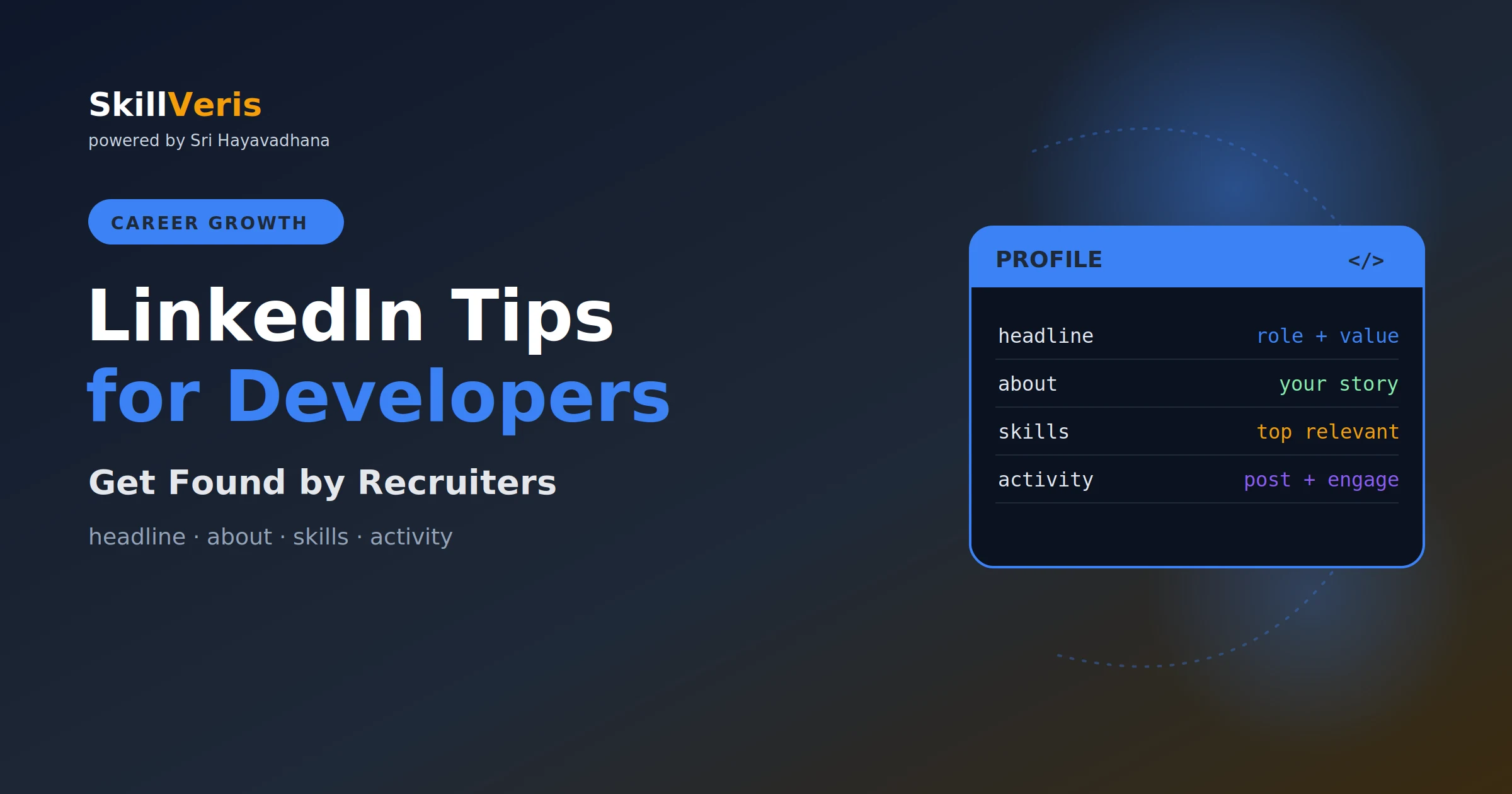
A keyword-rich headline makes recruiters find you and understand your value in seconds.
In this guide, you'll learn:
The about section should tell your data story, not just list a job title.
The featured section is where you showcase portfolio projects for instant credibility.
Genuine, specific networking beats mass connection requests every time.
Sharing what you learn positions you as engaged and keeps you visible in feeds.
1Why Does LinkedIn Matter for Aspiring Data Analysts?
For aspiring data analysts, LinkedIn is where recruiters search for candidates and where hiring managers verify you before an interview, so an optimized profile can generate opportunities you never applied for. A strong headline, a story-driven about section, featured projects, and steady networking turn a passive page into a lead generator.
Many job seekers treat LinkedIn as an online resume they set up once and forget. That is a missed opportunity, because the platform actively surfaces profiles to recruiters based on keywords and activity. A little deliberate effort puts you in front of people who are hiring right now.
This guide walks through each part of the profile that matters and the networking habits that actually produce replies, tailored specifically for someone breaking into data analytics.
2Writing a Headline That Gets Found
Your headline is the most important text on your profile because it appears everywhere and is heavily weighted in recruiter searches. The default, which just shows your current job title, wastes that space if it is unrelated to analytics.
Instead, pack it with the keywords recruiters search for and a hint of value. Something like "Aspiring Data Analyst | SQL, Python, Tableau | Turning Data Into Decisions" tells both the algorithm and a human reader exactly what you offer. Include the phrase data analyst deliberately, since that is what recruiters type into the search bar.
💡Front-load your keywords
Put your target role and top tools at the very start of the headline. Search previews truncate, and recruiters skim, so the most important words should never be buried at the end.
3Crafting a Compelling About Section
The about section is your chance to tell a story a resume cannot. Write it in the first person, keep it human, and make the first two lines count, because that is all that shows before the reader clicks to expand.
Open with who you are and the value you bring, then briefly cover your journey into analytics, your core skills, and what you are looking for. If you are switching careers, connect your past to your present so the move reads as intentional. End with a light call to action inviting people to connect or view your work, and weave in keywords like SQL, data visualization, and analytics naturally throughout.
4Showcasing Projects in Featured
The featured section sits high on your profile and lets you pin links, posts, and documents. For an aspiring analyst, this is prime space to prove you can actually do the work.
Pin your best portfolio projects, a link to your GitHub or Tableau Public, and any well-received posts you have written about analytics. A reviewer who lands on your profile and immediately sees a dashboard or a clear project write-up forms a far stronger impression than one who only reads a headline. Make the leap from claim to proof effortless.
🔑Show, then tell
A single featured dashboard or project write-up does more for your credibility than three paragraphs describing your skills. Let recruiters see the work before they read about it.
5Experience, Skills, and Recommendations
Fill out the rest of your profile completely, because LinkedIn rewards completeness with better search placement. Even non-analytics experience belongs here if you frame the transferable and analytical parts of each role.
Add the skills recruiters filter by, such as SQL, Python, data visualization, Excel, and Power BI, and prioritize the ones most relevant to the roles you want. Skill endorsements and a few genuine recommendations from colleagues or mentors add credibility, so it is worth asking people who know your work to write a short, specific note.
6Networking That Actually Works
Networking on LinkedIn works when it is genuine and specific, and fails when it is mass-blasted. A thoughtful, personalized approach gets replies; a generic connect-and-pitch does not.
When you send a connection request, add a short personal note referencing a shared interest, a post they wrote, or a genuine question. Engage with analysts' content by adding a substantive comment rather than a bare like. Over time, these small, real interactions build relationships that surface referrals and advice, which quietly outperform cold applications.
7Sharing What You Learn
Posting about your learning journey keeps you visible and positions you as engaged, even before you land a role. You do not need to be an expert; documenting what you are learning is genuinely valuable to others on the same path.
Share a project you completed, an insight from a course, or a lesson from a mistake you made in an analysis. Keep it authentic and specific, and let people see your reasoning. Consistent, honest posting compounds over months into a reputation and a network, and it often catches the eye of exactly the people who hire.
8Approaching Recruiters and Hiring Managers
Reaching out directly can accelerate a job search when done respectfully. Recruiters and hiring managers are people juggling many messages, so make yours easy to say yes to.
Keep outreach short: introduce yourself in a line, state your interest specifically, and make one clear, low-friction ask, such as whether they are open to a brief conversation about a role. Attach or link your featured work rather than describing it at length. Follow up once if you hear nothing, then move on gracefully, because persistence should never tip into pressure.
9Staying Active and Consistent
A profile you touch once fades from the algorithm and from people's minds. Consistency, not intensity, is what keeps you visible and credible over a job search.
Spend a small amount of time each week updating your profile with new projects, engaging thoughtfully with a few posts, and reaching out to one or two new people. This light, steady rhythm keeps your network warm and your profile surfacing in searches, so opportunities keep finding you rather than the reverse.
10Frequently Asked Questions
Is a data analytics course really free? Yes. SkillVeris offers free data analytics courses and study notes, so you can build the skills and projects that make your LinkedIn profile credible without paying anything.
What should an aspiring data analyst put in their headline? Include your target role, your top tools like SQL, Python, and Tableau, and a short value statement. Front-load the keywords recruiters search for, especially the phrase data analyst.
Do I need work experience to have a strong LinkedIn profile? No. You can feature portfolio projects, list relevant skills, and tell your career story in the about section. Demonstrated projects can carry a profile when formal experience is thin.
How do I network without sounding pushy? Personalize every connection request, engage genuinely with people's content, and lead with curiosity rather than a pitch. Specific, respectful interactions get far more replies than mass outreach.
Should I post content if I am still learning? Yes. Sharing what you learn, including projects and lessons from mistakes, positions you as engaged and keeps you visible. You do not need to be an expert to add value.
How often should I update my LinkedIn profile? Touch it lightly every week by adding new projects and engaging with a few posts. Consistency keeps you in recruiter searches and keeps your network warm.
11Make Your Profile Work for You
LinkedIn rewards aspiring data analysts who treat it as an active tool rather than a static resume. A keyword-rich headline gets you found, a story-driven about section earns the click, featured projects prove your ability, and genuine networking turns visibility into opportunity. Each piece reinforces the others.
You cannot feature projects you have not built, so pair your profile work with real skill-building. Learn SQL, visualization, and analysis for free with the data analytics courses and study notes on SkillVeris, then showcase what you create. A strong profile plus real work is what makes recruiters reach out first.
Does SkillVeris have a tech blog, and what does it cover?
Yes, the SkillVeris blog has over 500 articles covering AI and machine learning, programming, web development, DevOps, cloud, security, databases and career guidance. Articles are practical and answer-first, and many use the Learn Through Hobbies approach, teaching technical concepts through cricket, music, gaming or cooking analogies. Everything is free to read.
What is the SkillVeris tech glossary and how big is it?
The SkillVeris glossary is a free reference of roughly 2,000-plus technology terms, each with a clear plain-language definition. It spans AI, programming, web, DevOps, cloud, security and database vocabulary, so whenever a lesson, article or job description uses jargon you do not recognise, the glossary gives you a fast, reliable answer.
Are the developer cheat sheets on SkillVeris free to download?
The cheat sheets are completely free to use, like everything else on SkillVeris. Each sheet condenses a language or tool into its essential syntax, commands and patterns for quick reference while coding. They are designed for rapid lookup during real work, complementing the deeper explanations found in study notes and courses.
Which programming references and cheat sheets are available?
Cheat sheets cover the platform's main domains, including programming languages, AI and ML tooling, web development, DevOps, cloud, security and databases, matching the topics of the 37 live courses. Each sheet lists related reading links and hashtags, so you can jump from a quick reference into fuller study notes or blog articles.
How do I find the meaning of a technical term quickly?
Search the SkillVeris glossary, which holds around 2,000-plus terms with concise, plain-language definitions. Each entry gets to the point in its first sentence, then links to related reading like blog posts or study notes for deeper context. It is faster and more consistent than sifting through scattered search results.
Is the SkillVeris blog good for beginners learning to code?
Yes, many blog articles are written specifically for beginners, and the Learn Through Hobbies style makes them unusually approachable: you might learn Python concepts through cricket or understand APIs through cooking. With 500-plus articles across skill levels, beginners can start with fundamentals and keep reading as they advance, entirely free.
Can cheat sheets replace full courses for learning a language?
No, cheat sheets are references, not teaching tools; they assume you already understand the concepts and just need syntax or commands fast. To actually learn a language, take a structured SkillVeris course with its 24–40 lessons and assessments, then keep the cheat sheet beside you while practising in Code Lab.
How often are new blog articles published on SkillVeris?
The blog grows regularly and already exceeds 500 articles, with new posts added as courses launch and technologies evolve. Topics track the platform's catalogue across AI, programming, web development, DevOps, cloud and security, so checking the Blog section periodically surfaces fresh tutorials, explainers and career-focused pieces, all free to read.
Does the glossary cover AI and machine learning terms?
Yes, AI and machine learning vocabulary is a major part of the roughly 2,000-plus term glossary, covering everything from foundational terms to modern concepts around LLMs, RAG and MLOps. Definitions are plain-language and answer-first, which helps when dense AI papers or course lessons throw unfamiliar jargon at you.
Are there cheat sheets for interview preparation?
Cheat sheets work well as interview-day refreshers because they compress syntax, commands and key concepts into scannable references. For dedicated preparation, combine them with the SkillVeris interview questions feature, which includes readiness scoring, plus study notes for depth. Reviewing a relevant cheat sheet just before an interview steadies recall under pressure.
Can I read the tech blog without signing up?
Yes, the blog is freely readable, and SkillVeris never charges for content. All 500-plus articles are open, covering tutorials, concept explainers and career advice. Creating a free account adds value elsewhere on the platform, like course progress tracking and certificates, but reading the blog requires no commitment at all.
How is the SkillVeris glossary different from Wikipedia?
The glossary is purpose-built for learners: definitions are short, plain-language and answer-first, sized for a quick lookup mid-lesson rather than a deep encyclopedic read. Entries also cross-link to related SkillVeris study notes, blog posts and courses, so a definition becomes a doorway into structured learning instead of a dead end.
Do blog articles use the Learn Through Hobbies method?
Many blog articles teach technical topics through hobby analogies, a hallmark of the SkillVeris blog, so you will find articles explaining programming through cricket, machine learning through music, or system design through cooking. The analogy is the teaching device; the article still delivers the real technical concept underneath.
Where can I find quick programming references while coding?
Open the SkillVeris cheat sheets, which are built exactly for that moment: compact, scannable references for syntax, commands and common patterns across languages and tools. Keep the relevant sheet in a browser tab while you work in Code Lab or your own editor, and dip into the glossary for terminology.
Is there a glossary entry for terms I meet in job descriptions?
Very likely yes, with roughly 2,000-plus terms across AI, programming, web, DevOps, cloud, security and databases, the glossary covers most jargon that appears in tech job descriptions. Decoding a listing this way helps you judge role fit honestly and prepares you to discuss those terms in interviews.
Are the blog articles written for the Indian tech audience?
The blog serves Indian learners plus a worldwide audience. Content stays globally relevant while acknowledging realities that matter in India, such as free access being essential for students and freshers, and career guidance that connects naturally to the SkillVeris jobs portal, which aggregates roles across India, UK, USA, Germany and Remote.
Can I suggest a topic for the blog or glossary?
SkillVeris content grows in response to what learners need, so feedback is welcome through the platform's support channels. If a term is missing from the glossary or a topic deserves an article, telling the team helps prioritise it. Meanwhile, the AI Mentor can answer the question immediately, 24/7, at any depth.
Do cheat sheets and glossary entries link to deeper learning?
Yes, every cheat sheet and glossary entry carries related reading links into study notes, blog articles and courses, plus concept hashtags for discovering similar content. This cross-linking means a thirty-second lookup can smoothly become a structured learning session whenever you decide you want more than a quick answer.
What makes SkillVeris programming references trustworthy?
The references are written to strict internal quality standards, kept consistent with the platform's 37 live courses, and never padded with invented statistics or hype. Definitions and cheat sheets are reviewed against the same content contracts that govern courses, and the answer-first style makes any inaccuracy easy to spot and correct.
How do the blog, glossary and cheat sheets fit into my learning routine?
Use them as satellites around your main course: read blog articles for context and motivation, hit the glossary the instant jargon appears, and keep cheat sheets open while coding. Together with study notes, Code Lab and the 24/7 AI Mentor, they turn passive reading into a complete, free learning system.
What Learners Say
Real journeys from the SkillVeris community — swipe for more.
“SkillVeris taught me Python through Cricket. Now I’m building real projects and feeling confident!”
Arjun S. · B.Tech Student
“The best platform for hobby-based learning. Concepts finally stick.”
Priya R. · Data Analyst
“I went from zero coding to a portfolio of projects — all by learning through my love for gaming. Landed my first internship!”