Junior vs Senior Developer: What Changes
SkillVeris Team
Careers Team
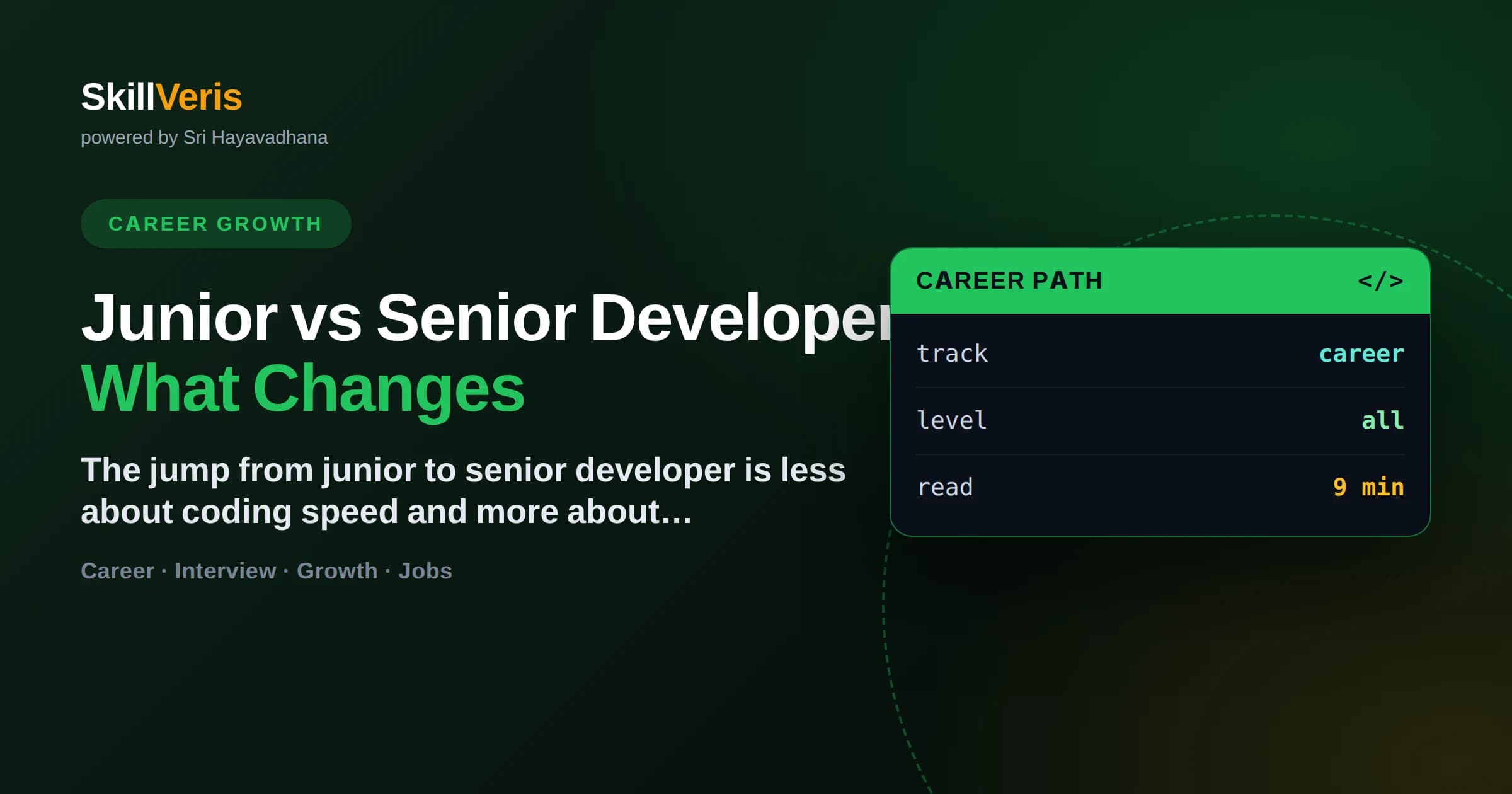
The core shift from junior to senior is from writing code that works to making decisions that hold up — judgement, not just syntax.
In this guide, you'll learn:
- Juniors are given well-defined tasks; seniors take ambiguous problems and define the tasks themselves.
- Seniors are measured by outcomes and team impact, not lines of code or hours worked.
- Communication and mentoring become as important as technical skill at the senior level.
- Knowing when NOT to build something is a signature senior instinct.
1What Actually Changes From Junior to Senior
The biggest difference between a junior and a senior developer is not typing speed or knowing more frameworks — it is judgement, scope, and ownership. A junior is handed a clearly defined task and implements it well. A senior takes a vague business problem, decides what should be built (and what shouldn't), breaks it into tasks, anticipates failure modes, and owns the result end to end.
Seniority is best understood as the size and ambiguity of the problems you can be trusted to handle alone. That is why 'senior' is not a purely time-based title: some developers reach it in a few years, and others plateau because they keep operating at task level rather than growing into decisions and impact.
2Scope: From Tasks to Problems
The clearest dividing line is the size and clarity of the work you are given. Juniors thrive on well-specified tickets. Seniors are handed ambiguity and expected to turn it into a plan.
- Junior: 'Add validation to this form field' — a defined, bounded task.
- Mid: 'Build the signup flow' — a feature with several tasks to sequence.
- Senior: 'Reduce signup drop-off' — an outcome with the approach left open.
- Senior also decides what not to build when a simpler path exists.
🔑Key Distinction
Juniors solve the problem they are given. Seniors figure out which problem is actually worth solving.
3Judgement and Decision-Making
Seniors accumulate a library of trade-offs learned from real consequences. They know that the clever abstraction often costs more than the duplication it removes, that most performance worries are premature, and that boring, proven technology usually beats the exciting new thing for production systems. This judgement is why teams trust seniors to make calls without supervision.
Juniors tend to reach for the solution they most recently learned; seniors weigh several options against context — team size, deadline, maintenance cost, and risk. The senior answer to most design questions is 'it depends,' followed by a clear explanation of what it depends on.
4How Daily Work Differs
The texture of the workday changes as you grow. A junior spends most of the day heads-down coding. A senior's time fragments across code, design discussions, reviews, mentoring, and unblocking others — and that is the job, not a distraction from it.
Where the Time Goes
Coding never disappears, but it shares the day with higher-leverage work.
Junior: mostly implementation against clear tickets, with frequent questions.
Mid: implementation plus owning a feature area and reviewing peers.
Senior: architecture, code review, mentoring, and cross-team coordination.
Across all levels: writing clear code and asking good questions still matters.5Communication Becomes the Multiplier
At the senior level, the ability to explain, persuade, and align people often matters more than raw coding skill. A senior who can write a clear design doc, run a productive review, and translate business needs into technical plans multiplies the output of the whole team. A brilliant coder who cannot communicate stays capped at their own two hands.
💡Pro Tip
Practising writing — design docs, thorough PR descriptions, clear postmortems — is one of the fastest ways to grow toward senior-level impact.
6Ownership and Accountability
Seniors own outcomes, not just commits. When a feature ships, a senior thinks about monitoring, rollback plans, edge cases, and what happens at 3 a.m. if it breaks. They do not consider a task 'done' when the code merges — they consider it done when it works reliably in production and the team can maintain it. This ownership mindset is often what a promotion committee is really looking for.
- Think past 'it works on my machine' to 'it works under load and on-call.'
- Plan for failure: retries, alerts, graceful degradation.
- Leave the codebase more maintainable than you found it.
- Take responsibility for the outcome, including when things go wrong.
7Lifting the Team Around You
A defining senior behaviour is making everyone else better. Through code review, pairing, and patient answers, seniors raise the whole team's baseline. This is why impact, not individual output, is the true senior metric: a senior who mentors three juniors into stronger engineers has more impact than one who simply ships more code alone.
8Common Mistakes on the Way Up
Some habits keep capable developers stuck at the junior or mid level longer than necessary.
- Chasing new frameworks instead of deepening judgement and fundamentals.
- Measuring yourself by lines of code or hours rather than outcomes.
- Avoiding ambiguous problems because clear tickets feel safer.
- Neglecting communication skills, assuming code speaks for itself.
- Hoarding knowledge instead of mentoring, which caps your impact.
⚠️Watch Out
Years of experience alone do not make someone senior. A developer who spends five years only doing task-level work stays junior in everything but title.
9Key Takeaways
The junior-to-senior transition comes down to a few shifts.
- Move from executing tasks to defining and owning problems.
- Build judgement about trade-offs from real production consequences.
- Treat communication and writing as core engineering skills.
- Own outcomes end to end, including failure and maintenance.
- Grow your impact by lifting the whole team, not just your own output.
10Frequently Asked Questions
Q: How long does it take to become a senior developer? A: There is no fixed timeline — it depends on the range and difficulty of problems you take on, not the calendar. Some developers reach senior scope in a handful of years by seeking ambiguity and ownership; others take longer if they stay at task level. Growth in judgement, not tenure, is what matters.
Q: Do I need to be a coding genius to be senior? A: No. Senior developers are defined more by judgement, ownership, and communication than by raw brilliance. Many effective seniors are solid, reliable engineers who make good decisions and lift their teams, not virtuoso coders.
Q: What is the difference between senior and staff or principal? A: Broadly, senior means owning outcomes within a team, while staff and principal roles extend that ownership across multiple teams or the whole organisation, often with more emphasis on strategy and technical direction. The scope of influence keeps widening as you climb.
Q: Can I become senior faster by switching companies? A: Sometimes a new environment offers more scope and mentorship, which accelerates growth, but a title bump without a real change in responsibility is hollow. Focus on the size of problems you can own; the title tends to follow genuine capability.
Get The Print Version
Download a PDF of this article for offline reading.
About the Publisher
SkillVeris Team
Careers Team
Our careers team helps you navigate tech job markets, build portfolios, and land the roles you want.
View all postsRelated Posts


Never miss an update
Get the latest tutorials and guides delivered to your inbox.
No spam. Unsubscribe anytime.