How to Write a Great Developer Cover Letter
SkillVeris Team
Careers Team
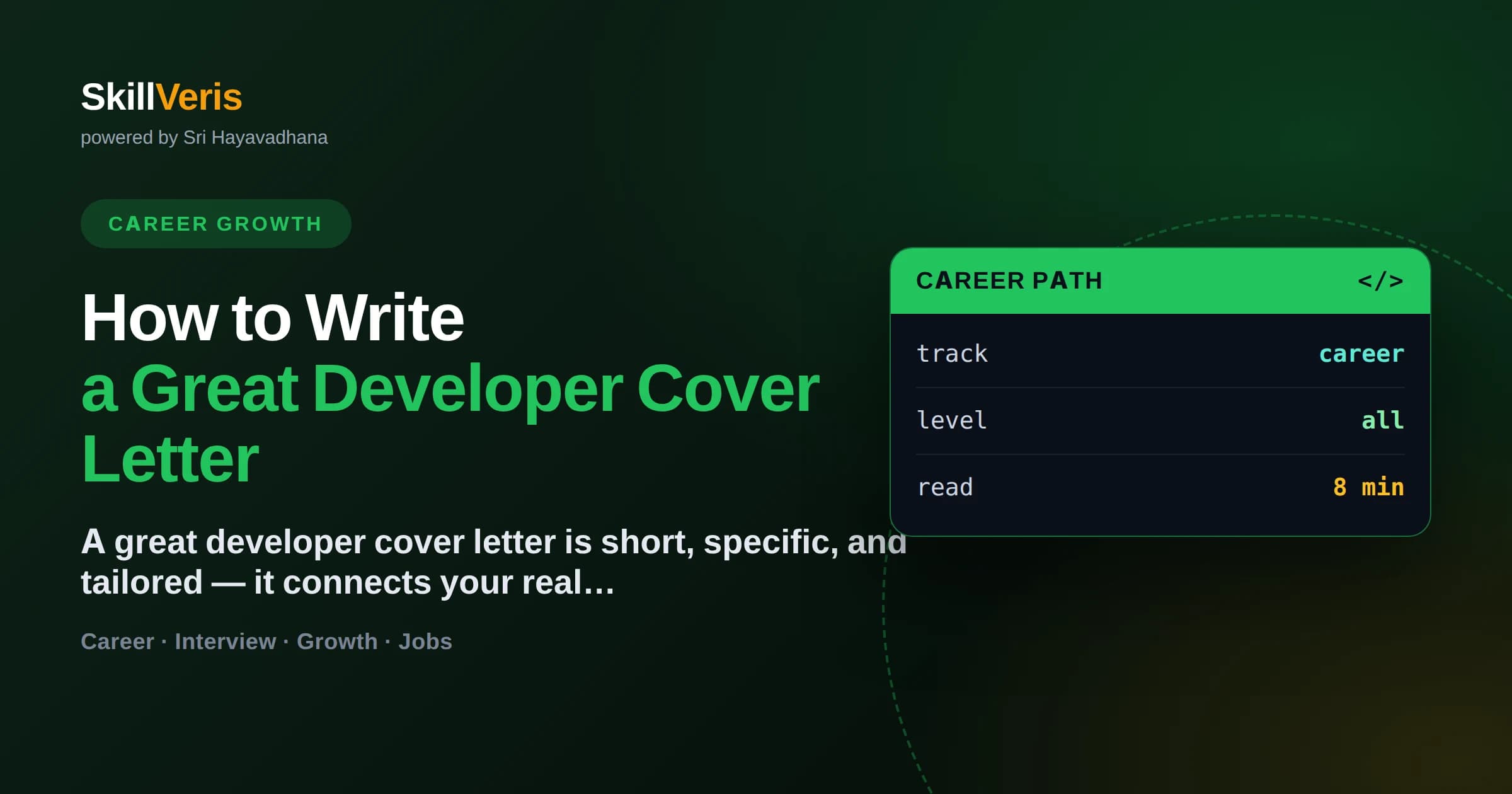
A great developer cover letter is a short, tailored note that connects your specific skills and projects to this particular role and company — not a rehash of your resume.
In this guide, you'll learn:
- Open with a strong, specific first line that states the role and gives a concrete reason you are a fit, not a generic 'I am writing to apply'.
- Show evidence: reference real projects, technologies, and results that match what the job description asks for.
- Demonstrate that you researched the company by naming something specific about its product, mission, or engineering work.
- Keep it to three or four tight paragraphs on a single page — hiring managers skim, so every sentence must earn its place.
1What Makes a Developer Cover Letter Great
A great developer cover letter is a short, specific, and tailored note that connects your real experience to the exact role you are applying for. Instead of repeating your resume, it tells a focused story: here is what the team needs, here is the relevant thing I have built, and here is why this company in particular interests me.
The bar is not eloquence — it is relevance. Hiring managers read many applications quickly, so the letters that land are the ones that immediately show a match. A tailored half-page that speaks to the job beats a polished but generic essay every time. Specificity is the whole game.
2Do Developers Even Need a Cover Letter?
Not every application requires a cover letter, but a good one still helps in several common situations. When it is optional, a strong letter is upside with little downside.
- Career changers: it explains your path and transferable skills a resume cannot.
- Standout roles: it shows genuine interest when you really want a specific job.
- Thin resumes: for juniors, it adds context and personality around limited experience.
- Requested explicitly: skipping a required letter can get your application filtered out.
🔑Key Takeaway
When a cover letter is optional, a tailored one is a low-cost way to stand out. When it is required, treat it as a filter you must pass — not an afterthought.
3The Structure of a Strong Letter
A developer cover letter works best in three or four short paragraphs, each with a clear job. Keeping to this structure stops you from rambling and keeps the whole thing on one page.
- Opening: name the role and give one concrete reason you are a strong fit.
- Evidence: one or two paragraphs tying your projects and skills to the job's needs.
- Company fit: show you understand and are drawn to this specific company.
- Close: a brief, confident sign-off with a clear next step.
Keep It on One Page
Three or four tight paragraphs is the target. If your letter runs past one page, you are almost certainly restating your resume or over-explaining. Cut until every sentence adds something the resume does not.
4Write a Strong Opening Line
The first line decides whether the rest gets read, so skip the generic throat-clearing and lead with something specific. Name the role and immediately signal a real connection to it.
- Weak: 'I am writing to apply for the software engineer position at your company.'
- Strong: 'When I saw your team is rebuilding its payments service in Go, I thought of the payment API I shipped last year.'
- Reference the actual role, product, or challenge from the posting.
- Lead with what you offer or admire, not with the fact that you are applying.
💡Pro Tip
If your opening line could be pasted into an application for any company, rewrite it. The best first lines are impossible to reuse elsewhere.
5Show Evidence, Not Adjectives
Anyone can call themselves passionate and detail-oriented; what persuades is concrete evidence. Match the job description's requirements to specific things you have actually built or done.
- Point to real projects and the technologies the role uses.
- Describe outcomes qualitatively — what you built, improved, or solved — without inventing metrics.
- Mirror the language of the posting so the relevance is unmistakable.
- Link to a repo or live demo when it strengthens a claim.
Tie It to the Job
For each key requirement in the posting, aim to reference something you have done that maps to it. If the role wants React and API design, mention a project where you built exactly that. Relevance is more persuasive than a long list of unrelated achievements.
6Show You Researched the Company
A single specific, accurate detail about the company proves your interest is real and not a mass application. This is often what separates a memorable letter from a forgettable one.
- Name a product, feature, or recent launch you genuinely find interesting.
- Reference their engineering blog, open-source work, or tech stack.
- Connect their mission to something you care about — honestly, not flattery.
- Avoid empty praise like 'I admire your innovative culture' that could apply anywhere.
⚠️Watch Out
A visibly generic letter — or worse, one with the wrong company name pasted in — signals carelessness. If you cannot tailor it, you are better off not sending one.
7Common Mistakes to Avoid
Most weak cover letters fail in the same predictable ways.
- Restating the resume line by line instead of adding context.
- Sending an obviously generic letter with no company-specific detail.
- Opening with a tired 'I am writing to apply for...' line.
- Making it too long — anything past one page loses the reader.
- Leaving in typos or the wrong company name from a previous application.
8Key Takeaways
Writing a great developer cover letter comes down to a few principles.
- Tailor every letter to the specific role and company — generic is worse than nothing.
- Open with a specific, non-reusable first line that shows a real fit.
- Back claims with concrete projects and technologies from the job description.
- Include one genuine, specific reason you want this company.
- Keep it to three or four paragraphs on a single page, and proofread carefully.
9Frequently Asked Questions
Q: How long should a developer cover letter be? A: Keep it to a single page — usually three or four short paragraphs. Hiring managers skim, so a concise, focused letter that ties your experience to the role is far more effective than a long one that restates your resume.
Q: Do I need a cover letter if it is marked optional? A: Often yes, especially if you are a career changer, a junior with a thin resume, or genuinely excited about the role. When it is optional, a tailored letter is a low-effort way to stand out. Just make sure it is specific, not generic.
Q: What should the first line say? A: Something specific to the role or company that signals a real fit — never 'I am writing to apply for...'. Reference the actual product, tech, or challenge in the posting and connect it to what you offer.
Q: Can I reuse the same cover letter for multiple applications? A: You can reuse a structure, but the content must be tailored each time. A letter that could apply to any company reads as a mass application. At minimum, customise the opening, the evidence, and the company-specific paragraph.
Get The Print Version
Download a PDF of this article for offline reading.
About the Publisher
SkillVeris Team
Careers Team
Our careers team helps you navigate tech job markets, build portfolios, and land the roles you want.
View all postsRelated Posts
Never miss an update
Get the latest tutorials and guides delivered to your inbox.
No spam. Unsubscribe anytime.