How to Transition From QA to Development
SkillVeris Team
Careers Team
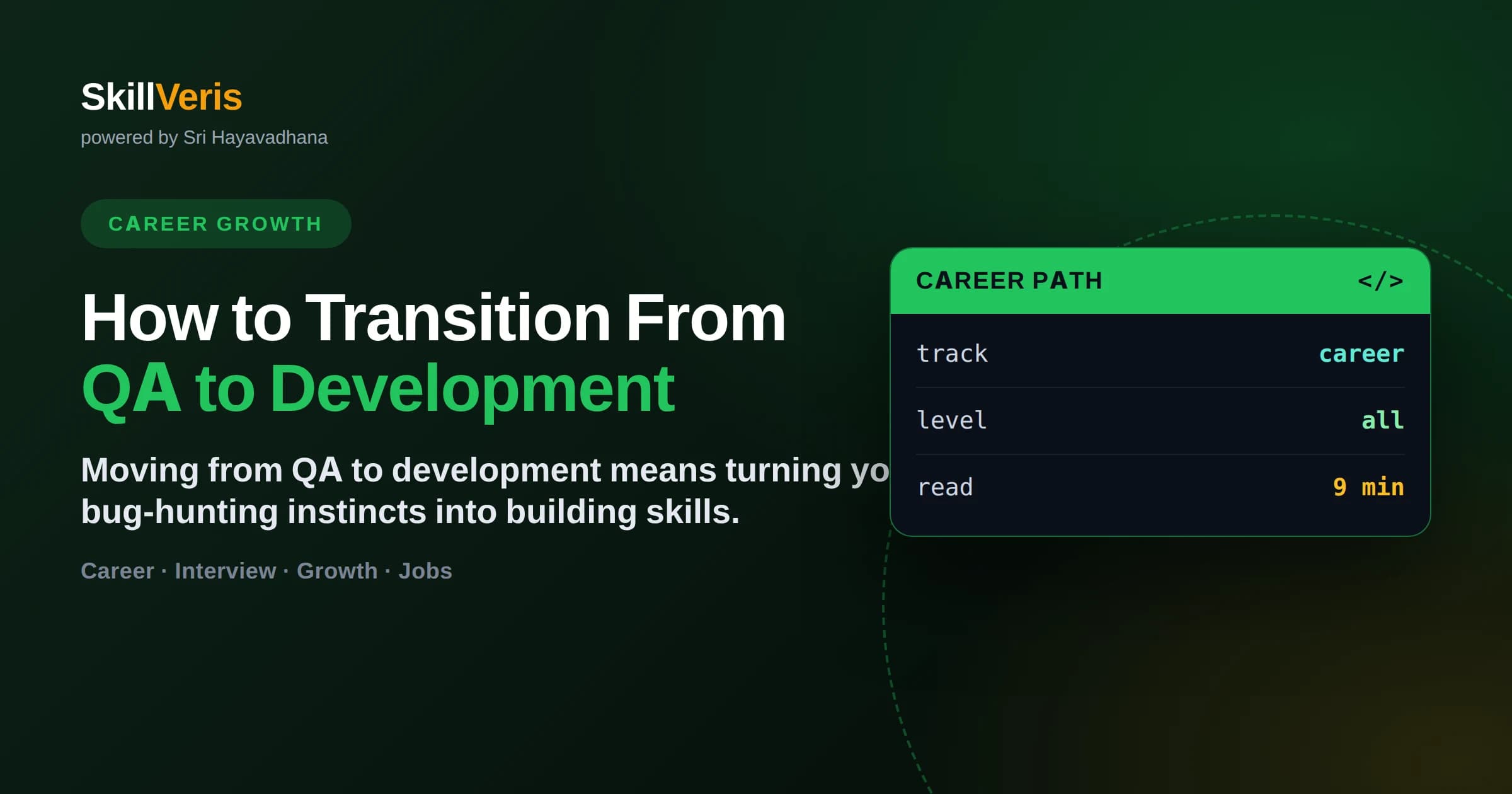
Transition from QA to development by deepening one programming language, contributing real code to your team's repo, and reframing your testing knowledge as an engineering asset rather than starting over.
In this guide, you'll learn:
- Your QA background is an advantage: you already understand the product, edge cases, and what breaks in production better than most new developers.
- Automation testing is the natural bridge — writing test scripts in Python, Java, or JavaScript builds the coding muscle you need for feature work.
- Volunteer for small bug fixes and internal tooling first; these low-risk tasks let you ship real code while you learn the codebase.
- Study data structures, version control, and one framework deeply rather than sampling many technologies shallowly.
1Can a QA Engineer Become a Developer?
Yes, moving from QA to development is one of the most natural career transitions in tech, because you already understand the product, its failure modes, and how software is shipped. The gap is mostly about building fluency in writing production code rather than learning the domain from scratch.
QA engineers spend their days reasoning about behavior, edge cases, and requirements — the same reasoning developers use, just pointed at breaking software instead of building it. Your job now is to redirect that skill and prove you can write, review, and maintain code your team trusts.
2Why Your QA Background Is an Advantage
Many developers see testing as an afterthought. You do not. That perspective makes you the kind of engineer teams actually want, because you naturally write more defensive, well-tested code.
- Product knowledge: you know how features are supposed to behave and where they historically break.
- Edge-case thinking: you instinctively ask what happens with empty inputs, timeouts, or concurrent users.
- Reproduction skills: you can turn a vague bug report into a precise failing test — a rare and valuable talent.
- Release awareness: you understand deployment risk and what a regression costs in the real world.
- Empathy for users: you have watched software fail people, which shapes better design decisions.
🔑Reframe, Don't Restart
You are not a beginner switching fields. You are an insider adding a skill. Frame every conversation around what you already bring, then the code you are learning to write.
3Use Automation Testing as Your Bridge
The fastest path from manual QA to development runs through test automation. Writing automated tests forces you to code every day, read the application source, and use the same tools developers use — version control, CI pipelines, and code review.
Pick the language your engineering team uses so your skills transfer directly. If they build in JavaScript, learn Playwright or Cypress. If they build in Python, learn pytest and Selenium. If it is Java, learn JUnit and REST Assured.
- Start by converting your most repetitive manual test cases into automated scripts.
- Read the application code your tests exercise — this is free codebase onboarding.
- Learn to run and debug the CI pipeline so failing tests do not block the team.
- Refactor your own test code as you learn cleaner patterns; treat it like real software.
4The Core Development Skills to Build
Depth beats breadth when you are transitioning. Employers and internal hiring managers want to see that you can go deep on one stack, not that you have watched tutorials on ten.
Programming Fundamentals
Pick one language and get genuinely comfortable with it. Learn functions, classes, error handling, and asynchronous behavior well enough to explain them to someone else.
Data structures: arrays, hash maps, sets, and when to use each.
Algorithms: sorting, searching, and reasoning about time complexity.
Debugging: using a real debugger and breakpoints, not just print statements.
Engineering Practices
Development is a team sport with shared tooling. Learn the workflow, not just the syntax.
Git branching, pull requests, and resolving merge conflicts.
Reading and writing code review comments constructively.
One framework your team uses, learned deeply rather than surface level.5Start Shipping Real Code Early
You learn to build by building. The moment you can, volunteer for small, low-risk coding tasks inside your current team. This is the single highest-leverage move you can make, because it converts learning into a track record.
Good starter tasks are bug fixes you already understand from testing, internal tooling that automates your own work, small UI copy or validation changes, and improving error messages. Each merged pull request is proof that you can contribute production code.
💡Build a Portfolio at Work
Ten merged pull requests in your company's real codebase impress a hiring manager far more than a solo side project nobody uses. Your day job is your portfolio.
6Common Mistakes to Avoid
Most stalled QA-to-dev transitions fail for predictable reasons. Avoid these and you will move faster than you expect.
- Tutorial hopping: watching endless courses without ever shipping code you own.
- Learning five languages at once instead of mastering one your team uses.
- Waiting until you feel fully ready — nobody does; ship the small fix now.
- Hiding your QA background instead of selling it as a differentiator.
- Neglecting Git and code review etiquette, which teams notice immediately.
- Not telling your manager you want to grow, so no one creates the opportunity.
7Make the Move Internal First
The easiest development job to get is often at the company where you already work. You know the product, the team knows you, and your product knowledge is expensive to replace. Many managers will happily create a hybrid QA-plus-development role as a stepping stone.
Have the conversation early and framed around value: explain that you want to contribute code, ask what a realistic path looks like, and offer to keep covering critical testing while you ramp up. A gradual internal transition carries far less risk than quitting to job-hunt cold.
8Key Takeaways
The transition from QA to development is an evolution of skills you already have, not a reset.
- Your product and edge-case knowledge is a genuine engineering advantage — lead with it.
- Use test automation as the bridge that builds daily coding habits.
- Go deep on one language and framework rather than sampling many.
- Ship small, real pull requests at work to build an undeniable track record.
- Pursue an internal move first — it is the lowest-risk, highest-odds path.
9Frequently Asked Questions
Q: How long does it take to move from QA to development? A: With focused effort and access to a real codebase, many people make a partial transition in six to twelve months and a full one within about two years. It depends heavily on how much real code you get to ship along the way.
Q: Do I need a computer science degree to switch? A: No. A degree helps in some hiring pipelines, but demonstrated coding ability, a portfolio of merged work, and strong fundamentals matter more to most teams than formal credentials.
Q: Should I quit my job to learn to code? A: Usually not. Transitioning internally while employed gives you a real codebase, a paycheck, and colleagues to learn from — far better conditions than studying alone with no income pressure.
Q: Is automation testing the same as development? A: Not quite, but it is close and it counts. Automation is real coding with version control and CI, and it is the most natural bridge into feature development work.
Get The Print Version
Download a PDF of this article for offline reading.
About the Publisher
SkillVeris Team
Careers Team
Our careers team helps you navigate tech job markets, build portfolios, and land the roles you want.
View all postsRelated Posts
Never miss an update
Get the latest tutorials and guides delivered to your inbox.
No spam. Unsubscribe anytime.