How to Switch to Data Analytics From Any Background
SkillVeris Team
Careers Team
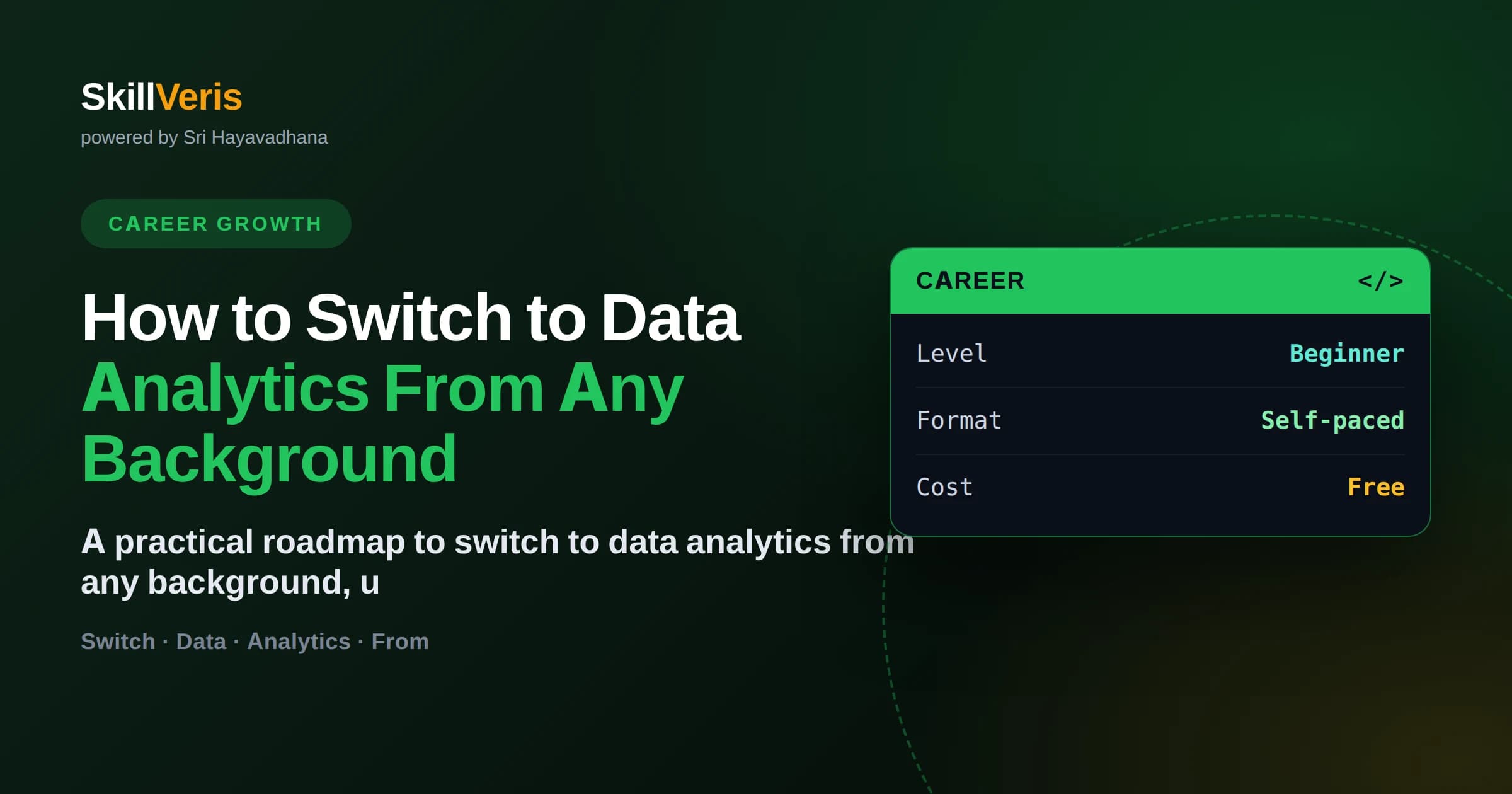
Almost every prior career carries transferable skills that data teams value, from communication to domain knowledge.
In this guide, you'll learn:
- You only need three core competencies to start: spreadsheets, SQL, and one BI or visualization tool.
- Domain expertise from your old field is a hiring advantage, not baggage, when you position it correctly.
- A focused 90-day plan beats an open-ended one because it forces you to build, not just consume tutorials.
- Two or three portfolio projects rooted in your own domain make your career switch believable to hiring managers.
1Can You Switch to Data Analytics From Any Background?
Yes, you can switch to data analytics from almost any background, and many working analysts started in teaching, nursing, retail, marketing, finance, or the arts. Data analytics rewards curiosity, clear thinking, and communication, and those are traits people build in countless careers, not just technical ones.
The switch feels intimidating because job listings emphasize tools you may not know yet. But tools are learnable in weeks; the judgment to ask the right question and explain an answer takes years, and you may already have it. This guide shows you how to inventory what you already bring, close the technical gaps efficiently, and tell a story that makes your background an asset.
You will leave with a concrete plan, not just encouragement. The goal is your first analytics role, and every step here points toward that.
2The Transferable Skills You Already Have
Start by recognizing what transfers. Data analytics is not only writing queries; it is understanding a problem, working with people, and communicating findings. Most careers build at least some of these muscles.
Map your experience against the list below and note specific examples. These become the backbone of your resume and interview answers.
- Communication: explaining complex things simply, which analysts do constantly for non-technical stakeholders.
- Domain knowledge: deep understanding of an industry, so you know which questions actually matter.
- Attention to detail: catching errors, reconciling numbers, or following precise procedures.
- Problem solving: breaking a vague goal into steps, common in operations, teaching, and project work.
- Stakeholder management: balancing competing priorities and managing expectations under pressure.
3The Core Technical Skills to Learn
You do not need to learn everything. A focused analyst starter kit is small, and mastering it well beats dabbling in ten tools. Aim for genuine competence in three areas before you apply.
First, spreadsheets, because Excel or Google Sheets remain the everyday tool for quick analysis and are still tested in interviews. Second, SQL, the single most in-demand analyst skill, used to pull and shape data from databases. Third, one BI or visualization tool such as Power BI or Tableau to turn results into dashboards leaders act on. Once those feel comfortable, a scripting language like Python adds range, but it is not required for your first role.
💡Depth beats breadth
A candidate who writes confident SQL and builds one clean dashboard interviews better than someone who lists eight tools they have only skimmed. Go deep on the core three first.
4Turning Your Old Field Into an Advantage
Your previous career is not something to hide; it is a differentiator. A nurse moving into analytics understands healthcare data and clinical workflows in a way a fresh graduate never will. A teacher understands education metrics. A retail manager understands inventory and seasonality.
Employers in your former industry will value an analyst who already speaks their language, so consider targeting analytics roles in the sector you are leaving. You skip the steep domain learning curve and can contribute meaningfully far sooner, which shortens the time it takes to prove your worth.
5A 90-Day Learning Plan
Open-ended learning drifts. A time-boxed plan forces momentum and gives you something concrete to show. Here is a realistic structure for roughly ten focused hours a week.
Days 1-30: Foundations
Build spreadsheet fluency and start SQL. Learn to filter, aggregate, and join data, and practice on real datasets rather than toy examples.
Master pivot tables, lookups, and basic formulas.
Learn SELECT, WHERE, GROUP BY, and JOIN in SQL.
Complete daily short exercises to build muscle memory.
Days 31-60: Analysis and Visualization
Deepen SQL with window functions and subqueries, and learn one BI tool. Begin thinking about the story behind the numbers, not just the numbers.
Days 61-90: Build and Apply
Complete two portfolio projects, write them up clearly, and start applying. Applying while still learning is normal; you refine your skills fastest under real pressure.
6Building Proof With Projects
A career switcher without a portfolio asks employers to take a leap of faith. A portfolio removes the doubt by showing you can actually do the work. Two or three focused projects are enough.
Pick questions from your own domain so your insight shines through. If you came from retail, analyze sales seasonality; if from healthcare, explore patient wait times using a public dataset. For each project, state the question, show your process, and end with a clear recommendation. The recommendation matters as much as the chart, because that is what analytics is actually for.
7Positioning Your Career-Switch Story
Hiring managers worry that a switcher is running away from a previous field rather than toward analytics. Your story should close that gap by framing the move as a natural evolution.
The strongest narrative connects the dots: you were already doing analytical work, you enjoyed it, and you decided to make it your focus. A teacher might say the part of the job they loved most was using assessment data to help students, and they wanted to do that full time. That framing turns your history into a runway, not a detour.
🔑Lead with the through-line
Every good switch story has a through-line: the analytical thread that ran through your old work and pulled you toward data. Find yours and repeat it in your resume, cover letter, and interviews.
8Common Traps to Avoid
Career switchers tend to make a few predictable mistakes. Knowing them in advance saves months.
The biggest is tutorial paralysis, endlessly consuming courses without ever building anything. The second is chasing every tool instead of mastering the core few. The third is hiding your background out of insecurity, when it is often your best selling point. Avoid all three and you will move faster than most.
9Frequently Asked Questions
Is a data analytics course really free? Yes. SkillVeris provides complete data analytics learning paths and study notes at no cost, so a career switcher can build spreadsheets, SQL, and BI skills without paying for a bootcamp.
How long does it take to switch to data analytics? With focused study of around ten hours a week, many people reach an entry-level standard in three to six months. The exact time depends on your starting point and how consistently you build projects.
Do I need to quit my job to switch careers? No. Most successful switchers study part time around their current job and only leave once they have skills, projects, and interviews lined up. That reduces financial risk considerably.
Will employers hold my non-technical background against me? Rarely, if you position it well. Domain expertise and communication skills from another field are often advantages, especially for analytics roles within that same industry.
What is the single most important skill to learn first? SQL, because it is the most in-demand analyst skill and underpins almost everything else you will do. Spreadsheets and one BI tool follow closely behind.
How many portfolio projects do I need? Two or three well-documented projects are enough to demonstrate your ability. Quality and clear storytelling matter far more than the number of projects.
10Your Next Step
Switching to data analytics from any background is not a fantasy; it is a well-worn path. Your prior career gave you transferable skills and domain knowledge that many candidates lack, and the technical gap is smaller and more learnable than it looks from the outside.
Start this week. Inventory your transferable skills, begin the core three with the free data analytics courses and study notes on SkillVeris, and commit to your first portfolio project. Momentum, not perfection, is what carries career switchers across the line.
Related Reading
Get The Print Version
Download a PDF of this article for offline reading.
About the Publisher
SkillVeris Team
Careers Team
Our careers team helps you navigate tech job markets, build portfolios, and land the roles you want.
View all postsRelated Posts
Never miss an update
Get the latest tutorials and guides delivered to your inbox.
No spam. Unsubscribe anytime.