How to Switch Careers Into Tech
SkillVeris Team
Careers Team
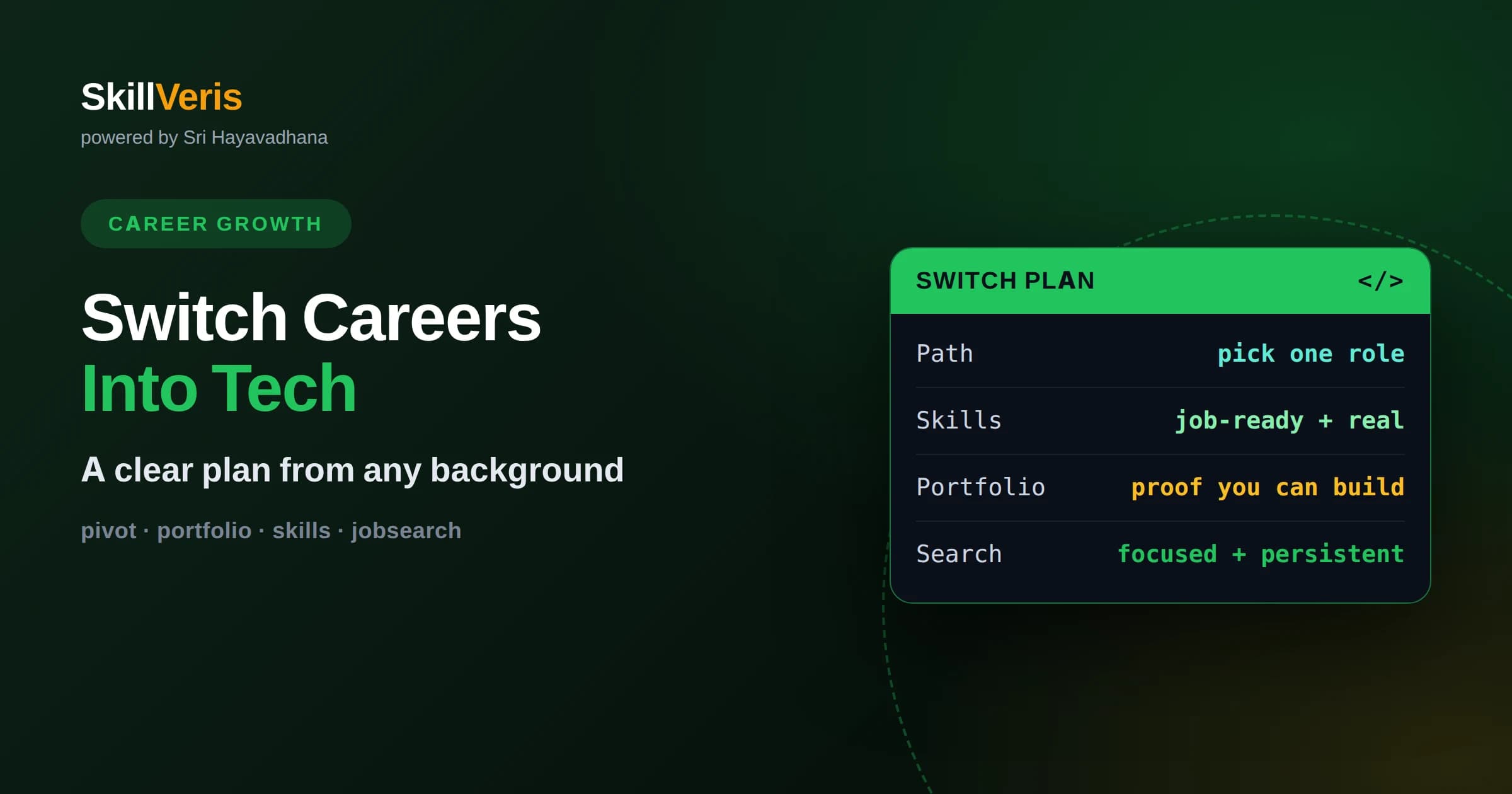
A successful tech career switch follows a plan: choose a specific path, build real skills and a portfolio, then run a focused job search.
In this guide, you'll learn:
- Your existing career is an asset, not a liability, because transferable skills and domain knowledge make you valuable in ways pure newcomers are not.
- A portfolio of real projects is what convinces employers to hire a career changer who lacks a traditional tech background.
- The switch takes months of consistent effort and some persistence through rejection, but it is a well-worn path that ordinary people complete regularly.
1How a Career Switch Into Tech Actually Works
Switching careers into tech works best as a deliberate three-part plan: choose a specific tech path that fits you, build genuine job-ready skills backed by a portfolio of real projects, and then run a focused, persistent job search that frames your background as an asset. Thousands of people from unrelated fields make this transition every year, and they succeed by following a structured path rather than hoping a certificate alone will open doors.
The most important early realization is that you do not need to erase your past to enter tech. Your prior experience, whether in teaching, finance, healthcare, or the trades, gives you skills and domain knowledge that many pure computer-science graduates lack. The switch is a pivot that builds on who you are, not a total restart from zero.
Set realistic expectations about time and effort. A serious switch typically takes many months of consistent learning alongside your current responsibilities, and the job search itself requires patience through rejection. This is normal, and the difficulty is not a sign you are unsuited; it is simply the cost of the change.
2Choose a Specific Path That Fits You
Tech is not one job but many, so your first task is to choose a specific direction rather than aiming vaguely at tech. Web development, data analysis, software engineering, quality assurance, and technical support each demand different skills and suit different temperaments. Narrowing your target focuses your learning and makes you far more employable.
Choose based on both interest and fit. Consider what kind of work energizes you, whether building visible products, working with data, or solving systems problems, and how each path connects to your existing strengths. A path aligned with both your interests and your background gives you the best chance of persisting and standing out.
You can adjust later, but commit enough to make progress now. A clear target tells you which language and skills to learn and prevents the scattered, half-finished learning that stalls so many career changers before they gain momentum.
3Leverage Your Existing Background as a Strength
Your previous career is one of your biggest advantages, and framing it as such changes everything. Transferable skills like communication, project management, problem solving, and working under pressure are genuinely valued in tech and are often what separate a good hire from a merely technical one. You already have professional maturity that many newcomers lack.
Domain knowledge is especially powerful. A former nurse moving into health technology, a former accountant moving into financial software, or a former teacher moving into educational tools brings understanding of the users and the problem that a generic engineer cannot easily acquire. This makes you uniquely valuable in the right niche.
Rather than apologizing for your non-traditional background, learn to tell a story that connects your past to your future. Employers respond to a candidate who explains clearly why their prior experience makes them a stronger developer for a particular role, not a weaker one.
4Build Genuine, Job-Ready Skills
There is no shortcut around actually learning to do the work. Whatever path you choose, invest the time to build real, applicable skills through structured learning and constant practice. The goal is genuine competence, the ability to build things, not just a collection of course completions that look good but do not translate into capability.
Focus your learning on what your target role actually requires rather than trying to learn everything. Research the skills listed in real job postings for your chosen path and build toward those specifically. This focused approach gets you to job-ready faster than sampling every topic that catches your eye.
Prioritize depth and understanding over speed. Employers can tell the difference between a candidate who truly understands their work and one who memorized enough to pass a course, and in interviews that difference surfaces quickly. Solid fundamentals are what make you hireable and what let you keep growing on the job.
5Build a Portfolio That Proves You Can Do the Work
For a career changer without a traditional tech resume, a portfolio of real projects is your single most powerful asset. It is concrete proof that you can actually build things, which is exactly what a hiring manager needs and cannot infer from a degree in another field. Projects turn your claim of competence into demonstrable fact.
Build projects that are real and, where possible, connected to your background or interests, because these are more memorable and show initiative. A few substantial, polished projects that solve genuine problems are worth more than many trivial tutorial clones, since they demonstrate that you can carry work through to completion.
Make your work visible and easy to evaluate. Host your code publicly, write clear explanations of what each project does and how you built it, and be ready to walk an interviewer through your decisions. A portfolio that tells a clear story of your capability can outweigh the absence of a conventional tech background.
6Learn Efficiently While Managing Life
Most career changers learn while holding a job and other responsibilities, so efficiency and consistency matter enormously. A steady, sustainable routine, even a modest amount of focused study each day, accumulates into real skill over months and is far more effective than sporadic bursts that fizzle out. Protect a regular slot and defend it.
Be strategic about what you study so limited time is not wasted. Follow a structured curriculum toward your specific goal rather than jumping between random resources, which keeps you moving forward instead of relearning the same basics repeatedly. A clear path is a gift when your time is scarce.
Accept that progress will feel slow at times, especially when balancing learning against a full life. Consistency through those slow stretches, not intensity in occasional bursts, is what carries people across the finish line. The switchers who succeed are the ones who simply kept going.
7Network Your Way Into the Field
Relationships open doors that applications alone cannot, and this is especially true for career changers who need someone to look past an unconventional resume. Connecting with people already in your target field, whether through communities, events, or online platforms, leads to advice, referrals, and opportunities you would never find on a job board.
You do not need to be a natural networker. Being genuinely curious, asking thoughtful questions, and sharing your learning journey attracts helpful people. Many in tech remember their own transition and are glad to help someone making the same leap, so reaching out is rarely as unwelcome as it feels.
Referrals are particularly valuable when your resume does not fit the usual mold, because a trusted recommendation gives an employer confidence to take a chance on you. Building even a small network in your target field measurably improves your odds of landing that first role.
8Reframe Your Resume and Online Presence
Your resume and professional profiles need to tell the story of a career changer confidently, not defensively. Lead with your new skills and projects, present your transferable strengths clearly, and frame your background as relevant context rather than an unrelated detour. The narrative should make it obvious why you are pivoting and what you bring.
Tailor your materials to the specific role you are targeting, using the language of that field and highlighting the skills it asks for. A generic resume that reads as an old-career document with a coding course tacked on is far less effective than one deliberately positioned for your new direction.
Keep your online presence consistent with this story. A profile that showcases your projects, your relevant skills, and a clear statement of the role you seek helps recruiters and hiring managers place you correctly, rather than dismissing you for lacking a traditional path.
9Run a Focused, Persistent Job Search
The final phase is a focused job search, and it requires both strategy and stamina. Target roles that genuinely fit your skills and that value your background, and be willing to consider entry-level or adjacent positions that get you into the industry, from which you can grow. Your first tech role is a doorway, not a destination.
Expect rejection and do not let it define you. Even strong candidates face many nos before a yes, and for career changers the search can take longer because you are asking employers to see past a non-traditional profile. Persistence through this stage is often what separates those who make it from those who give up just short.
Treat each application and interview as practice that sharpens your story and reveals gaps to close. Refine your pitch, learn from feedback, and keep going. The switch is a numbers game combined with continuous improvement, and steady effort reliably compounds into an offer.
10Prepare for Interviews With Your Story Ready
Interviews for a career changer are part technical evaluation and part storytelling. Be ready to demonstrate your skills through your projects and to answer technical questions honestly, admitting what you are still learning while showing you can figure things out. Employers hiring for potential value a candidate who learns well over one who pretends to know everything.
Prepare a clear, confident answer to why you are switching careers, because you will be asked. A strong answer connects your past to your future and frames the change as a deliberate move toward work you are genuinely suited for, not an escape from something you disliked.
Practice explaining your projects and your decisions out loud, since interviews often center on walking through your work. The ability to reason clearly about what you built and why reassures an interviewer that your competence is real and that you will keep growing on the job.
Treat early interviews as practice rather than pass-or-fail tests. Each one teaches you which questions recur, where your explanations wobble, and how to tell your story more smoothly. Reviewing what went well and what to sharpen after every interview steadily turns nervous first attempts into confident, well-rehearsed conversations.
11Expect a Long Game and Stay the Course
Switching careers into tech is a marathon, and knowing that up front protects your motivation. There will be moments of doubt, slow progress, and rejection, and none of these mean you have chosen wrongly or that you cannot do it. They are simply the terrain of a significant life change that thousands navigate successfully every year.
Sustain yourself with small milestones: a finished project, a first interview, a helpful connection, a concept that finally clicked. Celebrating these keeps momentum alive through the long middle stretch where the finish line is not yet visible. Progress is real even when it is slow.
The people who complete this switch are rarely the most naturally gifted; they are the ones who kept learning, kept applying, and kept believing the change was possible. That persistence, more than any single skill, is what carries ordinary people into new tech careers.
12Begin Your Transition on SkillVeris
A career switch begins with a first concrete step, and the most useful one is to start building real skills toward a specific path today. SkillVeris offers structured courses that take you from fundamentals through the project work that becomes your portfolio, which is exactly what a career changer needs to prove capability.
Choose your path, commit to a sustainable daily routine, and build projects that connect your new skills to the strengths you already have. Use the courses to stay focused and the projects to make your competence visible to future employers.
Keep going through the slow stretches and the rejections, trusting that consistent effort compounds. The switch into tech is a well-worn path, and with a clear plan, real skills, and persistence, you can walk it just as many others have. Start your next lesson on SkillVeris and take the first step now.
Get The Print Version
Download a PDF of this article for offline reading.
About the Publisher
SkillVeris Team
Careers Team
Our careers team helps you navigate tech job markets, build portfolios, and land the roles you want.
View all postsRelated Posts
Never miss an update
Get the latest tutorials and guides delivered to your inbox.
No spam. Unsubscribe anytime.