How to Succeed as a Remote Developer
SkillVeris Team
Careers Team
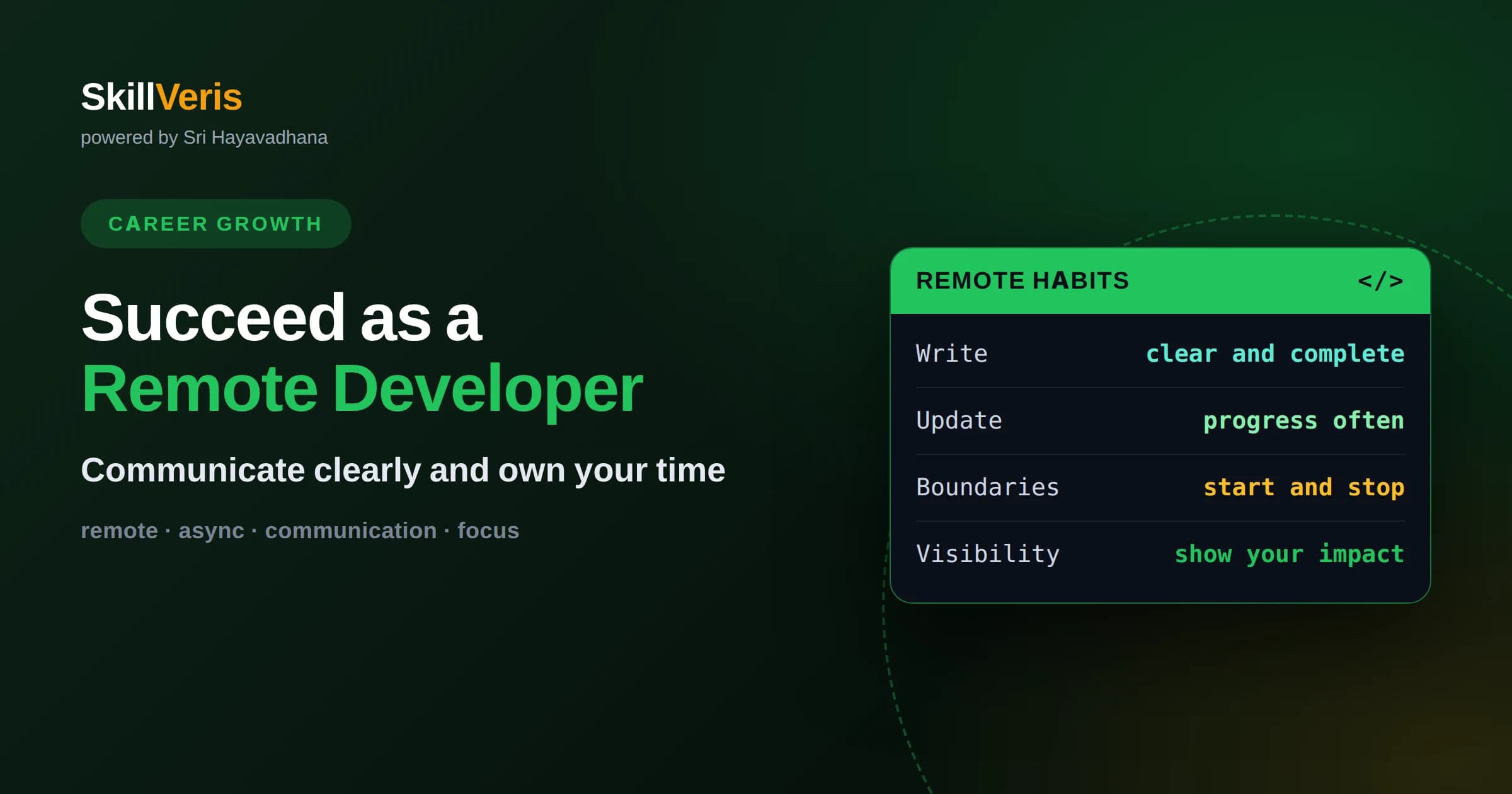
Written communication becomes your primary tool, so clarity in messages and documentation is a core remote skill.
In this guide, you'll learn:
- Proactive updates and visible progress replace the passive presence of sitting in an office.
- Strong boundaries between work and home prevent the burnout that remote flexibility can quietly cause.
- Overcommunicating slightly is almost always better than leaving colleagues guessing what you are doing.
1How to Succeed as a Remote Developer
Succeeding as a remote developer comes down to communicating clearly in writing, managing your own time without supervision, and making your work visible so colleagues always know your progress. The central adjustment is that presence no longer signals productivity; in an office, being seen at your desk implies you are working, but remotely your output and your communication are the only evidence anyone has. Mastering deliberate, proactive communication is what separates thriving remote developers from struggling ones.
Remote work rewards autonomy and self-direction. Without someone nearby to nudge you, you must structure your own days, hold your own focus, and decide what to work on when priorities are ambiguous. Developers who take ownership of their time flourish, while those who wait to be told what to do can drift.
The upside is substantial: freedom over your schedule, no commute, and the ability to design an environment that suits your focus. Capturing those benefits, though, requires building habits that replace the natural structure an office provides.
2Make Written Communication Your Superpower
In a remote team, most communication happens in writing through chat, tickets, documents, and pull request descriptions. Your ability to write clearly and concisely directly shapes how effective and how respected you are. A well-structured message that anticipates questions saves everyone time and prevents the misunderstandings that quietly erode remote teams.
Aim for clarity over brevity when they conflict. Provide enough context that a colleague in a different time zone can act on your message without needing a follow-up. Because responses may be hours apart, each unclear message can cost a full day of back-and-forth, so front-loading context is a genuine productivity multiplier.
Adapt your tone to the medium. Text lacks the warmth of face-to-face conversation, so a little extra friendliness prevents messages from reading as curt. Being pleasant and precise in writing is a skill worth deliberately developing, because it colors every interaction you have.
3Overcommunicate Your Progress
When no one can see you working, silence can read as absence. Sharing regular, lightweight updates on what you are doing, what you have finished, and where you are stuck keeps your team informed and builds trust. A brief daily note or status update is a small habit with an outsized effect on how reliable you appear.
Overcommunicating slightly is far safer than undercommunicating. If you are blocked, say so early rather than struggling silently for days. Colleagues would much rather help you unblock quickly than discover a stalled task at the deadline. Raising problems promptly is a sign of maturity, not weakness.
Make your work visible in the systems your team uses. Keep tickets updated, write clear pull request descriptions, and leave notes in shared documents. This visible trail lets others follow your progress asynchronously and reduces the need for status meetings that interrupt deep work.
4Manage Your Own Time and Focus
Remote work hands you control of your schedule, which is both a gift and a responsibility. Structure your day around your natural energy, protecting your most focused hours for demanding work and reserving lower-energy periods for meetings and routine tasks. Designing your day intentionally beats letting it happen to you.
Guard against the two opposite failure modes: distraction and overwork. Some people struggle to focus at home, while others cannot stop and drift into unhealthy hours. Techniques like time-blocking, defined start and stop rituals, and short scheduled breaks help you stay both productive and sustainable.
Learn to work asynchronously. Not everything requires an immediate response, and expecting instant replies from teammates across time zones is unrealistic. Batching your communication and respecting others' focus time makes the whole team more effective and reduces the anxiety of constant availability.
5Build a Workspace That Supports You
A dedicated workspace, even a small one, dramatically improves focus and helps separate work from the rest of life. Sitting in the same spot to work each day trains your brain to shift into concentration mode, while working from bed or the couch blurs the line and undermines both focus and rest.
Invest in the basics that affect you daily: a comfortable chair, a screen at the right height, reliable internet, and decent audio for calls. These are not luxuries but the tools of your trade, and small improvements compound into real comfort and productivity over the thousands of hours you will spend working.
Manage your environment for fewer interruptions. Communicate your working hours to those you live with, use headphones to signal focus time, and reduce notifications during deep work. A calm, controllable environment is one of the underrated advantages remote work can offer if you set it up deliberately.
6Build Relationships Without an Office
Remote work can feel isolating, and the casual bonds that form naturally in an office require deliberate effort online. Make time for the human side of work: greet people warmly, participate in team channels, and take part in optional social calls. These small investments build the trust that makes collaboration smoother.
Reach out to colleagues one on one, not only when you need something. A short message to check in or a virtual coffee chat helps you form the relationships that make remote work enjoyable and effective. People help those they feel connected to, and connection online must be created intentionally.
Getting to know teammates also improves your work. Understanding their strengths, communication styles, and pressures helps you collaborate better and ask for help gracefully. Relationships are the invisible infrastructure of a productive remote team.
7Protect Against Isolation and Burnout
The freedom of remote work carries a hidden risk: the boundaries between work and life can dissolve, leading to overwork and eventual burnout. Establish clear start and end times, and when the workday ends, close the laptop and step away. Physical rituals like a short walk can mark the transition your commute once provided.
Loneliness is a real challenge, especially for those who live alone. Counter it by maintaining social connections outside work, occasionally working from a shared space, and staying active. Your wellbeing directly affects your productivity, so caring for it is a professional priority, not a distraction from work.
Watch for warning signs in yourself: declining motivation, trouble sleeping, or resentment toward work. Addressing these early by adjusting your habits or talking to your manager prevents small strains from becoming serious problems. Sustainable pace beats heroic sprints every time.
8Master Your Team's Tools and Workflows
Remote teams run on tools for chat, video, project tracking, documentation, and code collaboration. Learning these tools well and using them the way your team expects makes you a smoother collaborator. Fumbling with the basics creates friction, while fluency makes your contributions frictionless.
Understand the norms around each tool. Know when to use chat versus a document, when a quick call beats a long thread, and how your team tracks decisions. Every remote team develops conventions, and adopting them quickly signals that you are a considerate teammate.
Keep shared knowledge current. When you learn something or make a decision, write it down where others can find it. Good documentation is the memory of a remote team, and contributing to it makes you visibly valuable while sparing everyone repeated questions.
9Make Your Impact Visible
Because managers cannot observe your daily effort, you must ensure your contributions are recognized. Summarize your accomplishments regularly, tie your work to team goals, and speak up in reviews about what you delivered. This is not bragging; it is providing the information your manager needs to evaluate you fairly.
Keep a simple record of what you achieve week to week. This makes performance conversations, promotion cases, and salary discussions far easier, because you can point to concrete results rather than relying on memory. A short running log costs little and pays off at review time.
Volunteer for visible, meaningful work when you can. Taking on a project that matters to the team, and communicating your progress clearly, builds your reputation faster than quietly doing routine tasks. Visibility, earned through real contribution, is essential to remote career growth.
10Keep Growing While Remote
Remote work can make learning feel more solitary, since you cannot simply lean over to ask a nearby colleague. Compensate by being proactive: ask questions in team channels, request code reviews, seek mentorship explicitly, and set aside time for deliberate learning. Growth remotely requires initiative rather than proximity.
Seek feedback actively, because it may not flow to you naturally without hallway conversations. Ask your manager and peers how you are doing and where you can improve. Regular feedback keeps you developing and prevents small blind spots from persisting unnoticed.
Invest in skills that make you more effective remotely and more valuable generally. Strong writing, self-management, and deep technical ability all compound over a remote career. The developers who keep learning stay in demand no matter where they work.
11Avoid Common Remote Work Mistakes
A frequent mistake is going quiet, assuming that as long as the work gets done, communication is optional. In remote settings, silence breeds uncertainty and erodes trust. Regular, lightweight updates prevent colleagues from wondering what you are doing and keep collaboration flowing.
Another pitfall is never disconnecting, treating always-on availability as dedication. This path leads to burnout and actually reduces long-term output. Setting boundaries and protecting rest makes you more productive over any meaningful timespan, not less committed.
Finally, neglecting relationships turns remote work into isolating drudgery. Skipping the human side may feel efficient, but it weakens the trust and camaraderie that make teams function. Investing in connection is part of the job, not a distraction from it.
12Work Well Across Time Zones
Many remote teams span multiple time zones, which changes how work flows. Overlapping hours become precious, so use them for the conversations that truly need real-time discussion and push everything else to asynchronous channels. Being intentional about what deserves synchronous time respects everyone's schedule.
Write with the assumption that the reader is many hours away and cannot ask a quick follow-up. Provide complete context, clear next steps, and any relevant links so colleagues can act without waiting for you to wake up. This discipline keeps work moving around the clock instead of stalling overnight.
Be considerate of your teammates' local hours when scheduling and messaging. Small courtesies, like avoiding meetings that force someone to join late at night and not expecting instant replies outside their day, build the mutual respect that makes distributed teams function smoothly.
13Find and Land Remote Roles
Competition for remote roles can be intense because they draw applicants from everywhere, so you must present yourself as someone who will thrive without supervision. Emphasize evidence of self-direction, clear written communication, and past remote or independent work in your applications and interviews. Employers hiring remotely worry about these traits above all.
In interviews, expect questions about how you manage your time, communicate progress, and handle being blocked. Prepare concrete examples that show you can operate autonomously and keep others informed. Demonstrating that you understand the demands of remote work reassures employers far more than simply saying you prefer it.
Once hired, invest heavily in your first weeks. Learn the tools, understand the team's norms, introduce yourself proactively, and establish a reputation for reliability early. A strong start remotely, where trust must be built without in-person cues, sets the tone for everything that follows.
14Sharpen Your Remote Skills on SkillVeris
Many of the skills that make a great remote developer, from clear technical writing to independent problem-solving, are exactly the ones you can strengthen through deliberate practice, and SkillVeris is built to help you develop them hands-on at your own pace. Learning to work autonomously and communicate clearly pays off in every remote role.
Start by improving one habit this week, whether it is writing crisper updates, protecting your focus hours, or documenting a decision for your team. Small, consistent improvements in how you work remotely compound into a career defined by trust, autonomy, and sustained productivity.
Get The Print Version
Download a PDF of this article for offline reading.
About the Publisher
SkillVeris Team
Careers Team
Our careers team helps you navigate tech job markets, build portfolios, and land the roles you want.
View all postsRelated Posts




Never miss an update
Get the latest tutorials and guides delivered to your inbox.
No spam. Unsubscribe anytime.