How to Stay Motivated While Learning to Code
SkillVeris Team
Careers Team
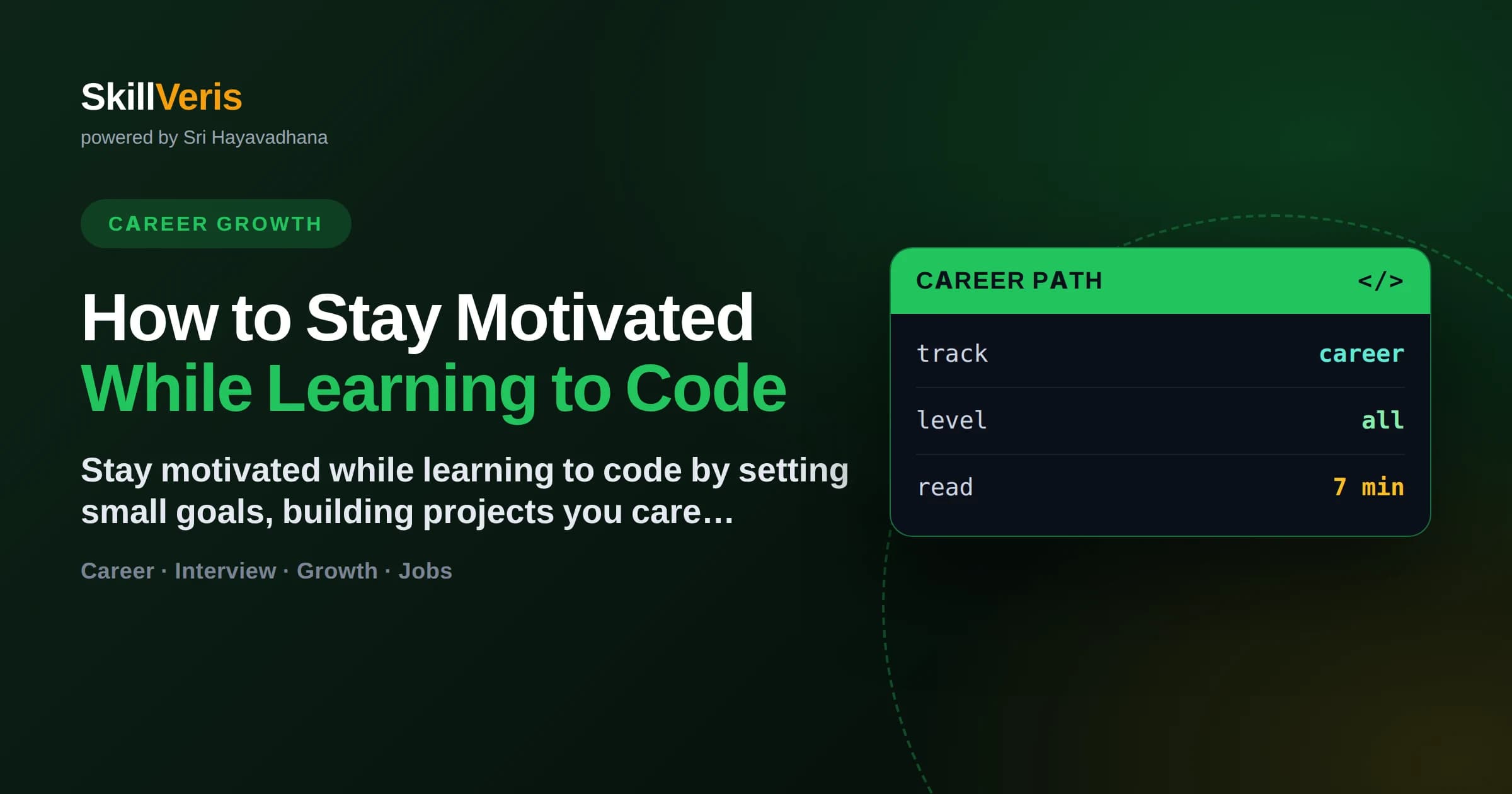
Stay motivated while learning to code by setting small achievable goals, building projects you genuinely care about, tracking your progress, and prioritizing consistency over bursts of intensity.
In this guide, you'll learn:
- Motivation follows action more often than it precedes it — starting a small session usually generates the drive to continue.
- Building things you care about sustains interest far longer than abstract exercises alone.
- Small, visible wins and a record of progress counter the feeling of not improving.
- The dip where everything feels hard is normal and temporary, not a sign you are not cut out for it.
1How to Stay Motivated While Learning to Code
You stay motivated while learning to code by setting small, achievable goals, building projects you actually care about, tracking your progress so improvement is visible, and treating consistency as more important than intensity. Motivation is not a fixed trait you either have or lack — it is something you engineer through habits and structure that keep you moving even on days you do not feel inspired.
Learning to code is a marathon, and nearly everyone hits stretches where it feels slow, frustrating, or pointless. The learners who make it are rarely the most naturally driven; they are the ones who built systems to keep going when motivation dipped. Understanding how motivation actually works lets you design a learning routine that survives the hard weeks.
2How Motivation Actually Works
A common misconception is that you must feel motivated before you start. In reality, motivation frequently follows action rather than preceding it — beginning a small task generates the momentum that carries you forward. Waiting to feel inspired is a trap, because the feeling usually arrives after you have already begun.
- Action first: starting a five-minute session often unlocks the drive to continue.
- Momentum compounds: small consistent efforts build the habit that carries you.
- Feelings follow: motivation tends to appear once you are already in motion.
- Systems over willpower: a routine beats relying on daily inspiration.
🔑Key Insight
Do not wait to feel motivated before you start — start, and the motivation usually follows. A tiny first step is almost always easier to take than to think about, and it sets everything else in motion.
3Set Small, Achievable Goals
Vague ambitions like 'become a developer' are motivating in theory but paralyzing in practice, because the finish line feels impossibly far away. Breaking the journey into small, concrete goals gives you frequent wins that prove you are progressing and keep the momentum alive.
Aim for goals you can complete in a day or a week — finish a lesson, build a small feature, solve a set of problems. Each completed goal delivers a hit of accomplishment that fuels the next. Stacking these small wins is how a distant, intimidating destination becomes a series of manageable, satisfying steps.
Make Goals Concrete
Specific, finishable goals beat open-ended intentions.
Set a clear target for each session, not just 'study coding.'
Choose goals you can complete in a day or a week.
Celebrate finishing them — acknowledgment reinforces the habit.
Break big projects into small, shippable pieces.4Build Things You Care About
Nothing sustains motivation like building something you genuinely want to exist. Endless abstract exercises drain enthusiasm, whereas a project connected to your interests — a tool for your hobby, a site for a cause, a game you would play — makes the learning feel purposeful and even fun.
When you care about the outcome, the inevitable obstacles become puzzles worth solving rather than reasons to quit. Personal projects also teach you more, because you hit real problems and have a real reason to push through them. Let your curiosity guide what you build, and the practice starts to feel less like study.
💡Pro Tip
Start building real projects earlier than feels comfortable, even before you feel ready. Applying what you learn to something you care about cements the knowledge and keeps motivation far higher than tutorials alone.
5Track Your Progress
One of the most demotivating feelings in learning to code is the sense that you are not improving, and tracking progress is the direct antidote. When you can look back and see how far you have come, the day-to-day slowness stops feeling like standing still.
Keep a simple record — a learning log, a streak, a folder of finished projects, or notes on what you can now do that you could not before. Reviewing it during low moments provides concrete evidence of growth that your in-the-moment frustration will always try to deny.
6Push Through the Dip
Almost every learner hits a stretch where everything feels hard and progress seems to stall — often after the exciting early wins fade. This dip is a normal, universal phase, not a signal that you lack talent or should give up. Simply knowing it is coming makes it far easier to ride out.
During the dip, lean on your systems rather than your feelings. Shrink your goals, revisit a project you enjoy, and remind yourself why you started. Many people quit right before things click, mistaking a temporary plateau for a permanent ceiling. Persistence through this phase is what separates those who make it from those who do not.
7Common Mistakes to Avoid
Certain habits quietly drain motivation. Recognizing them helps you protect your momentum.
- Comparing your beginning to someone else's middle and feeling behind.
- Trying to learn everything at once and burning out on overload.
- Only doing tutorials and never building anything of your own.
- Studying in intense bursts, then disappearing for weeks.
- Treating one hard day as proof you are not cut out for coding.
⚠️Watch Out
Tutorial hell — endlessly watching without building — feels productive but stalls real progress and morale. You learn to code by writing code, so break out and build something, however small and imperfect.
8Find a Community
Learning alone is harder than learning alongside others. A supportive community — a study group, an online forum, a peer learning the same thing — provides accountability, encouragement, and help when you are stuck, turning a lonely grind into a shared journey.
Community also normalizes the struggle. Seeing others hit the same walls reminds you that difficulty is part of the process, not a personal failing. Whether you find people in person or online, connection makes the hard stretches lighter and the wins more rewarding.
9Key Takeaways
Staying motivated is a system you build, not luck you wait for.
- Start first — motivation usually follows action, not the other way around.
- Set small, finishable goals for frequent, momentum-building wins.
- Build projects you genuinely care about to keep learning purposeful.
- Track your progress so you can see growth during low moments.
- Expect the dip, prioritize consistency over intensity, and lean on community.
10Frequently Asked Questions
Q: Why do I keep losing motivation to code? A: Losing motivation is normal and usually points to a fixable cause — goals that are too big, too much abstract study without building, isolation, or the natural dip after early excitement fades. Shifting to small wins, personal projects, and a supportive community typically restores momentum.
Q: How long does it take before coding feels easier? A: It varies widely by person and pace, but most learners describe a gradual shift where things start clicking after consistent practice over months, not days. The early dip where everything feels hard is temporary, and pushing through it is often when the biggest improvements happen.
Q: Is it better to study intensely or consistently? A: Consistency wins. Short, regular sessions build durable habits and steady progress, while intense bursts followed by long gaps lead to burnout and forgotten material. Coding a little most days beats occasional marathon sessions for both learning and motivation.
Q: How do I get out of tutorial hell? A: Start building your own projects, even small and imperfect ones, and use tutorials only to solve specific problems you encounter. You learn to code by writing code, so the escape from passive watching is active building. Discomfort at first is normal and expected.
Get The Print Version
Download a PDF of this article for offline reading.
About the Publisher
SkillVeris Team
Careers Team
Our careers team helps you navigate tech job markets, build portfolios, and land the roles you want.
View all postsRelated Posts
Never miss an update
Get the latest tutorials and guides delivered to your inbox.
No spam. Unsubscribe anytime.