How to Stand Out as a Junior Developer
SkillVeris Team
Careers Team
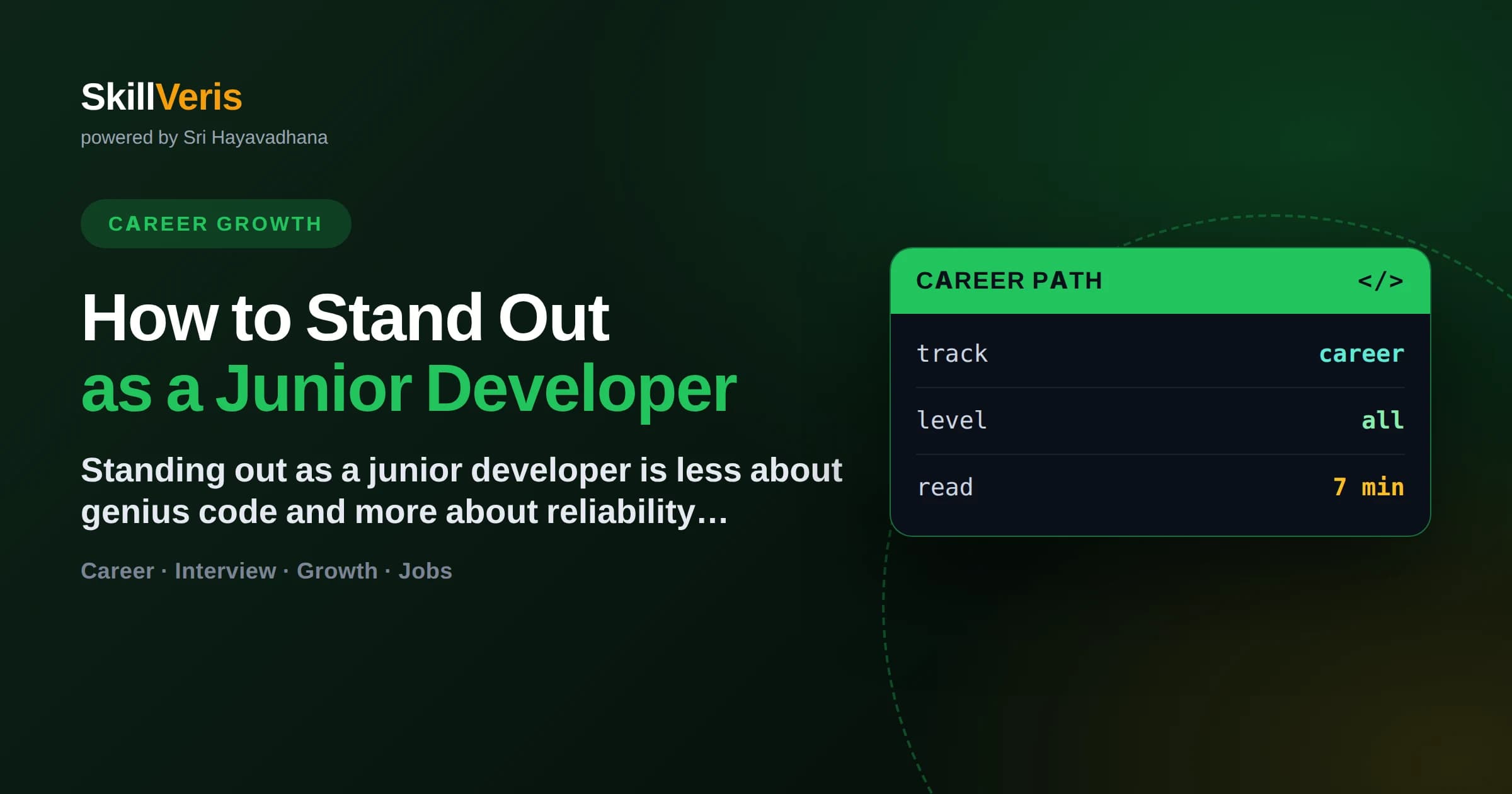
Stand out as a junior developer by being reliable, asking good questions, communicating clearly, and taking ownership of problems rather than chasing the flashiest code.
In this guide, you'll learn:
- Teams notice reliability and follow-through long before they notice clever algorithms.
- Ask well-researched questions: show what you tried before asking, and respect people's time.
- Write clear updates and pull requests — communication is a force multiplier for junior engineers.
- Take ownership: see a task through, admit mistakes early, and follow up on what you break.
1How Do Junior Developers Stand Out?
Junior developers stand out through reliability, clear communication, good questions, and ownership — not through writing the cleverest code. Teams remember the person who consistently follows through and is easy to work with far more than the one who occasionally writes a slick one-liner.
As a junior, you are not expected to know everything. What managers actually watch for is trajectory and dependability: can they hand you a task and trust it gets done, do you learn from feedback, and do you make the team better to work with. Those are habits, and habits are entirely within your control.
2Be the Reliable One
Reliability is the fastest way to build trust, and trust is what earns you bigger opportunities. It sounds unglamorous, but consistent follow-through is genuinely rare and deeply valued.
- Do what you said you would, or flag early if you cannot.
- Communicate blockers before a deadline, not after it passes.
- Finish tasks completely, including tests and edge cases, not just the happy path.
- Follow up on bugs you introduce instead of hoping no one notices.
- Show up prepared to standups and meetings with a clear status.
🔑Trust Compounds
Every task you complete reliably makes a manager more comfortable giving you a bigger one. Reliability is the flywheel that turns junior into senior.
3Ask Good Questions
Asking questions is expected of juniors, but how you ask signals your judgment. A well-formed question shows you respect people's time and can think for yourself; a lazy one signals the opposite.
Do Your Homework First
Before asking, read the docs, search the codebase, and try something. Then ask with context: 'I'm trying to X, I tried Y and got Z, here is my guess — am I on the right track?'
Know When to Ask
Struggling productively is learning; struggling for hours on something a teammate could unblock in two minutes is waste. A common guideline is to try for a bounded time, then ask.
4Communicate Clearly
Communication is an underrated superpower for junior developers because it multiplies the value of your technical work. Code that no one understands and updates no one reads create friction; clear writing removes it.
Write pull request descriptions that explain what changed and why. Give status updates that are honest and specific. When you get stuck, describe the problem in a way others can actually help with. These small habits make you the kind of teammate senior engineers want to work with.
5Take Ownership
Ownership means treating a problem as yours to solve until it is done, not passing it along at the first obstacle. It is the trait that most distinguishes engineers who get promoted quickly.
In practice, ownership looks like seeing a task through end to end, chasing down the answer instead of waiting to be told, admitting mistakes early and fixing them, and caring whether the feature actually works for users. You do not need permission to take ownership — you simply decide to.
💡Own Your Mistakes First
Breaking something is normal. The junior who says 'I broke the build, I'm on it' immediately earns more trust than one who stays quiet and hopes it resolves itself.
6Learn the Codebase and the Product
The juniors who rise fastest invest early in understanding the whole system, not just the ticket in front of them. Knowing how the codebase and product fit together lets you make better decisions and spot issues others miss.
Read code beyond your immediate task, trace how a feature works end to end, and learn what the product does for real users. This context turns you from someone who needs every step spelled out into someone who can be handed an ambiguous problem and figure it out. It is also how you start contributing ideas, not just closing assigned tickets.
7Common Mistakes to Avoid
Some habits quietly hold juniors back even when their coding is fine. Steer clear of these.
- Staying silent when stuck for hours instead of asking for help.
- Chasing shiny side projects while neglecting assigned work.
- Taking code review feedback personally and getting defensive.
- Trying to look impressive instead of being genuinely useful.
- Ignoring the product and users, focusing only on syntax and tools.
- Overpromising to seem capable, then missing commitments.
8Key Takeaways
Standing out is built from consistent, learnable habits — not innate brilliance.
- Reliability and follow-through build the trust that earns bigger opportunities.
- Ask questions well: show your work first and respect people's time.
- Clear communication multiplies the value of everything you build.
- Take ownership of problems and admit mistakes early.
- Stay curious about the codebase and product, not just the language.
9Frequently Asked Questions
Q: What matters most for a junior developer's success? A: Reliability, communication, and a willingness to learn from feedback matter more than raw coding skill. Teams trust and promote people they can depend on.
Q: How often should I ask for help as a junior? A: Ask after you have researched and tried something for a bounded time. Show what you attempted so the question respects your teammate's time and demonstrates your thinking.
Q: Do side projects help me stand out at work? A: They can build skills, but not at the expense of your assigned work. Reliably delivering your real tasks impresses managers far more than an unfinished personal project.
Q: How do I recover from breaking something in production? A: Speak up immediately, take ownership, and help fix it. Owning a mistake openly builds more trust than staying quiet, and everyone breaks things eventually.
Get The Print Version
Download a PDF of this article for offline reading.
About the Publisher
SkillVeris Team
Careers Team
Our careers team helps you navigate tech job markets, build portfolios, and land the roles you want.
View all postsRelated Posts
Never miss an update
Get the latest tutorials and guides delivered to your inbox.
No spam. Unsubscribe anytime.