How to Prepare for a Coding Interview in 2026
SkillVeris Team
Careers Team
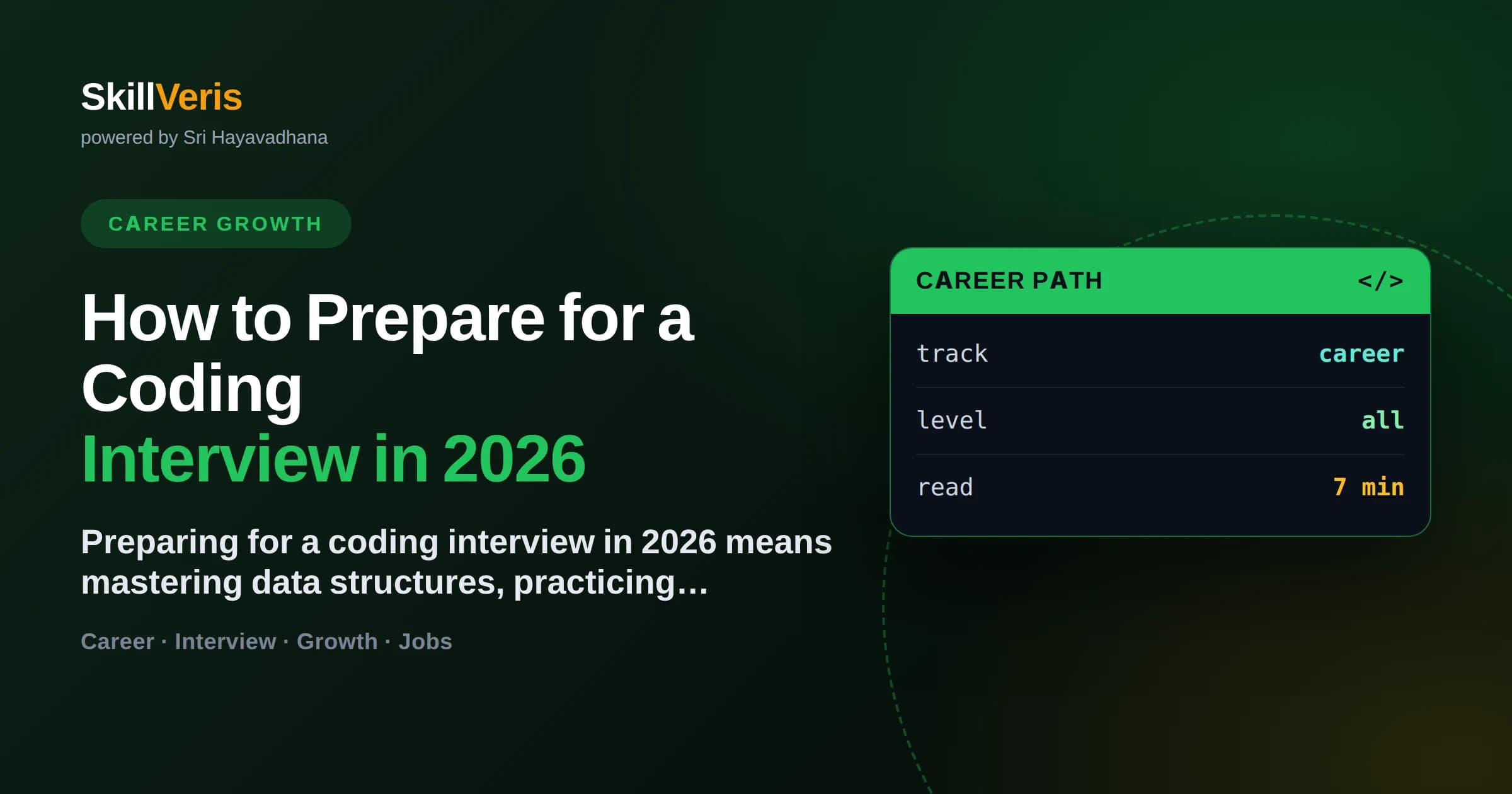
Prepare for a 2026 coding interview by drilling core data structures and algorithms, practicing problems out loud on a timer, and rehearsing behavioral and system design rounds until they feel routine.
In this guide, you'll learn:
- Depth beats volume: solving 100 problems while explaining your reasoning aloud teaches more than rushing through 500 silently.
- Modern loops now probe how you use AI tools responsibly, so be ready to reason about correctness rather than just paste generated code.
- A simple problem-solving framework — clarify, plan, code, test — keeps you calm when your mind goes blank.
- Spaced repetition on the patterns you miss most is the fastest route to durable recall under pressure.
1How to Prepare for a Coding Interview in 2026
To prepare for a coding interview in 2026, build fluency in core data structures and algorithms, practice solving problems out loud under a timer, and rehearse the full interview loop — behavioral, coding, and system design. Consistent daily practice over six to eight weeks beats a last-minute cram, because interview skills are recalled under pressure and pressure recall only comes from repetition.
The format has evolved. Companies still test problem-solving, but many now watch how you collaborate, how clearly you explain trade-offs, and how thoughtfully you use AI assistants. Treating the interview as a conversation about engineering — not a puzzle to solve in silence — is the mindset that carries most candidates through.
2What Interviewers Actually Evaluate
Interviewers are rarely just checking whether you reach the right answer. They are building a picture of what it would be like to work with you on a real team facing real ambiguity.
- Problem-solving: can you break an unfamiliar problem into smaller, tractable steps?
- Communication: do you narrate your thinking so the interviewer can follow and help?
- Code quality: is your solution readable, correctly structured, and free of obvious bugs?
- Testing instinct: do you check edge cases before declaring you are done?
- Complexity awareness: can you state and justify the time and space cost of your approach?
🔑Key Insight
A working solution you cannot explain scores lower than a slightly slower one you reason through clearly. Interviewers hire for how you think, not just what you produce.
3Build Your Fundamentals First
Before grinding practice problems, make sure the underlying toolkit is solid. Most interview questions are variations on a small set of data structures and the algorithms that operate on them. If you can recall how each behaves and when to reach for it, unfamiliar problems become recognizable.
- Arrays and strings — two pointers, sliding window, prefix sums.
- Hash maps and sets — constant-time lookups, frequency counting, deduplication.
- Stacks and queues — parsing, monotonic patterns, breadth-first traversal.
- Trees and graphs — DFS, BFS, recursion, and shortest-path basics.
- Sorting and searching — binary search on sorted data and on answers.
- Dynamic programming — recognizing overlapping subproblems and memoizing.
Know the Cost
For each structure, memorize the Big-O of its common operations. Being able to say a hash lookup is O(1) average and a balanced tree search is O(log n) lets you compare approaches on the spot instead of guessing.
4Practice With Purpose, Not Just Volume
Deliberate practice matters far more than raw problem count. Solving fifty problems while explaining each aloud and reviewing your mistakes teaches more than racing through three hundred in silence. The goal is to internalize patterns you can apply, not to memorize specific answers you might never see again.
Use a spaced-repetition loop: when you miss a problem, tag its pattern, and revisit similar problems a few days later. This surfaces your real weak spots and forces recall at exactly the interval where it strengthens memory.
A Reliable Problem-Solving Framework
When your mind goes blank in the room, a fixed process keeps you moving forward.
Clarify: restate the problem and confirm inputs, outputs, and constraints.
Plan: describe an approach in plain words before writing code.
Code: implement steadily, narrating as you go.
Test: walk through an example and check the edge cases you named.5Simulate the Real Thing
The single biggest gap between practicing alone and interviewing well is the pressure of a live audience. Talking through your logic while someone watches is a distinct skill, and it only improves by doing it. Schedule mock interviews with peers, mentors, or a study group so the format feels familiar before it counts.
Record yourself if you cannot find a partner. Playing it back reveals filler habits, long silences, and moments where you jumped to code before you had a plan — all fixable once you notice them.
💡Pro Tip
Practice on a plain editor or whiteboard, not an IDE with autocomplete. Many interviews use bare environments, and losing your safety net for the first time on the day itself is a costly surprise.
6Using AI Tools the Right Way
By 2026, many companies openly allow AI assistants in certain rounds — but they are watching how you use them. The skill under evaluation has shifted from raw recall toward judgment: can you prompt effectively, verify the output, and catch when a generated solution is subtly wrong?
Practice reasoning about code you did not write. Given an AI-suggested function, be ready to explain what it does, where it might fail, and how you would test it. Blindly pasting output that you cannot defend is the fastest way to lose credibility in a modern loop.
7Don't Skip Behavioral and System Design
A full interview loop is rarely just coding. Behavioral rounds probe how you handle conflict, ownership, and failure, while system design rounds — even at junior levels — check whether you can reason about components, data flow, and trade-offs. Neglecting these is the most common reason strong coders still get rejected.
- Prepare five to seven concrete stories using the STAR structure for behavioral questions.
- Learn the vocabulary of system design: load balancers, caching, databases, and queues.
- Practice sketching a simple design, such as a URL shortener or a news feed, end to end.
- Rehearse explaining trade-offs aloud — there is rarely one correct architecture.
8Common Mistakes to Avoid
Even well-prepared candidates trip over the same avoidable errors. Knowing them in advance is half the fix.
- Coding in silence — interviewers cannot help or score reasoning they cannot hear.
- Jumping straight to code before clarifying requirements or naming edge cases.
- Memorizing solutions instead of patterns, which collapses the moment a question shifts.
- Ignoring the behavioral round until the night before.
- Cramming hundreds of problems in a week rather than practicing steadily over weeks.
⚠️Watch Out
Silence is scored as absence of thought. If you get stuck, say what you are considering out loud — a stuck candidate who is thinking aloud is far more hireable than one who freezes.
9Key Takeaways
Interview readiness comes down to a handful of durable habits.
- Master core data structures and their Big-O costs before grinding problems.
- Practice out loud, on a timer, and review every mistake by pattern.
- Simulate real interviews to build comfort with a live audience.
- Prepare behavioral stories and basic system design alongside coding.
- Use AI tools as a candidate who verifies, not one who pastes blindly.
10Frequently Asked Questions
Q: How long should I prepare for a coding interview? A: Most candidates need six to eight weeks of consistent daily practice, though this varies with your starting level. Short, focused sessions every day beat occasional marathon cramming, because interview recall depends on repeated exposure over time.
Q: How many practice problems should I solve? A: Quality matters more than a target number. Around 100 to 150 well-understood problems, solved aloud and reviewed by pattern, prepares most people better than 500 rushed problems. Focus on covering the major categories rather than hitting a count.
Q: Are AI tools allowed in coding interviews now? A: It depends on the company and the round. Many allow them for certain tasks and evaluate how well you verify and reason about the output. Always ask the interviewer what is permitted before assuming, and be ready to defend any code you present.
Q: What if I get stuck and cannot solve the problem? A: Keep communicating. Explain your approach, name what is blocking you, and describe a brute-force solution if nothing better comes. Interviewers frequently pass candidates who reason clearly through a partial solution over those who go silent.
Get The Print Version
Download a PDF of this article for offline reading.
About the Publisher
SkillVeris Team
Careers Team
Our careers team helps you navigate tech job markets, build portfolios, and land the roles you want.
View all postsRelated Posts
Never miss an update
Get the latest tutorials and guides delivered to your inbox.
No spam. Unsubscribe anytime.