How to Prepare for a Coding Interview
SkillVeris Team
Careers Team
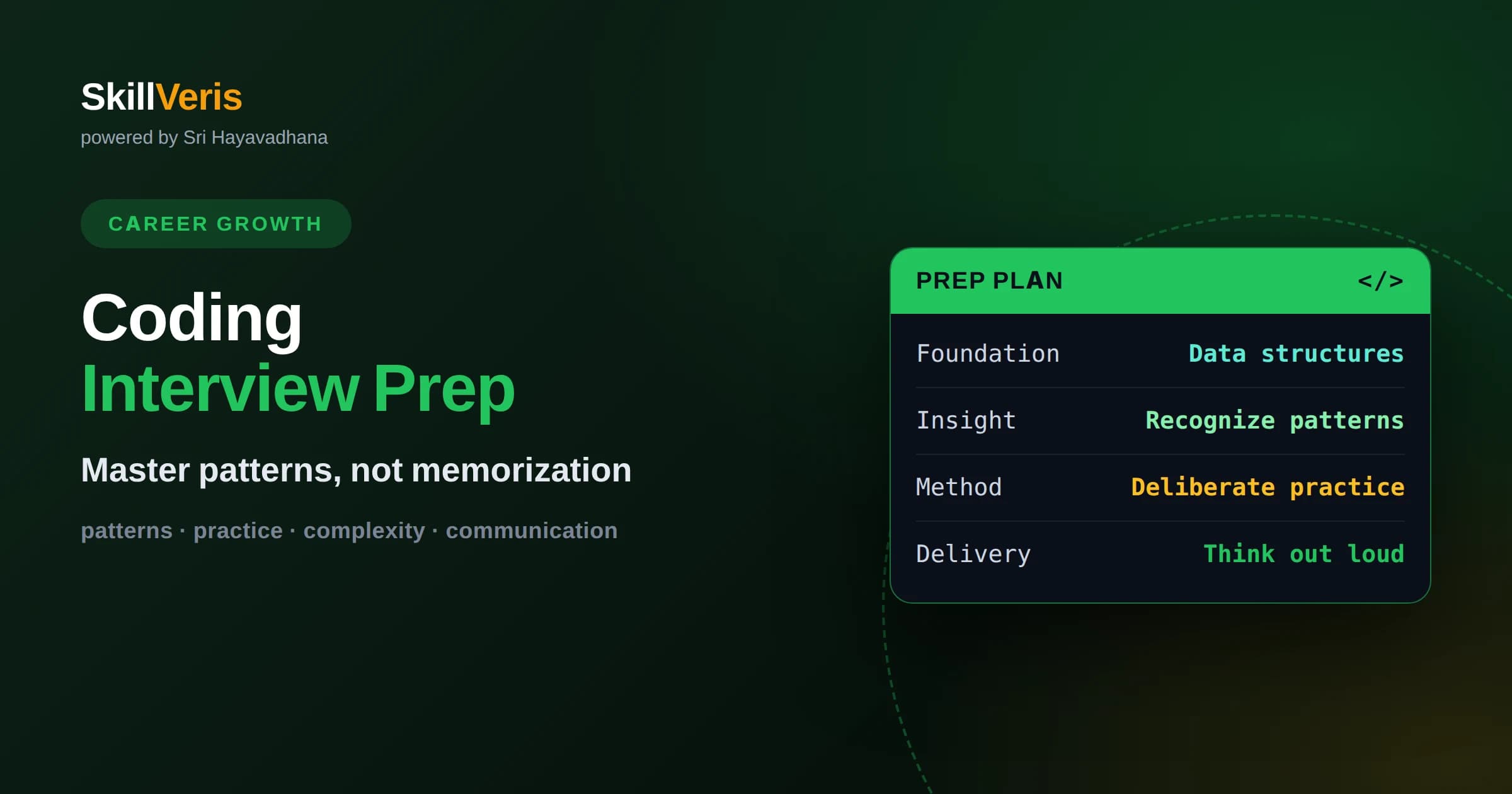
Coding interviews test problem-solving and communication, not memorization of specific solutions.
In this guide, you'll learn:
- Mastering a core set of data structures and patterns covers the majority of questions you will face.
- Deliberate, spaced practice with real problems beats passively watching solutions.
- A clear step-by-step approach and thinking out loud can turn a shaky answer into a strong one.
1How To Prepare For A Coding Interview
The most effective way to prepare for a coding interview is deliberate, pattern-focused practice: learn the core data structures, master a set of recurring problem-solving patterns, and practice explaining your reasoning out loud while you solve real problems. Preparation is a skill you build, not luck you hope for.
Coding interviews can feel intimidating because they combine technical knowledge with performing under pressure. But they are highly learnable. The questions draw from a well-understood pool of concepts, and thousands of engineers have prepared successfully using the same approach.
This roadmap walks through what to study, how to practice, and how to perform on the day. The emphasis throughout is on understanding rather than memorization, because interviewers can tell the difference, and understanding transfers to problems you have never seen.
2What Coding Interviews Really Test
It helps to understand what interviewers are actually evaluating. They are not checking whether you memorized a specific solution. They want to see how you break down an unfamiliar problem, choose an approach, write clean code, and communicate along the way.
This is why memorizing answers to hundreds of problems is the wrong strategy. Interviewers can tell when you have simply recalled a solution versus reasoned your way to one, and they will probe with follow-up questions that memorization cannot survive.
The right goal is to build genuine problem-solving ability. When you understand the underlying patterns, you can adapt them to new variations on the spot. That flexibility is exactly what interviews are designed to reveal.
Interviewers also watch how you handle uncertainty. When you hit a wall, do you panic, or do you methodically explore alternatives? A candidate who stays composed and reasons through a tough spot often impresses more than one who happens to know the answer instantly but cannot explain how they got there.
3Master The Core Data Structures
Everything in coding interviews builds on a foundation of data structures. You should deeply understand arrays, strings, hash maps, linked lists, stacks, queues, trees, and graphs. For each, know how it stores data, what operations it supports, and how fast those operations are.
Hash maps deserve special attention because they appear constantly. Their ability to look up values almost instantly turns many slow solutions into fast ones. Recognizing when a hash map simplifies a problem is one of the highest-value skills you can develop.
Do not just memorize definitions. Understand the trade-offs. A hash map offers fast lookups but no ordering; an array offers fast indexed access but slow insertion in the middle. Knowing why you would reach for one over another is what interviews reward.
Trees and graphs intimidate many beginners, but they are worth the effort because they unlock a large family of problems. Once you are comfortable traversing them and understand a few standard techniques, questions that once looked impossible start to feel like variations on things you already know.
4Understand Time And Space Complexity
Interviewers almost always ask about the efficiency of your solution, so you must understand complexity analysis. This is a way of describing how the time or memory a solution needs grows as the input grows, expressed in a standard notation.
The practical goal is recognizing whether a solution is efficient enough. A slow approach that checks every pair of elements might be fine for small inputs but disastrous for large ones. Being able to spot and improve inefficient solutions is a core interview skill.
You do not need heavy mathematics, but you must be fluent in the common categories, from constant and logarithmic time up through linear and quadratic. Being able to state your solution's complexity and discuss how to improve it signals real competence.
Get in the habit of analyzing complexity for every problem you practice, not just when asked. Over time you develop an instinct for whether an approach will be efficient enough before you even write it, which helps you steer toward good solutions from the start rather than discovering a dead end after coding it.
5Learn The Recurring Patterns
Here is the key insight that transforms preparation: most interview problems are variations on a limited set of patterns. Once you recognize the pattern behind a problem, the path to a solution becomes far clearer, and unfamiliar questions start to feel familiar.
Common patterns include using two pointers that move through data from different positions, sliding a window across a sequence to examine ranges efficiently, and exploring possibilities through recursion. Each pattern applies to a whole family of problems.
When you practice, consciously label the pattern each problem uses. Over time you build a mental library, and when a new problem appears you can ask which pattern fits. This pattern recognition is what separates confident candidates from those who solve every problem from scratch.
Learning patterns also makes your study far more efficient. Instead of treating a thousand problems as a thousand separate puzzles, you see them as a manageable handful of ideas dressed in different clothing. Mastering the small set of underlying techniques covers a surprisingly large share of everything you might be asked.
6Practice Deliberately, Not Passively
How you practice matters more than how much. Passive practice, like watching someone else solve a problem, feels productive but builds little skill. Deliberate practice means struggling with problems yourself before looking at any solution.
Give each problem a genuine attempt, even when it is hard. The struggle is where learning happens. If you are truly stuck after a real effort, study the solution carefully, understand exactly why it works, then set the problem aside and solve it again later from scratch.
Revisit problems over spaced intervals rather than cramming. Solving a problem once and moving on rarely sticks. Returning to it days later cements the pattern in long-term memory, which is what you can actually draw on during an interview.
7Choosing What To Practice
Quality beats quantity. Grinding through hundreds of random problems is less effective than thoughtfully working through a curated set that covers the core patterns and data structures. A well-chosen fifty can teach you more than a scattered five hundred.
Progress from easier problems to harder ones. Build confidence and fundamentals on approachable questions before tackling the tricky variations. Jumping straight to the hardest problems usually produces frustration rather than learning.
Track the problems you find difficult and return to them. Your weak spots are where the most improvement is available. A short list of problems you have revisited until they feel easy is worth more than a long list you solved once.
Consistency beats intensity. A modest amount of focused practice several times a week compounds far better than occasional marathon sessions. Regular exposure keeps the patterns fresh and steadily builds the fluency that lets you recognize an approach quickly under pressure.
8A Step-By-Step Approach During The Interview
Having a consistent approach keeps you calm when a hard problem appears. Start by making sure you fully understand the question. Restate it in your own words and clarify any ambiguity with the interviewer before writing anything.
Next, work through a small example by hand to build intuition, then discuss possible approaches and their trade-offs before committing to one. Only after you have a plan should you start coding. This order prevents the common mistake of coding into a dead end.
As you write, keep your code clean and talk through what you are doing. When finished, walk through your solution with a test case to catch bugs. This structured rhythm turns a stressful blank page into a manageable sequence of steps.
9Communication Is Half The Battle
Many candidates focus entirely on getting the right answer and neglect communication, but interviewers weigh how you think as heavily as what you produce. Thinking out loud lets them follow your reasoning and gives them a chance to nudge you when you drift.
If you get stuck, say so and describe what you are considering. Silence leaves the interviewer guessing, while narrating your thought process shows how you tackle obstacles. A partial solution explained well often beats a perfect solution reached in silence.
Treat the interviewer as a collaborator rather than a judge. Ask clarifying questions, respond to hints, and stay open to feedback. Demonstrating that you would be good to work with is a real part of passing the interview.
10Simulate The Real Experience
Solving problems alone in a quiet room is very different from solving them while a person watches and the clock ticks. To prepare for that pressure, practice under realistic conditions with mock interviews.
Have a friend or peer pose a problem while you solve it aloud, or practice explaining your solutions to an imaginary interviewer. The goal is to make thinking out loud under observation feel natural, so it does not throw you on the real day.
Simulating the experience also builds time awareness. You learn how long you can spend exploring before you must commit to coding, a sense that is hard to develop by practicing without any time constraint.
Record or reflect on your mock sessions to find recurring stumbles. Maybe you rush into code before understanding the problem, or forget to test your solution. Spotting these habits in low-stakes practice lets you correct them before they cost you in a real interview.
11Managing Nerves And Setbacks
Even well-prepared candidates get nervous, and that is normal. A little adrenaline can sharpen focus. The problem is when anxiety causes you to freeze, so build habits that keep you moving, like always starting with clarifying questions to get your bearings.
Accept that you may not solve every problem perfectly, and that is often okay. Interviewers frequently care more about your approach than a flawless result. Making steady progress and reasoning clearly can leave a strong impression even without a complete solution.
Rejection is part of the process for almost everyone. Treat each interview as practice and each setback as data about what to study next. Persistence, more than raw talent, is what carries most people across the line.
12Prepare With SkillVeris
Consistent, structured practice is what turns interview anxiety into confidence. Build a study routine, focus on understanding patterns over memorizing answers, and practice explaining your reasoning out loud until it feels natural.
On SkillVeris you can strengthen the fundamentals behind every coding interview through hands-on programming and problem-solving courses. Master the core data structures and patterns, practice deliberately, and walk into your interview ready to think clearly under pressure.
Get The Print Version
Download a PDF of this article for offline reading.
About the Publisher
SkillVeris Team
Careers Team
Our careers team helps you navigate tech job markets, build portfolios, and land the roles you want.
View all postsRelated Posts
Never miss an update
Get the latest tutorials and guides delivered to your inbox.
No spam. Unsubscribe anytime.