How to Negotiate Your Tech Salary
SkillVeris Team
Careers Team
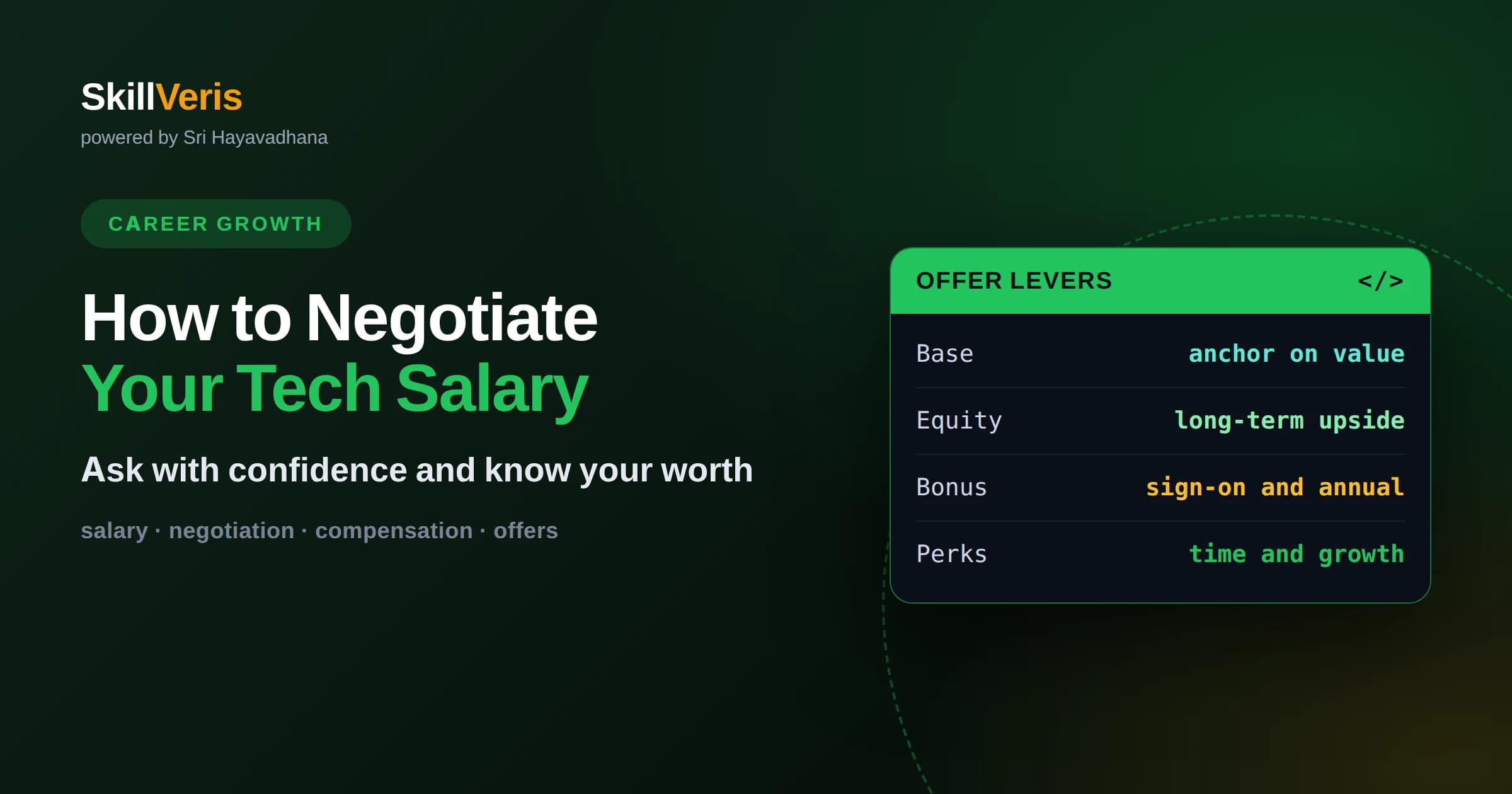
Negotiation is expected in tech, and most employers leave room in their first offer for you to counter.
In this guide, you'll learn:
- Research and a clear sense of your market value give you the confidence to ask without fear.
- The total compensation package includes equity, bonus, and benefits, not just the base salary number.
- A calm, collaborative tone frames negotiation as problem-solving rather than confrontation.
1How to Negotiate Your Tech Salary
To negotiate your tech salary effectively, research the market rate for your role and location, avoid naming a number first, and once you receive an offer, counter with a specific figure justified by your value and your research. The core mindset shift is understanding that negotiation is normal and expected; most companies build room into their initial offer precisely because they anticipate a counter. Declining to negotiate often leaves money on the table that was already reserved for you.
Negotiation is not a battle to win but a conversation to align on fair value. The company wants to hire you or they would not have made an offer, and that gives you real leverage. Your job is to advocate for yourself calmly and factually, treating the discussion as a shared effort to reach an agreement both sides feel good about.
Many developers feel anxious about negotiating, fearing they will seem greedy or lose the offer. In practice, rescinding an offer over a polite, reasonable counter is extremely rare. Recruiters negotiate constantly and generally respect candidates who advocate for themselves professionally.
2Why Negotiation Matters More Than You Think
The salary you start with sets the baseline for years of raises, since increases are usually calculated as a percentage of your current pay. A higher starting point compounds over time, meaning a single successful negotiation can influence your earnings well beyond the immediate job. The stakes are larger than the first paycheck suggests.
Negotiation also signals confidence and self-awareness, qualities employers value. A candidate who understands their worth and can discuss it professionally often earns more respect, not less. Handled well, the conversation can actually strengthen how the team perceives you before you even start.
Because the potential upside is large and the downside is small, the expected value of negotiating is almost always positive. A brief, respectful conversation can yield a meaningful difference in compensation, which makes skipping it a costly habit over a career.
3Research Your Market Value
Before any conversation, gather data on what your role pays. Look at salary aggregators, community-shared compensation reports, and job postings for similar positions in your region and industry. Understanding the realistic range for your experience level gives you a factual foundation and calibrates your expectations so your ask is credible.
Consider the factors that move your value within that range: your specific skills, relevant experience, the demand for your specialty, and the size and funding of the company. A well-funded firm competing for scarce talent has more flexibility than a small early-stage team, and knowing the context helps you set a reasonable target.
Write down three numbers before you negotiate: the amount you would be delighted with, a solid target, and the minimum you would accept. Having these clear in advance keeps you grounded during the conversation and prevents you from anchoring too low under pressure.
4Let the Employer Name a Number First
When asked early what salary you expect, try to defer politely. You might say you would like to learn more about the role and are confident you can find a fair number together, or ask what range is budgeted for the position. Whoever names a figure first often anchors the discussion, and you generally benefit from hearing their number before revealing yours.
If pressed for a figure, respond with a researched range rather than a single number, and set the lower end at a point you would genuinely be happy with. Anchoring toward the higher part of the realistic market range gives you room to negotiate downward while still landing well.
Avoid disclosing your current salary if you can, since it can cap the new offer at a small bump rather than reflecting the role's true value. In many places you are not obligated to share it, and redirecting to your expectations for the new role keeps the focus on the job's worth.
5Evaluate the Whole Offer
When an offer arrives, resist the urge to respond immediately. Thank the recruiter, express genuine enthusiasm, and ask for time to review the details. A short pause is completely normal and gives you space to think clearly rather than reacting emotionally to a number.
Look beyond base salary at the total package. Equity, signing bonuses, annual bonuses, retirement contributions, health benefits, learning budgets, and flexible working arrangements all carry real value. Sometimes a company that cannot move much on base pay has flexibility on these other components.
Assess the offer against your research and your priorities. A slightly lower salary with excellent growth opportunities, strong mentorship, or meaningful equity may be worth more to you than a marginally higher number elsewhere. Clarity about what you value most helps you negotiate for the right things.
6Make a Confident Counteroffer
When you counter, be specific and justify your number with reasons. Point to your research, your relevant skills, and the value you will bring rather than to personal financial needs. A counter framed around value and market data is persuasive; one framed around what you need to pay your bills is not.
Ask for a concrete figure rather than vaguely requesting more. A precise number, especially one that looks carefully calculated, signals that you have done your homework and taken the process seriously. Pair it with genuine enthusiasm for the role so the employer knows you want to say yes.
Keep the tone collaborative. Phrasing like you are excited about the opportunity and hoping to find a number that reflects the value you will add invites the employer to work with you. Framing negotiation as joint problem-solving rather than a demand keeps the relationship warm.
7Negotiate More Than Base Salary
If the base salary is truly fixed, shift the conversation to other levers. A signing bonus, additional equity, extra paid time off, a professional development budget, a better title, or remote flexibility can all meaningfully improve an offer. Companies often have more room on these than on base pay.
These components can be worth a great deal over time. Learning budgets accelerate your growth, additional equity offers upside, and flexible arrangements improve your daily quality of life. Considering the full picture lets you construct a package that fits your circumstances, not just a bigger headline number.
Prioritize what matters most to you and ask for it directly. If you care about growth, negotiate for mentorship and learning support. If you care about balance, negotiate for flexibility. Knowing your priorities makes the conversation efficient and helps both sides find a satisfying arrangement.
8Use Competing Offers Wisely
If you are fortunate enough to hold multiple offers, they can strengthen your position, but handle them with tact. Mentioning that you are weighing another opportunity can encourage a company to improve their offer, yet you should never bluff about an offer you do not have. Getting caught in an exaggeration can damage trust irreparably.
Present competing offers as a genuine situation you are trying to resolve, not as a threat. You might explain that you are excited about this role and also considering another option, and ask whether there is flexibility to help you make the decision. This keeps the tone respectful and honest.
Even with leverage, stay gracious. The people you negotiate with may become your colleagues, and starting the relationship with mutual respect matters. A hard-edged negotiation can win a slightly better number while souring the goodwill you will want on day one.
9Manage the Emotional Side
Money conversations trigger anxiety for many people, so prepare emotionally as well as factually. Rehearse what you plan to say, perhaps with a friend, until the words feel natural. Practice reduces the nervousness that can push you into accepting the first offer just to end the discomfort.
Remember that a firm, polite ask will not offend a reasonable employer. Recruiters expect negotiation and do not think less of candidates who engage in it professionally. Reframing the conversation as a normal business process, rather than a personal confrontation, calms the nerves considerably.
If you feel yourself getting flustered mid-conversation, it is fine to slow down, ask for time to consider, and follow up in writing. Written negotiation removes the pressure of responding on the spot and lets you craft your message carefully.
10Know When to Accept
Negotiation has a natural endpoint, and pushing past it can backfire. Once an employer has moved to meet you or clearly explained they have reached their limit, continuing to press for more can create friction and start the relationship poorly. Recognize a fair outcome and accept it graciously.
If the final offer meets your target and the role excites you, saying yes with enthusiasm is the right move. You do not need to squeeze every last dollar to have negotiated well; landing meaningfully above the first offer, at a number you feel good about, is a clear success.
When you accept, get the final terms in writing before resigning from any current position. A written offer protects both parties and ensures everyone shares the same understanding of what was agreed. Confirming details in writing is a normal, professional step, not a sign of distrust.
11Avoid These Negotiation Mistakes
The most common mistake is not negotiating at all, accepting the first number out of gratitude or fear. Employers rarely lead with their best offer, so accepting immediately often means leaving reserved money behind. A single polite counter is almost always worth attempting.
Another error is negotiating from need rather than value, or apologizing for asking. Framing your request around market data and the contributions you will make is far more compelling than appeals to personal circumstances, and apologizing undercuts your own position.
Finally, avoid burning bridges. An aggressive or ungracious negotiation can win a marginally better package at the cost of goodwill you will need later. Staying warm, factual, and collaborative gets you the best of both worlds: a strong offer and a good relationship.
12Confirm Everything in Writing
Verbal promises during negotiation are easy to misremember, so insist on seeing the final agreed terms in writing before you accept or resign from another role. A written offer that spells out base salary, bonus, equity, start date, and any special arrangements protects both you and the employer from honest misunderstandings.
If a recruiter agrees to something over a call, follow up with a short, friendly email summarizing what you understood. This creates a record and gives the other side a chance to correct anything. Putting agreements in writing is standard professional practice, not a sign that you distrust anyone.
Read the full offer document carefully, including how bonuses are earned and how equity vests, since these details significantly affect what you actually receive. If anything is unclear, ask before signing. A few clarifying questions upfront prevent disappointment months later when reality differs from what you assumed.
13Negotiation Continues Throughout Your Career
The skills you build negotiating a job offer serve you far beyond that first conversation. Raises, promotions, and expanded responsibilities all involve advocating for yourself, and the same principles apply: know your value, gather evidence, and ask clearly and professionally. Negotiation is a career-long capability, not a one-time event.
Keep a running record of your accomplishments and their impact so that when review season arrives, you can make a concrete case for higher compensation. Vague appeals rarely move employers, but a documented pattern of contribution is persuasive and hard to dismiss.
Treat each negotiation as practice that makes the next one easier. The discomfort fades with repetition, and developers who advocate for themselves consistently, in a respectful and evidence-based way, tend to be paid meaningfully more over a career than equally skilled peers who stay silent.
14Grow Your Value With SkillVeris
The strongest negotiating position comes from genuinely valuable skills, and the most reliable way to raise your market value is to keep learning in-demand capabilities. SkillVeris helps you build exactly the kind of practical, current skills that justify a higher number and give you confidence in the conversation.
Before your next offer, do the research, decide your target, and rehearse your counter. Then let your growing expertise back you up. Every skill you add strengthens both the value you bring and the calm assurance with which you can ask to be paid for it.
Get The Print Version
Download a PDF of this article for offline reading.
About the Publisher
SkillVeris Team
Careers Team
Our careers team helps you navigate tech job markets, build portfolios, and land the roles you want.
View all postsRelated Posts
Never miss an update
Get the latest tutorials and guides delivered to your inbox.
No spam. Unsubscribe anytime.