How to Negotiate Your First Tech Salary
SkillVeris Team
Careers Team
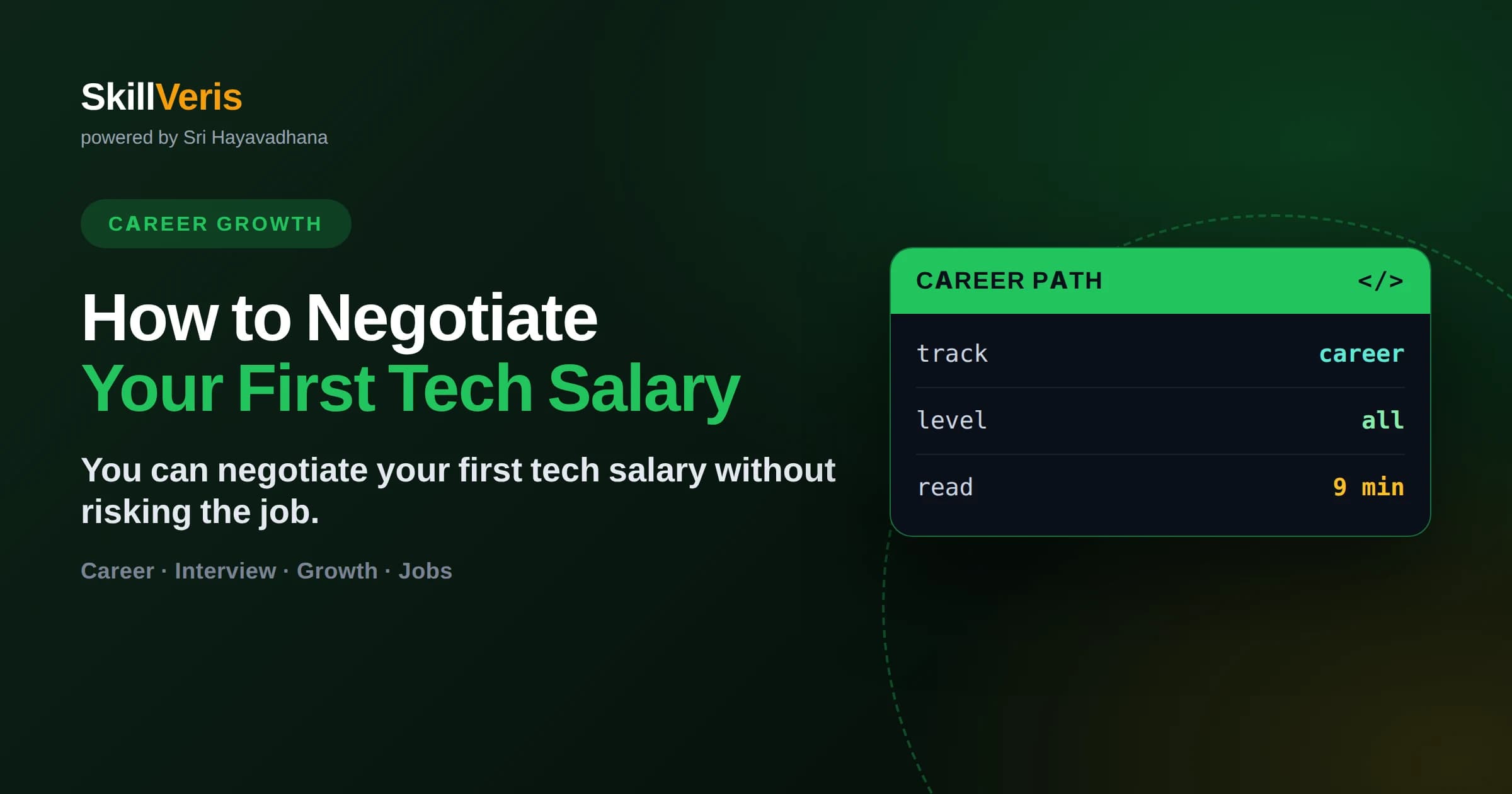
You can and should negotiate your first tech salary — research the market range, evaluate the full compensation package, and make a polite, specific counteroffer backed by your value.
In this guide, you'll learn:
- Negotiating is expected, not offensive; most companies leave room in an initial offer and rarely rescind it over a professional counter.
- Compensation is more than base salary — weigh equity, bonus, signing bonus, benefits, and growth before deciding.
- Never share your current or desired number first; let the employer anchor and respond to their figure.
- A calm, gratitude-first counter framed around the role's value outperforms ultimatums every time.
1How to Negotiate Your First Tech Salary
You negotiate your first tech salary by researching the market range for the role and location, evaluating the entire offer rather than the base number alone, and responding with a polite, specific counteroffer that ties your request to the value you bring. Negotiation is a normal, expected part of hiring — most initial offers leave deliberate room, and asking professionally almost never costs you the job.
First-time candidates often accept the first number out of fear or gratitude, leaving real money on the table. Because future raises and job offers frequently build on your starting salary, a small increase now can compound into a significant sum over a career. Approaching the conversation with preparation and calm turns an intimidating moment into a routine one.
2Why You Should Negotiate
Declining to negotiate can quietly cost you far more than the first paycheck suggests. Starting salary sets a baseline that percentage raises and future offers are measured against, so the effect stretches across years.
- Compounding: annual raises are usually a percentage of your current salary.
- Anchoring: future employers often ask about or benchmark against your prior pay.
- Expectation: recruiters typically expect a counter and price the first offer accordingly.
- Respect: a professional negotiation signals confidence and self-awareness, not greed.
🔑Key Insight
Employers rarely rescind an offer because a candidate negotiated politely. The initial number is a starting point, not a final verdict — treating it as fixed leaves value unclaimed.
3Do Your Research First
Effective negotiation rests on data, not hope. Before any conversation, gather a realistic range for the specific role, seniority, company size, and location so your counter sounds grounded rather than arbitrary. Preparation is what separates a confident ask from a nervous guess.
Look across several sources, since any single one can be skewed. Public salary databases, community surveys, and conversations with people in similar roles together paint a more honest picture than one website alone.
- Compare multiple salary sites rather than trusting a single figure.
- Factor in location and whether the role is remote or on-site.
- Account for company stage — startups may trade cash for equity.
- Talk to peers or mentors in similar roles for a real-world sense check.
4Evaluate the Whole Package
Base salary is only one part of your compensation. A lower base with strong equity, bonus, and benefits can outweigh a higher base with little else, so weigh the full picture before deciding whether — and what — to negotiate.
What to Weigh
Look at each component and its real value to you, not just the headline number.
Base salary — your guaranteed, predictable income.
Equity — stock or options, whose value depends heavily on the company.
Bonus and signing bonus — one-time or performance-based cash.
Benefits — health coverage, retirement matching, paid time off, learning budgets.
Growth — mentorship, project scope, and the trajectory the role offers.5Let the Employer Name a Number First
Whoever names a figure first sets the anchor, and as a candidate you usually benefit from letting the employer go first. If asked your expected salary early, you can deflect gracefully by saying you would like to learn more about the role and are confident you can agree on fair compensation.
If pressed, offer a researched range rather than a single number, and keep the bottom of that range at a figure you would genuinely accept. This keeps you from underselling yourself before you know what the company is prepared to offer.
💡Pro Tip
A clean deflection: 'I am flexible and want to find a package that works for both of us. What range do you have budgeted for this role?' It moves the anchor to their side without seeming evasive.
6Making the Counteroffer
When the offer arrives, thank them warmly, ask for time to consider it, and then respond with a specific, justified counter. Lead with genuine enthusiasm for the role — you want them to feel you are working toward yes, not threatening a walkout.
Frame your ask around value and market data rather than personal need. 'Based on my research for this role and the skills I bring, I was hoping for X' lands far better than 'I need more because my rent is high.' Anchor slightly above your target so there is room to settle in the middle.
- Express real gratitude and interest before raising numbers.
- State a specific figure, not a vague 'a bit more.'
- Justify it with market research and the value you offer.
- If base is capped, pivot to signing bonus, equity, or extra time off.
7Common Mistakes to Avoid
First-time negotiators tend to sabotage themselves in a few recognizable ways. Sidestepping these keeps the conversation professional and productive.
- Accepting instantly out of relief before even reviewing the details.
- Sharing your desired or current salary before the employer anchors.
- Making it personal — rent and bills are not negotiation leverage.
- Issuing ultimatums or bluffing about offers you do not have.
- Negotiating over email tone alone without confirming details in writing afterward.
⚠️Watch Out
Never invent a competing offer to gain leverage. If asked to produce it, your credibility collapses instantly. Negotiate on your real value and honest research, not on a fabricated bidding war.
8Handling Their Response
After you counter, the employer may accept, meet you partway, or hold firm. Any of these is a normal outcome, and your job is to respond with the same composure you brought to the ask. If they improve the offer, confirm the final terms in writing before accepting.
If they cannot move on base, ask whether other levers — a signing bonus, a review in six months, or additional equity — are open. And if the answer is a firm no, you still get to decide whether the total package works for you. Walking away politely is always an option you retain.
9Key Takeaways
A successful first negotiation rests on a few principles.
- Always negotiate — a polite counter rarely costs the job and can pay off for years.
- Research a realistic range across multiple sources before you talk numbers.
- Evaluate the full package: base, equity, bonus, benefits, and growth.
- Let the employer anchor first, and justify your counter with value and data.
- Stay professional, get final terms in writing, and keep the right to walk away.
10Frequently Asked Questions
Q: Can negotiating cause a company to withdraw my offer? A: It is very rare when done professionally. Companies expect candidates to negotiate and build room into offers accordingly. A polite, well-reasoned counter almost never leads to a rescinded offer; aggressive ultimatums or dishonesty are what create risk.
Q: How much more should I ask for? A: This depends on the gap between the offer and your researched market range. Anchoring somewhat above your target leaves room to settle in the middle. Base the figure on data for the role and location, not on a fixed percentage rule.
Q: What if I have no competing offers? A: You do not need one. Negotiate on the strength of your skills and market research instead. Fabricating a competing offer is dangerous and unnecessary — a genuine, value-based case is more persuasive and far safer.
Q: Should I negotiate benefits or only salary? A: Both are fair game. If base salary is capped, benefits like a signing bonus, extra equity, additional paid time off, or an early performance review can meaningfully improve the package. Always consider total compensation, not just the base figure.
Get The Print Version
Download a PDF of this article for offline reading.
About the Publisher
SkillVeris Team
Careers Team
Our careers team helps you navigate tech job markets, build portfolios, and land the roles you want.
View all postsRelated Posts
Never miss an update
Get the latest tutorials and guides delivered to your inbox.
No spam. Unsubscribe anytime.