How to Give and Receive Code Review Feedback
SkillVeris Team
Careers Team
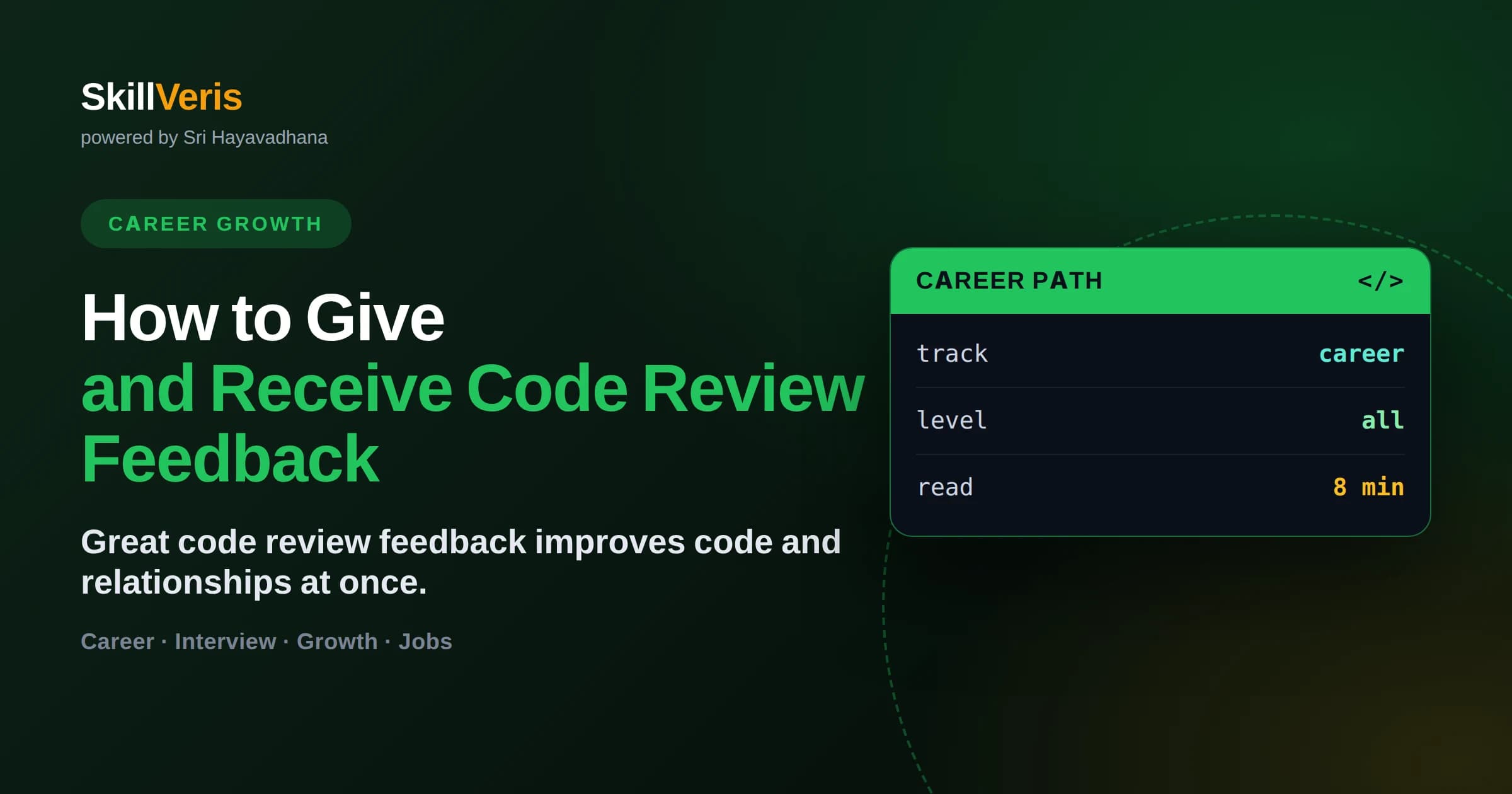
Give code review feedback that is specific, kind, and focused on the code not the person, and receive it by treating comments as gifts that improve the work rather than attacks on you.
In this guide, you'll learn:
- Review the code, never the coder — phrase feedback about the change, not the author's ability.
- Distinguish blocking issues from nitpicks so reviews do not stall on trivia.
- Explain the 'why' behind each suggestion so the author learns, not just complies.
- As an author, assume good intent, ask questions instead of defending, and thank reviewers.
1What Makes Good Code Review Feedback?
Good code review feedback is specific, kind, and focused on the code rather than the person, and it explains the reasoning behind each suggestion. Its goal is to improve the change and help the author grow, not to prove the reviewer is smarter.
Code review is one of the highest-leverage practices in software teams. Done well, it catches bugs, spreads knowledge, and builds trust. Done poorly, it becomes a source of friction, resentment, and slow delivery — so the human skills matter as much as the technical ones.
2Why Code Review Skills Matter
Code review is where much of a team's real learning and quality control happens, which makes the human skills around it disproportionately valuable. Handling it well marks you as a mature engineer regardless of seniority.
Reviews catch defects before they reach users, spread knowledge so no single person is a bottleneck, and set the informal standards a codebase follows. But all of that only works if feedback flows respectfully in both directions. A team where reviews feel like attacks slows down and hides problems; one where they feel collaborative ships better software faster.
3How to Give Feedback Well
The reviewer's job is to make the code better while keeping the author motivated. A few habits make the difference between helpful and demoralizing.
- Review the code, not the coder: say 'this function could be simpler' not 'you overcomplicated this.'
- Be specific: point to lines and suggest a concrete alternative rather than vague disapproval.
- Explain the why: 'this could throw on null input' teaches; 'change this' does not.
- Ask questions: 'what happens if the list is empty here?' invites thinking over defensiveness.
- Acknowledge good work: call out a clean solution, not only the problems.
🔑Comment on the Change, Not the Person
Every comment should be something you would say kindly to a respected colleague sitting next to you. If it would sting in person, rewrite it.
4Separate Blocking Issues From Nitpicks
Not every comment carries equal weight, and treating them all the same way stalls reviews. Label the severity so the author knows what must change versus what is optional.
Blocking
Real problems: bugs, security issues, broken logic, or missing tests. These should hold the merge until resolved.
Suggestions
Improvements worth considering but not mandatory, like a cleaner pattern or a clearer name. The author decides.
Nitpicks
Minor style preferences. Prefix them clearly (many teams write 'nit:') so they are never mistaken for blockers, and let automation handle formatting where possible.
5How to Receive Feedback Well
Receiving review gracefully is a skill that accelerates your growth. The core mindset shift is treating comments as feedback on the code, not judgments of your worth.
When a comment stings, pause before responding. Assume the reviewer wants the change to succeed. If you disagree, ask a clarifying question or explain your reasoning rather than defending emotionally — a short discussion often reveals context both sides missed.
- Assume good intent: reviewers are helping, not attacking.
- Ask, do not defend: 'can you say more about the risk here?' beats 'it works fine.'
- Say thanks: reviewers spent their time improving your work.
- Separate ego from code: a flaw found now is a bug avoided in production.
6Handling Disagreements Gracefully
Disagreements in review are normal and often productive, but only if both sides stay focused on the code and the goal. The aim is the best outcome, not winning an argument.
When a reviewer and author disagree, a short synchronous conversation usually resolves what a long comment thread cannot, because tone and context come through. If it comes down to genuine preference rather than correctness, defer to the code's owner or an agreed team convention. Document the decision so the same debate does not resurface on the next pull request.
7Best Practices for a Healthy Review Culture
The best review cultures are fast, respectful, and consistent. These practices keep both quality and morale high across a team.
- Review promptly: a pull request left for days blocks a teammate and kills momentum.
- Keep changes small: small pull requests get better, faster reviews than giant ones.
- Automate the trivial: let linters and formatters handle style so humans focus on logic.
- Discuss offline when threads get long: a two-minute call resolves what ten comments cannot.
- Rotate reviewers so knowledge spreads and no one becomes a bottleneck.
⚠️Beware the Review Bottleneck
Slow reviews are a hidden productivity killer. If pull requests routinely wait days, the problem is the process, not the authors — fix response time as a team norm.
8Key Takeaways
Code review is a two-way skill that improves code and relationships together.
- Give feedback on the code, be specific, and always explain the why.
- Label severity so blockers, suggestions, and nitpicks are never confused.
- Receive feedback by assuming good intent and asking instead of defending.
- Keep pull requests small and reviews prompt to protect velocity.
- Automate style so human attention goes to logic and design.
9Frequently Asked Questions
Q: How do I give critical feedback without hurting feelings? A: Focus every comment on the code, be specific, explain the reasoning, and phrase suggestions as questions. If a comment would sting said aloud, rewrite it more kindly.
Q: What should I do when I disagree with a reviewer? A: Ask a clarifying question or explain your reasoning calmly rather than defending emotionally. If the thread grows, move to a quick call — context usually resolves it.
Q: How fast should code reviews happen? A: As a norm, aim to respond within a day so teammates are not blocked. Prompt reviews and small pull requests together keep a team's velocity high.
Q: Should nitpicks block a merge? A: No. Label them clearly as minor and let the author decide. Reserve blocking status for bugs, security issues, broken logic, or missing tests.
Get The Print Version
Download a PDF of this article for offline reading.
About the Publisher
SkillVeris Team
Careers Team
Our careers team helps you navigate tech job markets, build portfolios, and land the roles you want.
View all postsRelated Posts
Never miss an update
Get the latest tutorials and guides delivered to your inbox.
No spam. Unsubscribe anytime.