How to Get Your First Tech Job Without Experience
SkillVeris Team
Careers Team
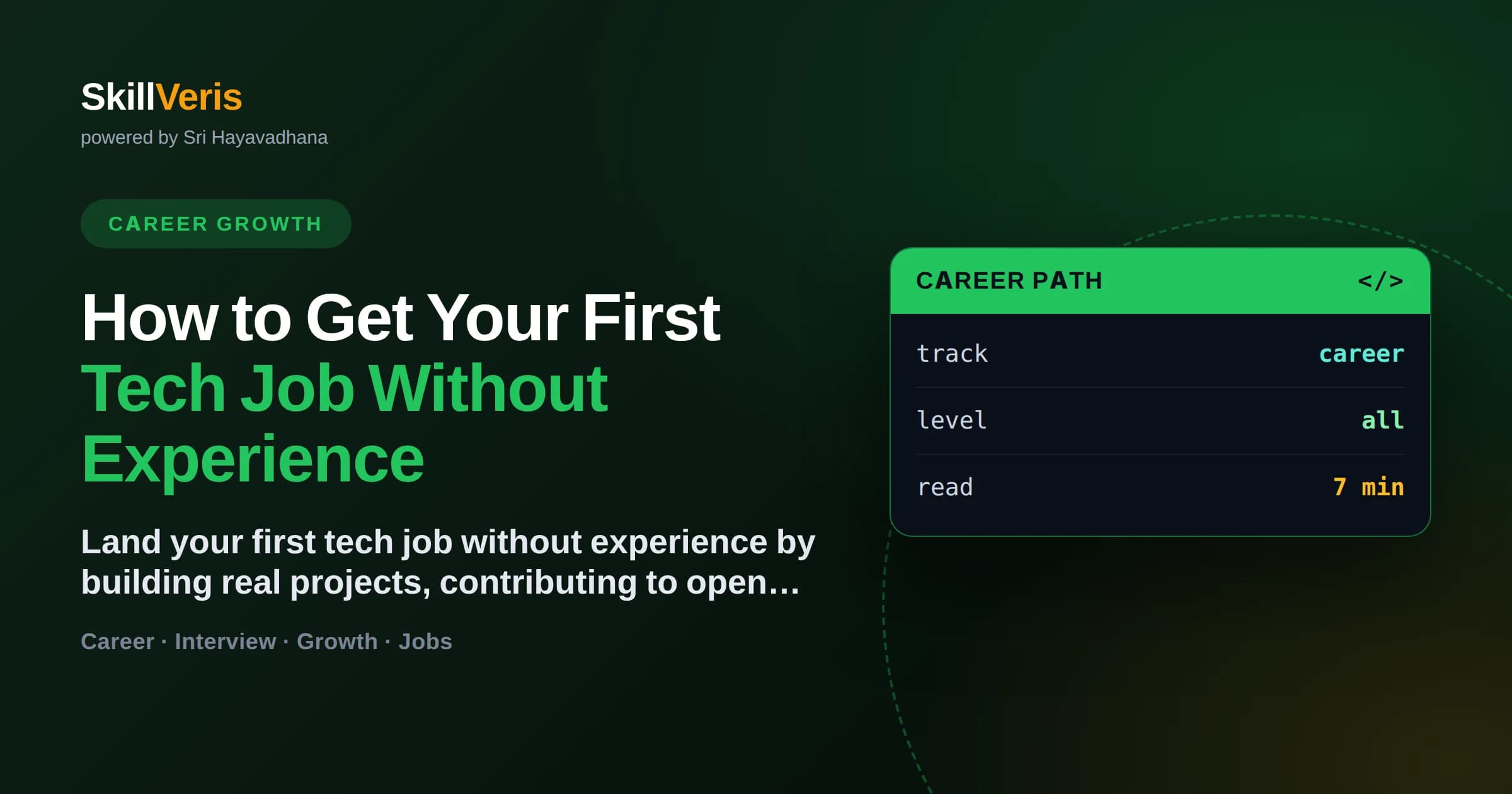
Get your first tech job without experience by building real projects that prove your skills, contributing to open source, networking genuinely, and tailoring applications to each role.
In this guide, you'll learn:
- A portfolio of working projects is the experience employers actually want — build the proof yourself.
- Open-source contributions turn 'no experience' into real collaboration on production codebases.
- Most first jobs come through people, not job boards, so networking is a core part of the search.
- Tailoring each application to the role beats mass-applying with a generic resume.
1How to Get Your First Tech Job Without Experience
You land your first tech job without professional experience by manufacturing your own proof: build real projects that demonstrate your skills, contribute to open source, network with people in the field, and tailor each application to the role. Employers hiring juniors are buying potential and evidence of ability, not a long resume — and a portfolio of working code is the strongest evidence you can offer.
The classic frustration is that every job seems to want experience you cannot get without a job. The way through is to stop waiting for permission and start creating experience on your own terms. Every project you ship, every open-source pull request you merge, and every genuine connection you make chips away at the experience gap until it no longer holds you back.
2Build a Portfolio of Real Projects
A portfolio is the single most persuasive asset for a candidate without experience, because it shows what you can do rather than merely claiming it. Two or three polished projects that solve real problems beat a dozen half-finished tutorials, and they give interviewers concrete work to discuss.
Prioritize depth and originality. Anyone can follow a to-do-list tutorial; a project that reflects your own idea, handles real data, and is deployed live signals genuine capability. Put the code on a public repository with a clear README so employers can explore how you think and write.
- Choose projects that solve a real problem you or someone you know actually has.
- Deploy them live so employers can click through, not just read code.
- Write a clear README explaining what it does, why, and how to run it.
- Show range — a couple of different project types beats five clones of one idea.
🔑Key Insight
Your portfolio is your experience. When you cannot point to a job title, point to shipped, working software — it answers 'can this person actually build things?' better than any bullet point.
3Contribute to Open Source
Open-source contributions are a powerful way to gain real-world experience on production codebases before anyone hires you. Working within an existing project teaches you to read unfamiliar code, follow contribution guidelines, and collaborate through pull requests and reviews — exactly the skills a first job demands.
Start small and build up. Fixing documentation, closing beginner-friendly issues, and adding tests are legitimate contributions that get your name into real projects. Over time these merged pull requests become concrete, verifiable evidence that you can work the way professional teams work.
Where to Begin
Lower the barrier by targeting projects and issues meant for newcomers.
Look for issues labeled 'good first issue' or 'beginner friendly.'
Improve documentation — a valued and approachable first contribution.
Read the contributing guide before opening a pull request.
Engage respectfully with maintainers and act on their feedback.4Network Genuinely
A large share of first jobs come through people rather than public job boards, which makes networking a core part of the search rather than an optional extra. A referral moves your application to the top of the pile and gives a hiring manager a reason to look closely.
Networking does not mean asking strangers for jobs. It means building real relationships: sharing what you are learning, helping others, attending meetups, and engaging thoughtfully in developer communities. Done sincerely, it creates a network that thinks of you when opportunities appear.
💡Pro Tip
Share your learning journey publicly — posts about projects and problems you solved. It attracts opportunities passively, because people can see your skills and enthusiasm without you asking for anything.
5Tailor Every Application
Mass-applying with a generic resume is one of the least effective strategies, especially without experience. Tailoring each application to the specific role — mirroring its keywords, highlighting the most relevant projects, and writing a short, genuine note — dramatically improves your odds even against more experienced applicants.
Just as important: apply even when you do not meet every requirement. Job descriptions are wish lists, and if you meet most of them you are a legitimate candidate. Screening yourself out of roles you could grow into is a mistake many beginners make without realizing it.
- Match your resume language to the skills the job description emphasizes.
- Surface the projects most relevant to that particular role.
- Add a brief, specific note on why this company and role appeal to you.
- Apply if you meet most requirements — you rarely need every single one.
6Keep Learning and Show It
Demonstrating that you learn quickly and consistently reassures employers who worry about your lack of experience. Visible, ongoing growth — new projects, new skills, and reflection on what you have learned — signals that you will ramp up fast once hired.
Structured learning helps you fill gaps methodically rather than randomly. Working through a focused curriculum, whether a course or a self-directed track, gives you both the skills and the artifacts to prove them. What matters is that your progress is visible to anyone who looks.
7Common Mistakes to Avoid
Beginners often undermine an otherwise good search in predictable ways. Avoiding them keeps your momentum intact.
- Waiting until you feel 'ready' instead of applying and building in parallel.
- Filling a portfolio with identical tutorial clones that show no originality.
- Applying only through job boards and ignoring networking entirely.
- Sending the same generic resume to every posting.
- Skipping roles because you do not meet every listed requirement.
⚠️Watch Out
Perfectionism is a trap. Waiting until you know everything before applying means never applying. You will keep learning on the job — employers expect it. Apply while you build, not after.
8Key Takeaways
Breaking in without experience rests on creating your own proof.
- Build two or three real, deployed projects — your portfolio is your experience.
- Contribute to open source to gain production-style collaboration on your record.
- Network genuinely, since most first jobs come through people.
- Tailor every application and apply even when you meet only most requirements.
- Keep learning visibly so employers see your speed and momentum.
9Frequently Asked Questions
Q: How many projects should be in my portfolio? A: Two or three strong, polished projects generally outweigh a large number of shallow ones. Aim for work that solves a real problem, is deployed live, and shows some range. Interviewers care more about depth and originality than about sheer count.
Q: Do I need a computer science degree? A: No. Many developers enter the field through self-teaching, bootcamps, or online courses. Employers hiring juniors care most about demonstrated ability — projects, open-source work, and problem-solving — rather than a specific credential. A degree can help but is far from required.
Q: Should I apply if I do not meet every requirement? A: Yes. Job descriptions are wish lists, and meeting most of the requirements makes you a legitimate candidate. Many strong hires did not tick every box. Screening yourself out of roles you could grow into is a common and costly mistake.
Q: How important is networking really? A: Very. A large share of first jobs come through referrals and personal connections rather than cold applications. Genuine relationships and a visible learning presence often open doors that job boards never will, so treat networking as a core part of your search.
Get The Print Version
Download a PDF of this article for offline reading.
About the Publisher
SkillVeris Team
Careers Team
Our careers team helps you navigate tech job markets, build portfolios, and land the roles you want.
View all postsRelated Posts
Never miss an update
Get the latest tutorials and guides delivered to your inbox.
No spam. Unsubscribe anytime.