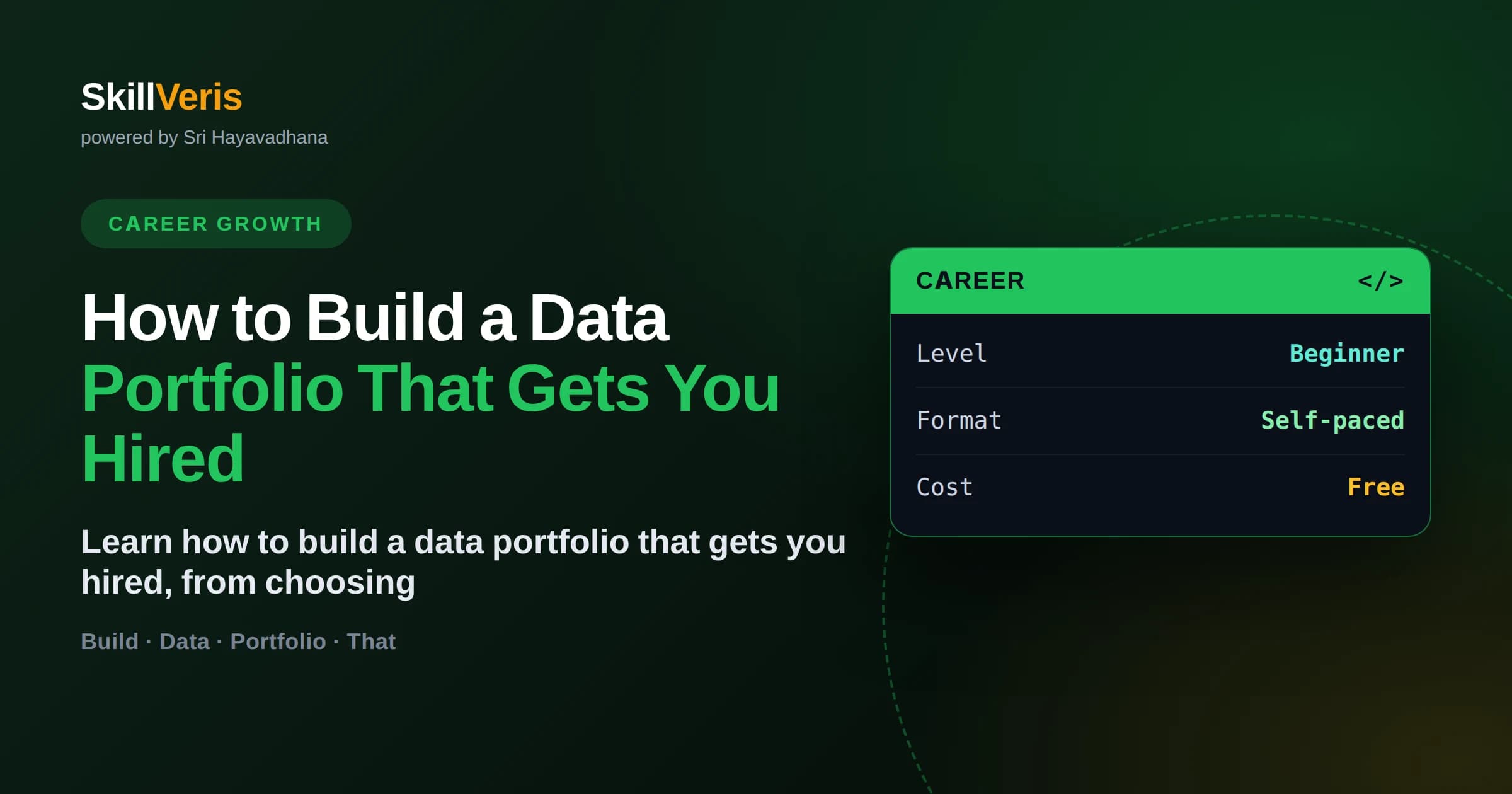
How to Build a Data Portfolio That Gets You Hired
SkillVeris Team
Careers Team
A focused portfolio of three to four strong projects beats a long list of shallow ones.
In this guide, you'll learn:
- The best projects answer a real question and end with a decision, not just a chart.
- Storytelling is what separates a memorable portfolio from a folder of notebooks.
- GitHub and a simple project write-up make your work reviewable and credible to hiring managers.
- Using messy, real-world data shows you can handle the parts of the job tutorials skip.
1What Makes a Data Portfolio That Gets You Hired?
A data portfolio gets you hired when it proves you can turn a real question into a clear, defensible decision, using three or four well-told projects hosted where employers can review them. Hiring managers trust demonstrated work far more than a list of courses, because a portfolio shows the judgment and communication the job actually requires.
The mistake most beginners make is treating a portfolio as a collection of finished tutorials. Recruiters have seen the same Titanic and iris datasets a thousand times, and a copied notebook proves little. What stands out is original, imperfect, real work where you clearly owned the thinking.
This guide shows you how to choose projects that impress, tell their story well, and host them so a busy reviewer can see your value in minutes.
2Why a Portfolio Beats a Resume Line
A resume claims you can analyze data; a portfolio proves it. That difference matters most for career switchers and juniors who lack a track record of paid analytics work, but it helps everyone.
When a hiring manager can click into a project, follow your reasoning, and see a sound recommendation, the uncertainty of hiring you drops sharply. You have effectively given them a work sample before the interview, which is exactly what makes you easier to say yes to.
3Choosing the Right Projects
Project selection is the highest-leverage decision in your portfolio. Aim for variety that shows range and for topics you genuinely care about, since your interest shows in the depth of the work.
A well-rounded portfolio typically includes the following kinds of projects. You do not need all of them, but a spread signals versatility.
- An end-to-end analysis: a question, data cleaning, exploration, and a recommendation.
- A dashboard: an interactive Power BI or Tableau view that a stakeholder could actually use.
- A SQL-heavy project: answering business questions against a realistic database.
- A domain project: something tied to a field you know, showing subject-matter insight.
- Optionally, a statistical or predictive piece: an A/B test analysis or a simple model, clearly explained.
4Use Real, Messy Data
Clean tutorial datasets hide the hardest and most valuable part of the job: wrangling messy, incomplete, real-world data. Using genuine data instantly separates your portfolio from the crowd.
Pull from public sources like government open-data portals, public APIs, Kaggle's less-common datasets, or data you can scrape ethically. When you show how you handled missing values, inconsistent formats, and duplicates, you demonstrate the exact skills employers struggle to find. Document those decisions, because how you clean data reveals your judgment.
💡Pick questions you care about
A project about your local sports team, a hobby, or an issue you follow will be more original and more engaging than another generic dataset. Genuine curiosity produces better analysis.
5Telling a Clear Story
Technical skill gets you noticed; storytelling gets you hired. A portfolio full of charts without narrative forces the reviewer to do the interpreting, and most will not bother.
Structure every project as a story: the question you set out to answer, why it matters, what you did, what you found, and what you would recommend. Lead with the insight rather than saving it for the end, and use visuals to support the point rather than to decorate the page. The goal is that a non-technical reader finishes understanding both your finding and its implication.
6Documenting Your Process
Reviewers care about how you think, not just your final answer. Clear documentation lets them follow your reasoning and trust your conclusions.
For each project, write a short README that states the question, the data source, your approach, the tools used, and the key finding. Comment your code so it reads like an explanation, not a puzzle. This habit also prepares you for the interview, where you will be asked to walk through exactly these decisions.
🔑The README is the front door
Many reviewers read only your README before deciding whether to look deeper. A crisp summary with the question, method, and headline finding earns the click into your code.
7Hosting on GitHub and the Web
Your work needs a home that is easy to share and review. GitHub is the standard for hosting analysis code and notebooks, and it doubles as proof that you use industry tooling.
Create a clean repository per project with a clear name and a strong README, and pin your best repositories to your GitHub profile. For dashboards, publish to Tableau Public or share a Power BI link so reviewers can interact without installing anything. Consider a simple personal site or a single portfolio page that links everything together, so one URL tells your whole story.
8Presenting the Portfolio to Employers
A great portfolio only helps if people see it. Make it effortless to find and impossible to ignore.
Put the portfolio link in your resume header, your LinkedIn featured section, and your job applications. When you reference a project in an interview or cover letter, link directly to it. The easier you make it for a hiring manager to view your best work, the more that work does on your behalf.
9Mistakes That Weaken a Portfolio
A few avoidable errors quietly cost people interviews. Steer clear of these and your portfolio will already be ahead of most.
The common ones are copying tutorial projects without adding original thinking, including too many shallow projects instead of a few deep ones, presenting charts with no narrative or recommendation, and leaving repositories messy and undocumented. Fix these and each project pulls its full weight.
10Frequently Asked Questions
Is a data analytics course really free? Yes. SkillVeris offers free data analytics courses and study notes, so you can learn the SQL, visualization, and analysis skills to build every portfolio project at no cost.
How many projects should a data portfolio have? Three to four strong, well-documented projects are ideal. A few deep projects with clear storytelling outperform a long list of shallow ones.
Where can I find data for portfolio projects? Government open-data portals, public APIs, Kaggle, and ethically scraped web data are all good sources. Real, messy data is more impressive than clean tutorial sets.
Do I need to know machine learning for a data analyst portfolio? No. A strong analyst portfolio can rely on SQL, visualization, and clear analysis. A simple, well-explained statistical piece is a bonus, not a requirement.
Should I host my portfolio on GitHub? Yes, for code and notebooks. GitHub is the industry standard and signals you use professional tooling; pair it with Tableau Public or a Power BI link for dashboards.
How long does it take to build a portfolio? With consistent effort, a solid three-project portfolio can come together in four to eight weeks. Prioritize depth and documentation over speed.
11Start Building Today
A data portfolio that gets you hired is not about flashy visuals; it is about proof. Choose a few real questions, work with messy data, tell a clear story that ends in a decision, and host it all where employers can easily review it. Each project becomes evidence that you can do the job.
You do not need to wait until you feel ready. Start your first project this week and build the underlying skills for free with the data analytics courses and study notes on SkillVeris. The portfolio grows one honest project at a time, and so does your confidence walking into interviews.
Related Reading
Get The Print Version
Download a PDF of this article for offline reading.
About the Publisher
SkillVeris Team
Careers Team
Our careers team helps you navigate tech job markets, build portfolios, and land the roles you want.
View all postsRelated Posts
Never miss an update
Get the latest tutorials and guides delivered to your inbox.
No spam. Unsubscribe anytime.