How to Become a Data Analyst With No Experience
SkillVeris Team
Careers Team
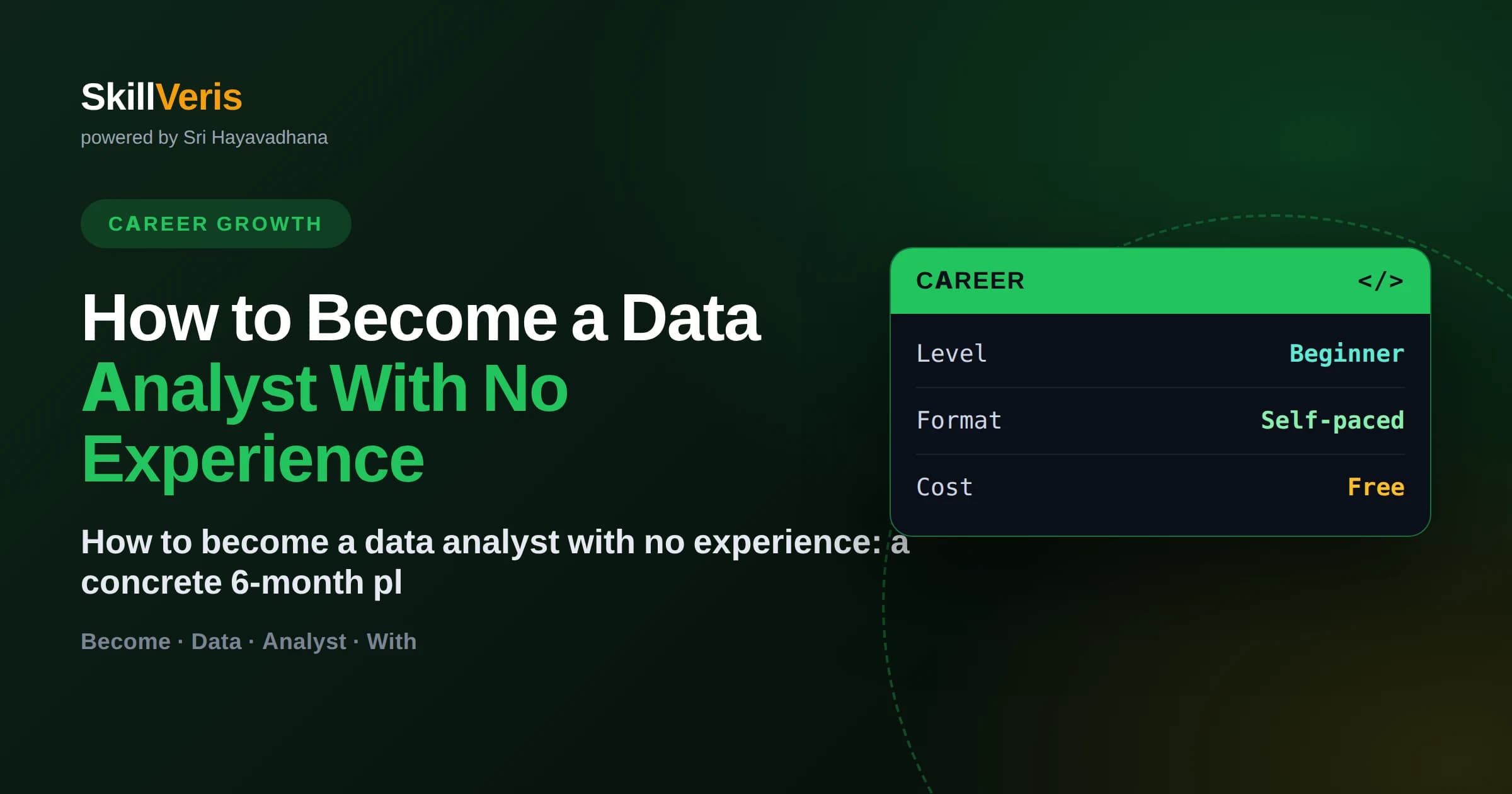
You can become a job-ready data analyst with no prior experience in about six months of focused, consistent study and practice.
In this guide, you'll learn:
- The core toolkit is compact: spreadsheets, SQL, a visualization tool like Tableau or Power BI, and basic statistics.
- Projects using real, messy public data are what actually build skill and prove it to employers, far more than certificates.
- A portfolio of three to five polished projects with clear write-ups is your single most powerful job-search asset.
- You do not need a computer science or math degree; you need demonstrable skills and the ability to communicate insights.
1Can You Become a Data Analyst With No Experience?
Yes, you can become a job-ready data analyst with no prior experience in roughly six months of focused effort, because the role rewards demonstrable skills over formal credentials. Data analysis is one of the most accessible entry points into tech: the core tools are learnable free, the work is in high demand, and a strong project portfolio can outweigh the lack of a degree or past job title.
The path is not effortless, but it is clear. You learn a compact set of tools, practice on real data, build projects that prove your ability, and package them into a portfolio that gets you interviews. Thousands of people switch into this field every year from unrelated backgrounds.
This article lays out a concrete six-month plan, the exact skills you need, how to build convincing projects, and how to run a job search when your resume has no analyst experience on it yet.
2What a Data Analyst Actually Does
Before diving in, it helps to know the job. A data analyst collects, cleans, and examines data to answer business questions and guide decisions, then communicates the findings clearly to people who are not analysts. The role is part detective, part translator.
A typical day might involve pulling data with SQL, cleaning it, spotting a trend, building a chart or dashboard, and explaining what it means for the business in plain language. Notice that communication is half the job; the best analysts are not just technically skilled, they make their insights understood and acted upon.
3The Skills You Actually Need
The required toolkit is smaller than beginners fear. You do not need to master everything in data science; you need a focused set of practical skills. Learn these well and you are genuinely employable as an analyst.
- Spreadsheets: Excel or Google Sheets for quick analysis, formulas, and pivot tables, still used everywhere.
- SQL: the language for pulling data from databases, and the single most important technical skill for analysts.
- Data visualization: a tool like Tableau or Power BI to turn numbers into clear charts and dashboards.
- Statistics basics: averages, distributions, correlation versus causation, and how to avoid misleading conclusions.
- Communication: explaining findings in simple, decision-focused language, both in writing and out loud.
- Optional but valuable: a little Python or R for more advanced cleaning and analysis.
4A Concrete 6-Month Plan
Here is a realistic month-by-month roadmap assuming you can commit around ten to fifteen hours a week. Adjust the pace to your life, but keep the sequence, because each stage builds on the last.
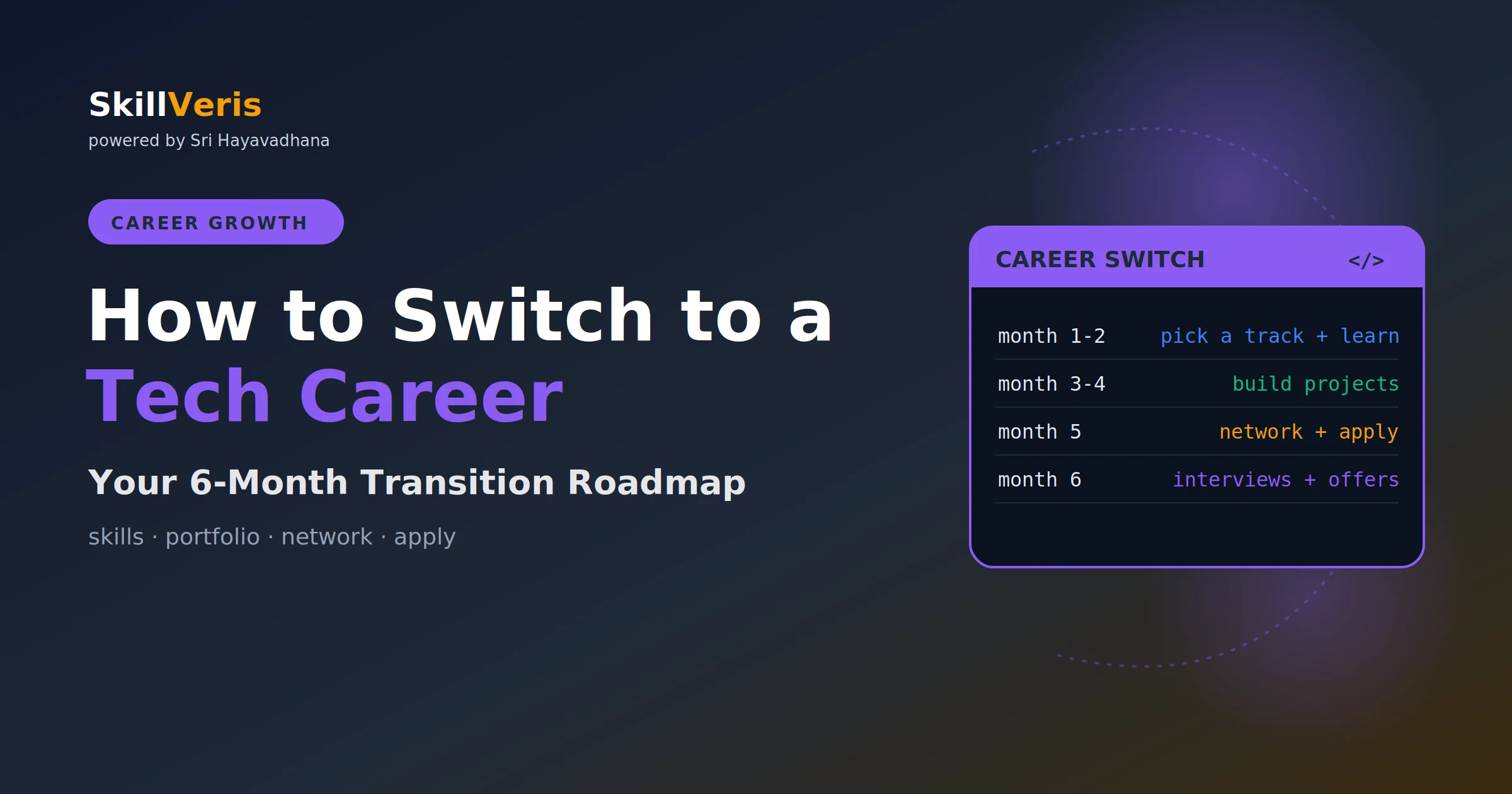
Months 1-2: foundations
Master spreadsheets and start SQL. Learn to write SELECT queries, filter, join tables, and aggregate. Alongside, learn basic statistics: mean, median, distributions, and correlation. Do lots of small exercises so the fundamentals become second nature.
Months 3-4: visualization and first projects
Learn Tableau or Power BI and build your first two portfolio projects using real public datasets. Focus on the full cycle: get messy data, clean it, analyze it, visualize it, and write up what you found and why it matters.
Months 5-6: polish, portfolio, and job search
Add one or two stronger projects, optionally introducing basic Python. Polish your portfolio and write-ups, build a focused resume and LinkedIn profile, practice common interview questions, and start applying while continuing to sharpen SQL.
5Learn by Doing, Not Just Watching
The biggest trap for career changers is tutorial hell, where you watch course after course but never build anything yourself. Watching feels like progress but does not create skill or evidence of it. Real learning happens when you struggle through a messy dataset on your own.
As a rule, for every hour you spend learning a concept, spend at least an hour applying it to real data. The friction of cleaning imperfect data, deciding what to analyze, and interpreting results is exactly where the durable skill forms. Employers can tell the difference between someone who watched courses and someone who has actually wrestled with data.
⚠️Avoid tutorial hell
Endlessly watching courses without building projects feels productive but teaches little. Balance every hour of learning with an hour of hands-on practice on real datasets.
6Building Projects That Impress
Projects are the heart of your job search because they prove you can do the work. The best projects use real, messy public data and answer a genuine question, mirroring what analysts actually do. Sources like government open-data portals, Kaggle, and public APIs give you endless material for free.
Aim for a project that tells a story: here was the question, here is the data I used, here is how I cleaned and analyzed it, and here is what I found and why it matters. A dashboard analyzing local housing trends, an exploration of a public health dataset, or an analysis of a company's simulated sales data all work well. Depth and a clear narrative beat flashy but shallow charts.
7Assembling Your Portfolio
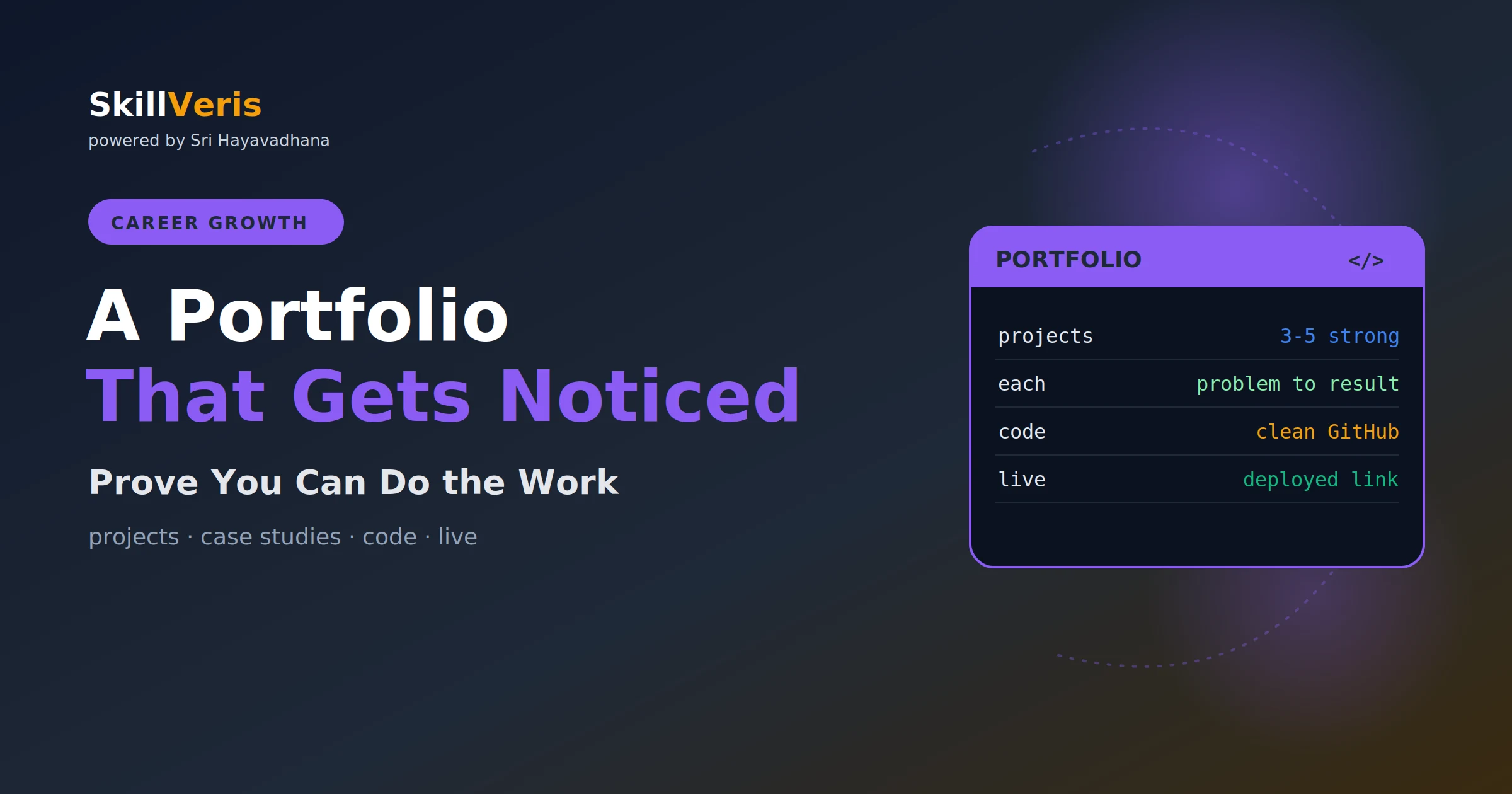
Collect three to five of your best projects into a portfolio that a hiring manager can browse in a few minutes. This is where you replace the missing line on your resume with concrete proof. Host it somewhere simple, such as a personal site, a GitHub profile, or a Tableau Public page.
For each project, write a short, plain-language summary of the question, your approach, and your key finding, alongside the visuals. Do not assume the reader will dig through your code; lead with the insight. A well-presented portfolio of solid projects is more persuasive than any certificate and often the reason you get an interview.
💡Lead with the insight
Hiring managers skim. For each portfolio project, put the business question and your key finding first, then the visuals, then the technical detail for those who want it.
8Running the Job Search
When you start applying, tailor your approach to the fact that you are switching careers. Emphasize transferable skills from your past work, such as problem-solving, attention to detail, and communication, and let your portfolio carry the technical proof. Do not wait until you feel fully ready; apply while you are still improving.
Look for entry-level, junior, and adjacent titles like reporting analyst, business analyst, or operations analyst, not just 'data analyst'. Network genuinely by sharing your projects and learning publicly, since referrals dramatically improve your odds. Expect rejection as part of the process and treat each interview as practice that sharpens the next one.
9Common Mistakes to Avoid
A few predictable errors slow people down. Being aware of them helps you move faster than most beginners who make them all.
- Collecting certificates instead of building projects, when employers weigh projects far more heavily.
- Trying to learn everything, including advanced machine learning, before applying, instead of focusing on the core analyst toolkit.
- Neglecting communication and treating the job as purely technical, when explaining findings is half the role.
- Using only clean, pre-packaged tutorial datasets that hide the messy reality of real analysis.
- Waiting to feel one hundred percent ready before applying, which means never applying at all.
10Frequently Asked Questions
How long does it take to become a data analyst with no experience? With focused, consistent effort of around ten to fifteen hours a week, most people can become job-ready in about six months. The exact timeline depends on your pace, your starting point, and how much you build rather than just study.
Do I need a degree to become a data analyst? No, a specific degree is not required. Many analysts come from unrelated backgrounds, and employers increasingly prioritize demonstrable skills and a strong project portfolio over formal credentials, especially for entry-level roles.
What skills do I need to learn first? Start with spreadsheets and SQL, since SQL is the most important technical skill for analysts. Then add a visualization tool like Tableau or Power BI and basic statistics, and always practice communicating your findings clearly.
Do I need to know Python to get a data analyst job? Not necessarily. Many data analyst roles rely mainly on SQL, spreadsheets, and a visualization tool. Python is a valuable bonus that expands your options, but you can land your first analyst job without it.
How do I get experience if no one will hire me? Build it yourself through projects using real public datasets. A portfolio of three to five well-documented projects demonstrates real skill and substitutes for job experience, which is exactly what gets career changers their first interviews.
Is data analysis a good career for beginners? Yes. It is one of the most accessible entry points into tech, with strong demand, a learnable core toolkit, and clear paths to grow into roles like senior analyst, data scientist, or analytics engineer over time.
11Conclusion and Next Steps
Becoming a data analyst with no experience is a realistic, well-trodden path: learn a compact toolkit, practice relentlessly on real data, build a portfolio that proves your skill, and apply before you feel perfectly ready. Six months of consistent, project-driven effort can genuinely take you from zero to your first analyst role.
You can follow this entire plan for free on SkillVeris, with courses and study notes on SQL, spreadsheets, statistics, and data visualization that walk you through the skills and projects step by step. Pick a start date, commit to a weekly rhythm, and begin building your first project this week.
Related Reading
Get The Print Version
Download a PDF of this article for offline reading.
About the Publisher
SkillVeris Team
Careers Team
Our careers team helps you navigate tech job markets, build portfolios, and land the roles you want.
View all postsRelated Posts
Never miss an update
Get the latest tutorials and guides delivered to your inbox.
No spam. Unsubscribe anytime.