How to Avoid Burnout as a Developer
SkillVeris Team
Careers Team
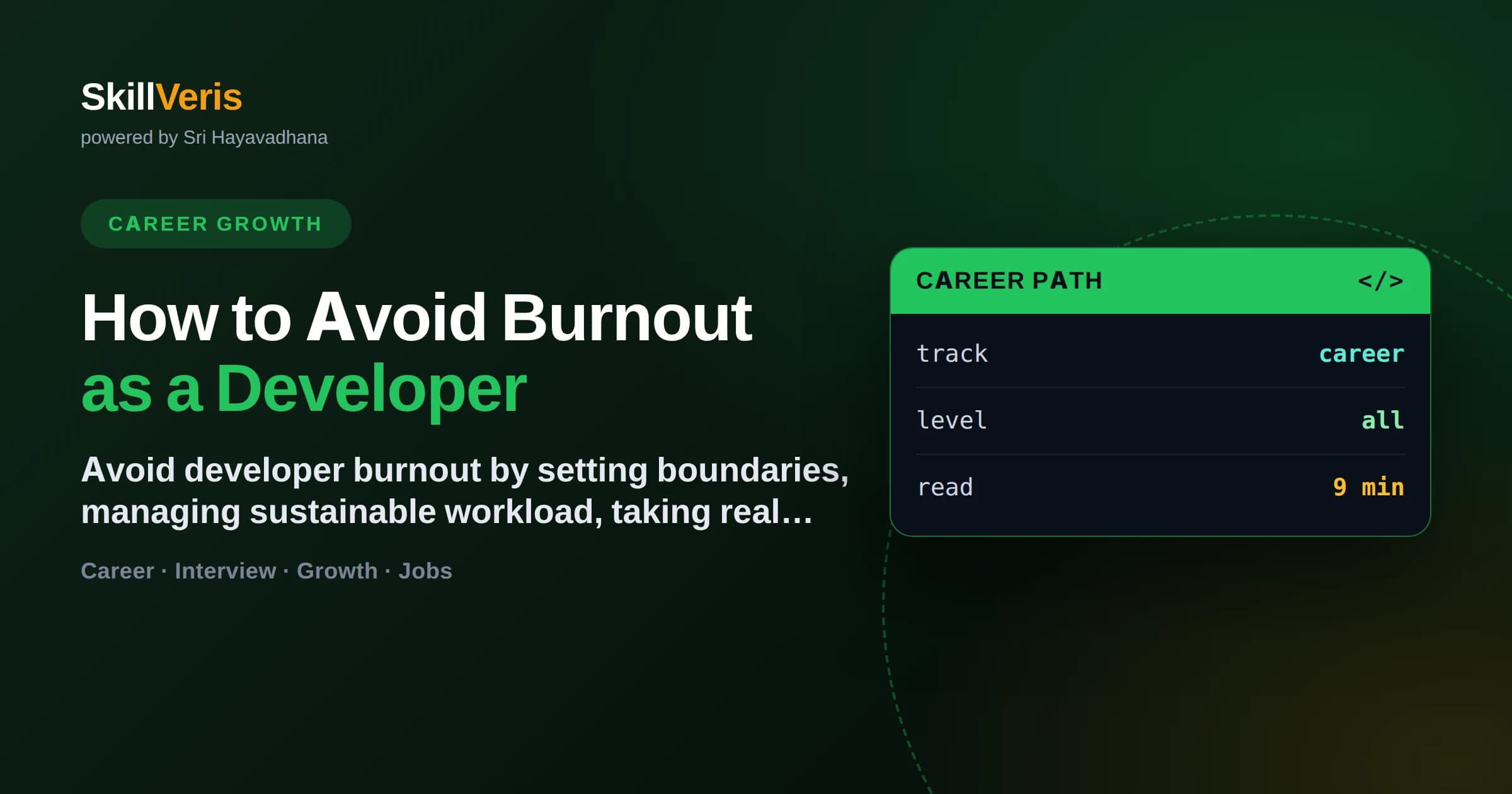
Avoid burnout by protecting boundaries, keeping workload sustainable, and treating rest as part of the job, not a reward for finishing it.
In this guide, you'll learn:
- Burnout is chronic, not a single bad week — watch for cynicism, exhaustion, and a creeping sense that your work no longer matters.
- Sustainable pace beats heroic sprints; consistent moderate effort ships more over a career than repeated crunch.
- Real breaks mean genuinely disconnecting — not scrolling code discussions during your time off.
- Say no and negotiate scope; constantly absorbing every request is a fast path to exhaustion.
1How to Avoid Developer Burnout
You avoid burnout as a developer by keeping your workload sustainable, setting firm boundaries between work and rest, taking real breaks, and noticing the early warning signs before exhaustion becomes chronic. Burnout is not the same as being tired after a hard week — it is a prolonged state of emotional exhaustion, cynicism, and reduced effectiveness that builds over months of unsustainable pressure.
Preventing it matters because burnout is far easier to avoid than to recover from. Once it sets in, it can take a long time to heal and often costs people jobs, projects, and their love of the craft. Treating your own capacity as a finite resource to manage — not an infinite one to spend — is the core skill.
2Recognise the Warning Signs Early
Burnout rarely arrives all at once; it creeps in. Learning to spot the early signals gives you time to correct course before you hit a wall. Pay attention when these patterns persist beyond a stressful week or two.
- Exhaustion that sleep no longer fixes.
- Growing cynicism or detachment from work you used to enjoy.
- Dreading tasks that once felt manageable or interesting.
- Reduced output despite working the same or longer hours.
- Irritability, trouble concentrating, or physical symptoms like headaches.
⚠️Watch Out
If you no longer care about the quality of your work and feel constantly drained, that is not laziness — it is a warning sign worth taking seriously.
3Work at a Sustainable Pace
A software career is a long game, and consistent moderate effort beats repeated heroic sprints. Crunch periods may occasionally be unavoidable, but when overtime becomes the norm, productivity actually falls as fatigue accumulates and mistakes multiply. The developers who last treat a steady, sustainable pace as a professional discipline, not a lack of ambition.
Tired brains write buggy code and make poor decisions, so pushing past your limits often produces less usable work, not more. Guarding your pace is not slacking — it is how you keep shipping quality work year after year instead of flaming out.
🔑Reframe It
Rest is not the reward for finishing the work. It is part of the work — the thing that lets you keep doing it well over a whole career.
4Set and Defend Boundaries
Clear boundaries between work and the rest of your life are one of the strongest protections against burnout, especially with remote work blurring the lines. Decide when your workday ends and hold to it. Turn off notifications after hours so work cannot quietly follow you into every evening and weekend.
- Define start and stop times, and actually stop.
- Silence work chat and email notifications outside working hours.
- Keep a physical or ritual separation between work and rest, even at home.
- Protect weekends as genuine recovery time whenever possible.
5Take Real Breaks
A break only restores you if you genuinely disconnect. Scrolling technical discussions or half-checking messages during your time off keeps your mind at work and defeats the purpose. Build in short daily pauses, longer weekly downtime, and real vacations where you fully unplug — these are what let your mind recover and often where your best ideas surface.
Breaks That Actually Recharge
Effective rest is active disconnection, not passive proximity to work.
Step away from the screen entirely during lunch, not just switch tabs.
Move your body — a walk resets attention better than more sitting.
Take real vacations and leave work devices behind.
Protect a hobby that has nothing to do with computers.6Manage Workload and Learn to Say No
Much burnout comes from absorbing more than any one person can carry. Learning to say no, negotiate scope, and push back on unrealistic deadlines is a core professional skill, not insubordination. When new work lands on an already-full plate, make the trade-offs visible: ask what should be deprioritised rather than silently trying to do everything.
- Make your capacity visible instead of quietly overcommitting.
- Negotiate scope and timelines rather than accepting every deadline.
- Ask 'what should I drop?' when new work arrives on a full plate.
- Delegate and ask for help before you are underwater.
7Protect the Fundamentals
Sleep, movement, nutrition, and relationships are the foundation of resilience, and they are the first things sacrificed under pressure. Guarding them is not indulgence — it is maintenance. A rested, active developer with interests and connections outside code recovers from stress far faster than one whose entire identity and schedule revolve around work.
8Common Mistakes to Avoid
These patterns quietly accelerate burnout.
- Treating constant overtime as normal or as a badge of honour.
- Ignoring early warning signs until you hit a full wall.
- Never fully disconnecting, so work bleeds into all your time.
- Tying your entire identity to your job and output.
- Waiting for permission to rest instead of building it into your routine.
9Key Takeaways
Protect yourself over the long run with these principles.
- Watch for early signs — exhaustion, cynicism, and dropping output.
- Work at a sustainable pace; steady effort beats repeated crunch.
- Set and defend clear boundaries between work and rest.
- Take breaks where you genuinely disconnect from work.
- Say no, manage scope, and protect sleep, movement, and life outside code.
10Frequently Asked Questions
Q: What is the difference between burnout and just being tired? A: Tiredness usually lifts after rest, while burnout is a chronic state of exhaustion, cynicism, and reduced effectiveness that persists for weeks or months regardless of sleep. If time off no longer restores you and you feel detached from work you once enjoyed, that points to burnout rather than ordinary fatigue.
Q: Can I recover from burnout without quitting my job? A: Often, yes, especially if you catch it early and can change what caused it — reducing workload, resetting boundaries, and taking real recovery time. Sometimes deeper changes to the role or environment are needed, but leaving is not always required, particularly when a supportive manager can help adjust the conditions.
Q: Is burnout a sign of weakness? A: No. Burnout results from prolonged unsustainable pressure, and it affects capable, dedicated people, often the most committed ones. Treating it as a systemic and workload issue rather than a personal failing is the healthier and more accurate framing.
Q: How do I take breaks when there is always more work? A: There is always more work, so waiting for it to end guarantees no rest. Schedule breaks and downtime deliberately and treat them as non-negotiable, the same way you would a meeting. Sustainable output over time depends on it, and rested work is usually better work.
Get The Print Version
Download a PDF of this article for offline reading.
About the Publisher
SkillVeris Team
Careers Team
Our careers team helps you navigate tech job markets, build portfolios, and land the roles you want.
View all postsRelated Posts
Never miss an update
Get the latest tutorials and guides delivered to your inbox.
No spam. Unsubscribe anytime.