How to Ask for a Raise as a Developer
SkillVeris Team
Careers Team
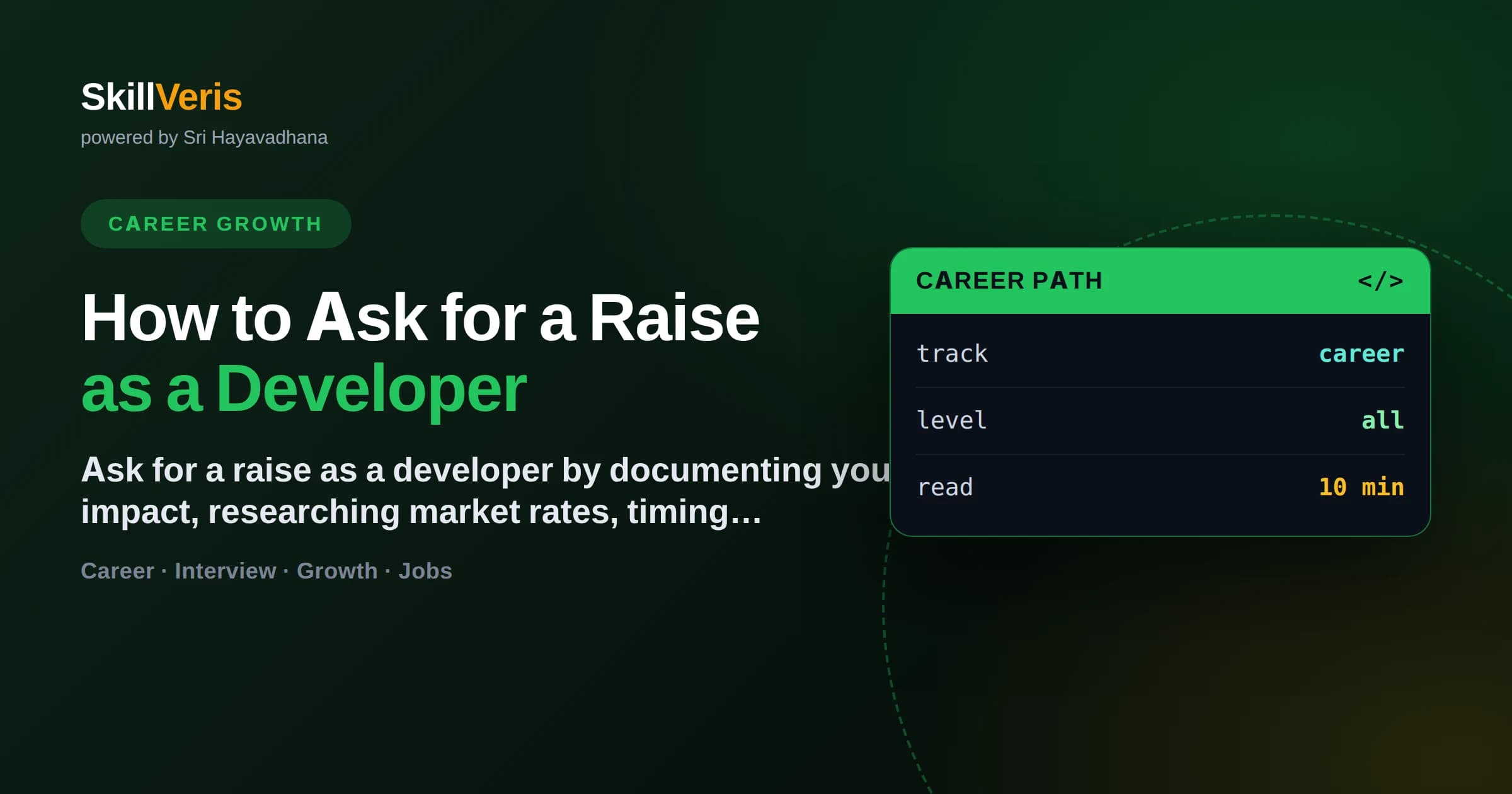
Ask for a raise by presenting documented impact and market data, then making a specific number request — not a vague hope.
In this guide, you'll learn:
- Build the case before the conversation: keep a running record of shipped work, outcomes, and expanded scope.
- Research current market rates for your role and location so your number is grounded, not guessed.
- Timing matters: after a big win, at review cycles, or when you take on new responsibility.
- Frame the request around value you deliver, not personal expenses or how long you have stayed.
1How to Ask for a Raise as a Developer
To ask for a raise effectively, come prepared with three things: documented evidence of your impact, market data for your role, and a specific number. Then have a direct, professional conversation with your manager that frames the raise around the value you deliver. Asking is normal and expected — managers negotiate compensation regularly, and a well-prepared, respectful request rarely damages a relationship.
The developers who succeed at this are not the loudest; they are the best prepared. A raise conversation is essentially a case you build in advance. Walking in with concrete accomplishments and a researched figure turns an awkward ask into a straightforward business discussion.
2Build Your Case First
Before you say a word to your manager, assemble the evidence. The strongest raise requests rest on a clear record of impact — features shipped, problems solved, responsibilities that grew. Keep a 'brag document' throughout the year so you are never scrambling to remember what you did.
- List shipped projects and their business or user impact.
- Note times you unblocked others, mentored, or led an effort.
- Capture scope you have taken on beyond your original role.
- Gather any positive feedback from peers, leads, or customers.
- Translate technical work into outcomes a non-engineer would value.
💡Pro Tip
Start a brag document today, even if a raise is months away. Recording wins as they happen makes every future review and negotiation far easier.
3Research Your Market Rate
Your number needs an anchor in reality. Research what developers with your skills, experience, and location currently earn using salary aggregators, job postings, and conversations with peers in your network. This grounds your request in the market rather than in a feeling, and it gives you a defensible range to negotiate within.
Be realistic about the factors that shape pay: region, company size, industry, and remote versus on-site all move the number. A figure that is well outside the market for your context weakens your credibility, while a well-researched target signals that you have done your homework.
4Choose the Right Timing
When you ask matters almost as much as how you ask. The best moments are when your value is freshly visible or when the company is naturally reviewing compensation. Avoid asking during layoffs, hiring freezes, or immediately after a project you were part of went badly.
- Right after delivering a significant, visible win.
- During formal performance or annual review cycles.
- When you have taken on new responsibilities or a bigger role.
- When you have gathered clear evidence and market data — not on impulse.
- Avoid moments of company stress, such as freezes or restructuring.
5Have the Conversation
Request a dedicated meeting rather than raising it in passing. Open by stating that you would like to discuss your compensation, then present your impact and market data calmly and make a specific request. A precise number ('I would like to move to X') is far stronger than an open-ended 'can I get a raise?'
A Simple Script
Keep it direct, evidence-based, and unemotional. You are making a business case, not asking a favour.
State the purpose: 'I would like to discuss my compensation.'
Summarise impact: the projects, outcomes, and expanded scope.
Cite the market: 'For my role and experience, the range is around X.'
Make the ask: a specific number or range you are targeting.
Then pause and let your manager respond — silence is fine.6Frame It Around Value, Not Need
Anchor the conversation on the value you bring to the company, not your personal expenses. 'My rent went up' is not a business reason; 'I have taken on ownership of the payments system and shipped X' is. Managers can advocate for raises tied to impact, but personal costs put them in an awkward position and rarely move a budget.
🔑Reframe It
A raise is the company adjusting your pay to match the value you deliver. Make that value undeniable, and the number becomes a logical conclusion.
7Handle a 'No' Gracefully
If the answer is 'not right now,' treat it as the start of a plan, not the end of the conversation. Ask specifically what would justify a raise and by when. This turns a rejection into a concrete roadmap and a scheduled follow-up. If your value is clear and the company still cannot meet a fair market rate over time, that is useful information for your broader career decisions.
- Ask: 'What specific results would make a raise possible?'
- Agree on a timeline and a follow-up date.
- Get any commitments in writing where appropriate.
- Reflect on whether the role still fits your goals if 'no' becomes permanent.
8Common Mistakes to Avoid
A few missteps weaken even a deserved request.
- Asking with no evidence, relying on general 'I work hard' claims.
- Naming a number with no market research behind it.
- Framing the ask around personal expenses instead of value.
- Making it a threat or ultimatum without meaning it.
- Springing it on your manager in a hallway instead of a real meeting.
⚠️Watch Out
Only use a competing offer as leverage if you are genuinely willing to take it. Bluffing can backfire badly and erode trust with your manager.
9Key Takeaways
Approach the raise conversation with these principles.
- Document your impact continuously so the case is ready when you need it.
- Anchor your number in real market research for your role and region.
- Time the ask around wins, reviews, or expanded scope.
- Frame everything around value delivered, not personal need.
- Turn a 'no' into a concrete plan with clear targets and a follow-up date.
10Frequently Asked Questions
Q: How much of a raise should I ask for? A: Base your target on market research for your role, experience, and location rather than a fixed rule. Aim for a number that is ambitious but defensible given comparable pay and your documented impact, and be ready to explain how you arrived at it.
Q: Is it better to ask for a raise or change jobs? A: It depends. Internal raises are often smaller than the jump from switching companies, but staying preserves relationships, context, and stability. Try a well-prepared internal ask first; if the company repeatedly cannot meet fair market pay for your value, exploring the market is reasonable.
Q: What if I am nervous about asking? A: Preparation reduces nerves. Rehearse your case out loud, keep the framing on business value, and remember that compensation discussions are a normal part of every manager's job. A calm, evidence-based request is professional, not presumptuous.
Q: Should I mention a competing offer? A: Only if it is real and you would genuinely accept it. A truthful competing offer can be strong leverage, but using a fabricated one risks your credibility and could damage the relationship if your manager calls the bluff.
Get The Print Version
Download a PDF of this article for offline reading.
About the Publisher
SkillVeris Team
Careers Team
Our careers team helps you navigate tech job markets, build portfolios, and land the roles you want.
View all postsRelated Posts
Never miss an update
Get the latest tutorials and guides delivered to your inbox.
No spam. Unsubscribe anytime.