From Junior to Senior Developer: A Roadmap
SkillVeris Team
Careers Team
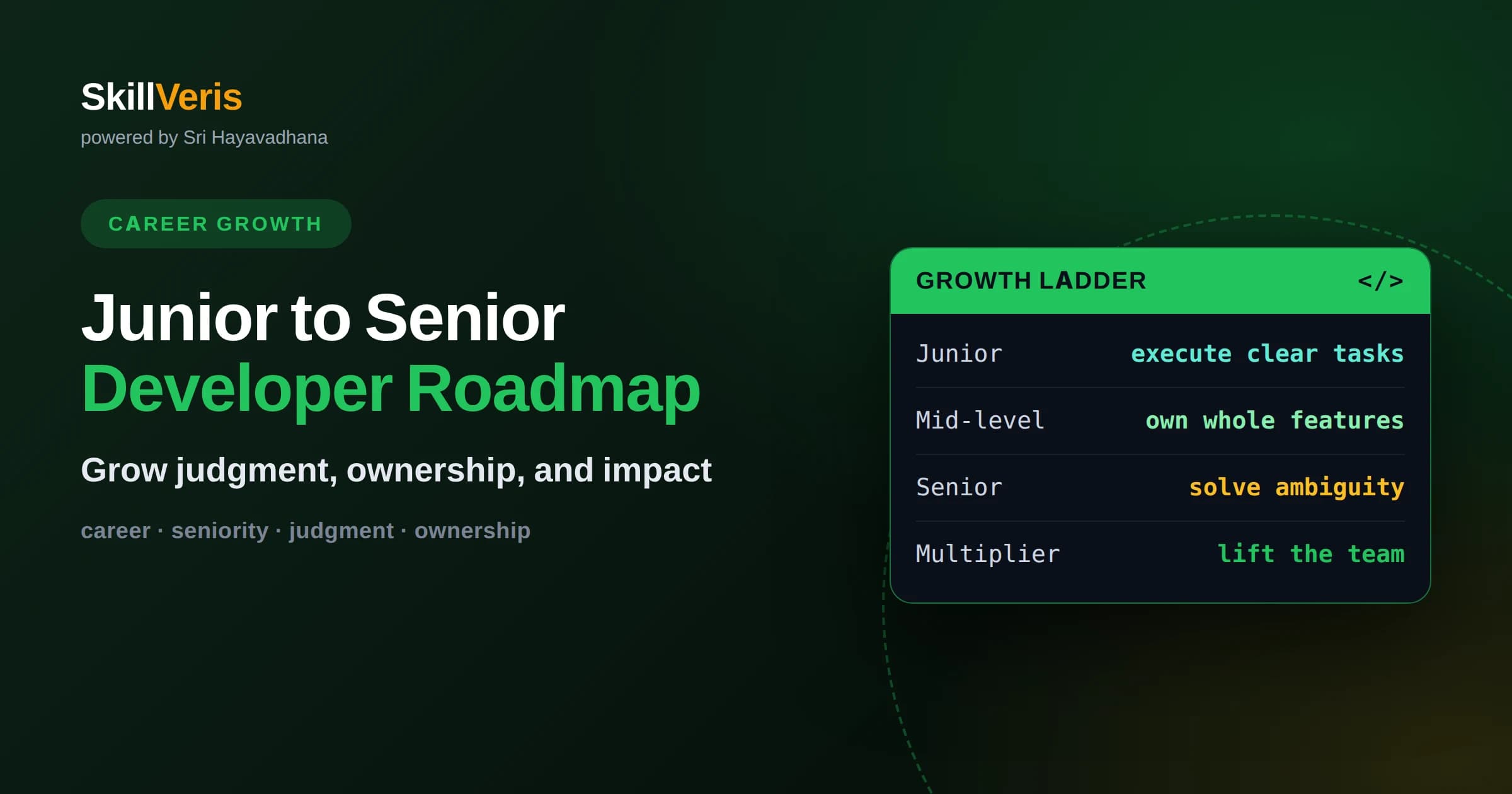
Seniority is defined by judgment, ownership, and impact, not by the number of years you have worked.
In this guide, you'll learn:
- Juniors execute defined tasks, mid-levels own features, and seniors solve ambiguous problems and lift the whole team.
- Communication and mentoring become as important as coding skill as you climb the ladder.
- Deliberately seeking bigger problems and broader responsibility accelerates the transition more than waiting for time to pass.
1What Actually Makes a Developer Senior
The path from junior to senior developer is fundamentally about growing your judgment, ownership, and impact, not simply accumulating years on the job. A senior developer is someone the team trusts to take an ambiguous, important problem and drive it to a good outcome with little supervision, while making the people around them better in the process. Time helps, but plenty of developers stall for years because they keep doing the same task rather than steadily taking on harder ones.
Seniority is measured by the scope of problems you can handle and the reliability with which you handle them. A junior needs a clearly defined task; a senior can take a vague business need, break it into a plan, anticipate the pitfalls, and deliver. This shift from execution to judgment is the heart of the journey.
Understanding this reframes how you should grow. Rather than counting years, focus on steadily increasing the ambiguity you can absorb and the responsibility you can carry. Each step up that ladder is what actually moves you toward senior, regardless of your title.
2The Junior Stage: Learn to Execute
As a junior, your primary job is to become reliable at executing well-defined tasks. You take a ticket with clear requirements and turn it into working, tested code that fits the team's conventions. Building this foundation of dependable execution is essential; you cannot handle ambiguity until you can handle clarity.
This stage is about absorbing as much as you can. Read the codebase, ask questions, study how experienced colleagues approach problems, and pay close attention to code review feedback. Every review is a free lesson, and juniors who internalize feedback quickly progress far faster than those who repeat the same mistakes.
Focus on fundamentals: writing clean code, understanding version control, testing your work, and debugging methodically. Resist the urge to chase every shiny new technology. A strong grasp of the basics is what everything else is built on, and it is what earns you the trust to take on more.
3Developing Technical Judgment
The single most important thing that separates senior developers is judgment: knowing which solution fits a given situation and why. Judgment grows from exposure to many problems, from seeing the consequences of decisions over time, and from reflecting on what worked and what did not. You cannot memorize it; you build it through experience examined thoughtfully.
Accelerate this by paying attention to trade-offs rather than just solutions. When you or a colleague chooses one approach, ask what alternatives existed and why this one won. Understanding the reasoning behind decisions, not just the decisions themselves, is how you develop the instincts that seniors rely on.
Learn from failures, both yours and others'. When something breaks in production or a design proves brittle, study why. These lessons stick precisely because they hurt, and a developer who mines their mistakes for insight grows judgment much faster than one who simply moves on.
4The Mid-Level Stage: Own Whole Features
Progressing to mid-level means you can take ownership of an entire feature, not just individual tickets. You translate a described need into a design, break it into tasks, implement it, handle the edge cases, and see it through to production. This end-to-end ownership is a major step up in responsibility and trust.
At this stage you start thinking beyond the immediate code to how your work affects the wider system, other teams, and future maintenance. You consider performance, reliability, and how your feature will evolve. This broader awareness is the seed of the systems thinking that defines senior work.
Mid-level is also where you begin to work more independently. You need less hand-holding, you unblock yourself more often, and you start to be a resource for juniors. Demonstrating that you can carry real responsibility reliably is what opens the door to the senior stage.
5Learning to Thrive in Ambiguity
Senior work is defined by ambiguity. Instead of a clear ticket, you receive a fuzzy goal, a business problem, or a vague complaint, and you must figure out what to actually build. Learning to structure ambiguous problems, ask the right questions, and propose a path forward is a defining senior skill.
Practice this by volunteering for underspecified problems and doing the work of clarifying them. Talk to stakeholders, define the real requirements, identify constraints, and turn the fog into a plan. The ability to convert uncertainty into a concrete direction is exactly what teams rely on seniors to provide.
Comfort with ambiguity also means being decisive despite incomplete information. Seniors gather enough context to make a reasonable choice, commit to it, and adjust as they learn more, rather than freezing in search of certainty that never arrives. Cultivating that decisiveness is a key part of the transition.
6Communication and Influence
As you become senior, communication grows as important as coding. You must explain technical decisions to non-technical stakeholders, write clear design documents, advocate for the right approach, and align people around a plan. A brilliant solution that you cannot communicate rarely gets adopted.
Influence, not authority, is how seniors get things done. You persuade through clear reasoning, credibility built over time, and genuine respect for others' perspectives. Learning to disagree constructively and build consensus is a skill that separates those who merely code from those who shape direction.
Invest deliberately in your writing and speaking. Practice explaining complex ideas simply, structuring arguments clearly, and listening well. These communication skills compound throughout your career and often matter more for advancement than any single technical ability.
7Lifting the People Around You
A true senior developer multiplies the team's effectiveness rather than just producing individual output. Mentoring juniors, giving thoughtful code reviews, sharing knowledge, and helping others get unblocked all amplify the whole team's results. This shift from personal productivity to team impact is central to seniority.
Mentoring also deepens your own understanding. Explaining a concept forces you to clarify it in your own mind, and answering others' questions exposes gaps you did not know you had. Teaching is one of the most effective ways to solidify and extend your expertise.
Look for opportunities to raise the team's standards. Improving documentation, championing better practices, and helping create a supportive learning culture all mark you as someone operating at a senior level. Employers value developers who make everyone around them better.
8Thinking in Systems, Not Just Code
Senior developers see the whole system, not just the piece in front of them. They understand how components interact, where the failure points are, how data flows, and how a change in one place ripples elsewhere. This holistic view lets them make decisions that keep the whole system healthy over time.
Build systems thinking by exploring beyond your immediate tasks. Study the architecture, understand the infrastructure, and learn how your product actually reaches users. The broader your mental model of the system, the better your decisions and the more valuable your perspective becomes.
Systems thinking also means weighing long-term consequences. Seniors consider maintainability, technical debt, and how choices made today will affect the team a year from now. Balancing immediate delivery against long-term health is a hallmark of mature engineering judgment.
9Taking Ownership Beyond Your Tasks
Ownership is a mindset that accelerates the climb to senior. It means caring about outcomes, not just completing assigned work; noticing problems and fixing them without being told; and treating the product's success as partly your responsibility. Developers who own outcomes stand out immediately.
This shows up in small ways: improving a flaky process, fixing a bug you happened to notice, or flagging a risk before it becomes a crisis. These acts of initiative demonstrate that you think like an owner, which is precisely the trust seniority requires.
Ownership does not mean doing everything yourself; it means taking responsibility for results and coordinating whatever is needed to achieve them. Balancing initiative with collaboration is how seniors drive impact without becoming bottlenecks.
10How to Accelerate the Transition
The developers who advance fastest do not wait passively for promotion; they deliberately seek out bigger problems and broader responsibility. Volunteer for challenging work slightly beyond your current level, ask for stretch assignments, and take on the ambiguous problems others avoid. Growth follows the challenges you accept.
Seek feedback relentlessly and act on it. Ask your manager and senior colleagues what would make you more effective and where your gaps are, then close those gaps intentionally. A tight loop of feedback and improvement compresses years of drifting into months of focused progress.
Make your growth visible and communicate your ambitions. Let your manager know you want to advance and ask what specifically would demonstrate readiness. Clear goals, backed by consistent delivery on harder work, turn the vague hope of promotion into a concrete plan.
11Avoiding the Career Plateau
Many developers plateau by repeating the same year of experience many times over. If your work stops challenging you and you rarely learn something new, you have likely stopped growing regardless of your tenure. Recognizing a plateau is the first step to escaping it.
Break out by deliberately stretching yourself: pick up an unfamiliar part of the system, take on a leadership responsibility, or tackle a problem that scares you a little. Discomfort is usually a sign of growth, and consistently reaching just beyond your current ability is what keeps you moving forward.
Beware of comfort disguised as mastery. Being the go-to person for one narrow area can feel like seniority while actually limiting your growth. Expanding your range, even at the cost of temporary discomfort, keeps your career trajectory healthy over the long run.
12Balance Depth and Breadth
As you grow, you face a choice about how to allocate your learning between going deep in one area and broadening across many. Both matter, and the healthiest path usually combines a solid area of depth with enough breadth to see the whole picture. Depth earns you credibility; breadth lets you connect systems and make sound trade-offs.
Early on, developing real depth in something builds the confidence and reputation that come from being genuinely good at a skill. That expertise becomes an anchor from which you can safely expand. Without any depth, you risk being a generalist who cannot be trusted with hard problems in any domain.
Over time, deliberately widen your range so you understand the areas adjacent to your specialty. Seniors are valuable precisely because they see beyond their own niche and can reason about how the parts fit together. Balancing depth and breadth intentionally keeps your growth aligned with what senior roles actually require.
13Measure Your Progress Honestly
Because seniority is about capability rather than time, you need honest ways to gauge your growth. Periodically ask yourself whether the problems you handle are getting harder, whether you need less guidance, and whether others increasingly rely on you. Rising answers to these questions are the real markers of progress.
Seek external calibration too. Feedback from managers and respected peers reveals whether your self-assessment matches how others experience your work. Sometimes we overrate our progress in comfortable areas and underrate it in areas where we have quietly grown, and outside perspective corrects both errors.
Set concrete growth goals and revisit them regularly. Deciding to take on more ambiguity, mentor someone, or own a larger system gives you something specific to measure against. Reflecting on your trajectory a few times a year keeps you deliberate rather than drifting, which is how the fastest-growing developers operate.
14Chart Your Growth With SkillVeris
The journey from junior to senior is built on continuous, deliberate learning across both technical depth and broader engineering skills, and SkillVeris is designed to support exactly that kind of structured, hands-on growth. Working through progressively challenging material helps you build the judgment and range that seniority demands.
Choose one dimension to stretch this quarter, whether it is handling more ambiguity, mentoring a teammate, or deepening your systems understanding. Seniority arrives not in a single leap but through steady accumulation of harder problems solved well, and every deliberate step brings it closer.
Get The Print Version
Download a PDF of this article for offline reading.
About the Publisher
SkillVeris Team
Careers Team
Our careers team helps you navigate tech job markets, build portfolios, and land the roles you want.
View all postsRelated Posts

Never miss an update
Get the latest tutorials and guides delivered to your inbox.
No spam. Unsubscribe anytime.