Freelancing as a Developer: Getting Started
SkillVeris Team
Careers Team
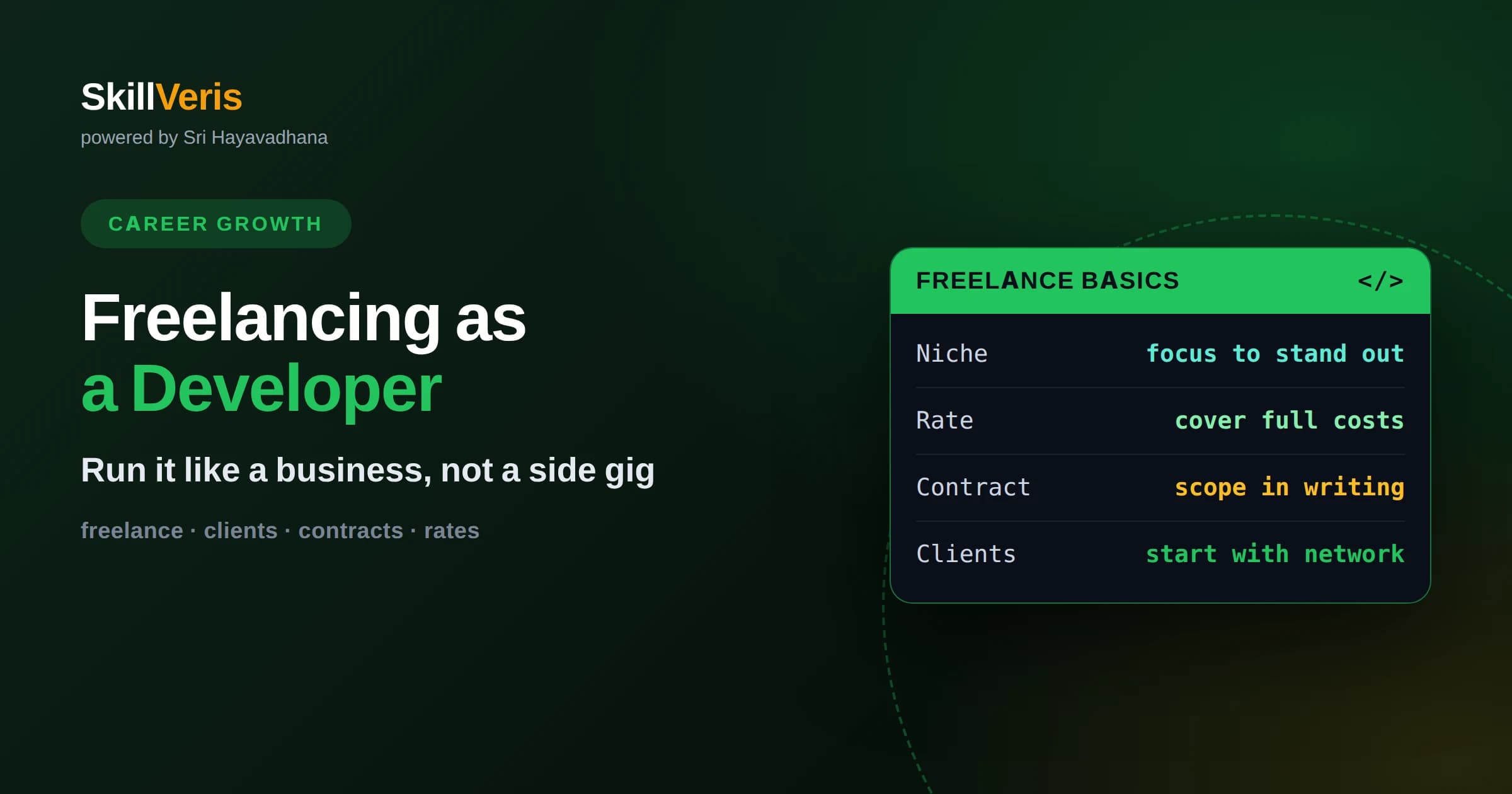
Freelancing means running a business, so client management, contracts, and finances matter as much as coding.
In this guide, you'll learn:
- A clear niche and a small portfolio of relevant work help you stand out and command better rates.
- Your first clients usually come from your existing network, not from cold bidding on crowded marketplaces.
- Written scopes, contracts, and deposits protect you from the scope creep and non-payment that sink new freelancers.
1How to Start Freelancing as a Developer
To start freelancing as a developer, choose a focused niche, define your services and rates, build a small portfolio of relevant work, and find your first clients through your existing network before turning to marketplaces. The essential mindset shift is recognizing that freelancing is not just coding for pay; it is running a small business where finding clients, negotiating contracts, and managing money are as important as the technical work. Developers who embrace the business side succeed, while those who treat it as an afterthought struggle no matter how skilled they are.
Freelancing offers real freedom: you choose your clients, set your rates, and control your schedule. But that freedom comes with responsibility for everything a company would normally handle for you, from sales to invoicing to taxes. Understanding this from the start prevents painful surprises later.
You do not need to be a world-class expert to begin. You need enough skill to deliver value, a willingness to learn the business fundamentals, and the persistence to find that first paying client. From there, momentum and reputation build on themselves.
2Deciding Whether Freelancing Fits You
Freelancing suits people who value autonomy and are comfortable with uncertainty. Income can be irregular, especially early on, and you must be self-motivated enough to find work and deliver it without anyone managing you. If a steady paycheck and clear structure matter deeply to you, employment may be a better fit, and that is perfectly valid.
Consider your tolerance for the non-coding work. Freelancers spend significant time on sales calls, proposals, invoicing, and client communication. If those activities sound draining rather than acceptable, freelancing may frustrate you. Being honest with yourself here saves a lot of grief.
Many developers ease in by freelancing on the side before going full time. Taking on a small project alongside a job lets you test the waters, build a client base, and gain confidence with far less financial risk. This gradual approach is often the wisest way to start.
3Choose a Focused Niche
Trying to be everything to everyone makes you invisible. Choosing a specific niche, whether a technology, an industry, or a type of project, makes you memorable and lets you command higher rates. A specialist who builds online stores for small retailers is far easier to hire than a generalist who does anything.
A niche also concentrates your learning and your reputation. As you complete similar projects, you get faster and better, and referrals flow more naturally because people know exactly what you do. Focus compounds into expertise, which compounds into pricing power.
You can start broad and narrow over time as you learn what you enjoy and where demand lies. The point is not to lock yourself in forever but to give prospective clients a clear reason to choose you. A sharp positioning statement beats a vague list of everything you can do.
4Build a Portfolio and Proof
Clients hire based on evidence that you can deliver, so a portfolio of relevant work is essential. If you lack client projects to show, build sample projects in your niche, contribute to open source, or take on a small discounted project to create a case study. Proof of ability matters more than credentials.
Present your work in terms of outcomes, not just code. Explain the problem a project solved and the value it delivered, because clients care about results far more than technical elegance. Framing your portfolio around client benefit speaks the language buyers actually use.
Collect testimonials and permission to reference your clients as you complete work. Social proof reassures hesitant prospects and shortens the path to yes. Early on, even a small satisfied client whose words you can quote is a genuinely valuable asset.
5Set Your Rates With Confidence
Pricing intimidates many new freelancers, who tend to charge too little out of fear. Remember that your rate must cover not just your working hours but also unpaid time spent finding clients, handling admin, and covering gaps between projects, as well as expenses employees never see. A freelance rate is not comparable to an hourly wage at a job.
Research what others in your niche charge and position yourself sensibly for your experience. You can start slightly lower to win early work, but raise your rates as your portfolio and confidence grow. Undercharging traps you in a cycle of overwork and resentment that is hard to escape.
Consider pricing by project or value rather than strictly by the hour when it makes sense. Fixed-price arrangements reward your efficiency and give clients cost certainty, while value-based pricing ties your fee to the outcome you deliver. Choosing the right model can meaningfully increase what you earn.
6Find Your First Clients
Your first clients usually come from people who already know you. Tell your network that you are available, reach out to former colleagues and acquaintances, and let people understand exactly what you offer. Warm connections trust you already, which makes them far easier to convert than strangers.
Freelance marketplaces can supply work, but they are crowded and competitive, and beginners often get pushed toward low rates. They can be a useful starting point for building a track record, but relying on them alone is a hard road. Treat them as one channel, not your whole strategy.
Be visible where your ideal clients gather. Sharing helpful content, participating in relevant communities, and building a simple professional presence all bring opportunities over time. Marketing consistently, even in small ways, keeps a steady flow of prospects coming rather than lurching from feast to famine.
7Scope Projects and Use Contracts
Clear scope is the freelancer's best protection. Before starting, agree in writing on exactly what you will deliver, by when, and for how much, including what is not included. Vague expectations lead to scope creep, where clients keep adding to the work without adding to the pay, which quietly destroys your profitability.
Always use a written contract, even for small projects and friendly clients. A contract that specifies deliverables, timelines, payment terms, and what happens if things change protects both sides and signals professionalism. Working without one leaves you exposed to disputes you cannot easily win.
Handle changes explicitly. When a client requests something beyond the agreed scope, treat it as a new item with its own price and timeline rather than absorbing it silently. Managing scope firmly but politely is one of the most important skills a freelancer can develop.
8Manage Money and Get Paid
Cash flow discipline keeps a freelance business alive. Invoice promptly, set clear payment terms, and follow up on late payments without hesitation. Many new freelancers feel awkward chasing money, but getting paid for your work is simply part of running a business, not something to apologize for.
Protect yourself against non-payment by taking a deposit before starting and, for larger projects, billing in stages tied to milestones. This ensures you are never far ahead of the payments you have received. Requiring an upfront deposit also filters out clients who were never serious.
Set aside money for taxes and slower periods from the start. Because no employer withholds taxes for you and income fluctuates, building a financial buffer prevents nasty surprises. Treating your finances with the same care as your code is what turns freelancing into a sustainable livelihood.
9Manage Clients and Communication
Strong client relationships are the foundation of a lasting freelance business, because repeat clients and referrals cost far less to win than new ones. Communicate clearly, set realistic expectations, and update clients regularly on progress. Reliability and good communication often matter more to clients than raw technical brilliance.
Manage expectations proactively. If a project will slip or a request is outside scope, say so early and honestly rather than hoping the problem resolves itself. Clients respect freelancers who communicate difficulties promptly far more than those who go silent and deliver surprises.
Learn to recognize and gracefully decline bad-fit clients. A client who disrespects your time, haggles endlessly, or ignores your expertise will cost you more than they pay. Protecting your energy for good clients keeps your business healthy and your work enjoyable.
10Deliver Quality and Build Reputation
Your reputation is your most valuable asset as a freelancer, and it is built one delivered project at a time. Doing excellent work, meeting your commitments, and being pleasant to work with generate the referrals and repeat business that make freelancing sustainable. Every project is an investment in your future pipeline.
Aim to exceed expectations in small, meaningful ways: communicate well, deliver on time, and leave clients confident they made a good choice. Delighted clients become advocates who recommend you to others, which is the cheapest and most effective marketing that exists.
Ask satisfied clients for testimonials and referrals explicitly, since many are happy to help but will not think to do so unprompted. Turning good work into visible proof and warm introductions compounds your reputation and steadily reduces how hard you must hunt for the next project.
11Avoid Common Freelancing Mistakes
The most common early mistake is underpricing out of fear, which traps you in overwork for too little reward. Charge rates that reflect the full cost of running your business, and raise them as your track record grows. Sustainable freelancing requires sustainable pricing from the outset.
Another frequent error is skipping contracts and clear scopes, which invites scope creep and payment disputes. A little paperwork upfront prevents the painful conflicts that end relationships and cost you money. Professionalism in the details protects you when things go wrong.
Finally, neglecting the ongoing search for clients leads to a boom-and-bust cycle. When you are busy, it is tempting to stop marketing, only to face an empty pipeline when the project ends. Keeping a steady, modest marketing effort running at all times smooths out the peaks and valleys.
12Handle Taxes and Admin Like a Pro
The unglamorous administrative side of freelancing is where many otherwise talented developers stumble. Because no employer withholds taxes or handles paperwork for you, you must track income and expenses, set aside money for taxes, and keep organized records from day one. Neglecting this creates stressful surprises that can threaten your whole business.
Build simple systems early rather than scrambling later. Use a dedicated account for business income, keep receipts for deductible expenses, and consider consulting a professional about your tax obligations in your location. A little structure upfront saves enormous headaches and often money at tax time.
Treat admin as a regular, scheduled part of your work rather than something to avoid. Setting aside a small recurring block for invoicing, bookkeeping, and record-keeping keeps everything current and prevents the pile-up that makes these tasks feel overwhelming. Professional habits here are what let the creative work continue undisturbed.
13Grow Beyond Your First Clients
Once you have a few happy clients, the goal shifts from finding any work to building a sustainable, growing business. Raise your rates as your reputation strengthens, focus increasingly on higher-value projects, and let go of low-paying work that no longer fits. Growth comes from working smarter, not simply from working more hours.
Cultivate repeat clients and referrals, which are the lifeblood of a mature freelance practice because they cost far less to win than new clients. Staying in touch with past clients and consistently delivering excellent work turns one-off projects into ongoing relationships and a steady stream of recommendations.
Consider how you want your business to evolve over the long term. Some freelancers stay solo and deliberately keep things small, while others move toward productized services, retainers, or building a small team. There is no single right path, but choosing your direction intentionally helps you build the kind of freelance career you actually want.
14Sharpen Your Skills With SkillVeris
Successful freelancing rests on genuinely valuable, current technical skills that let you deliver real results for clients, and SkillVeris helps you build exactly that kind of practical, in-demand expertise through hands-on learning. The stronger your abilities, the higher the rates you can justify and the more confidently you can take on ambitious projects.
Start small and real: pick a niche, build one portfolio piece, and reach out to your network about a first project. Pair steady skill growth with the business fundamentals in this guide, and freelancing can grow from a nervous first gig into a rewarding, self-directed career.
Get The Print Version
Download a PDF of this article for offline reading.
About the Publisher
SkillVeris Team
Careers Team
Our careers team helps you navigate tech job markets, build portfolios, and land the roles you want.
View all postsRelated Posts
Never miss an update
Get the latest tutorials and guides delivered to your inbox.
No spam. Unsubscribe anytime.