Freelance Data Analytics: How to Land Your First Client
SkillVeris Team
Careers Team
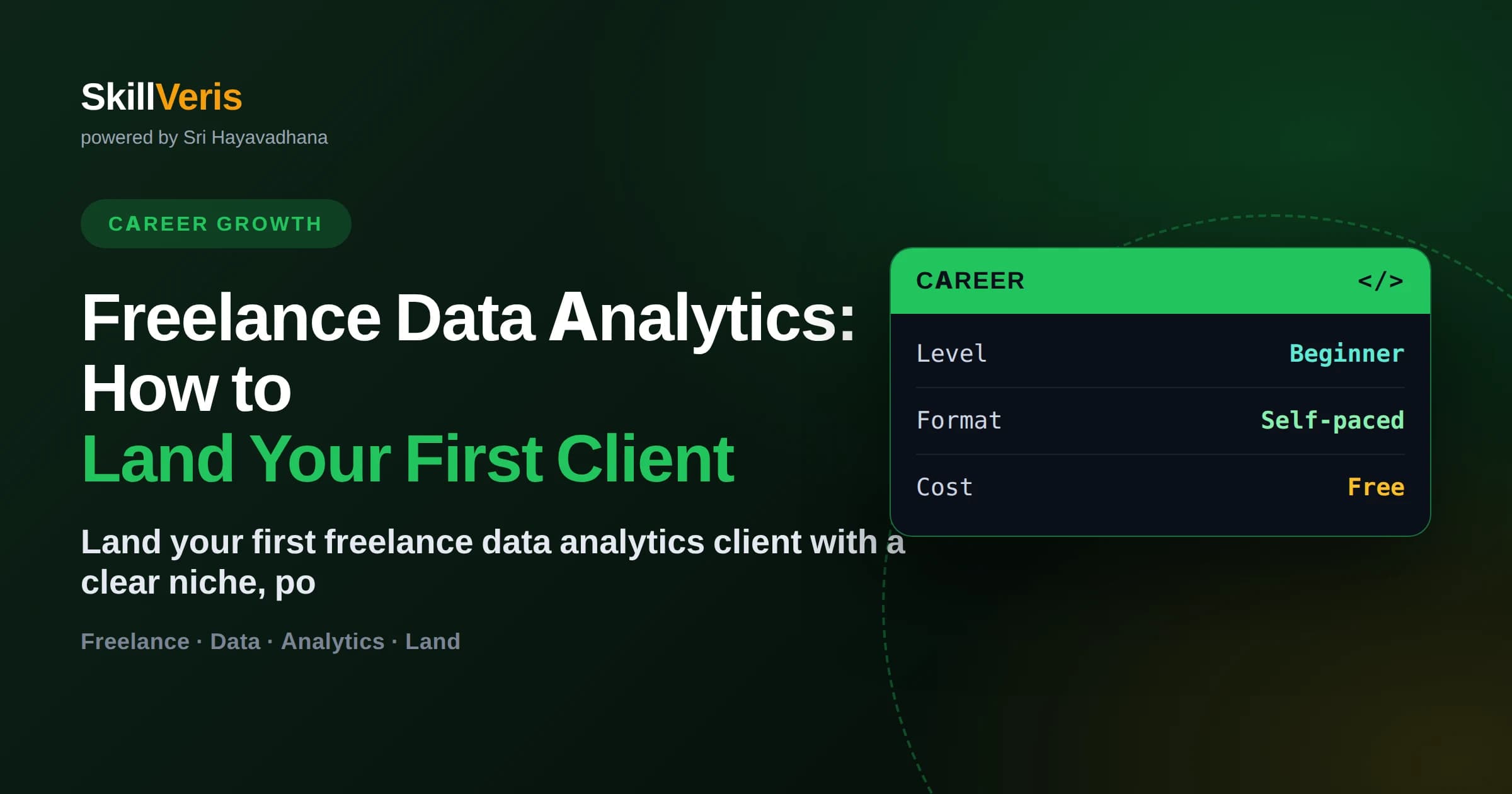
You land your first freelance data analytics client faster by picking a narrow niche than by advertising every skill you own.
In this guide, you'll learn:
- A tiny portfolio of two or three problem-focused projects beats a long resume when a stranger is deciding whether to trust you.
- Pricing your first few gigs by project scope, not by the hour, protects you from underselling your speed as you improve.
- Cold outreach works when it leads with the client's business problem, not with your tools or your availability.
- Freelance marketplaces get you volume, but referrals and niche communities get you higher-paying, repeat work.
1How Beginners Actually Land Their First Freelance Client
To land your first freelance data analytics client, you need three things working together: a specific niche a client can recognize, one or two portfolio projects that prove you can solve a real problem, and a short, personalized outreach message that speaks to money the client is losing or leaving on the table. You do not need years of experience, a fancy certification, or a huge network. You need to be the obvious choice for one narrow type of problem.
Most beginners get stuck because they try to be a generalist who does 'data stuff' for 'anyone'. That message is invisible. A client with a churn problem does not hire a general analyst; they hire the person whose portfolio says 'I help subscription businesses find why customers cancel'. This article walks you through positioning, pricing, and the exact places beginners find their first paying gigs, plus how to protect yourself once the money is on the line.
Treat your first client as a stepping stone, not a payday. The goal is a completed project, a testimonial, and a case study you can show the next five prospects. Get that flywheel turning and the second client is dramatically easier than the first.
2Pick a Niche Narrow Enough to Remember
Positioning is the single highest-leverage decision you make as a freelancer. A niche combines an audience (who you help) with an outcome (the result you deliver). 'Data analyst' is a job title, not a niche. 'I help e-commerce stores understand which marketing channels actually drive profit' is a niche, because a store owner reading it instantly knows whether it applies to them.
You do not have to be an expert in the industry yet. Pick a niche where you have some exposure, curiosity, or an unfair advantage: a previous job, a hobby, a friend who runs a business. Familiarity with the domain lets you ask sharper questions and speak the client's language, which matters more to a small business than raw technical depth.
A narrow niche feels risky because it seems to shrink your market, but it does the opposite. Specialists command higher rates, are easier to refer ('you should talk to the churn person'), and face far less competition than the flood of generalists on every freelance platform.
- Subscription and SaaS businesses: churn analysis, cohort retention, MRR reporting.
- E-commerce: marketing attribution, customer lifetime value, inventory and returns analysis.
- Local service businesses: lead-source tracking, seasonal demand, simple dashboards.
- Content creators and agencies: audience analytics, campaign performance, ROI reporting.
- Nonprofits: donor segmentation, program impact reporting, grant data cleanup.
3Build a Portfolio That Proves You Solve Problems
Clients do not read portfolios to admire your code; they read them to answer one question: can this person solve my problem without me babysitting them? Structure every portfolio project as a story with a problem, your approach, and a quantified result. 'Reduced a retailer's weekly reporting time from four hours to fifteen minutes with an automated dashboard' says more than a screenshot of a scatter plot.
You can build convincing projects without a paying client. Use public datasets, but frame them around a business decision. Instead of 'analysis of the Titanic dataset', publish 'how a fictional insurer could price policies using survival factors'. The framing is what signals commercial thinking, and commercial thinking is what clients pay for.
Two or three strong projects in your chosen niche beat ten random ones. Depth in one area reads as expertise; breadth reads as a hobbyist. Publish them somewhere a non-technical client can view without installing anything: a simple portfolio site, a PDF case study, or a short Loom-style walkthrough video.
💡The offer-to-help shortcut
No portfolio yet? Offer one free or steeply discounted analysis to a small business in your niche in exchange for a testimonial and permission to publish it as a case study. One real client story converts better than five hypothetical projects.
4Price for Value, Not for Your Insecurity
New freelancers routinely underprice because they anchor on an hourly wage and their own doubt. The problem with hourly pricing is that it punishes you for getting faster: the better you get, the less you earn per project. Whenever possible, price by the project or the deliverable so the fee reflects the value delivered, not the minutes spent.
For your very first gigs, it is fine to charge modestly to lower the client's risk and win the testimonial, but never work entirely for free with a stranger who can pay. Free work is often disrespected and abandoned. A small fee creates commitment on both sides. As you accumulate case studies and testimonials, raise your prices deliberately, roughly every two or three projects.
Quote a single number for a defined scope, not a menu. 'A customer churn analysis with a written summary and a dashboard, delivered in two weeks, is $X' is easy to say yes to. If the client wants more, that is a new, separately priced project, not a favor.
- Anchor on the outcome: what is this insight worth to the client's revenue or costs?
- Offer two or three packaged tiers so the client chooses how much, not whether.
- Always take a deposit, typically 50%, before starting work.
- Build a small buffer into every quote; first projects always take longer than you expect.
5Where Beginners Actually Find Their First Gigs
There is no single best place; there is a sequence. Freelance marketplaces like Upwork and Fiverr give you volume and a built-in payment system, which is useful when you have zero reputation, but competition is fierce and rates start low. Treat them as a way to get your first two or three reviews, not as a long-term home.
Once you have a case study, shift energy toward higher-qualitysources: niche online communities (industry Slack groups, subreddits, Discord servers), local business networks, and your own warm network. People buy from people they trust, and a warm introduction skips the entire trust-building phase that makes cold marketplaces so hard.
Do not overlook the businesses right around you. Small local companies are drowning in spreadsheets and rarely have an analyst. A friendly message offering to turn their messy sales data into a clear monthly dashboard can land a repeat client who values you far more than an anonymous bidder ever would.
6Write Outreach That Leads With Their Problem
Effective outreach is short, specific, and about them. The mistake beginners make is opening with themselves: 'Hi, I'm a data analyst looking for work.' Nobody cares. Open with an observation about the prospect's business and a concrete outcome you could deliver: 'I noticed your store runs sales across five channels but reports them together. I help stores like yours see which channel is actually profitable, which usually reveals one channel quietly losing money.'
Personalize the first sentence for every single message. Generic blasts have near-zero response rates and can damage your reputation. Fifteen well-researched messages beat two hundred copy-pasted ones. Reference something real: a recent product launch, a job posting, a comment they made in a community.
End with a low-friction call to action. Do not ask for a contract; ask for a fifteen-minute conversation or offer a small free insight ('I pulled a quick chart of your public review trends, happy to send it over'). Make the next step tiny and the yes becomes easy.
🔑The give-first move
Including one genuine, unpaid insight in your outreach, a small chart, a spotted anomaly, a quick benchmark, dramatically raises reply rates. It proves your skill instead of claiming it, and it triggers reciprocity.
7Run a Discovery Call That Wins the Deal
The first call is not a sales pitch; it is a diagnosis. Spend most of it asking questions and listening. What decision are they trying to make? What are they doing today, and why is it painful? What would a great outcome look like in ninety days? The client who feels deeply understood is the client who hires you, even over more technically impressive competitors.
Restate their problem back to them in your own words before you propose anything. This confirms you understood and quietly demonstrates competence. Only then outline how you would approach it, keeping the technical detail light and the business outcome front and center.
Close by summarizing the scope, timeline, and price out loud, then confirm you will send a short written proposal. Never let a promising call end with a vague 'I'll think about it' and no next step scheduled.
8Protect Yourself With Scope, Deposits, and Contracts
The two most common first-client disasters are scope creep and non-payment, and a simple written agreement prevents both. Your scope document does not need a lawyer; it needs clarity. List exactly what you will deliver, what you will not, the timeline, the price, the payment schedule, and how revisions work. Ambiguity always gets resolved in the client's favor unless you wrote it down.
Always take a deposit before you start. A 50% upfront, 50% on delivery split is standard and reasonable, and it filters out clients who were never serious. For larger projects, break payment into milestones so you are never carrying weeks of unpaid work.
Define revisions explicitly, for example two rounds of changes included, further changes billed separately. Without this, 'just one more tweak' becomes an infinite loop. Clear boundaries make you look professional, not difficult, and they protect the working relationship as much as they protect you.
9Deliver, Collect the Testimonial, and Compound
Delivering great work is table stakes; capturing the proof is what builds your business. The moment a client is happy, ask for a specific testimonial and permission to write up an anonymized case study. Ask targeted questions ('what was the outcome for you?') so the testimonial mentions results, not just that you were 'nice to work with'.
Then set up the next thing before the current project ends. Suggest a monthly retainer for ongoing reporting, propose a logical follow-up analysis, or simply ask who else they know that struggles with the same problem. Referrals from a happy first client are the cheapest, highest-converting leads you will ever get, and they turn one gig into a pipeline.
10Frequently Asked Questions
Do I need a certification to start freelancing in data analytics? No. Clients hire proof of results, not credentials. A small portfolio of niche-specific projects and a clear testimonial will win work faster than any certificate, though a free course can help you build the skills to produce that portfolio.
How much should I charge my very first client? Enough to create commitment but low enough to reduce their risk, often a modest fixed project fee. Price by deliverable rather than by hour, take a deposit, and raise your rates every two or three completed projects as your case studies grow.
How long does it take to land a first client? For most focused beginners it takes a few weeks to a couple of months of consistent, personalized outreach and portfolio building. Volume of generic messages does not speed this up; relevance and one strong case study do.
Should I use Upwork or Fiverr or find clients directly? Use marketplaces to collect your first few reviews, then shift toward niche communities, local businesses, and referrals for higher-paying, repeat work. Marketplaces are a starting ramp, not a destination.
What if I have no portfolio and no experience at all? Build two or three projects on public datasets framed around real business decisions, or do one free or discounted analysis for a small business in exchange for a testimonial. Manufactured proof beats no proof.
How do I avoid getting scammed or not paid? Always take a deposit before starting, put the scope and payment schedule in writing, and split larger projects into milestones. A client unwilling to pay a deposit is a client to walk away from.
11Your Next Steps
Landing your first freelance data analytics client is a sequence, not a leap: choose a narrow niche, build two or three problem-focused projects, reach out with personalized messages that lead with the client's pain, and protect the deal with a simple scope and deposit. Do those things consistently and the first client stops feeling like luck and starts feeling like a process you control.
If you still need to sharpen the underlying skills, you can learn data analytics, SQL, and visualization for free on SkillVeris, then turn those study projects directly into portfolio pieces. Explore the free data analytics courses and study notes, ship one niche project this week, and send five genuinely personalized messages. That is how the flywheel starts.
Related Reading
Get The Print Version
Download a PDF of this article for offline reading.
About the Publisher
SkillVeris Team
Careers Team
Our careers team helps you navigate tech job markets, build portfolios, and land the roles you want.
View all postsRelated Posts
Never miss an update
Get the latest tutorials and guides delivered to your inbox.
No spam. Unsubscribe anytime.