Entry-Level Data Analyst Jobs: Where to Find Them
SkillVeris Team
Careers Team
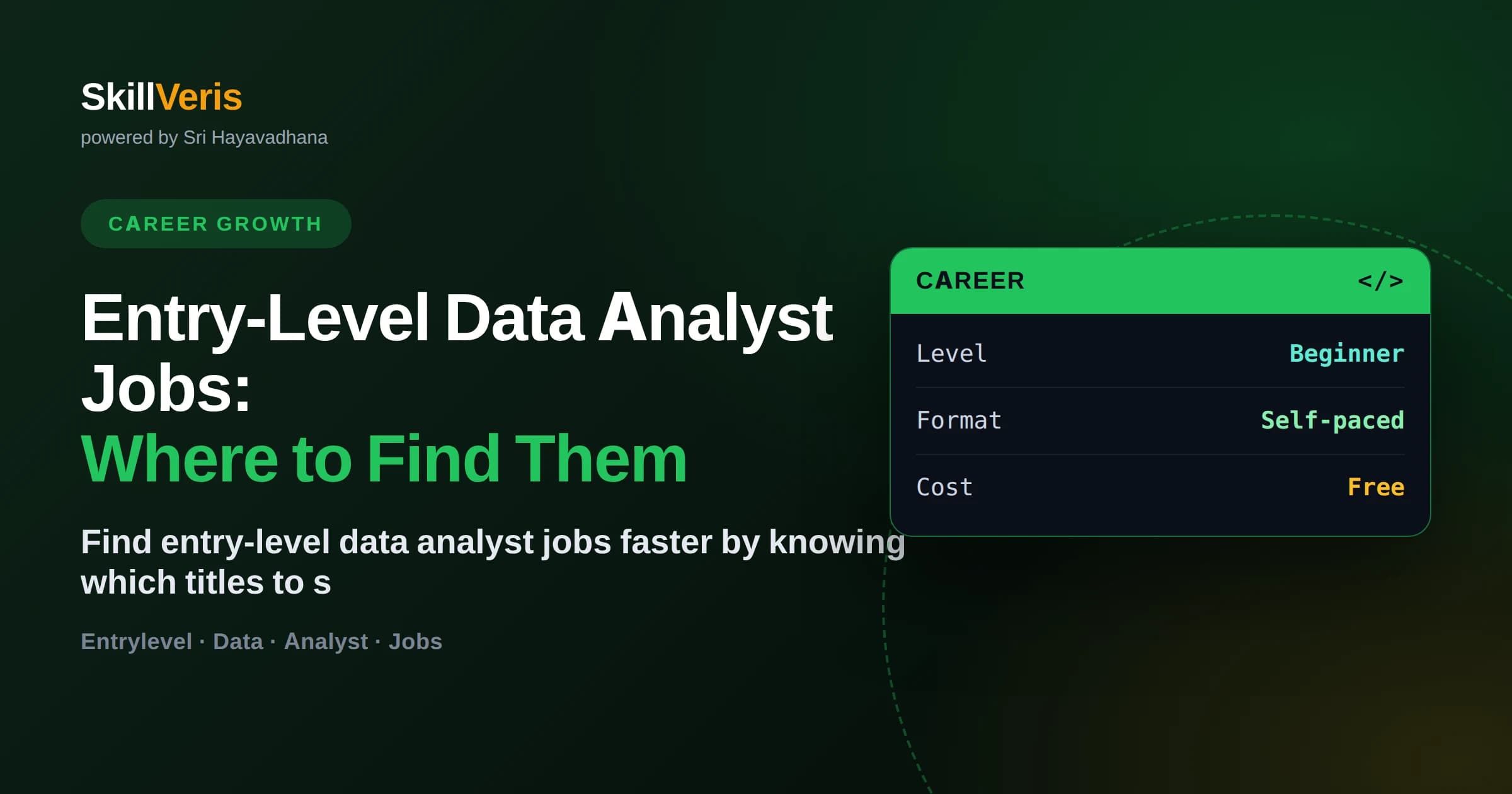
Entry-level analyst roles hide under many titles beyond just data analyst, so search broadly.
In this guide, you'll learn:
- General job boards, niche data boards, and company career pages each surface different roles.
- Company career pages often list roles before they hit the big aggregators.
- A targeted application with a tailored resume beats mass-applying to hundreds of listings.
- Referrals dramatically raise your odds, so networking is part of the job search, not separate from it.
1Where Are the Entry-Level Data Analyst Jobs?
Entry-level data analyst jobs are found by searching a range of titles beyond data analyst across general job boards, niche data boards, and company career pages, then applying selectively with a tailored resume. The roles exist, but many are hidden under different names or listed only on a company site, so a smart search strategy matters as much as your skills.
New job seekers often conclude there are no entry-level roles because searching the exact phrase data analyst returns mostly senior positions. The openings are there; you just have to look under the right titles and in the right places. Blind mass-applying, meanwhile, feels productive but rarely works.
This guide covers the titles to search, the boards and pages worth your time, and an application strategy that turns effort into interviews.
2Titles to Search Beyond Data Analyst
The same entry-level work appears under many labels depending on the company and industry. If you only search one phrase, you miss most of the market.
Broaden your searches to include these common variations, and read the requirements rather than trusting the title alone, since a junior role sometimes hides behind a generic name.
- Junior Data Analyst and Associate Data Analyst.
- Business Analyst and Business Intelligence Analyst.
- Reporting Analyst and Operations Analyst.
- Marketing Analyst, Financial Analyst, and Product Analyst.
- Data Coordinator, Data Specialist, and Analytics Associate.
3General Job Boards
The large aggregators carry the highest volume of listings, so they are a reasonable starting point. LinkedIn, Indeed, and Glassdoor host most mainstream openings and let you filter by experience level, location, and remote status.
Use filters aggressively to cut the noise: set the experience level to entry, add remote or your location, and save searches so new roles come to you. Turn on alerts for your target titles so you can apply early, since the first applicants often get the most attention before a posting is flooded.
💡Apply early, not just often
Roles get the most recruiter attention in the first days after posting. Alerts that let you apply within 48 hours can matter more than the total number of applications you send.
4Niche and Data-Specific Boards
Specialized boards carry fewer listings but higher relevance, and they attract employers specifically seeking data talent. That focus can mean less competition per role than on the giant aggregators.
Look at data and tech-focused job boards, analytics community boards, and remote-work boards if you want location flexibility. Many data communities and newsletters also share openings that never reach the big sites. These channels reward people who show up consistently, so bookmark a few and check them on a regular cadence.
5Company Career Pages
Some of the best opportunities appear on a company's own careers page before, or instead of, the big boards. Applying there can put you ahead of the crowd and signals genuine interest in that specific employer.
Make a shortlist of companies you would like to work for, especially those in an industry you already understand, and check their careers pages regularly. Following those companies on LinkedIn also surfaces new postings in your feed. This targeted approach pairs naturally with tailoring your application, which is what actually moves the needle.
6The Power of Referrals
A referral is the single biggest advantage in a job search, often lifting your odds of an interview several times over. Many roles are filled through referrals before they are widely advertised at all.
Build referrals by nurturing your network before you need it. Reconnect with former colleagues, engage with analysts online, attend meetups or virtual events, and let people know you are looking. When you spot a role at a company where you have a contact, a short, polite message asking about the team and a possible referral can open a door the front door never would.
🔑Networking is job searching
Treat relationship-building as part of your application strategy, not a separate task. A single warm introduction can outperform a hundred cold submissions.
7A Smarter Application Strategy
Volume is not a strategy. Sending the same generic resume to two hundred listings produces frustration and few replies, because it ignores what each role actually wants.
Instead, apply to fewer roles with genuinely tailored applications. For each, mirror the posting's keywords in your resume, adjust your summary to the role, and link relevant portfolio projects. Fifteen thoughtful applications a week will usually outperform a hundred careless ones, and they leave you the energy to follow up and network alongside them.
8Using Adjacent Roles as On-Ramps
If pure analyst roles feel out of reach at first, adjacent positions can be a fast way in. Roles like reporting analyst, operations analyst, or a data-heavy coordinator position let you do real analytical work and build a track record.
From one of these seats you gain access to company data, business context, and internal opportunities, which makes moving into a dedicated analyst role far easier a year later. Do not dismiss a role just because the title is not exactly data analyst; what matters is whether you will work with data and grow.
9Staying Organized and Persistent
A job search is a project, and treating it like one keeps you sane and effective. Rejection and silence are normal, especially at the entry level, so protect your momentum with structure.
Track your applications in a simple spreadsheet with the role, date, status, and any contact, so you can follow up and spot patterns. Set a realistic weekly target that mixes applications, networking, and skill-building. Consistency over weeks, not a frantic burst, is what eventually turns the search into an offer.
10Frequently Asked Questions
Is a data analytics course really free? Yes. SkillVeris offers free data analytics courses and study notes, so you can build job-ready skills and projects before and during your search at no cost.
Why do I only see senior data analyst roles when I search? Because many entry-level roles are listed under other titles like junior analyst, reporting analyst, or business analyst. Search those variations and read the requirements rather than trusting the title.
How many jobs should I apply to per week? Aim for a smaller number of tailored applications, such as ten to twenty, rather than hundreds of generic ones. Tailored applications get far better response rates.
Are company career pages worth checking directly? Yes. Companies often post roles on their own sites before the big boards, and applying there can put you ahead of the crowd while showing genuine interest.
How important are referrals for entry-level roles? Very. A referral can multiply your odds of getting an interview and sometimes surfaces roles before they are advertised, so networking is a core part of the search.
Should I take a role that is not called data analyst? Often yes. Adjacent roles like reporting or operations analyst let you work with real data and build a track record, making a move into a dedicated analyst role easier later.
11Turn the Search Into Offers
Entry-level data analyst jobs are more plentiful than they first appear once you search the right titles, use a mix of boards and company pages, and apply with focus instead of volume. Add referrals and a willingness to consider adjacent roles, and the market opens up considerably.
The strongest job seekers keep building skills while they search, because a growing portfolio makes every application stronger. Learn SQL, visualization, and analysis for free with the data analytics courses and study notes on SkillVeris, stay organized, and keep going. Persistence paired with a smart strategy is what lands the first role.
Related Reading
Get The Print Version
Download a PDF of this article for offline reading.
About the Publisher
SkillVeris Team
Careers Team
Our careers team helps you navigate tech job markets, build portfolios, and land the roles you want.
View all postsRelated Posts


Never miss an update
Get the latest tutorials and guides delivered to your inbox.
No spam. Unsubscribe anytime.