Data Analyst Resume: A Template That Gets Interviews
SkillVeris Team
Careers Team
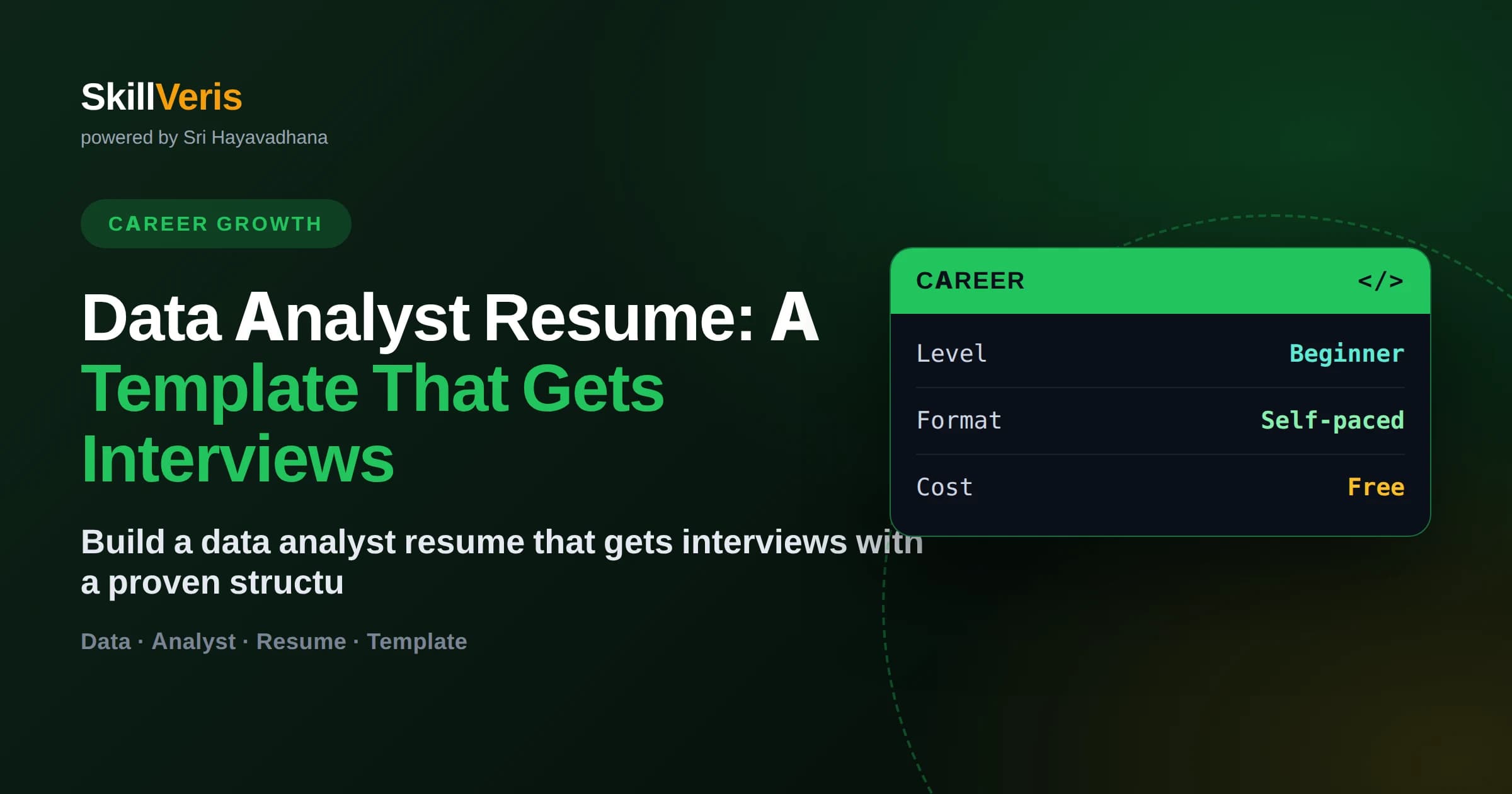
A strong data analyst resume fits on one page and leads with a concise summary tied to the target role.
In this guide, you'll learn:
- Recruiters and applicant tracking systems scan for specific keywords, so mirror the job description precisely.
- Every bullet should quantify impact, turning tasks into measurable outcomes hiring managers can trust.
- A projects section can substitute for experience when you are switching careers or just starting out.
- Clean, consistent formatting matters because cluttered resumes get skimmed and discarded in seconds.
1What Makes a Data Analyst Resume Get Interviews?
A data analyst resume gets interviews when it clearly proves you can turn data into decisions, using quantified bullet points, relevant keywords, and a clean one-page layout. Recruiters spend seconds on a first pass, so the resume must communicate value fast and survive the applicant tracking system that screens it before a human ever reads it.
Most rejected resumes are not from unqualified people. They are from qualified people who listed duties instead of results, buried their skills, or ignored the keywords in the job posting. Fixing those three things is often the difference between silence and a callback.
This guide gives you a section-by-section template, the keywords that matter, and the exact way to write bullets that make hiring managers want to talk to you.
2The Resume Structure That Works
Keep it to one page and follow a predictable order, because recruiters know where to look and reward resumes that respect their time. A clean structure signals a clear thinker, which is exactly what analytics teams want.
Use this top-to-bottom order for most analyst resumes.
- Header: name, target title, email, phone, LinkedIn, and portfolio or GitHub link.
- Summary: two or three lines stating who you are and the value you bring.
- Skills: a scannable list of tools and competencies, grouped logically.
- Experience: reverse-chronological, with quantified bullet points.
- Projects: two or three, especially important for switchers and juniors.
- Education and certifications: kept short and near the bottom.
3Writing a Summary That Sells
The summary is prime real estate at the top of the page, so make it work. Avoid vague objectives like wanting to grow in a dynamic company. State what you do and the impact you create.
A strong example reads: "Data analyst with three years turning marketing and sales data into decisions, skilled in SQL, Tableau, and Python. Built dashboards that cut reporting time by 60% and informed a pricing change worth $200,000 in annual revenue." It names skills, shows outcomes, and matches the target role in one glance.
💡Match the title exactly
If the posting says Business Data Analyst, mirror that phrase in your summary and header. Both applicant tracking systems and recruiters look for an exact title match early.
4Keywords and Beating the ATS
Most applications pass through an applicant tracking system that ranks resumes by keyword relevance before a human sees them. If your resume lacks the terms in the job description, it may never surface, no matter how qualified you are.
Read the posting carefully and mirror its exact language. If it asks for SQL, Power BI, and stakeholder management, use those precise phrases, not synonyms the system may not recognize. Weave keywords naturally into your skills and bullets rather than stuffing a hidden block of text, which modern systems and recruiters both penalize.
5Quantified Bullet Points
The single biggest upgrade to most resumes is turning duty statements into quantified achievements. A bullet that says "created reports" tells a hiring manager nothing; a bullet with a number proves impact.
Use a simple formula: action verb, what you did, the tool, and the measurable result. Compare the two versions below and you will see why numbers win every time.
- Weak: Responsible for building dashboards for the sales team.
- Strong: Built a Tableau sales dashboard that reduced weekly reporting time by 60% for a team of 12.
- Weak: Analyzed customer data to find trends.
- Strong: Analyzed 50,000 customer records in SQL to identify a churn driver, informing a retention campaign that lifted renewals 8%.
6The Projects Section
If you are early-career or switching fields, projects are your evidence. A well-described project can carry as much weight as a job because it shows real work rather than a claim.
For each project, give it a clear name, one line on the question you answered, the tools you used, and the outcome or insight. Link to the live dashboard or GitHub repository so a curious reviewer can dig in. Two strong projects beat five thin ones, so invest in depth and a clear write-up.
🔑Make projects reviewable
Always link your projects. A hiring manager who can click through to a clean, documented notebook or dashboard is far more likely to shortlist you than one who only reads a description.
7Presenting Your Skills
The skills section should be scannable in a glance and honest. List only what you can defend in an interview, because an inflated skills list falls apart the moment someone asks a follow-up question.
Group related items so the reader can parse them quickly: languages and querying such as SQL and Python; BI and visualization such as Power BI and Tableau; and analytical methods such as A/B testing and forecasting. Skip generic soft-skill buzzwords here and let your bullet points demonstrate those instead.
8Formatting and Common Mistakes
Presentation matters because a cluttered resume gets skimmed and set aside. Use one clean font, consistent spacing, standard section headings, and plenty of white space. Save and send as a PDF so your layout survives, unless the posting specifically requests a different format.
Avoid the frequent traps: multi-page resumes for junior roles, dense paragraphs instead of bullets, unexplained gaps you could easily address, and typos in a document meant to prove your attention to detail. Proofread twice, then have someone else read it once.
9Tailoring for Each Application
A single generic resume underperforms because no two roles want exactly the same thing. Tailoring does not mean rewriting from scratch; it means adjusting your summary, reordering skills, and emphasizing the most relevant bullets for each posting.
Spend ten focused minutes per application aligning your resume with the job description. That small investment lifts your response rate more than sending twice as many identical copies, because relevance is what recruiters and their systems reward.
10Frequently Asked Questions
Is a data analytics course really free? Yes. SkillVeris offers free data analytics courses and study notes, so you can build the SQL, BI, and project skills your resume needs without paying for training.
How long should a data analyst resume be? One page for most candidates, especially those with under ten years of experience. A concise, well-edited page outperforms a padded two-page document.
What if I have no data analyst work experience? Lead with a strong projects section using real datasets, and highlight transferable skills from other roles. Documented projects can substitute effectively for formal experience.
How do I get past the ATS? Mirror the exact keywords and job title from the posting, use a clean standard layout, and submit as a PDF unless told otherwise. Avoid images, tables, and unusual fonts that some systems misread.
Should I include a photo or personal details? In most regions, no. Skip photos, age, and marital status, and use that space for skills, quantified achievements, and projects instead.
How many bullet points per job? Aim for three to five focused, quantified bullets per role, prioritizing your most impactful and relevant work. Cut generic duties that do not show results.
11Put the Template to Work
A data analyst resume that gets interviews is not about clever design; it is about proof. Lead with a sharp summary, mirror the posting's keywords, quantify every bullet, and back it all with two or three reviewable projects. Do that, and you clear both the applicant tracking system and the recruiter's quick scan.
If your resume feels thin on projects or skills, that is a signal, not a dead end. Build the missing pieces for free with the data analytics courses and study notes on SkillVeris, then update your resume with real, quantified work. The interviews follow the proof.
Related Reading
Get The Print Version
Download a PDF of this article for offline reading.
About the Publisher
SkillVeris Team
Careers Team
Our careers team helps you navigate tech job markets, build portfolios, and land the roles you want.
View all postsRelated Posts
Never miss an update
Get the latest tutorials and guides delivered to your inbox.
No spam. Unsubscribe anytime.