Common Coding Interview Mistakes to Avoid
SkillVeris Team
Careers Team
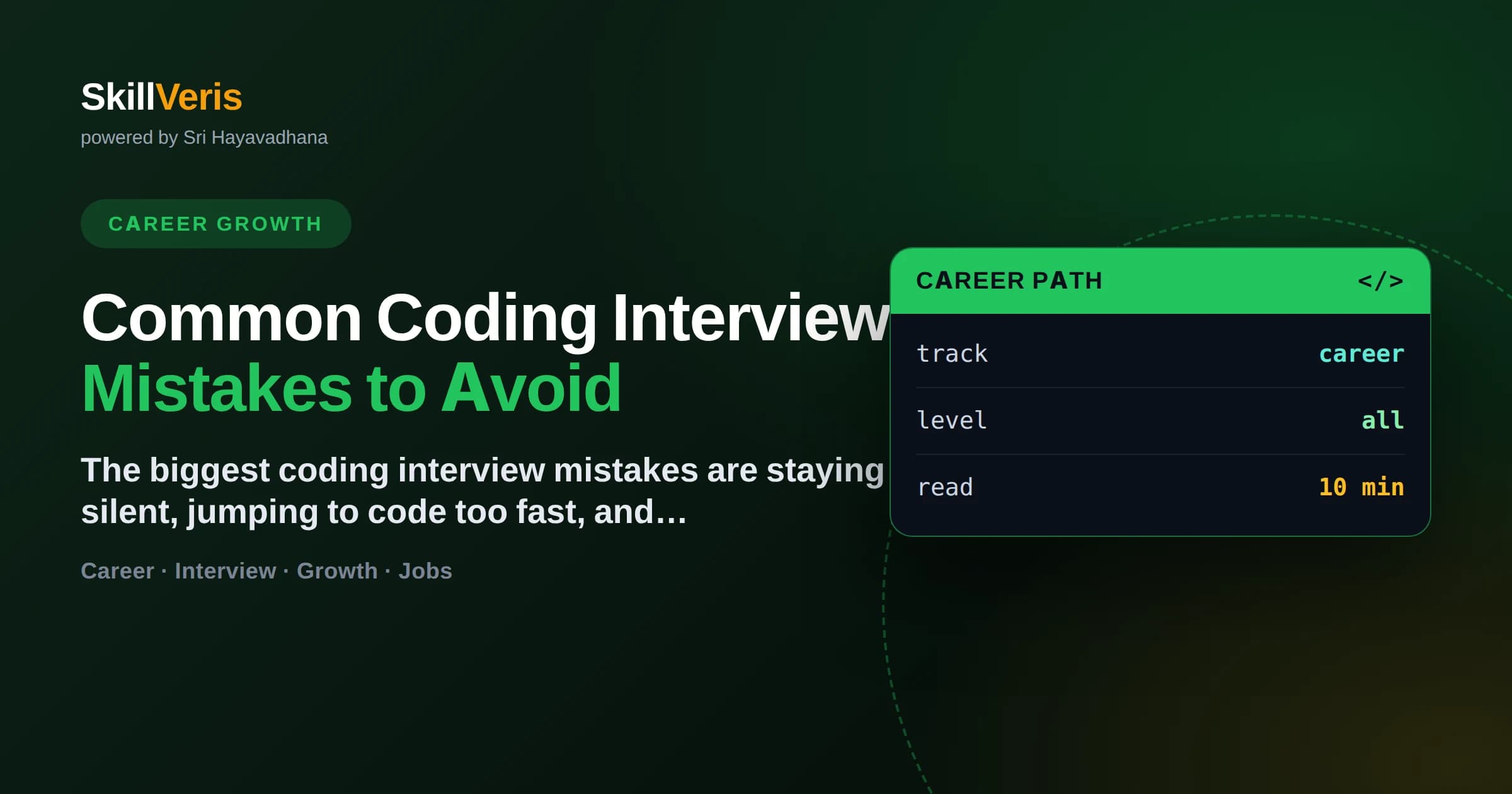
The most common coding interview mistakes are silence, coding before understanding the problem, ignoring edge cases, and not communicating your thought process — all of which are fixable with preparation.
In this guide, you'll learn:
- Interviewers evaluate how you think and communicate, not just whether you reach the perfect solution, so working out loud is essential.
- Jumping straight into code without clarifying the problem or discussing an approach leads to wasted time and wrong solutions.
- Skipping edge cases and never testing your code signals a lack of rigor that worries interviewers more than a small bug.
- Silence when stuck is a bigger red flag than being stuck; sharing your reasoning lets the interviewer help and see how you work.
1The Biggest Coding Interview Mistakes
The most common coding interview mistakes are staying silent, writing code before fully understanding the problem, ignoring edge cases, and failing to communicate your reasoning. None of these are about raw algorithm knowledge — they are process and communication errors, which means they are entirely within your control to fix.
This matters because interviewers are evaluating how you think and work, not just whether you land the optimal solution. A candidate who reasons clearly, asks good questions, and tests their code often outscores one who silently produces a perfect answer. Avoiding these mistakes can raise your results more than grinding another hundred problems.
2What Interviewers Are Really Assessing
Understanding what the interviewer is grading reframes the whole exercise and explains why communication matters so much.
- Problem-solving: how you break an unfamiliar problem into steps.
- Communication: whether you can explain your thinking clearly as you go.
- Coding ability: writing correct, reasonably clean code.
- Collaboration: how you respond to hints, feedback, and being stuck.
🔑Key Takeaway
The interview is a simulation of working together, not an exam. The interviewer wants to know what it would be like to solve problems with you — so show them your process.
3Mistake 1: Coding in Silence
The single most damaging mistake is going quiet — either while thinking or when stuck. When you stop talking, the interviewer loses all insight into your reasoning and cannot tell whether you are making progress or spiralling.
- Narrate your thinking: 'I am considering a hash map here because I need fast lookups.'
- When stuck, say so and share what you have tried and what you are weighing.
- Think out loud even during pauses so the interviewer can follow along.
- Treat hints as collaboration, not failure — engage with them openly.
Why Talking Helps You Too
Verbalising your thoughts often unsticks you, because explaining the problem forces structure onto it. It also lets the interviewer nudge you back on track before you waste ten minutes down a dead end. Silence denies you both of those benefits.
4Mistake 2: Coding Before Understanding
Rushing to write code before you fully understand the problem is a classic trap that wastes precious time. A few clarifying questions up front prevent solving the wrong problem entirely.
- Restate the problem in your own words to confirm you understand it.
- Ask about input size, ranges, types, and whether inputs can be empty or invalid.
- Work through a small example by hand before touching the keyboard.
- Sketch your approach and get a nod before you start coding.
💡Pro Tip
Spend the first few minutes clarifying and planning. It feels slow, but it almost always saves time overall and shows the interviewer you approach problems methodically.
5Mistake 3: Ignoring Edge Cases and Testing
Skipping edge cases and never testing your code undermines an otherwise good solution. Interviewers look for rigor, and thinking through boundaries shows you write code that survives the real world.
- Consider empty inputs, single elements, duplicates, and very large inputs.
- Think about negatives, zeros, and null or missing values where relevant.
- Trace your finished code with a concrete example, line by line.
- Fix bugs you find calmly — catching your own bug is a positive signal.
Test Before They Ask
Proactively walking through your code with an example, rather than declaring 'done', signals professionalism. Finding and fixing your own edge-case bug is far better than the interviewer pointing it out — it shows the habits they want on a real team.
6Mistake 4: Ignoring Complexity and Trade-offs
Failing to discuss time and space complexity, or defending your approach, is a missed opportunity to show depth. Even when your solution works, interviewers want to see that you understand its cost.
- State the time and space complexity of your approach in Big-O terms.
- Mention a brute-force idea first, then explain how you would optimise it.
- Discuss trade-offs — for example, using more memory to gain speed.
- Do not over-engineer; a clear, correct solution beats a clever, fragile one.
⚠️Watch Out
Prematurely chasing the most optimal solution can leave you with no working code at all. A correct brute-force answer you can then optimise is far stronger than an unfinished clever one.
7How to Prepare the Right Way
Preparation that targets these mistakes matters more than sheer problem volume. Practising the process, out loud, builds the habits that carry you through a real interview.
- Practise explaining your solution aloud, not just solving silently.
- Do mock interviews with a friend or a timer to simulate pressure.
- Review core data structures and patterns rather than memorising answers.
- After each practice problem, note which mistake you made and target it next time.
8Key Takeaways
Avoiding the big coding interview mistakes comes down to process, not genius.
- Communicate constantly — silence is the most damaging mistake you can make.
- Clarify and plan before you code; solving the wrong problem wastes everything.
- Handle edge cases and test your code before declaring it done.
- Discuss complexity and trade-offs to show depth of understanding.
- Follow a calm structure — clarify, plan, code, test — to prevent most mistakes.
9Frequently Asked Questions
Q: What is the most common coding interview mistake? A: Going silent — either while thinking or when stuck. Interviewers evaluate your reasoning, so staying quiet hides the very thing they are grading. Narrate your thought process throughout, and say what you are trying even when you are stuck.
Q: Should I always find the optimal solution? A: Not immediately. A correct, working brute-force solution you can then discuss optimising is stronger than an unfinished clever one. State a simple approach first, mention its complexity, and improve it if time allows.
Q: What should I do if I get stuck? A: Say so out loud and share your thinking — what you have tried and what you are weighing. This invites the interviewer to give a hint and shows how you handle difficulty, which is often more valuable than the solution itself.
Q: How can I avoid these mistakes? A: Follow a consistent structure: clarify the problem, plan an approach, code while talking through it, then test with edge cases. Practising this process out loud in mock interviews builds the habit so it holds up under real pressure.
Get The Print Version
Download a PDF of this article for offline reading.
About the Publisher
SkillVeris Team
Careers Team
Our careers team helps you navigate tech job markets, build portfolios, and land the roles you want.
View all postsRelated Posts
Never miss an update
Get the latest tutorials and guides delivered to your inbox.
No spam. Unsubscribe anytime.