Behavioral Interviews: How to Tell Your Story
SkillVeris Team
Careers Team
Behavioral interviews use past experiences to predict how you will handle situations in the role.
In this guide, you'll learn:
- The STAR method gives every answer a clear structure: situation, task, action, and result.
- Preparing a small bank of flexible stories lets you answer many questions without scrambling.
- Specific, honest examples with measurable outcomes are far more convincing than generic claims.
1What Behavioral Interviews Are
A behavioral interview asks you to describe how you handled real situations in the past, on the premise that past behavior is the best predictor of future behavior. Instead of hypotheticals, you get prompts like tell me about a time you faced a difficult teammate or describe a project that did not go as planned.
The interviewer is looking beyond technical skill. They want to know how you collaborate, handle conflict, respond to failure, and take ownership. These qualities determine whether you will thrive on a team, and they are hard to judge from a resume alone.
Because the questions draw on your actual experiences, you cannot bluff your way through convincingly. But you can prepare thoroughly, and preparation is exactly what separates a rambling answer from a compelling one.
The format is remarkably consistent across companies and roles, which is what makes preparation so effective. Once you understand the handful of themes interviewers return to again and again, you can ready yourself for the vast majority of what any behavioral round will throw at you.
2Why Companies Rely On Them
Technical ability gets you considered, but how you work with others often decides whether you get hired. Teams are made of people, and a brilliant engineer who cannot collaborate or communicate can slow an entire group down.
Behavioral interviews give companies a window into these human dynamics. By hearing how you actually navigated real challenges, they gauge your judgment, maturity, and values in a way that coding puzzles never could.
This is also why behavioral rounds carry real weight in hiring decisions. Many strong technical candidates are turned down because they could not clearly articulate how they work with others. Preparing for these questions is not optional polish; it is essential.
3The STAR Method Explained
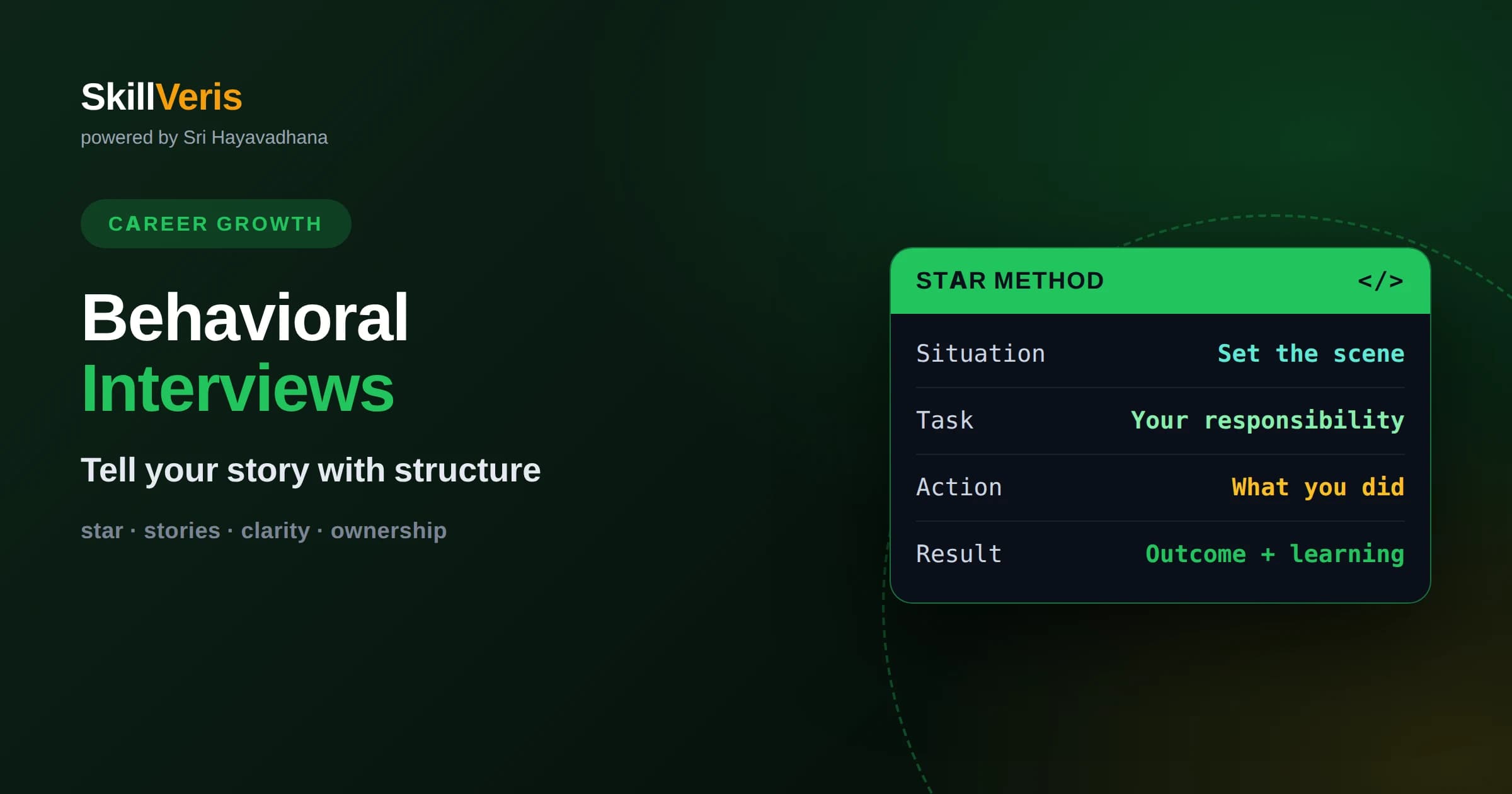
The most reliable way to structure a behavioral answer is the STAR method, which stands for Situation, Task, Action, and Result. It gives every story a clear beginning, middle, and end so your answer stays focused instead of wandering.
Situation sets the scene with just enough context. Task explains what you were responsible for or the challenge you faced. Action, the most important part, describes the specific steps you personally took. Result shares the outcome and what you learned.
This structure keeps you from the two most common failures: rambling without a point, and vague answers that never explain what you actually did. STAR ensures you deliver a complete, coherent story that answers the question being asked.
The beauty of STAR is that it works for almost any prompt. Whatever the interviewer asks, you can slot your experience into the same four beats and know your answer will land clearly. Practicing the structure until it feels automatic frees your attention for choosing the right story and telling it well.
4Spend Most Of Your Time On Action
Within the STAR structure, the action is where you should spend the majority of your answer. Interviewers care most about what you specifically did, because that reveals your skills, judgment, and initiative more than any other part.
Be careful with the word we. When a story is full of what the team did, the interviewer cannot tell what you contributed. Use I to describe your own actions clearly, while still giving honest credit to others. Your individual role must be visible.
Keep the situation and task brief. They exist only to give context. If you spend two minutes describing the background before mentioning what you did, you have buried the part that actually matters to your interviewer.
5Build A Bank Of Stories
You cannot predict every question, but you can prepare a small set of strong stories that cover the themes interviewers probe. Prepare examples of a challenge you overcame, a conflict you handled, a failure you learned from, a time you led, and a success you are proud of.
The clever part is that good stories are flexible. A single project might illustrate teamwork, problem-solving, and handling pressure depending on how you frame it. With five or six well-chosen stories, you can answer a wide range of questions without inventing anything on the spot.
Write these stories out in advance using the STAR structure and practice telling them aloud. You are not memorizing a script, which sounds robotic, but internalizing the key points so you can tell each story naturally and adapt it to the exact question asked.
6Be Specific And Concrete
Specificity is what makes a story believable and memorable. Vague claims like I am a hard worker or I am great with people mean nothing on their own. A concrete example showing you working hard or resolving a conflict proves the point far more convincingly.
Whenever possible, include real details and outcomes. Rather than saying you improved a process, describe what was slow, what you changed, and how much better it became afterward. Concrete results make your contribution tangible and credible.
Details also make stories easier to follow and harder to doubt. An answer rich with specific circumstances sounds like a real memory, while a generic answer sounds like something you invented to say what the interviewer wants to hear.
Be honest with your numbers and outcomes rather than inflating them. Interviewers often probe results with follow-up questions, and exaggeration tends to unravel under scrutiny. A modest but true outcome you can discuss in depth is far stronger than an impressive claim you cannot back up.
7Talking About Failure And Weakness
Questions about failure or weakness make many candidates nervous, but they are opportunities. Interviewers ask them to see whether you have self-awareness and the ability to grow. A candidate who claims to have no weaknesses seems either dishonest or lacking in reflection.
Choose a genuine failure, take real ownership without blaming others, and focus on what you learned and changed afterward. The arc of the story should move from a mistake to growth, showing that setbacks make you better rather than defeat you.
Avoid the trick of naming a fake weakness that is secretly a strength, like caring too much. Experienced interviewers see through it immediately. Honest reflection about a real area you have worked to improve is far more impressive.
8Align Your Stories With The Role
Before the interview, research the company and the role so you can choose stories that resonate. Many organizations emphasize particular values, and framing your examples to highlight those qualities shows that you understand and fit their culture.
This does not mean fabricating or pandering. It means selecting, from your genuine experiences, the ones most relevant to what this role needs. A story about mentoring lands well for a senior role; a story about learning fast suits a junior one.
Understanding the role also helps you emphasize the right qualities within a story. The same experience can be told to highlight leadership, technical depth, or collaboration depending on what the position most values.
9Preparing For Common Question Themes
While exact wording varies, behavioral questions cluster into recognizable themes. Expect prompts about teamwork and conflict, about a time you failed or made a mistake, about leadership and influence, about handling pressure or tight deadlines, and about a proud accomplishment.
There are also questions about you directly, like why you want this role or where you want to grow. Prepare thoughtful, honest answers that connect your goals to the opportunity rather than reciting generic ambition.
By preparing at least one strong story for each theme, you walk in ready for the vast majority of what you will be asked. Even an unexpected question usually maps to a theme you have already prepared, so you can adapt an existing story.
10Delivering Your Answers With Confidence
How you tell a story matters alongside its content. Speak clearly and at a steady pace, and give yourself a moment to think before answering rather than rushing into a jumbled response. A short pause to gather your thoughts reads as thoughtful, not uncertain.
Keep answers focused and appropriately concise. Aim to tell a complete STAR story in a couple of minutes rather than trailing off into unrelated tangents. If the interviewer wants more, they will ask follow-up questions.
Show authentic enthusiasm. Interviewers respond to candidates who seem genuinely engaged with their work and the opportunity. Warmth and honesty leave a stronger impression than a technically perfect but lifeless recitation.
11Turning The Interview Into A Conversation
Behavioral interviews usually end with a chance for you to ask questions, and this is part of your evaluation too. Thoughtful questions about the team, the challenges of the role, or how success is measured show genuine interest and good judgment.
Good questions also help you decide whether the role is right for you. An interview is a two-way street; you are assessing them as much as they are assessing you. Treating it that way projects confidence and self-respect.
Avoid asking only about perks or things you could easily find on the company website. Questions that reflect real curiosity about the work and the team leave a lasting positive impression as the conversation closes.
Prepare a few questions in advance so you are never caught with nothing to ask, which can read as disinterest. Keep them handy and pick the ones that fit how the conversation unfolded, tailoring them to what you genuinely want to know about the role.
12Practice Telling Your Story
The best way to improve at behavioral interviews is to rehearse out loud. Write your stories using the STAR method, practice telling them to a friend or even to yourself, and refine them until they feel natural and focused.
As you grow your technical skills on SkillVeris, you are also building the real experiences that make great interview stories. Take on projects, work through challenges, and reflect on what you learn, so that when the interview comes, you have authentic stories to tell with confidence.
Get The Print Version
Download a PDF of this article for offline reading.
About the Publisher
SkillVeris Team
Careers Team
Our careers team helps you navigate tech job markets, build portfolios, and land the roles you want.
View all postsRelated Posts
Never miss an update
Get the latest tutorials and guides delivered to your inbox.
No spam. Unsubscribe anytime.