Beating Imposter Syndrome in Tech
SkillVeris Team
Careers Team
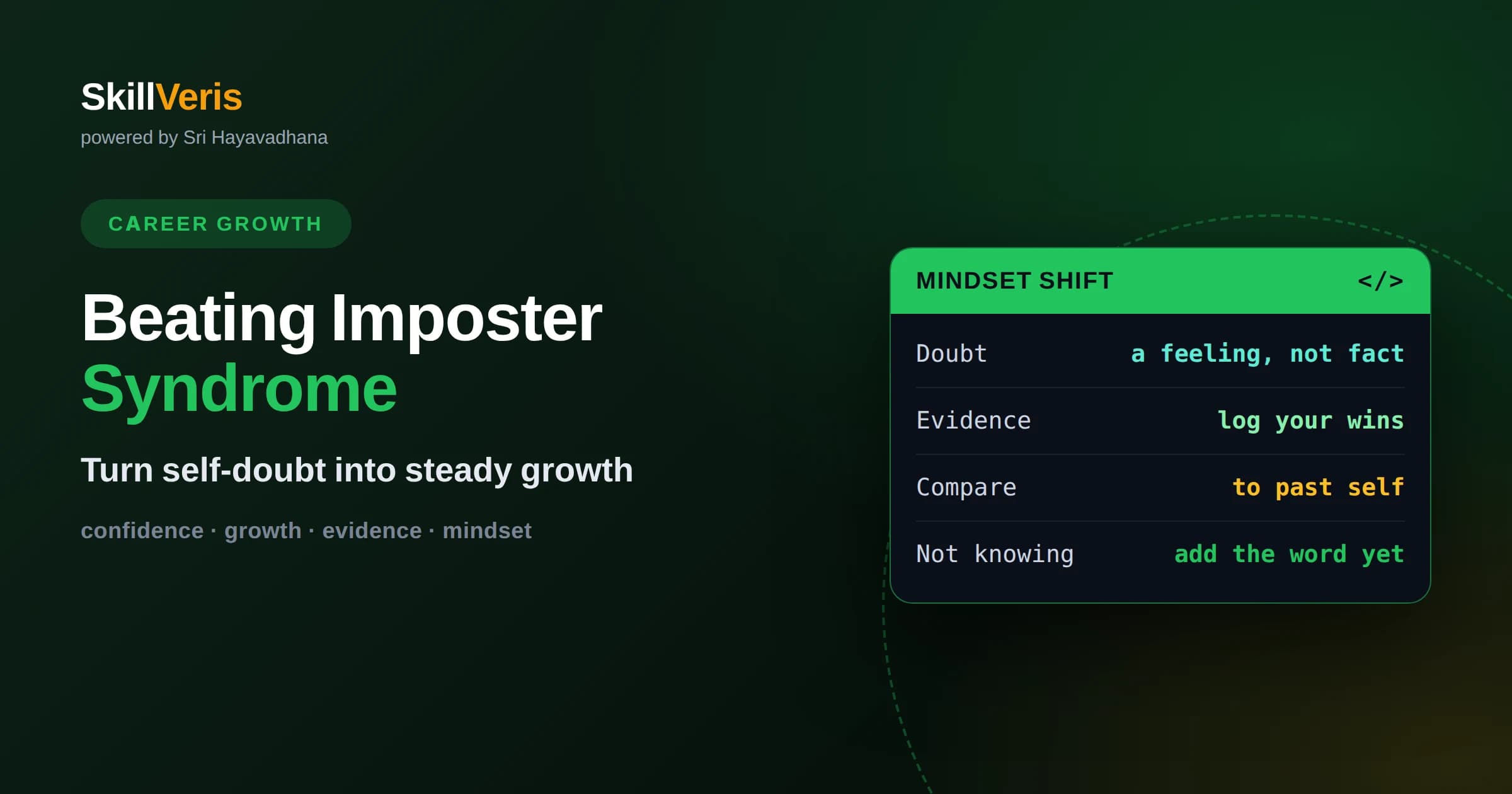
Imposter syndrome is the persistent feeling of being a fraud despite real competence, and it is extremely common among developers at every level.
In this guide, you'll learn:
- The fast-moving nature of tech means everyone is always learning, which fuels the illusion that everyone else already knows more than you.
- Collecting concrete evidence of your progress and reframing self-doubt are practical, repeatable ways to quiet the imposter voice.
- Beating imposter syndrome is about managing it, not eliminating it, so it stops driving your decisions and stealing your confidence.
1What Imposter Syndrome Is and Why It Persists
Imposter syndrome in tech is the persistent, often irrational feeling that you are not as competent as others believe and that you will eventually be exposed as a fraud, even when your work is genuinely good. Beating it does not mean erasing self-doubt entirely; it means recognizing the feeling for the distortion it is and refusing to let it drive your decisions. That reframing is the foundation everything else builds on.
The feeling persists because it is self-sealing. When you succeed, imposter syndrome attributes it to luck or to fooling people, so no amount of achievement ever registers as proof of competence. This is why talented, accomplished engineers can feel like frauds for entire careers; the evidence never counts in the imposter's ledger.
Understanding this mechanism is itself a relief. The problem is not a lack of skill but a faulty way of interpreting your own experience, and interpretations can be changed with practice, which means the situation is far more workable than it feels.
2Why It Is So Common in Software
Tech is almost designed to breed imposter feelings. The field changes constantly, so no matter how much you know, there is always a vast amount you do not, and that permanent gap is easy to misread as personal inadequacy rather than the normal condition of the industry. Everyone is perpetually a beginner at something.
Visibility of others' finished work makes it worse. You see polished projects, confident conference talks, and elegant open-source code, but you never see the confusion, the failed attempts, and the hours of searching behind them. Comparing your messy inside to everyone else's polished outside is a guaranteed route to feeling like a fraud.
The breadth of the field also means no one can know it all. A brilliant backend engineer may feel lost in frontend work, and a frontend expert may find infrastructure baffling. Specialization is normal, but if you expect yourself to be competent everywhere, every gap feels like exposure.
3Recognize How It Shows Up in You
Imposter syndrome wears several disguises, and naming yours helps you catch it. Some people become perfectionists who can never ship because nothing feels good enough. Others overwork to prove they belong, or avoid challenges for fear of being found out. Recognizing your particular pattern is the first step to interrupting it.
It often speaks in a specific inner voice: everyone else understands this but me, I only got here by luck, or I am about to be discovered as unqualified. Learning to notice these thoughts as thoughts, rather than accepting them as facts, creates a small but crucial gap in which you can respond differently.
Watch for behavioral tells too, such as not asking questions for fear of looking stupid, or downplaying your accomplishments reflexively. These behaviors both come from imposter feelings and reinforce them, so spotting them gives you a lever to push back.
Simply naming the feeling in the moment weakens it. When you can say to yourself that this is imposter syndrome talking, not a factual assessment, you create distance between you and the thought. That small act of labeling turns an overwhelming certainty into just one more mental event you can choose to disregard.
4Collect Concrete Evidence of Your Growth
Because imposter syndrome dismisses your successes, the antidote is to make them undeniable and visible. Keep a running record of things you have built, problems you have solved, positive feedback you have received, and skills you have gained. When the imposter voice claims you are incompetent, this record is concrete counter-evidence you can actually read.
This works because feelings are persuasive but not accurate, while a written record is stubbornly factual. On a bad day when your mind insists you know nothing, a list of real accomplishments interrupts the spiral with evidence the imposter voice cannot easily argue away.
Update this record regularly, especially after finishing something hard. Over months it becomes a growing testament to your progress, and reviewing it reminds you that the person struggling today has already overcome many things that once felt impossible.
5Reframe Not Knowing as Normal and Temporary
A powerful shift is to stop treating not knowing something as evidence of being a fraud and start treating it as the normal, temporary state of a learner. No developer knows everything; the good ones are simply comfortable saying they will look it up. Competence is not the absence of gaps but the ability to close them.
Replace the thought I do not know this yet with the honest addition of the word yet. That single word turns a verdict about your worth into a statement about your current position on a path. It reframes ignorance as a stage rather than a sentence.
Senior engineers search for basic things, forget syntax, and get confused by unfamiliar systems every day. The difference between them and beginners is not that they never feel lost but that they no longer interpret feeling lost as proof they do not belong.
This reframe also removes the pressure to appear all-knowing, which is exhausting and counterproductive. When you accept that continuous learning is the job rather than a temporary phase you must hide, you can direct your energy toward actually learning instead of toward maintaining a fragile facade of total competence.
6Talk About It and Discover You Are Not Alone
Imposter syndrome thrives in silence because it convinces you that you are uniquely fraudulent. The moment you mention it to peers, you almost always discover that they feel the same way, including people you assumed were completely confident. That shared admission strips the feeling of much of its power.
Find a trusted colleague, mentor, or community where you can be honest about doubts. Hearing an engineer you respect admit they also feel like an imposter is often more reassuring than any amount of solitary reasoning, because it proves the feeling is unrelated to actual ability.
Talking also lets others reflect your competence back to you, which counters the distorted self-image imposter syndrome maintains. An outside perspective from someone who has seen your work is frequently more accurate than your own harsh internal assessment.
7Compare Yourself to Your Past, Not to Others
Comparison to others is imposter syndrome's favorite fuel, and it is fundamentally unfair because you are comparing against people at different stages, with different backgrounds, showing only their highlights. A far healthier comparison is to your own past self: what can you do now that you could not do six months or a year ago?
Measured against your own starting point, your progress is usually obvious and real. The concepts that baffled you once are routine now, and that trajectory is the true measure of your growth, uncontaminated by anyone else's timeline or luck.
Whenever you catch yourself measuring your worth against a peer, redirect the comparison inward and backward. You are running your own race, and the only meaningful question is whether you are further along than you used to be.
8Embrace Asking Questions as a Strength
Imposter syndrome makes asking questions feel dangerous, as if each one reveals your ignorance. In reality, asking good questions is a mark of maturity and often saves hours for the whole team. The engineers who ask when they are stuck learn faster and build better than those who suffer in silence to protect an image.
Reframe a question as a contribution rather than a confession. Often the thing you are confused about is confusing to others too, and voicing it clarifies things for everyone. Silence protects a fragile self-image at the cost of learning and of the team's progress.
The most respected senior developers ask questions constantly, because they have long since stopped tying their self-worth to appearing to know everything. Adopting that freedom early accelerates your growth enormously.
9Accept That Mistakes Are Part of the Job
Every developer ships bugs, breaks builds, and makes decisions they later regret; this is intrinsic to the work, not a sign that you specifically do not belong. Imposter syndrome treats each mistake as confirmation of fraudulence, but a healthier view sees mistakes as the normal cost of doing anything difficult and new.
What matters is not whether you make mistakes but how you respond to them. Fixing the issue, learning from it, and moving on is exactly what competent engineers do. A mistake handled well is often more instructive and more career-building than a task that went perfectly.
Give yourself the same grace you would give a colleague who erred. You would not conclude a teammate was a fraud over one bug, so extend that same reasonable standard to yourself. Harsh self-judgment is a symptom of the syndrome, not an accurate assessment.
Keeping a light record of mistakes and what each one taught you reframes them as data rather than verdicts. Over time this log shows a clear pattern of learning and recovery, which is far closer to the truth about your abilities than the imposter voice that insists every error is proof you do not belong.
10Manage It Rather Than Wait for a Cure
It helps to release the expectation that imposter syndrome will vanish forever after enough achievement. Many accomplished people feel it throughout their careers; the difference is that they have learned to notice it, question it, and act despite it. The goal is management, not a permanent cure.
Treat the feeling like weather: it comes and goes, it is uncomfortable, and it does not have to dictate your plans. When it appears, you can acknowledge it, apply your evidence and reframing, and proceed with the work anyway. Over time it loses its grip even if it never fully disappears.
This expectation is freeing rather than discouraging. If you no longer wait to feel completely confident before acting, you can pursue opportunities, ask for the role, and take on the hard project while the doubt is still murmuring in the background, which is exactly how growth happens.
11Take Action Even While the Doubt Lingers
Confidence often follows action rather than preceding it. Waiting until you feel fully qualified before applying for a role, speaking up, or taking on a challenge usually means waiting forever, because the imposter voice moves the goalposts endlessly. Acting despite the doubt is what generates the evidence that eventually quiets it.
Each time you do the thing you felt unqualified for and it goes reasonably well, you add another entry to your evidence file and weaken the imposter narrative a little more. Courage here is not the absence of doubt but action taken alongside it.
Start with a stretch that scares you slightly but not overwhelmingly, and let the successful outcome update your self-image. Repeated over time, this deliberate practice of acting through doubt is the most reliable way to shrink imposter syndrome's hold on you.
12Keep Learning and Let the Evidence Grow
One of the surest cures for feeling like a fraud is a steady stream of real, visible progress, and structured learning provides exactly that. As you complete courses and build projects on SkillVeris, you accumulate concrete proof of your growing ability, the very evidence that imposter syndrome cannot easily deny.
Treat each finished lesson or project as another line in your evidence file. Notice what you can now do that you could not before, and let that trajectory speak louder than the doubt. The goal is not to feel perfectly confident but to keep moving despite the noise.
Keep learning on SkillVeris, keep a record of how far you have come, and remember that nearly everyone in tech feels this way at times. You belong on the path precisely because you are walking it, and every step forward is proof.
Get The Print Version
Download a PDF of this article for offline reading.
About the Publisher
SkillVeris Team
Careers Team
Our careers team helps you navigate tech job markets, build portfolios, and land the roles you want.
View all postsRelated Posts
Never miss an update
Get the latest tutorials and guides delivered to your inbox.
No spam. Unsubscribe anytime.