Acing the Data Analytics Interview: A Full Prep Guide
SkillVeris Team
Careers Team
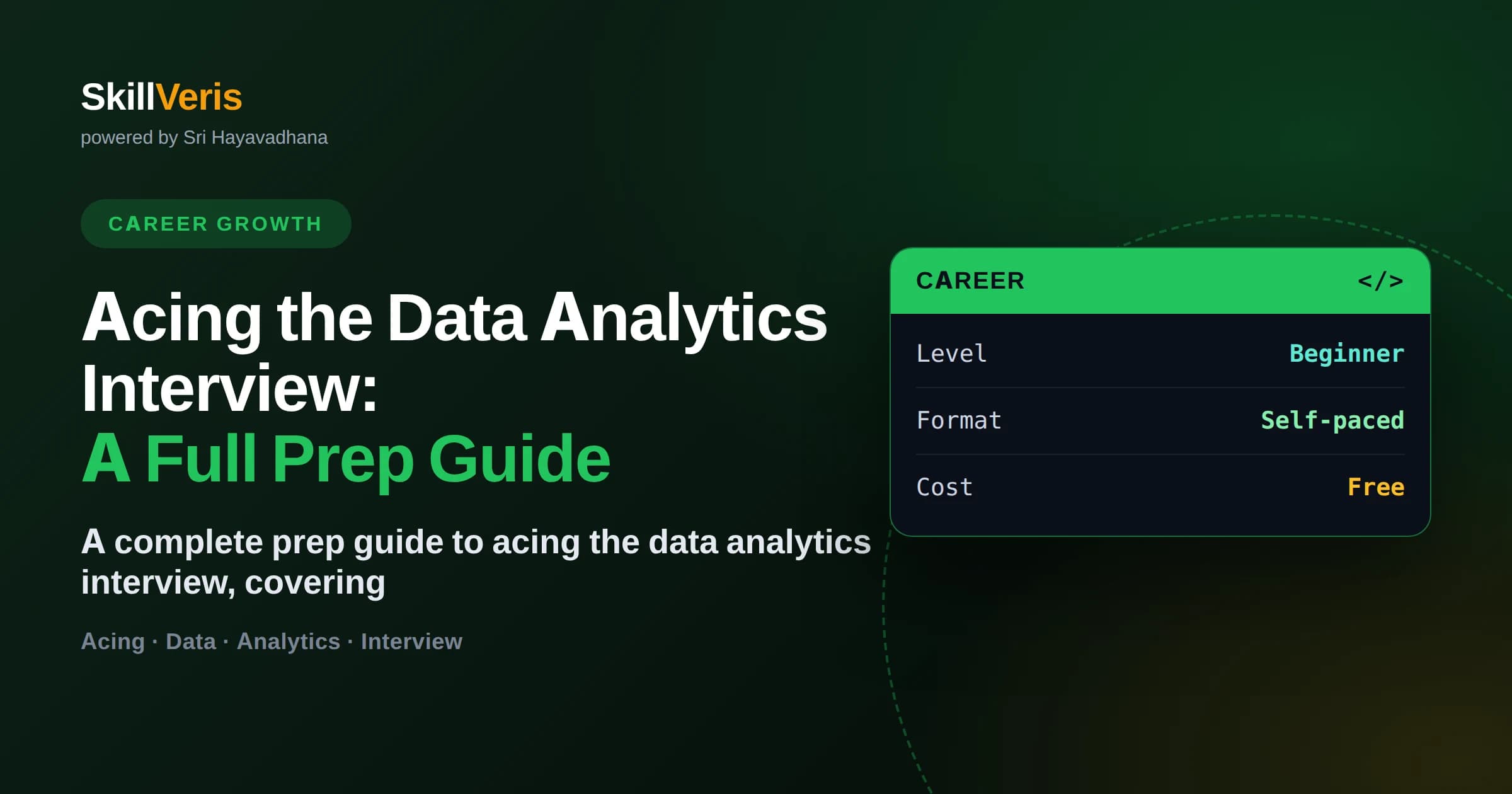
Data analytics interviews follow a predictable sequence of rounds you can prepare for individually.
In this guide, you'll learn:
- SQL is tested in nearly every process, so query fluency under pressure is non-negotiable.
- Case and business questions reward structured thinking more than a single correct answer.
- Take-home assignments are judged on clarity and communication as much as technical correctness.
- Behavioral answers land best when told with the STAR structure and quantified outcomes.
1How Do You Prepare for a Data Analytics Interview?
You prepare for a data analytics interview by practicing the four things it tests: SQL under pressure, structured case reasoning, a clean take-home analysis, and behavioral stories told with impact. Each round has a predictable shape, so targeted practice beats generic cramming every time.
Interviews feel intimidating because they seem to test everything at once. In reality, a data analytics loop is a sequence of distinct challenges, and once you know what each one is measuring, you can prepare for it specifically. That turns anxiety into a checklist.
This guide walks you through the full process, from the rounds you will face to the exact ways to answer the questions that decide the outcome.
2The Rounds You Will Face
Most analytics processes follow a recognizable sequence. Knowing the map lets you prepare the right thing at the right time instead of over-preparing one area and neglecting another.
A typical loop looks like this, though smaller companies may compress it.
- Recruiter screen: a short call on your background, motivation, and logistics.
- Technical screen: live SQL and sometimes a few statistics or spreadsheet questions.
- Take-home or case: an analysis you complete on your own or reason through live.
- Behavioral round: stories about collaboration, conflict, and impact.
- Final or panel: a mix of the above, often with a stakeholder you would work with.
3Mastering the SQL Round
SQL appears in nearly every analytics interview, and stumbling here is the most common reason strong candidates get cut. You need to write correct queries quickly while explaining your thinking out loud.
Focus your practice on the patterns that come up repeatedly: joins across multiple tables, aggregation with GROUP BY and HAVING, window functions like ROW_NUMBER and RANK, and subqueries or CTEs to break a hard problem into steps. Practice narrating as you type, because interviewers grade your reasoning, not just your final answer, and a clear explanation can rescue a small syntax slip.
💡Talk before you type
Restate the question, confirm assumptions about the data, then outline your approach before writing SQL. Interviewers reward candidates who clarify before coding, exactly as a real analyst would.
4Case and Business Questions
Case questions test whether you can turn an ambiguous business problem into an analysis. There is rarely one right answer; the interviewer wants to see a structured, sensible thought process.
When asked something like how you would investigate a 10% drop in daily active users, resist guessing. Clarify the metric and timeframe, break the problem into segments such as new versus returning users or platform and region, form hypotheses, and state what data you would pull to test each. This structure shows you think like an analyst rather than a report generator.
5Metrics and Product Sense
Many analytics interviews probe whether you understand what to measure, not just how. You might be asked which metric best captures the health of a subscription product, or how you would measure the success of a new feature.
Good answers distinguish between a primary metric that reflects the core goal and guardrail metrics that catch unintended harm. For a new feature you might track adoption and its effect on retention while watching that it does not slow the app or cannibalize another feature. Naming trade-offs signals maturity and separates you from candidates who list metrics without reasoning about them.
6Nailing the Take-Home Assignment
A take-home gives you a dataset and a question to answer on your own time. It is your chance to show polished work, and it is judged as much on communication as on technical depth.
Do not just dump charts. Start with the business question, walk through your cleaning and analysis briefly, and end with a clear recommendation and its limitations. Keep code readable and commented, and write a short summary a non-technical manager could follow. Reviewers often skim the analysis and read the conclusion closely, so make your takeaway impossible to miss.
🔑Lead with the answer
Put your recommendation at the top of the take-home, then support it. Reviewers are busy, and an analysis that buries its conclusion reads as one that never reached one.
7Behavioral Questions and the STAR Method
Behavioral rounds assess how you work with others, handle conflict, and drive results. The reliable way to answer is the STAR method: Situation, Task, Action, Result. It keeps you concise and ensures you land on an outcome.
Prepare five or six stories in advance covering a project you are proud of, a disagreement you resolved, a mistake you learned from, a tight deadline, and a time you influenced a decision with data. Rehearse them until you can tell each in under two minutes with a quantified result at the end. That polish reads as competence.
8Questions to Ask Your Interviewer
The end of an interview is not a formality; it is a signal. Thoughtful questions show genuine interest and help you judge whether the role fits you.
Ask about the problems the team is tackling this quarter, how success is measured for the role, what the data stack and quality are like, and how analysts partner with the rest of the business. Avoid questions you could answer from the job posting, and never open with time off or perks, which reads as disengaged this early.
9A Two-Week Prep Plan
If you have an interview coming up, structure your prep rather than studying at random. Two focused weeks are enough to sharpen every area if you divide them deliberately.
Spend the first week on technical fluency: daily SQL practice and a set of case and metrics questions. Spend the second week on delivery: rehearse behavioral stories, mock-interview with a friend, and complete one practice take-home end to end. Finish by researching the specific company so your answers connect to their actual business.
10Frequently Asked Questions
Is a data analytics course really free? Yes. SkillVeris offers free data analytics courses and study notes covering SQL, statistics, and case reasoning, so you can prepare for every interview round at no cost.
What is the hardest part of a data analytics interview? For most people it is the live SQL round, because it combines technical accuracy with communicating under time pressure. Regular timed practice is the best remedy.
How long should I prepare for a data analytics interview? Two to four focused weeks is typical if you already have foundational skills. Split the time between technical fluency and rehearsing your delivery.
Do I need to memorize statistics formulas? Not word for word, but you should understand core concepts like A/B testing, p-values, and confidence intervals well enough to reason about them. Interviewers care more about your judgment than exact recall.
What should I do on a take-home assignment? Answer the business question clearly, keep your code readable, and lead with a recommendation and its limitations. Communication is weighted as heavily as technical correctness.
How important are the questions I ask at the end? Quite important. Thoughtful questions signal genuine interest and engagement, and in a close decision they can tip the outcome in your favor.
11Walk In Prepared
Acing a data analytics interview is not about being a genius; it is about preparing for a known set of challenges. Practice SQL until it is automatic, structure your case answers, communicate clearly on the take-home, and rehearse your stories with real outcomes. Each round becomes manageable once you know what it measures.
Start with the area that scares you most, because that is where preparation pays off fastest. You can sharpen your SQL, statistics, and analytical thinking for free with the data analytics courses and study notes on SkillVeris, then walk into every round knowing you have done the work.
Related Reading
Get The Print Version
Download a PDF of this article for offline reading.
About the Publisher
SkillVeris Team
Careers Team
Our careers team helps you navigate tech job markets, build portfolios, and land the roles you want.
View all postsRelated Posts
Never miss an update
Get the latest tutorials and guides delivered to your inbox.
No spam. Unsubscribe anytime.