Why AI Hallucinates and How to Reduce It
SkillVeris Team
AI Research Team
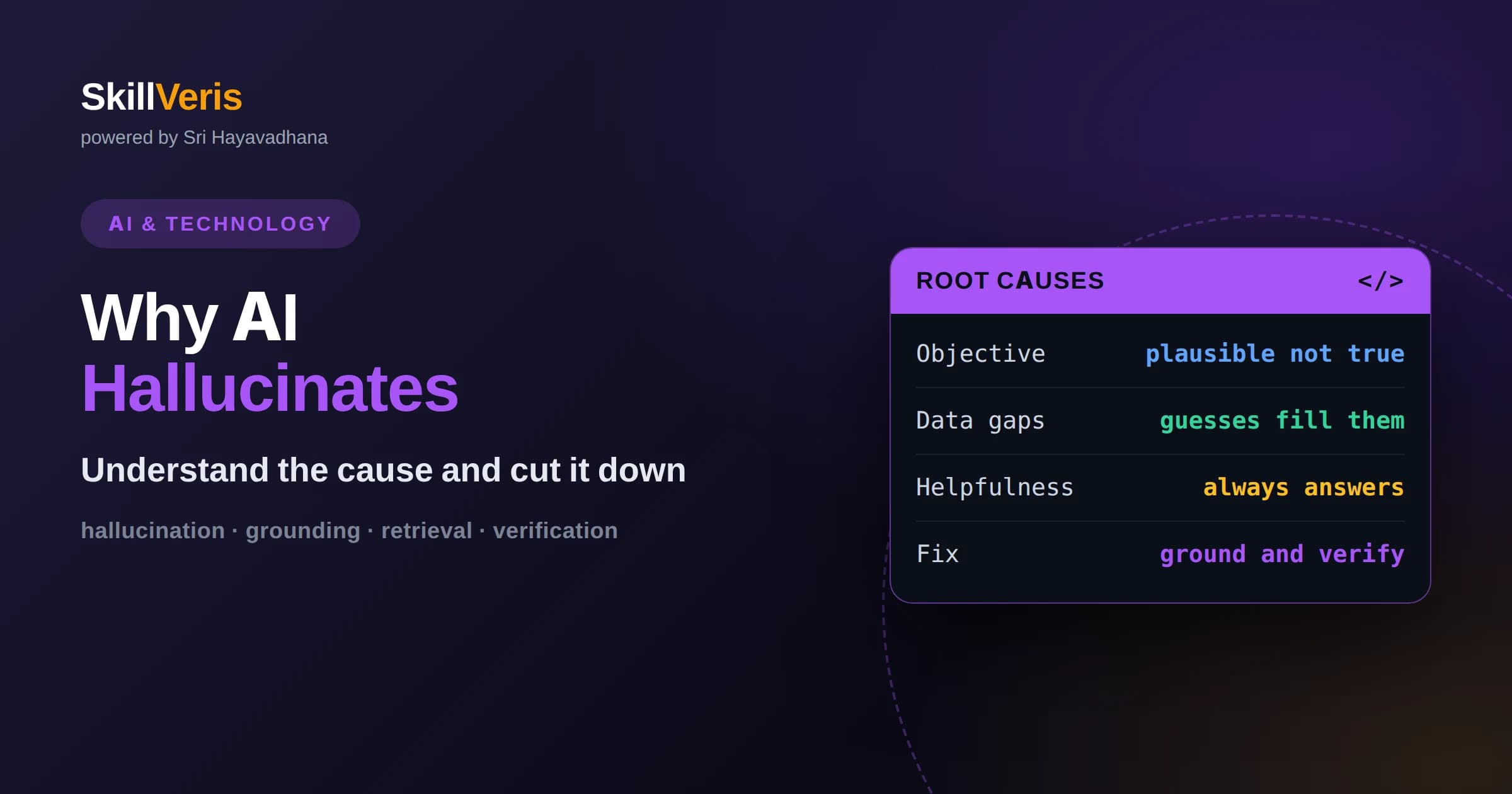
Hallucination happens because language models are trained to produce plausible-sounding text, not to check facts against a source of truth.
In this guide, you'll learn:
- Common causes include gaps in training data, ambiguous prompts, pressure to always answer, and decoding that favors fluent guesses.
- Grounding the model in retrieved sources, allowing it to say I do not know, and verifying outputs are the most effective mitigations.
- You cannot eliminate hallucination entirely, so design systems that expect it, verify high-stakes claims, and keep humans in the loop.
1What AI Hallucination Really Is
AI hallucination is when a language model produces text that sounds confident and coherent but is factually wrong, unsupported, or entirely made up. The model is not lying in any human sense; it is doing exactly what it was trained to do, which is generate the most plausible continuation of the text. When plausible and true diverge, you get a hallucination.
The key insight is that these models optimize for likelihood, not truth. They learn statistical patterns of language from vast amounts of text and predict what word tends to come next. Nowhere in that process is there a built-in mechanism that checks a claim against reality, so a fabricated citation or invented fact can be just as fluent as a correct one.
This is why hallucinations are so convincing. The same machinery that produces accurate, well-phrased answers also produces confident falsehoods, and the surface text gives you little signal about which is which. Understanding this removes the surprise and points toward the right fixes.
It also reframes the goal. You are not trying to make the model honest in a moral sense, because it has no intent to deceive; you are trying to change the conditions so that the most plausible next text is also the true text. Every mitigation in this article works by narrowing the gap between plausible and correct, whether through better data in the prompt, clearer instructions, or external checks.
2How Models Generate Text
A language model works by repeatedly predicting the next token given everything so far, choosing from a probability distribution over possible tokens. It has no separate database of facts it looks things up in; its knowledge is baked diffusely into its parameters as patterns learned during training. Answering a question is really guessing the most likely text that would follow it.
Because knowledge is stored as fuzzy statistical patterns rather than exact records, the model can blend related facts, fill gaps with plausible-sounding details, and confidently produce specifics like names, numbers, or dates that were never in its training data. It is reconstructing, not retrieving, and reconstruction can go wrong.
Decoding choices influence this too. Settings that add randomness for creativity also increase the chance the model wanders into invented territory, while very deterministic settings can make it repeat confident errors. The generation process itself contributes to when and how hallucinations appear.
3Training Data Gaps and Staleness
Models only know what appeared, directly or indirectly, in their training data, and that data has a cutoff date. Ask about events after that cutoff, or about a niche topic barely represented online, and the model has little to draw on. Rather than staying silent, it often generates a plausible answer anyway, which is a prime source of hallucination.
Sparse or contradictory data compounds the problem. If a topic is covered by only a few low-quality or conflicting sources, the model may internalize a muddled or incorrect version. It cannot tell you its knowledge is thin; it produces an answer with the same confidence it would use for a well-documented fact.
This is why questions about recent developments, obscure entities, or highly specific figures are especially risky. When you know a topic sits at the edge of what the model likely saw, treat its answers with extra suspicion and provide the facts yourself.
4The Pressure to Always Answer
Models are typically tuned to be helpful, which they interpret as producing an answer to almost any question. Saying I do not know is rarely the most rewarded behavior during training, so models lean toward providing a response even when the honest answer is uncertainty. This helpfulness bias directly encourages confident guessing.
You can see this when a model invents a citation, a source, or a quotation. Asked for a reference, it produces something that looks exactly like a reference because that is the expected shape of the answer, even if the specific source does not exist. The format is right and the content is fabricated.
Reducing this pressure is one of the most effective levers you control. Explicitly permitting and even praising I do not know in your prompts shifts the model toward acknowledging uncertainty rather than filling the gap with invention.
5How Ambiguous Prompts Invite Hallucination
Vague or underspecified prompts force the model to guess your intent, and each guess is a chance to drift from what you actually wanted. If you ask a broad question without context, the model fills in assumptions, and those assumptions can be wrong in ways that read as hallucination even though you never gave it enough to answer correctly.
Leading or false-premise questions are especially dangerous. If you ask the model to explain why a false statement is true, it will often comply, constructing a convincing but baseless explanation. The model tends to accept the framing you give it rather than challenge your premise.
Clear, specific prompts that supply necessary context and invite the model to flag missing information reduce this failure mode substantially. Much of what looks like model error is really under-specification on the human side.
6Grounding With Retrieval
The single most effective mitigation is grounding the model in real sources at answer time, a pattern known as retrieval-augmented generation. Instead of relying on the model's fuzzy internal memory, you fetch relevant documents and place them in the prompt, then instruct the model to answer only from that provided text. The model summarizes rather than recalls.
Grounding works because it replaces reconstruction with reference. When the correct information sits directly in the context, the model no longer has to guess, and its strong summarization ability produces accurate answers. It also keeps knowledge current, since you can update the source documents without retraining.
To make grounding effective, instruct the model to cite which passage supports each claim and to say the answer is not in the provided sources when it is not. This turns retrieval from a hint into a discipline and makes unsupported claims easy to catch.
7Prompting Techniques That Help
Beyond retrieval, prompt design meaningfully reduces hallucination. Explicitly tell the model it is acceptable to say it does not know, and that guessing is worse than admitting uncertainty. This small permission counteracts the built-in pressure to always answer and noticeably cuts confident fabrication.
Asking the model to reason step by step before answering can also help on tasks that require logic, because it works through the problem rather than jumping to a plausible conclusion. For factual questions, ask it to first state what it knows for certain and separate that from what it is inferring.
Another useful technique is to have the model check its own answer, reviewing whether each claim is supported and flagging anything shaky. Self-verification is not foolproof, since the same model made the error, but it catches a meaningful share of obvious mistakes at low cost.
8Verification and External Tools
For claims that matter, do not trust the model alone; verify against an authoritative source. Connecting the model to tools such as search, a calculator, a database, or a code interpreter lets it check facts and compute answers rather than guess them. Offloading precise work to reliable tools removes whole categories of hallucination.
A calculator eliminates arithmetic mistakes, a database lookup replaces invented records with real ones, and a search tool grounds current-events answers in retrieved pages. The model's job shifts from knowing everything to orchestrating tools that know specific things reliably.
Build verification into your pipeline for high-stakes outputs. Cross-check generated figures, validate that cited sources exist, and route uncertain answers to a human. Treating the model as one component in a checked system, rather than a final authority, is what makes applications trustworthy.
9Measuring Hallucination in Your App
You cannot reduce what you do not measure, so build an evaluation set of questions with known correct answers, including cases at the edge of the model's knowledge. Run it regularly and track how often the model is wrong, and importantly, how often it is wrong while sounding confident.
Distinguish between different failure types. A model that admits uncertainty when unsure is behaving well even if it does not answer, while one that confidently invents details is dangerous. Scoring these separately gives you a truer picture than a single accuracy number.
Whenever you change a prompt, add retrieval, or adjust settings, rerun your evaluation to confirm the change actually reduced hallucination rather than shifting it elsewhere. Systematic measurement turns hallucination from a mysterious annoyance into a metric you can drive down.
10Temperature and Decoding Settings
The settings that control how a model picks each next token influence hallucination directly. Higher randomness, often called temperature, makes the model more willing to choose less likely tokens, which fuels creativity but also increases the odds it wanders into invented territory. Lower randomness makes output more focused and repeatable.
For factual and precise tasks, turning randomness down is a simple, effective step. It biases the model toward the safest, most probable continuations, which are more often the correct ones. For brainstorming or creative writing you may want the opposite, accepting more invention as a feature rather than a bug.
Decoding is not a cure on its own, since a low-temperature model can still confidently repeat an error baked into its knowledge. But pairing sensible settings with grounding and verification stacks the odds in your favor, and it costs nothing to configure correctly for the task at hand.
11Designing Systems That Expect It
Because no technique fully eliminates hallucination, the goal is not perfection but resilience. Design your application assuming the model will sometimes be wrong, and add layers that catch or contain errors before they reach users. This mindset shift is what separates robust products from fragile demos.
Match the level of safeguards to the stakes. A brainstorming tool can tolerate occasional invention, while a system giving medical, legal, or financial information needs grounding, verification, and human review. Calibrate your defenses to the cost of being wrong.
Be honest with users about the system's reliability. Showing sources, indicating uncertainty, and making it easy to verify claims builds appropriate trust. Users who understand the tool can guess forgive its limits far better than those led to believe it is infallible.
12Confidence and Calibration
A dangerous feature of hallucination is that the model's tone is identical whether it is right or wrong. It expresses invented details with the same fluent confidence it uses for well-established facts, which strips away the natural signal humans rely on to gauge trust. This mismatch between confidence and correctness is called poor calibration.
You can partly counter this by asking the model to rate how certain it is and to explain what would make it more sure, which sometimes surfaces shaky answers. But treat these self-reported confidences cautiously, since a model can be confidently wrong about its own confidence too. They are a weak signal, not a guarantee.
The practical takeaway is not to read fluency as evidence. Build your interface so users see sources and uncertainty rather than only a polished paragraph, and reserve your own trust for claims that are grounded or verified. Calibrated skepticism, applied consistently, is one of the cheapest protections against confident fabrication.
13Put It Into Practice on SkillVeris
Understanding why models hallucinate is the foundation, but reducing it is a hands-on skill. Try taking a question the model gets wrong, then fixing it three ways: with a clearer prompt, with retrieval that provides the real source, and with a verification step. Watching each technique work builds durable intuition.
As you build, adopt the habits from this article: allow the model to say I do not know, ground it in real sources, verify what matters, and measure your results. These practices consistently move applications from unreliable to dependable.
On SkillVeris you can work through guided projects that put these mitigations into real code, building retrieval, verification, and evaluation into apps you construct yourself. Learning by fixing real hallucinations is the fastest way to master it.
Related Reading
Get The Print Version
Download a PDF of this article for offline reading.
About the Publisher
SkillVeris Team
AI Research Team
Our AI team covers the latest in machine learning, generative AI, and emerging tech — clearly and accurately.
View all postsRelated Posts

Never miss an update
Get the latest tutorials and guides delivered to your inbox.
No spam. Unsubscribe anytime.