What Is Synthetic Data and How Is It Used in AI?
SkillVeris Team
AI Research Team
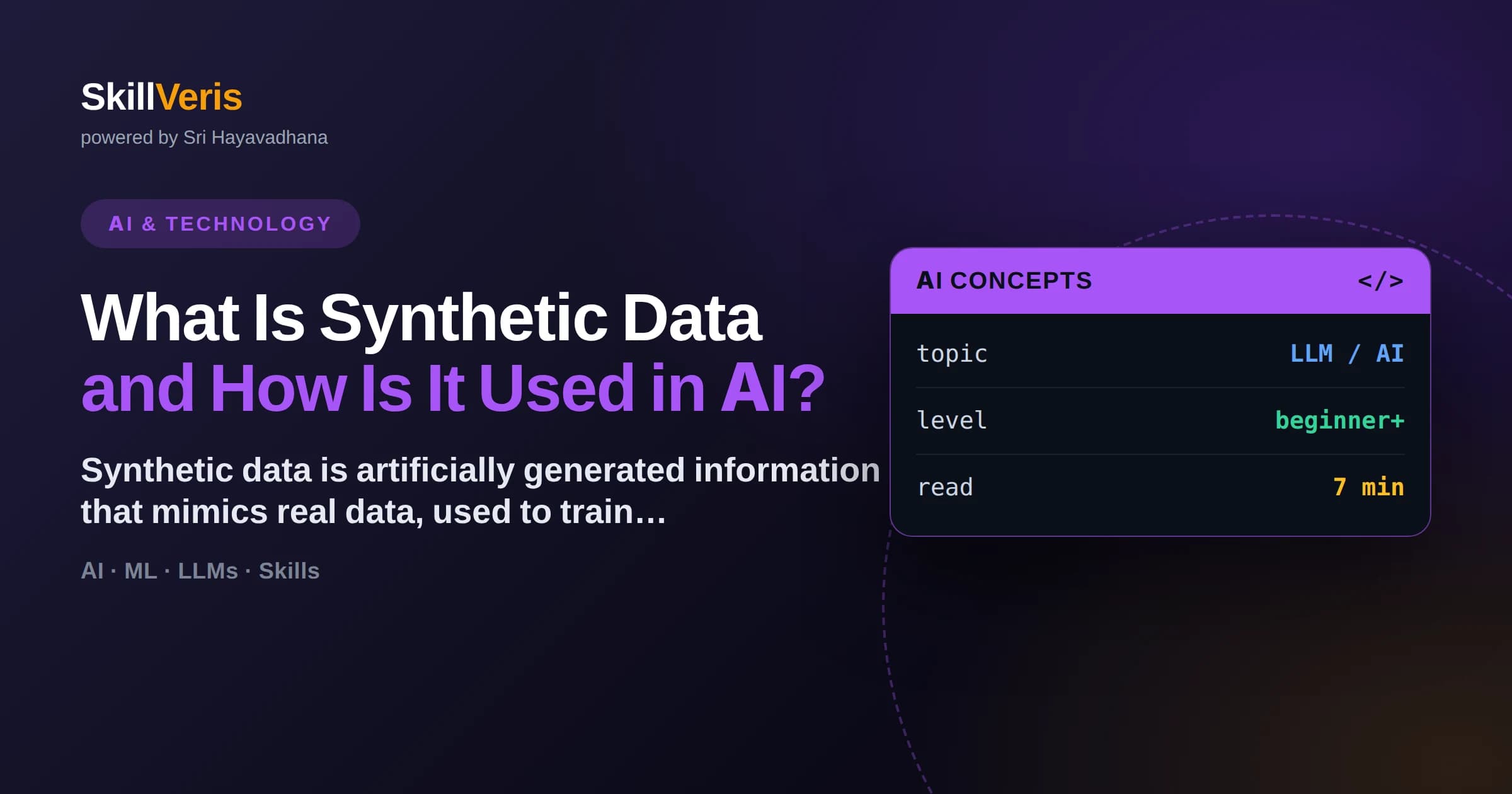
Synthetic data is artificially generated information that statistically resembles real data but contains no actual records from real people or events.
In this guide, you'll learn:
- It solves three big problems in AI: not enough data, privacy restrictions on real data, and the high cost of labeling.
- Generation methods range from simple rule-based simulation to GANs, diffusion models, and large language models producing realistic text.
- Common uses include augmenting small datasets, protecting privacy, balancing rare classes, and testing systems safely.
- Its main risk is fidelity: if synthetic data misses real-world patterns or bakes in bias, models trained on it fail in production.
1What Is Synthetic Data?
Synthetic data is artificially generated information created by an algorithm rather than collected from real-world events. It is designed to mimic the statistical properties and patterns of real data — the same distributions, correlations, and structure — without containing any actual records from real people.
This makes it a powerful tool for training AI when genuine data is scarce, private, or expensive to gather. A model can learn from millions of realistic but entirely fabricated examples that look and behave like the real thing, sidestepping many of the obstacles that block real data collection.
2Why Teams Use It
Synthetic data addresses three persistent pain points in machine learning, any one of which can stall a project.
- Data scarcity: rare events like equipment failures or fraud produce too few real examples.
- Privacy: medical, financial, and personal data is often legally restricted from use.
- Labeling cost: hand-annotating images or text is slow and expensive; generated data can arrive pre-labeled.
- Edge cases: you can generate dangerous or rare scenarios that are hard to capture safely.
- Balance: you can create more examples of underrepresented classes to fix skewed datasets.
🔑Pre-Labeled by Design
Because you generate synthetic data, you already know the correct label for every example — eliminating one of the most expensive steps in machine learning.
3How Synthetic Data Is Generated
There is no single method. The right technique depends on the data type and how realistic it needs to be.
Rule-Based and Simulation
Simple approaches use explicit rules or physics simulators. A driving simulator, for example, can render endless labeled road scenes with varied weather, lighting, and traffic that would be dangerous to stage in reality.
Generative Models
More sophisticated methods learn from real data and then generate new samples. GANs and diffusion models produce photorealistic images, while large language models generate realistic text, conversations, and structured records.
4Where It Is Used
Synthetic data has moved from research into production across many industries.
- Autonomous vehicles: simulated driving scenarios for training and safety testing.
- Healthcare: synthetic patient records that preserve privacy while enabling research.
- Finance: fabricated transactions to train fraud detection without exposing real accounts.
- Computer vision: rendered images to augment small or imbalanced datasets.
- Software testing: realistic but fake data to test systems without touching production.
5The Fidelity Challenge
The value of synthetic data hinges entirely on how faithfully it captures reality. This is its greatest strength and its biggest risk.
If generated data misses subtle real-world patterns, a model trained on it may perform well in testing but fail in production — a gap sometimes called the reality gap. Worse, if the generator learned from biased real data, it can amplify that bias at scale. High-quality synthetic data requires careful validation against real samples.
⚠️Watch Out
Synthetic data is only as good as the process that made it. Garbage generators produce convincing-looking data that quietly teaches models the wrong lessons.
6Types of Synthetic Data
Synthetic data is not one thing. It spans several data types, and the right generation method depends on which you need.
- Tabular: fabricated rows of records, like synthetic customers or transactions.
- Text: generated conversations, reviews, or documents for language models.
- Image and video: rendered or model-generated visuals for computer vision.
- Time series: simulated sensor readings or financial ticks over time.
- Structured records: privacy-safe stand-ins for medical or legal datasets.
7Best Practices
A few disciplines separate synthetic data that helps from synthetic data that harms.
- Validate against real data: compare distributions and correlations to catch drift.
- Blend, do not replace: mixing synthetic with real data usually beats using either alone.
- Test on real holdout: always evaluate final models on genuine, unseen real data.
- Watch for leakage: ensure synthetic records cannot be reverse-engineered to real people.
- Audit for bias: check that generation did not inherit or amplify unfair patterns.
💡Mix, Don't Swap
Most successful projects use synthetic data to augment real data, not to replace it. The blend gives you volume without losing grounding in reality.
8Key Takeaways
The essentials of synthetic data come down to a clear set of principles.
- Synthetic data is algorithmically generated data that mimics real data without real records.
- It solves scarcity, privacy, and labeling-cost problems in AI.
- Generation ranges from simulation to GANs, diffusion models, and LLMs.
- Fidelity is the central risk — poor synthetic data teaches wrong patterns.
- Validate against real data and blend with real data rather than fully replacing it.
9Frequently Asked Questions
Q: Is synthetic data as good as real data? A: It depends on quality. High-fidelity synthetic data can match or even exceed real data for specific tasks, especially rare or dangerous scenarios. But it can also miss subtle real-world patterns, so most teams validate it carefully and blend it with real data rather than relying on it alone.
Q: Does synthetic data protect privacy? A: It can, because well-generated synthetic data contains no actual records from real individuals. However, poorly generated data can inadvertently leak information about the real data it was trained on, so privacy claims require testing to confirm records cannot be traced back to real people.
Q: How is synthetic data generated? A: Methods range from simple rule-based simulators and physics engines to advanced generative models like GANs, diffusion models, and large language models. The choice depends on the data type and how realistic the output must be for the intended AI task.
Q: Can synthetic data introduce bias? A: Yes. If a generative model learns from biased real data, it can reproduce and even amplify that bias at scale. This is why auditing synthetic datasets for fairness and validating them against representative real samples is an essential step before training.
Related Reading
Get The Print Version
Download a PDF of this article for offline reading.
About the Publisher
SkillVeris Team
AI Research Team
Our AI team covers the latest in machine learning, generative AI, and emerging tech — clearly and accurately.
View all postsRelated Posts

Never miss an update
Get the latest tutorials and guides delivered to your inbox.
No spam. Unsubscribe anytime.