What Is Self-Attention in Neural Networks
SkillVeris Team
AI Research Team
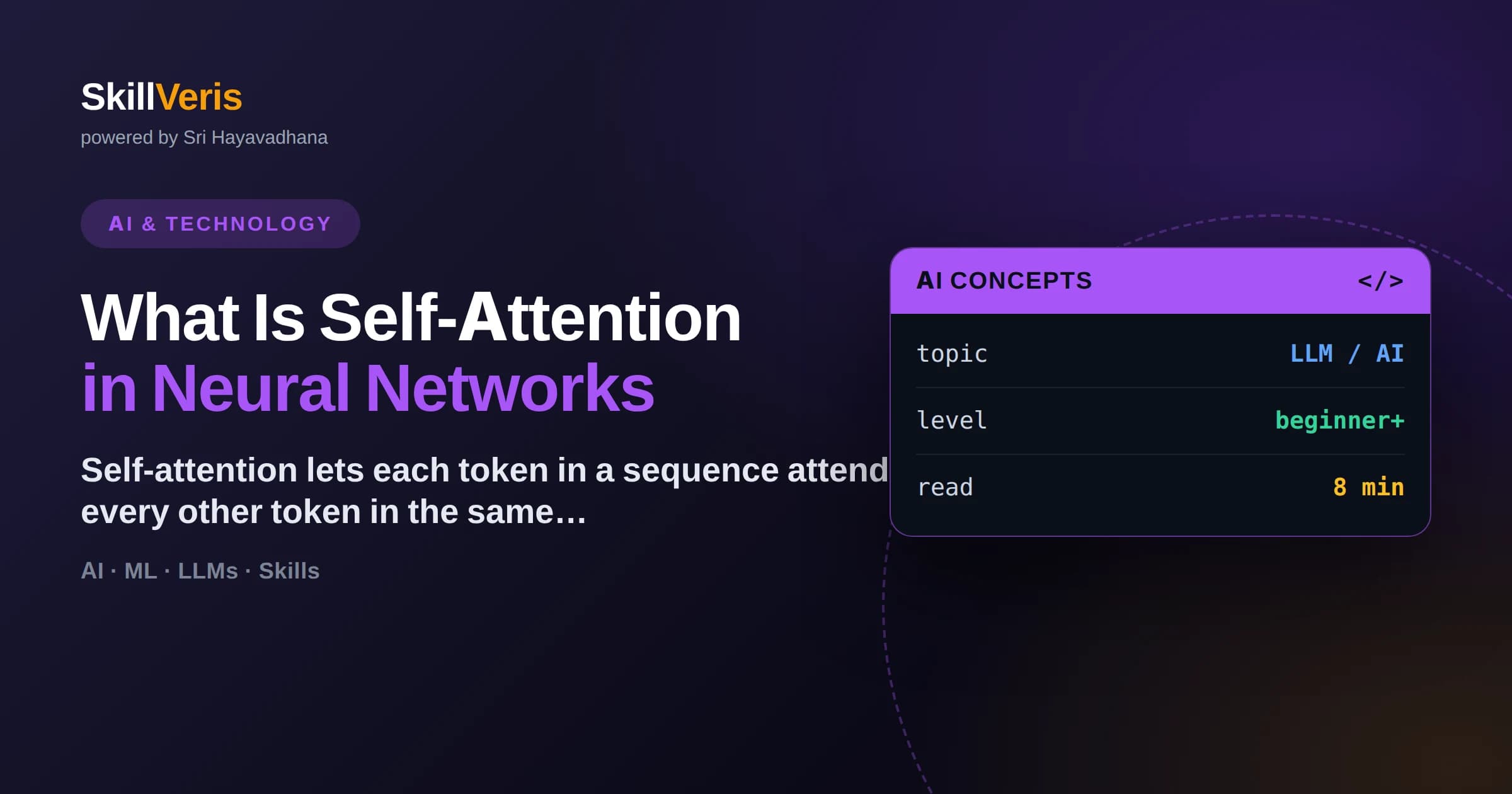
Self-attention is a mechanism where every token in a sequence attends to every other token in the same sequence, letting each build a representation informed by its full context.
In this guide, you'll learn:
- The 'self' means the sequence attends to itself — queries, keys, and values all come from the same input, unlike cross-attention which relates two different sequences.
- It gives each token a context-aware meaning, so the same word represents differently depending on the words around it.
- Self-attention is the core building block of transformers and therefore of nearly every modern large language model.
- Because every token compares against every other, cost grows with the square of sequence length, which drives research into efficient attention variants.
1What Is Self-Attention?
Self-attention is a mechanism in which every token in a sequence looks at every other token in that same sequence and decides how much attention to pay to each. The output is a new representation of each token that blends in information from the tokens most relevant to it — so the meaning of a word is shaped by its context.
The word 'self' is the key distinction: the sequence attends to itself, rather than to a separate sequence. This single operation is the engine inside transformers, and understanding it explains how modern language models capture context so well.
2Why 'Self' Attention?
The 'self' matters because it separates this mechanism from cross-attention, where one sequence attends to a different one — for example a translation decoder attending to the source sentence. In self-attention, the queries, keys, and values are all derived from the same input sequence.
- Self-attention: a sequence attends to itself to build internal context.
- Cross-attention: one sequence attends to another (e.g. decoder attends to encoder).
- Both use the same query-key-value math; only the source of the vectors differs.
- Self-attention is what gives each token its context-aware representation.
🔑Key Idea
Self-attention answers: given this word and all the other words in the sentence, which ones should reshape its meaning? Every token asks that question about every other token.
3How Self-Attention Works
Each token is projected into three vectors: a query, a key, and a value. To compute a token's output, the model scores its query against the keys of all tokens, turns those scores into weights, and takes a weighted sum of the values. Relevant tokens contribute more; irrelevant ones contribute little.
- Project each token into query, key, and value vectors.
- Score each token's query against every key to measure relevance.
- Normalise the scores into weights that sum to one.
- Blend the value vectors using those weights to get the new representation.
A Concrete Feel
In 'the animal did not cross the street because it was tired', self-attention on 'it' can place high weight on 'animal', pulling that meaning into the representation of 'it'. The model learns these associations from data rather than being told them.
4Context-Aware Representations
The payoff of self-attention is that a token's representation depends on its neighbours. The word 'bank' near 'river' ends up with a different internal representation than 'bank' near 'money', because self-attention blends in different surrounding context each time.
This is a big leap over static word representations that assign every occurrence of a word the same vector. By re-computing meaning in context, self-attention lets a model handle ambiguity, reference, and nuance that fixed representations cannot.
5Masked Self-Attention
Language models that generate text use masked self-attention, which stops a token from attending to tokens that come after it. This preserves the left-to-right nature of generation: when predicting the next word, the model may only use the words that came before.
Without masking, a model could 'cheat' during training by peeking at the answer. Masking enforces the causal order that makes autoregressive generation — writing one token at a time — possible.
- Unmasked self-attention: every token sees the whole sequence (used in encoders).
- Masked self-attention: a token sees only itself and earlier tokens (used in generators).
- Masking enforces causal, left-to-right generation.
- It prevents the model from seeing future tokens during training.
6The Cost of Attending to Everything
Because every token compares against every other token, the computation grows with the square of the sequence length. Double the input length and the attention work roughly quadruples, which becomes a real bottleneck for very long documents.
- Cost scales with the square of sequence length.
- Long inputs make full self-attention expensive in time and memory.
- Efficient variants approximate attention to handle longer contexts.
- This trade-off is an active area of research in 2026.
💡Pro Tip
When a model advertises a very long context window, it usually relies on efficient attention techniques rather than plain full self-attention, which would be prohibitively costly at that length.
7Common Misconceptions to Avoid
Self-attention is often muddled with related ideas. Keep these distinctions straight.
- Confusing self-attention with cross-attention — self attends within one sequence.
- Thinking attention weights explain the model's reasoning — they only show blending.
- Assuming self-attention knows word order — that comes from positional encodings.
- Ignoring the quadratic cost when planning for long inputs.
- Treating masked and unmasked attention as interchangeable — they serve different roles.
8Key Takeaways
Self-attention is the idea that makes transformers work.
- Self-attention lets each token attend to every other token in the same sequence.
- Queries, keys, and values all come from that one sequence — that is the 'self'.
- It produces context-aware representations, so meaning shifts with surrounding words.
- Masked self-attention enforces left-to-right generation in language models.
- Its cost grows with the square of sequence length, driving efficient attention research.
9Frequently Asked Questions
Q: What is the difference between self-attention and cross-attention? A: In self-attention, the queries, keys, and values all come from the same sequence, so a sequence attends to itself. In cross-attention, queries come from one sequence and keys and values from another, letting one sequence attend to a different one, such as a decoder attending to an encoder's output.
Q: Why is self-attention important? A: It builds context-aware representations, meaning each token's representation reflects the words around it. This lets models resolve ambiguity and long-range references, and it is the core operation that makes transformers and modern language models effective.
Q: What is masked self-attention? A: It is self-attention where each token can only attend to itself and earlier tokens, not future ones. This enforces left-to-right generation and prevents the model from seeing the answer during training, which is essential for autoregressive text generation.
Q: Why does self-attention get expensive for long text? A: Because every token attends to every other token, the computation grows with the square of the sequence length. Long inputs therefore cost far more time and memory, which is why researchers develop efficient attention variants for long-context models.
Related Reading
Get The Print Version
Download a PDF of this article for offline reading.
About the Publisher
SkillVeris Team
AI Research Team
Our AI team covers the latest in machine learning, generative AI, and emerging tech — clearly and accurately.
View all postsRelated Posts
Never miss an update
Get the latest tutorials and guides delivered to your inbox.
No spam. Unsubscribe anytime.