What Is Optical Character Recognition (OCR)
SkillVeris Team
AI Research Team
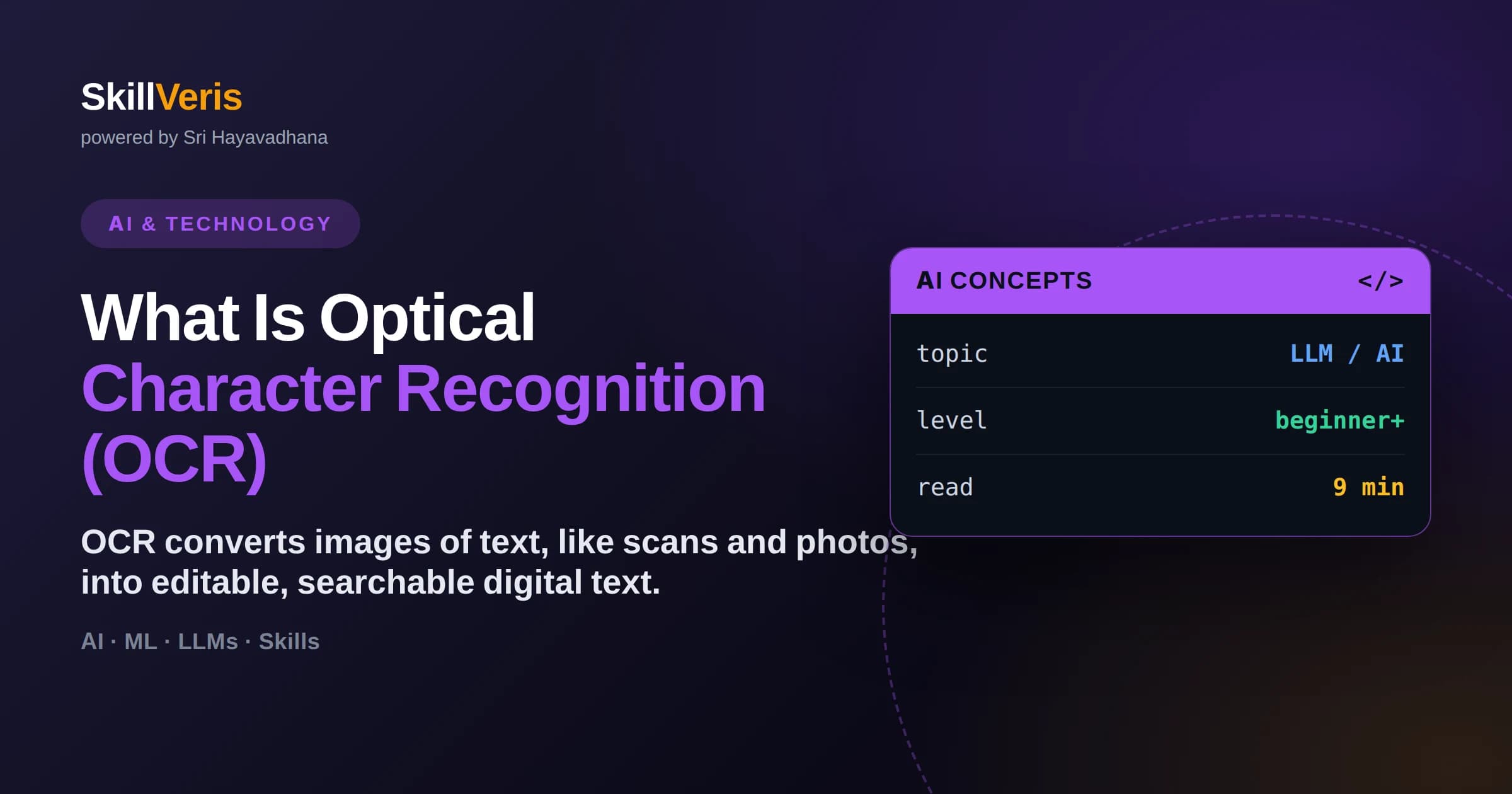
Optical character recognition (OCR) is technology that converts images of text, such as scanned documents and photos, into machine-readable digital text.
In this guide, you'll learn:
- It turns a picture of words into actual characters you can search, copy, edit, and store.
- Modern OCR uses deep learning to read whole lines of text, handling varied fonts, handwriting, and messy real-world images.
- A typical pipeline preprocesses the image, detects where text is, recognizes the characters, and applies language-aware correction.
- OCR powers document digitization, data entry, license plate reading, receipt scanning, and accessibility tools.
1What Is Optical Character Recognition?
Optical character recognition, or OCR, is technology that converts images of text into machine-readable digital text. When you scan a paper document or photograph a sign, the image is just pixels; OCR analyzes those pixels and outputs the actual characters, so the text becomes searchable and editable.
This turns static images into usable data. A scanned contract becomes a document you can search, a photographed receipt becomes structured expense data, and a printed book becomes an ebook. OCR is the bridge between the physical, printed world and digital text.
2Why Reading Text Is Hard for Computers
To a computer, an image of text is just a grid of colored dots with no inherent meaning. Extracting reliable characters from that grid is surprisingly difficult, and the challenges explain why OCR sometimes errs.
- Font variety: thousands of typefaces render the same letter differently.
- Handwriting: cursive and personal styles vary wildly between people.
- Image quality: blur, shadows, glare, and low resolution obscure characters.
- Skew and distortion: photos taken at an angle warp the text.
- Similar characters: the letter O and the number 0, or l and 1, look alike.
🔑Context Helps
OCR resolves ambiguous characters using language context. Knowing a word should read login helps it choose l over 1, just as humans do.
3How Modern OCR Works
A modern OCR system runs through several stages to move from raw image to clean text, with deep learning doing the heavy lifting in the middle.
- Preprocessing: deskew, denoise, and increase contrast to clean up the image.
- Text detection: locate where text appears, drawing regions around words or lines.
- Text recognition: a neural network reads each region and outputs characters.
- Language modeling: correct likely errors using dictionaries and context.
- Output: return structured text, often with layout and position preserved.
Detection Then Recognition
Modern OCR usually splits into two learned steps: first finding where text is in a cluttered image, then recognizing what it says. Separating these makes the system robust to photos where text can appear anywhere, at any size.
4From Template Matching to Deep Learning
Early OCR worked by matching each character against stored templates, one glyph at a time. It handled clean, printed text in known fonts but broke down on anything unusual, because it had no way to generalize beyond its templates.
Deep learning changed this. Modern recognizers read entire sequences of characters at once and learn features directly from data, so they cope with varied fonts, handwriting, and noisy backgrounds far better than rigid template matching ever could.
5Common OCR Tools
A range of OCR engines exist, from open-source libraries to cloud services, suited to different needs and budgets.
- Tesseract: a widely used open-source OCR engine, free and highly configurable.
- EasyOCR and PaddleOCR: open-source deep-learning OCR with strong multilingual support.
- Cloud OCR APIs: managed services from major providers for high accuracy at scale.
- Document AI platforms: OCR combined with layout understanding for forms and invoices.
💡Match the Tool to the Job
For clean printed documents, Tesseract is often enough. For photos, handwriting, or forms, a deep-learning engine or a document AI service will handle the mess far better.
6Where OCR Is Used
OCR quietly powers a huge amount of everyday digitization and automation.
- Document digitization: turning paper archives into searchable digital files.
- Data entry: extracting fields from invoices, forms, and receipts automatically.
- License plate recognition: reading plates for parking, tolls, and security.
- Banking: scanning checks and identity documents.
- Accessibility: reading printed text aloud for blind and low-vision users.
7Best Practices for Better OCR
OCR accuracy is often decided before recognition even begins, at the moment the image is captured. A few habits dramatically improve results.
- Scan at sufficient resolution: aim for crisp, high-contrast images of the text.
- Preprocess the image: deskew, remove noise, and boost contrast before recognition.
- Provide language and layout hints when the engine supports them.
- Validate critical fields: verify numbers and IDs against expected formats.
- Keep a human in the loop for high-stakes documents like contracts and IDs.
8Key Takeaways
The essentials of OCR come down to a few points.
- OCR converts images of text into searchable, editable digital text.
- Modern OCR uses deep learning to read varied fonts, handwriting, and messy images.
- A typical pipeline preprocesses, detects, recognizes, then language-corrects text.
- Image quality strongly determines accuracy, so good capture and preprocessing matter.
- It powers document digitization, data entry, plate reading, and accessibility.
9Frequently Asked Questions
Q: What does OCR stand for? A: OCR stands for optical character recognition. It is technology that reads images of text, such as scans and photos, and converts them into machine-readable digital characters you can search and edit.
Q: Can OCR read handwriting? A: Modern deep-learning OCR can read many kinds of handwriting, though accuracy is lower than for printed text. Neat, consistent handwriting works far better than messy or cursive styles.
Q: Why does OCR sometimes make mistakes? A: OCR struggles with poor image quality, unusual fonts, and characters that look alike, such as O and 0. Blur, glare, and skew all reduce accuracy, which is why good scanning matters.
Q: Is Tesseract good for OCR? A: Tesseract is a solid, free, open-source engine that works well on clean printed documents. For photos, handwriting, or complex forms, a modern deep-learning engine or cloud service usually performs better.
Related Reading
Get The Print Version
Download a PDF of this article for offline reading.
About the Publisher
SkillVeris Team
AI Research Team
Our AI team covers the latest in machine learning, generative AI, and emerging tech — clearly and accurately.
View all postsRelated Posts
Never miss an update
Get the latest tutorials and guides delivered to your inbox.
No spam. Unsubscribe anytime.