What Is Model Distillation in AI?
SkillVeris Team
AI Research Team
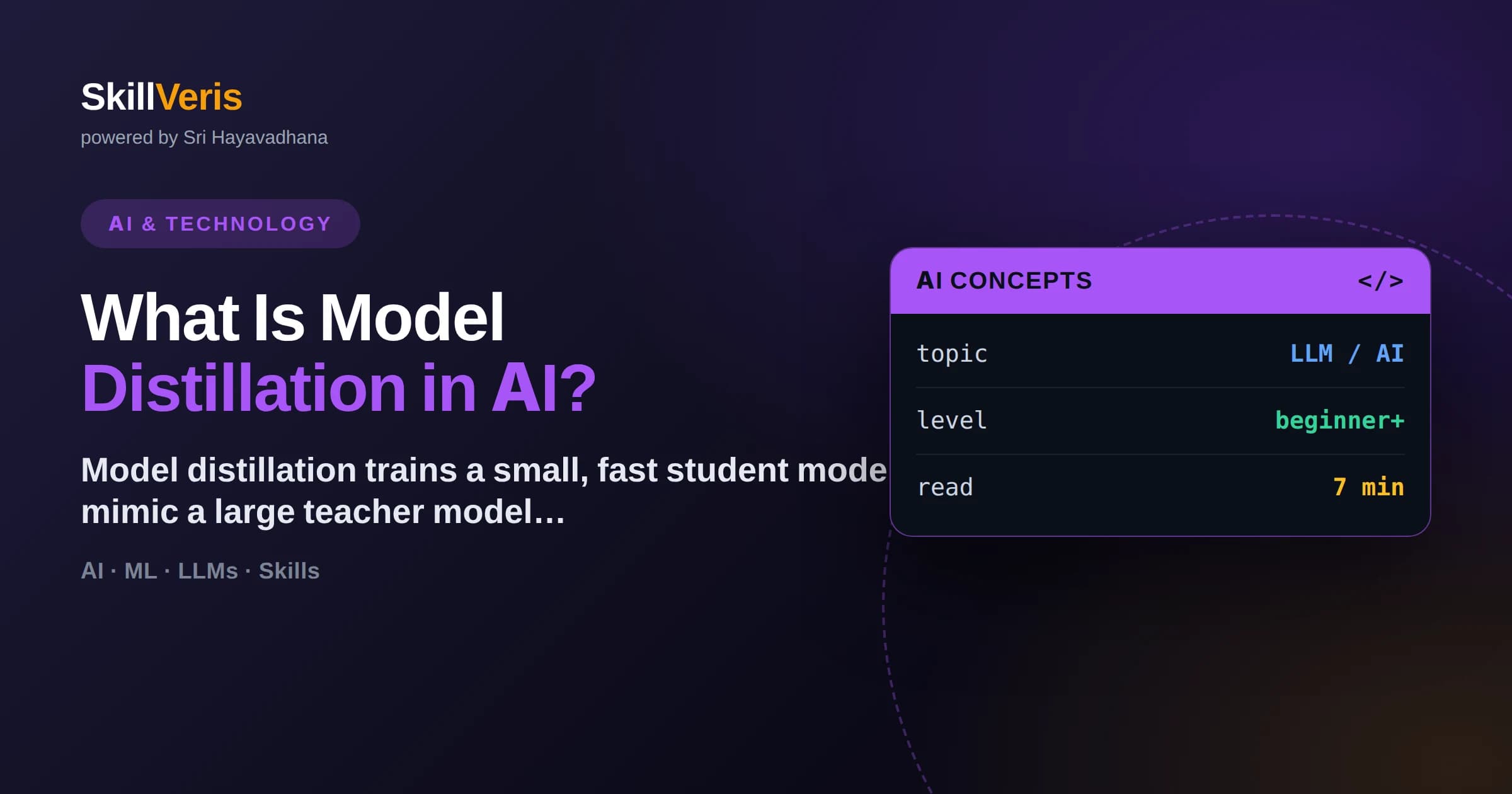
Model distillation trains a small student model to imitate a large teacher model, retaining much of its quality while being far smaller and cheaper to run.
In this guide, you'll learn:
- The student learns from the teacher's outputs, often its full probability distribution, not just from raw labeled data.
- The payoff is lower latency, lower cost, and the ability to run capable models on modest or edge hardware.
- It differs from quantization and pruning, which shrink a single model rather than train a new smaller one.
- Distilled models trade a little accuracy for big efficiency gains, which is a good deal for many production tasks.
1What Is Model Distillation?
Model distillation is a technique for training a small, efficient model, the student, to mimic the behavior of a large, powerful model, the teacher. The goal is to keep most of the big model's quality while running at a fraction of its size, cost, and latency.
The name comes from the idea of distilling the essential knowledge of a heavy model into a lighter one. Instead of training the student only on raw data, you train it to reproduce the teacher's outputs, letting it inherit patterns the teacher already learned from far more compute and data.
2How Distillation Works
The core idea is to use the teacher as a rich source of training signal. Rather than learning from hard labels alone, the student learns from the teacher's fuller, more informative outputs.
- Run many inputs through the large teacher model and record its outputs.
- Capture not just the final answer but the teacher's probabilities across options, its 'soft labels'.
- Train the small student to match those outputs as closely as it can.
- The soft labels reveal how the teacher weighs alternatives, teaching nuance a single label cannot.
- The student ends up approximating the teacher's behavior with far fewer parameters.
Why Soft Labels Help
A hard label just says 'this is a cat'. The teacher's soft output might say 'mostly cat, a little bit lynx, almost never car', which carries information about how classes relate. Learning from that richer signal lets the small student pick up subtle distinctions it would struggle to learn from plain labels alone, which is a big part of why distillation works so well.
3Why Use Distillation
Distillation exists because the biggest, most capable models are often too slow and expensive to run everywhere. A distilled student captures much of the capability in a package you can actually deploy at scale.
- Lower latency: smaller models respond faster, which matters for real-time apps.
- Lower cost: fewer parameters mean cheaper inference and less hardware.
- Edge deployment: compact models can run on phones, browsers, or embedded devices.
- Scalability: cheaper per-request costs make high-volume use affordable.
- Specialization: a student focused on your task can be small yet strong at it.
🔑The Trade-Off
Distillation swaps a little accuracy for large gains in speed and cost. For many production tasks, that is exactly the trade you want.
4Distillation vs Quantization vs Pruning
Distillation is one of several ways to make models smaller and faster, and it is easy to confuse them. The key difference is that distillation trains a brand-new smaller model, while the others compress an existing one.
- Distillation: train a new, smaller student to imitate a larger teacher.
- Quantization: reduce the numeric precision of an existing model's weights to shrink and speed it up.
- Pruning: remove weights or connections that contribute little, trimming the existing model.
- These are complementary; you can distill a model and then quantize the student for even more efficiency.
💡They Stack
These methods are not mutually exclusive. Teams often distill first, then quantize the smaller student, compounding the efficiency gains.
5Best Practices and Pitfalls
Distillation works well when the setup plays to its strengths, and disappoints when applied carelessly. Keep these guidelines in mind.
- Do use a strong teacher; the student can only approximate what the teacher already does well.
- Do generate plenty of diverse examples so the student sees the range of inputs it will face.
- Do scope the task; a focused student beats a tiny generalist.
- Avoid expecting the student to exceed the teacher; distillation transfers, it does not create new capability.
- Avoid distilling on narrow data, which leaves the student brittle on real-world inputs.
- Avoid skipping evaluation; measure the accuracy you actually give up against the efficiency you gain.
⚠️Mind the Licensing
Some model providers restrict using their outputs to train competing models. Check the terms of service before distilling from a hosted commercial model.
6Common Mistakes to Avoid
The usual disappointments with distillation come from unrealistic expectations or a weak setup.
- Expecting no quality loss; some drop is normal, and the goal is an acceptable trade.
- Using a mediocre teacher and being surprised the student is mediocre too.
- Training on too little or too narrow data, producing a fragile student.
- Ignoring licensing terms when distilling from a commercial API.
- Failing to benchmark the student on the real task before deploying it.
7Real-World Uses of Distillation
Distillation shows up wherever teams want strong model behavior without the cost of running the largest model on every request. It is a practical bridge between research-grade quality and production-grade economics.
- On-device features: compact assistants and classifiers that run on phones or in browsers.
- High-volume services: search ranking or moderation where per-request cost dominates.
- Latency-sensitive apps: real-time suggestions where a slow large model would frustrate users.
- Task specialists: a small model distilled for one job, like classifying support tickets.
- Cost control: serving most traffic with a cheap student and escalating hard cases to a larger model.
The Escalation Pattern
A common production design pairs a distilled student with its teacher. The small, cheap student handles the bulk of routine requests, and only the cases it is unsure about get escalated to the larger, more expensive model. This routing keeps average cost and latency low while preserving high quality on the hard inputs that need it most.
8Key Takeaways
The essentials of model distillation are quick to summarize.
- Distillation trains a small student model to imitate a large teacher model.
- The student learns from the teacher's outputs, including soft probability labels.
- It delivers lower latency, lower cost, and edge deployment for a small accuracy trade.
- It differs from quantization and pruning, which compress an existing model.
- Use a strong teacher, plenty of data, a scoped task, and always evaluate the result.
9Frequently Asked Questions
Q: What is the difference between a teacher and a student model? A: The teacher is the large, high-quality model whose behavior you want to reproduce. The student is the smaller model trained to imitate the teacher, ending up faster and cheaper while retaining much of the teacher's quality.
Q: Does a distilled model perform as well as the original? A: Usually not quite, but often close. Distillation trades a modest amount of accuracy for large gains in speed and cost, and for well-scoped tasks the student can come impressively near the teacher's performance.
Q: How is distillation different from quantization? A: Distillation trains a new, smaller model to mimic a larger one. Quantization reduces the numeric precision of an existing model's weights to shrink it. They address efficiency differently and can be combined for even more savings.
Q: When should I use model distillation? A: When you need a capable model to run cheaply, quickly, or on limited hardware, and you have a strong teacher plus enough data to train the student. It suits well-defined tasks where a compact specialist is good enough.
Related Reading
Get The Print Version
Download a PDF of this article for offline reading.
About the Publisher
SkillVeris Team
AI Research Team
Our AI team covers the latest in machine learning, generative AI, and emerging tech — clearly and accurately.
View all postsRelated Posts
Never miss an update
Get the latest tutorials and guides delivered to your inbox.
No spam. Unsubscribe anytime.