What Is LoRA Fine-Tuning Explained
SkillVeris Team
AI Research Team
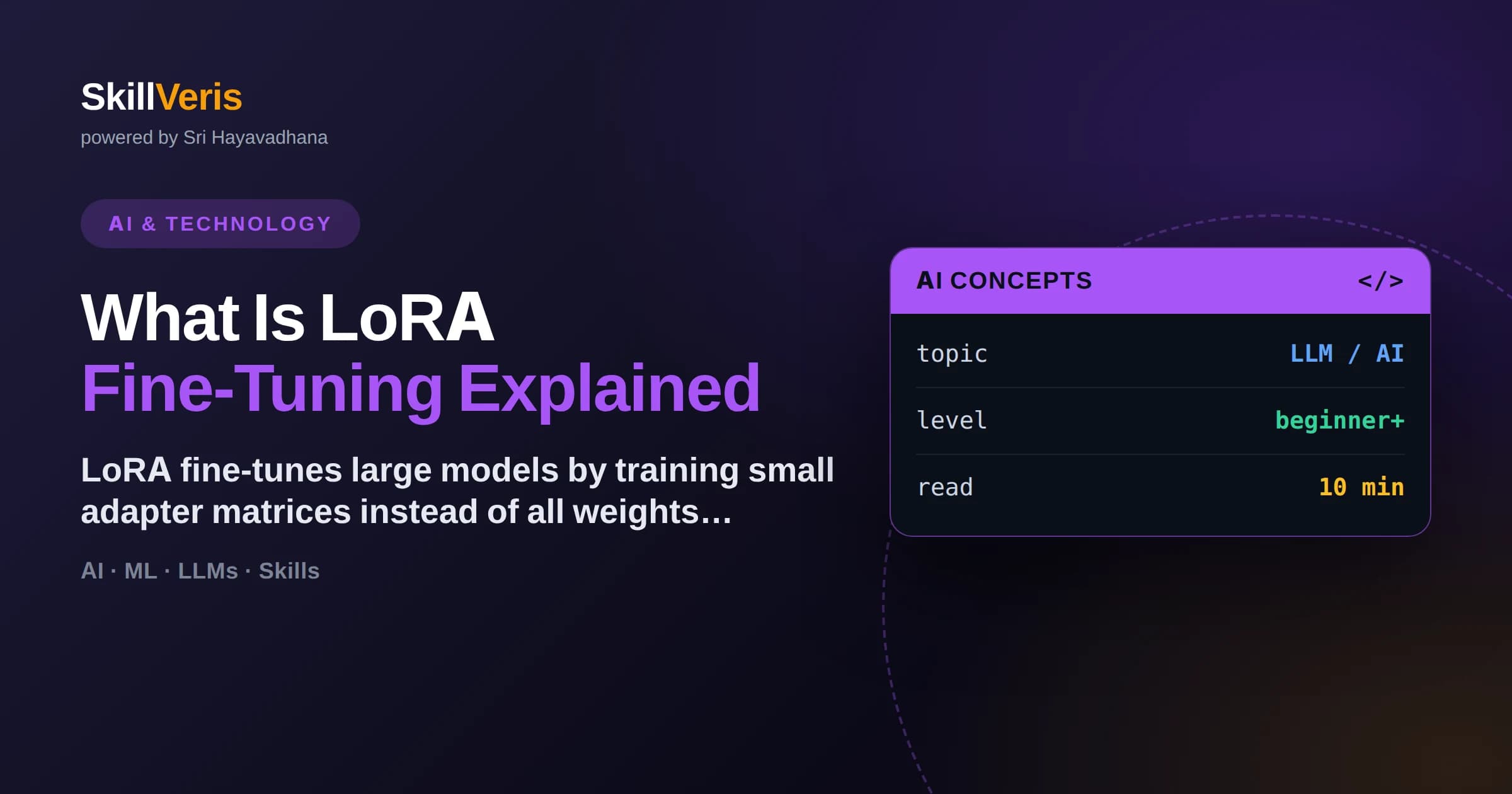
LoRA (Low-Rank Adaptation) fine-tunes a large model by training tiny added adapter matrices while keeping the original weights frozen, cutting memory and cost dramatically.
In this guide, you'll learn:
- Instead of updating billions of parameters, you train a few million, making fine-tuning feasible on a single GPU.
- It works by inserting small low-rank matrices whose product approximates the weight change the task needs.
- The base model stays untouched, so one model can host many swappable LoRA adapters for different tasks.
- QLoRA combines LoRA with quantization to fine-tune very large models on modest hardware.
1What Is LoRA Fine-Tuning?
LoRA, short for Low-Rank Adaptation, is a fine-tuning method that adapts a large model by training a small set of added parameters while leaving the original weights frozen. Rather than updating every weight in a model with billions of parameters, LoRA injects tiny matrices into the network and trains only those, often just a fraction of a percent of the total.
This makes fine-tuning enormously cheaper. A task that would otherwise need many high-memory accelerators can run on a single GPU, and the resulting adapter is small enough to store and share easily. LoRA is now the default approach for customising open models on a budget.
2Why Full Fine-Tuning Is Hard
Fully fine-tuning a large model means updating all of its weights, which is expensive in both memory and storage. You need enough memory to hold the model, its gradients, and optimiser states, and each fine-tuned copy is as large as the original.
- Memory: gradients and optimiser states can multiply the memory needed several times over.
- Storage: every fine-tuned variant is a full-size copy of the model.
- Cost: training all parameters needs substantial compute and time.
- Inflexibility: switching tasks means loading an entirely different full model.
🔑The Problem LoRA Solves
Full fine-tuning updates everything and stores a whole new model per task. LoRA updates a sliver and stores only that sliver.
3How LoRA Works
LoRA rests on the observation that the change a model needs for a new task is usually low-rank — it can be captured by a much smaller matrix than the full weight matrix. Instead of learning a full update, LoRA learns two small matrices whose product approximates that update.
- Freeze the original weight matrix W — it never changes during training.
- Add a bypass: two small matrices A and B, where B x A has the same shape as W.
- Only A and B are trained; their rank r is tiny (often 8, 16, or 32).
- At inference the output uses W plus the learned B x A adjustment.
Why Low Rank Is Enough
The rank r controls how much the adapter can express. A small r keeps the adapter tiny yet is often sufficient because task adaptations tend to live in a low-dimensional space. Raising r adds capacity at the cost of more parameters.
4Swappable Adapters
Because the base model stays frozen, a single copy of it can serve many tasks by swapping LoRA adapters in and out. Each adapter is small — often a few megabytes to tens of megabytes — so you can store dozens and load whichever a request needs.
This is a major operational advantage. A support assistant, a summariser, and a code helper can all share one base model in memory, each activated by its own adapter, instead of hosting three full fine-tuned models. Adapters can also be merged into the base weights permanently when you want a single standalone model.
💡One Base, Many Skills
Keep the base model loaded once and hot-swap adapters per task. It slashes memory compared with serving a separate full model for each use case.
5QLoRA and Going Further
QLoRA pushes LoRA further by quantizing the frozen base model to a low precision, such as 4-bit, while training the LoRA adapters on top. This slashes the memory needed to hold the base, making it possible to fine-tune very large models on a single consumer or modest cloud GPU.
The frozen base is quantized only for storage and forward passes, while the small adapters train in higher precision, preserving quality. QLoRA is why fine-tuning models that once required a cluster is now within reach of individuals and small teams.
6Best Practices
Getting good results with LoRA comes down to a few practical choices.
- Start with a modest rank (8 to 16) and raise it only if the task needs more capacity.
- Apply LoRA to attention projection layers first; add more targets if quality lags.
- Use a clean, focused dataset — LoRA adapts style and task well but cannot add broad new knowledge cheaply.
- Evaluate on held-out data to confirm the adapter helps without hurting general ability.
- Consider QLoRA when the base model is too large to fine-tune in full precision on your hardware.
- Keep adapters versioned; they are small and easy to store per task.
⚠️Manage Expectations
LoRA is excellent for adapting behaviour, tone, and format, but it is not a substitute for pretraining. Teaching genuinely new knowledge often needs more than a small adapter.
7Common Mistakes to Avoid
LoRA is forgiving, but a few errors reliably waste effort.
- Setting the rank far higher than needed, losing the efficiency benefit.
- Expecting LoRA to inject large amounts of new factual knowledge — it adapts more than it teaches.
- Training on noisy or tiny datasets and overfitting the adapter.
- Forgetting which base model an adapter was trained on; adapters are not portable across bases.
- Skipping evaluation and assuming the adapter did not harm general capabilities.
8Key Takeaways
LoRA made fine-tuning large models accessible to almost anyone.
- It trains small added adapter matrices while freezing the base model.
- You update a fraction of a percent of parameters, so it fits on a single GPU.
- The frozen base lets many task-specific adapters be swapped in and out.
- QLoRA adds base-model quantization to fine-tune very large models on modest hardware.
- It excels at adapting behaviour and format but is not a route to broad new knowledge.
9Frequently Asked Questions
Q: How is LoRA different from full fine-tuning? A: Full fine-tuning updates all of a model's weights and produces a full-size copy per task. LoRA freezes the original weights and trains small added adapter matrices, cutting memory and storage dramatically while keeping the base reusable.
Q: What is the rank in LoRA? A: The rank sets the size of the two small matrices whose product approximates the weight update. Lower ranks like 8 or 16 keep the adapter tiny and are often enough; higher ranks add capacity but more parameters.
Q: What is QLoRA? A: QLoRA combines LoRA with quantization of the frozen base model, often to 4-bit, so a very large model fits in far less memory. The adapters still train in higher precision, letting you fine-tune big models on modest hardware.
Q: Can LoRA teach a model new facts? A: LoRA is best at adapting tone, style, format, and task behaviour rather than injecting large bodies of new knowledge. For substantial new information, retrieval augmentation or more extensive training is usually more effective.
Related Reading
Get The Print Version
Download a PDF of this article for offline reading.
About the Publisher
SkillVeris Team
AI Research Team
Our AI team covers the latest in machine learning, generative AI, and emerging tech — clearly and accurately.
View all postsRelated Posts
Never miss an update
Get the latest tutorials and guides delivered to your inbox.
No spam. Unsubscribe anytime.